
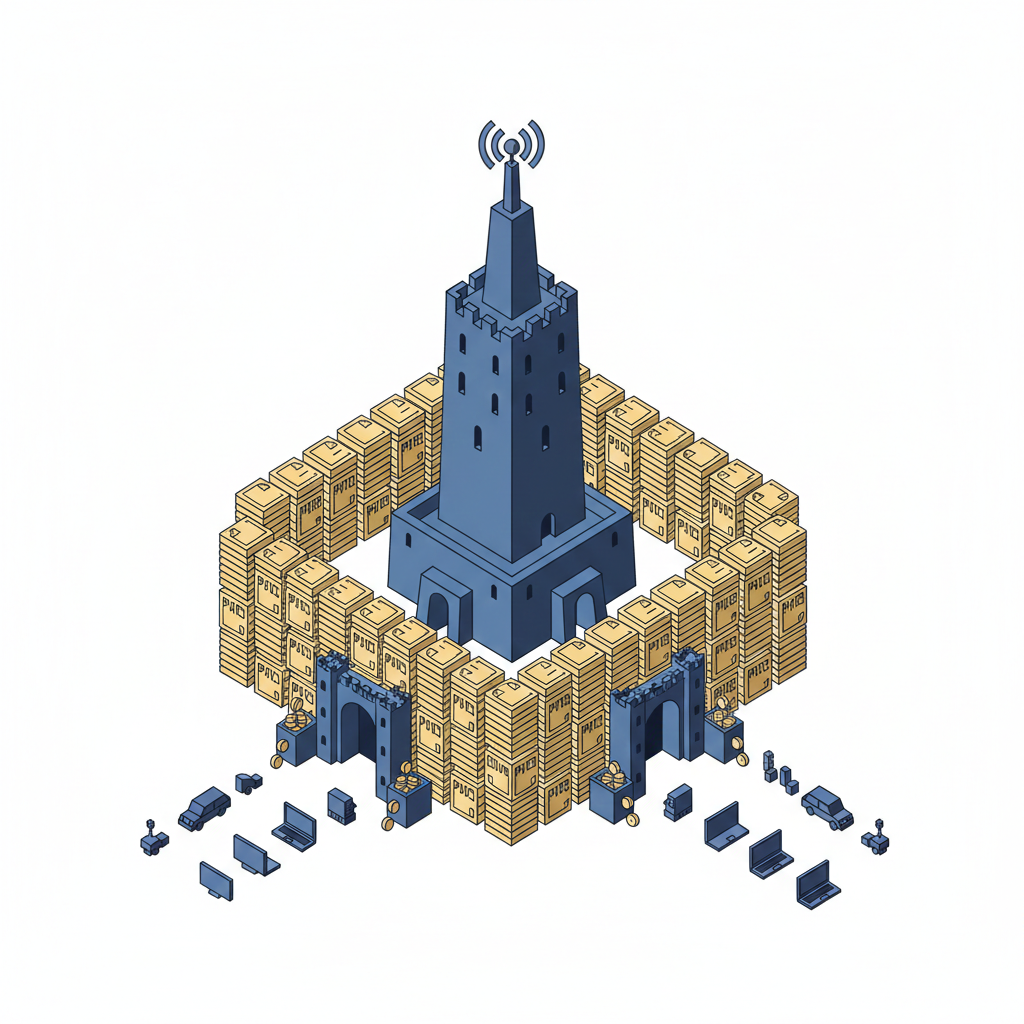
Foreword: The Tech Emperor Collecting Tolls
In the pantheon of the semiconductor industry, Qualcomm's reputation is arguably the most complex. Engineers admire its technology (especially wireless communication), but every mobile phone brand executive despises its business model.
Its core logic is singular, overbearing, yet simple: "Buy my chips, and pay me patent fees; don't buy my chips, and you still have to pay me patent fees."
This company is like a gatekeeper of the digital world. Do you want your phone to connect to the internet? Do you want your car to converse with the cloud? Do you want your laptop to be always connected? You must first pay the toll. Before NVIDIA defined AI computing power, Qualcomm had already defined how humanity "connects."
📶 Chapter One: Baseband —— The Core of the Core
Many people mistakenly believe Qualcomm primarily sells CPUs, which is a huge misunderstanding. Qualcomm's essence is that of a wireless communications company. A smartphone actually has two brains:
- AP (Application Processor): Responsible for running Android, playing "Genshin Impact," and processing photos. This is what Snapdragon does.
- BP (Baseband Processor): Responsible for making calls, connecting to 4G/5G, and processing signals. This is the Modem.
Qualcomm's impenetrable moat is built entirely upon its Modem technology.
1. The Technical Barrier of Modems: God's Linguist
Modems are among the most difficult chips to produce in the semiconductor industry.
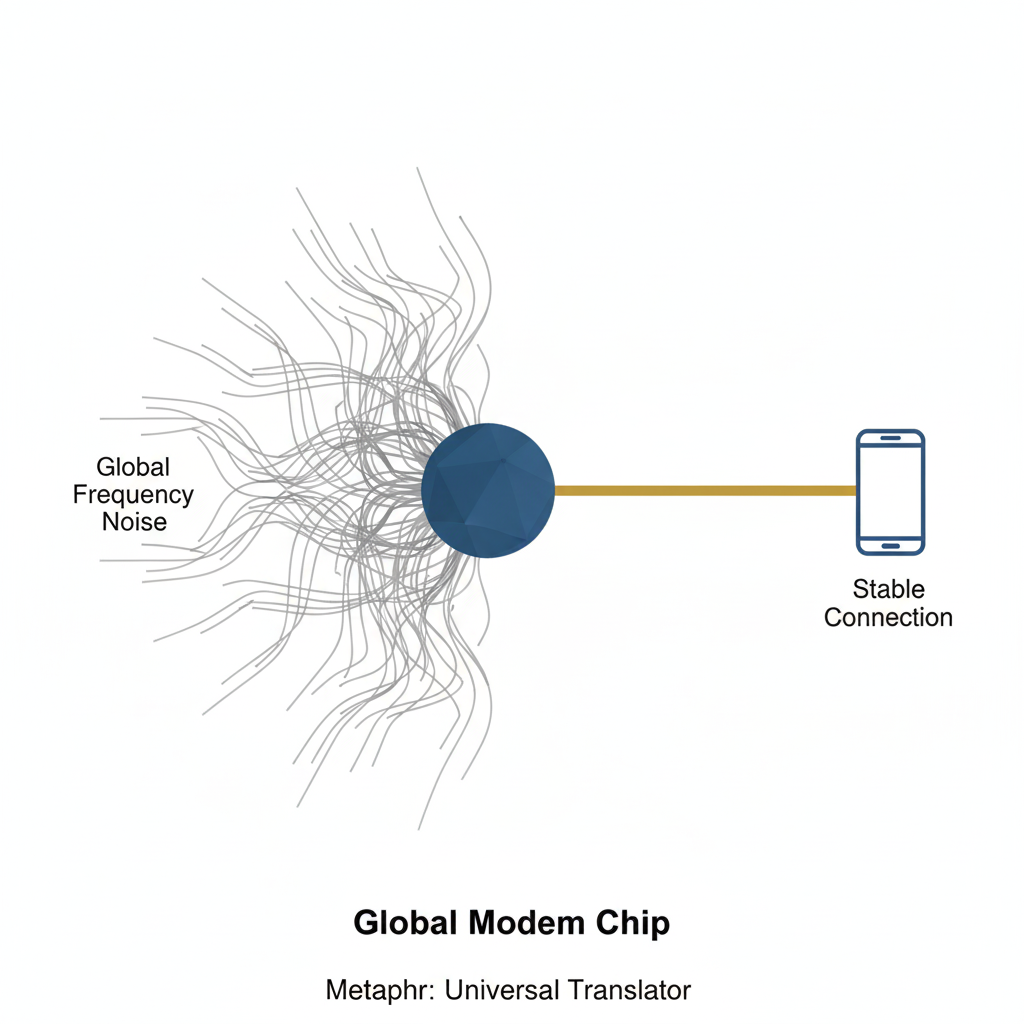
Analogy: A Super Diplomat Fluent in 100 Languages.
For a phone to connect to a base station, the process is extremely complex. It must handle background noise, switch frequency bands within 0.01 seconds (from 5G to 4G, then back to 3G), and accurately hop from one base station to the next without losing signal, even on a high-speed rail traveling at 300 km/h.
- Global Mode: Only Qualcomm's Modems perfectly support the frequency bands of all telecom operators worldwide. Whether you're in Africa, Antarctica, or New York, Qualcomm's chips can provide you with a signal.
- Apple's Bitter Lesson: Apple once found Qualcomm too expensive and their attitude too poor, so it spent $1 billion to acquire Intel's Modem division, vowing to make its own. After 5 years of R&D, the resulting chips were still plagued by overheating, high power consumption, and poor signal quality. Ultimately, Apple had to admit defeat in 2024, dutifully renewing its contract with Qualcomm and continuing to pay.
- Conclusion: Even Apple, with its vast resources, could not replicate this technology despite its best efforts, which demonstrates Qualcomm's absolute barrier to entry.
2. QTL (Qualcomm Technology Licensing) —— The Famous "Qualcomm Tax"
This is the business model that infuriates mobile phone manufacturers.
Most companies (like MediaTek) earn money by selling individual chips. Qualcomm is different; it operates on a "percentage of total device sales" model.
- Business Logic: As long as your phone uses 3G/4G/5G technology (regardless of whether you use Qualcomm's chips, or even MediaTek's), you must pay patent fees to Qualcomm based on a "percentage of the phone's selling price" (typically 3% to 5%).
- Overbearing Clause: If you sell an iPhone priced at NT$30,000, even if it doesn't use a Qualcomm CPU, you might still have to pay hundreds of NT dollars to Qualcomm. Why? Because Qualcomm invented CDMA (Code Division Multiple Access) technology during the 2G/3G era and incorporated it into global communication standards.
- Buy a Chip, Get a Lawyer's Letter: As soon as you want to make a call, you step on its patent landmine. This is what's known as "Standard Essential Patents (SEP)."
🐉 Chapter Two: Snapdragon X Elite —— Revolutionizing the PC Industry
This is Qualcomm's most formidable strategic move in 2024, striking fear into Intel and AMD: its foray into the laptop market (AI PC).
1. The Nuvia Acquisition —— A Core Transformation
Previously, Qualcomm's mobile chips used slightly modified ARM reference architectures, and their performance could never surpass Apple's M-series chips. Unwilling to accept this, Qualcomm took a decisive step: it acquired Nuvia.
- Who is Nuvia? This was an "Avengers team" of engineers, a company founded by three former Apple chief chip architects (the same masterminds who designed Apple's A-series and M1 chips).
- Oryon CPU Architecture: Following the acquisition, Qualcomm introduced its completely new Oryon core. This is no longer an ARM reference design; it's a super-powerful architecture designed by Qualcomm (the Nuvia team) from the ground up.
- Strategic Outcome: The Snapdragon X Elite, launched in 2024, directly surpassed Intel Core Ultra and Apple M3 in benchmark scores, while consuming only half the power of Intel's chips. This gave Qualcomm a weapon to directly challenge the x86 giants for the first time.
2. Windows on Arm (WoA) —— Microsoft's Betrayal
Background: For the past 30 years, Windows exclusively partnered with Intel (x86), forming the Wintel alliance.
Turning Point: Microsoft panicked when it saw Apple's M1 thoroughly defeat Intel. It realized that the x86 architecture was too power-hungry and unsuitable for the future demands of AI laptops. Thus, Microsoft decided to embrace the Arm architecture.
- CoPilot+ PC: Microsoft defined a new generation of AI PC standards. Surprisingly, the first wave of exclusive support for these chips did not go to Intel, but to Qualcomm Snapdragon X Elite.
- NPU (Neural Processing Unit): Qualcomm's NPU computing power reached 45 TOPS (45 trillion operations per second), just enough to pass Microsoft's AI PC qualification threshold. At that time, Intel's Meteor Lake only had 10 TOPS. In this round, Qualcomm won the race from the starting line.
🚗 Chapter Three: Snapdragon Digital Chassis —— The Digital Foundation for Cars
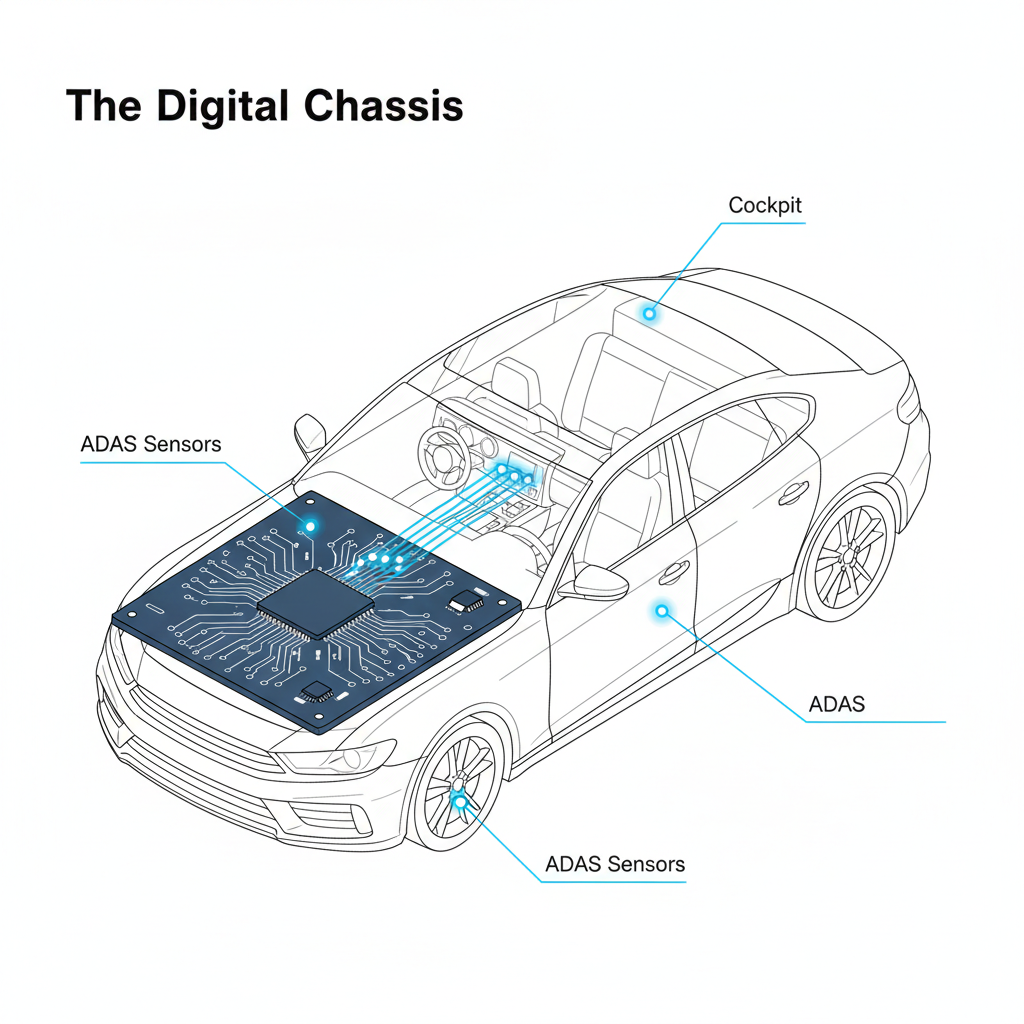
As the mobile phone market became saturated, Qualcomm turned its attention to electric vehicles. It discovered a new frontier: cars are transforming into super smartphones on wheels.
1. Smart Cockpit
Today's electric vehicles feature multiple 4K large screens, require voice control, and demand the ability to play AAA games. Traditional automotive chips (such as Renesas, NXP) simply cannot handle these workloads.
- Dimensionality Reduction Attack: Qualcomm adapted its flagship mobile chips (Snapdragon 8155/8295) for automotive use. This was a massacre for traditional automotive chip manufacturers.
- Advantages: Strong computing power, excellent Android ecosystem compatibility, and built-in 5G connectivity.
- Market Share: Currently, high-end electric vehicles (Mercedes-Benz, BMW, Porsche, BYD, Xiaomi EV) almost exclusively use Qualcomm's cockpit chips. This is currently Qualcomm's fastest-growing business.
2. Cockpit and Driving Integration (Flex SoC)
Future: Qualcomm doesn't just want to manage entertainment (cockpit); it also wants to manage driving (intelligent driving).
- Flex Architecture: Qualcomm introduced a chip called Flex, which can simultaneously run the instrument cluster (which must never crash) and autonomous driving (which requires significant computing power).
- Strategic Positioning: While it cannot yet outperform NVIDIA (Orin) in the highest-end intelligent driving (L3/L4), in the mid-range market, Qualcomm is rapidly eroding market share by offering "one chip that does the job of two" with high cost-effectiveness.
⚔️ Chapter Four: Deep Dive - Technology and Strategic Analysis
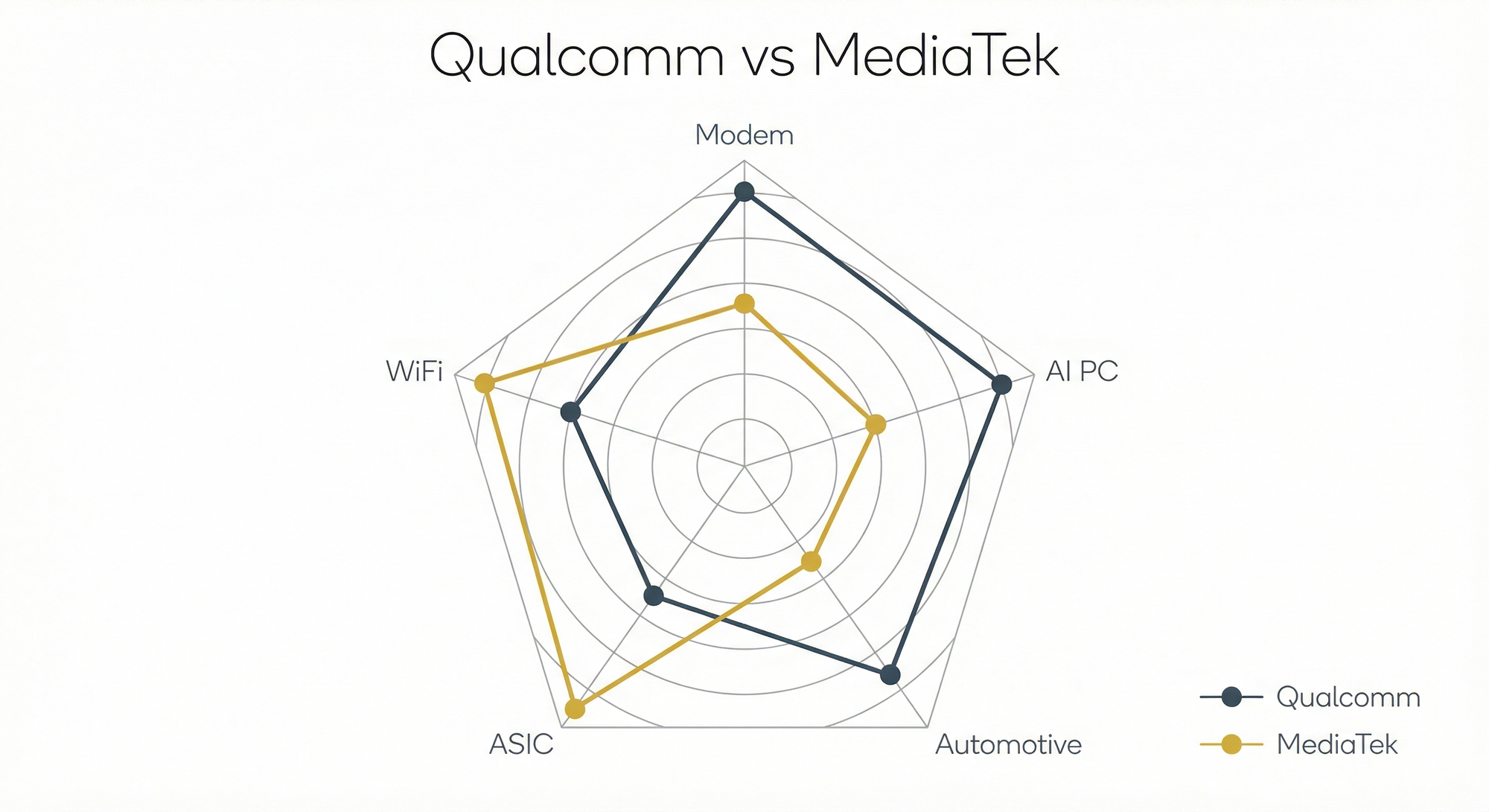
1. Qualcomm vs. MediaTek (The Edge War)
These two are arch-rivals; let's use a table to understand their differences:
| Comparison Item | Qualcomm | MediaTek |
|---|---|---|
| Strategic Positioning | Patent Emperor | King of Supply Chain Integration |
| Core Moat | Modem + Patent Wall | Turnkey Solutions |
| CPU Architecture | Self-developed Oryon (Nuvia) | ARM Reference Design (Cortex) |
| AI Strategy | Extremely strong NPU hardware (45 TOPS), primarily targeting PC | APU + Generative AI applications, primarily targeting mobile/ASIC |
| Main Battlefield | High-end mobile / AI PC / Automotive Cockpit | Mid-to-high-end mobile / WiFi 7 / Cloud ASIC |
Commentary: Qualcomm now has the capability to modify its architecture independently of ARM (Oryon), which allows it to target the PC market. MediaTek, on the other hand, remains a loyal ARM partner, with its main advantages lying in integration capabilities and cost-effectiveness. It is smartly developing into Cloud ASICs to avoid direct confrontation with Qualcomm.
2. Potential Crisis: The Legal Battle with ARM
This is Qualcomm's biggest concern and the largest legal minefield for 2025.
- The Story: ARM is upset. ARM claims: "Qualcomm originally used my reference architecture (paying per chip). Now you've acquired Nuvia, designed your own architecture (Oryon), and are paying me less!"
- ARM's Nuclear Threat: ARM is threatening to revoke Qualcomm's architectural license.
- Impact: If ARM wins, Qualcomm's AI PC chips might face a complete sales halt, or it could be forced to pay exorbitant licensing fees. This is not just a monetary issue; it concerns Qualcomm's future autonomy.
📊 1-3-3 Strategic Summary: An Investor's Perspective
- Modem is the Nuclear Weapon: As long as the world needs 5G/6G, Qualcomm remains an unavoidable hegemon. This is its key differentiator from Broadcom/NVIDIA. Apple's failure proves the depth of this moat.
- AI PC is the New Battlefield: Through Snapdragon X Elite, Qualcomm has successfully invaded Intel's stronghold. The future laptop market will be an architectural holy war between x86 (Intel/AMD) and Arm (Qualcomm/Apple). If you are optimistic about Arm architecture's penetration in PCs, Qualcomm is the sole direct play.
- MediaTek's Opponent is Formidable: It is very difficult for MediaTek to defeat Qualcomm in mobile (due to the Modem gap). Therefore, MediaTek has cleverly chosen to "take a detour" — expanding into Cloud ASICs and WiFi broadband, areas where Qualcomm is not dominant. Investing in MediaTek means watching how it avoids Qualcomm, not how it defeats Qualcomm.
The path forward for MediaTek is to avoid Qualcomm, not to defeat Qualcomm.
In-depth Research · Quantitative Perspective
Want to gain more quantitative research insights into semiconductors?
【Insight Subscription Plan】Break Free from Retail Investor Mentality: Build Your Alpha Trading System with "Quantitative Chips" and "Consensus Data"EDGE Semiconductor Research
📍 Series Map — Navigate the Complete EDGE Semiconductor Research →


