1-2-2-1 From 'Disruptive Innovation' to 'Defining the Future' — MediaTek's 27-Year Evolution
MediaTek evolved 27 years: from "clone king" to AI compute armorer. Assembled key 5G, SerDes, PMIC. Dimensity full-big-core revived smartphones; NVIDIA auto partnership; Google TPU entry. 2026 ASIC boom re-rates valuation from mobile to AI compute giant, revaluation.
Foreword: The Misunderstood Giant (The Misunderstood Giant)
As the entire market chases NVIDIA's spotlight, investors often overlook another giant lurking in the shadows.
🌐
If we liken the semiconductor world to a vast ecosystem: NVIDIA is the sovereign in the sky — defining the limits of cloud, AI, and computing power Qualcomm is the dominant force on the ground — long monopolizing high-end communication and mobile computing standards MediaTek — an omnipresent challenger attempting to bridge the gap between heaven and earth
Over the past two decades, the capital market's labels for MediaTek have often been singular and biased: "value for money," "second-place philosophy," and "shanzhai enabler." While these labels weren't entirely wrong, they are now severely outdated. They describe MediaTek of the 2010s, not MediaTek of 2024 and beyond.
Today, MediaTek is undergoing a fundamental transformation. It no longer relies solely on "low prices" to gain market share, but rather on a "strategic puzzle of core technologies" to define the market.
Through 20 years of meticulous mergers, acquisitions, and R&D spanning computers, communications, and consumer electronics, MediaTek has assembled four crucial puzzle pieces:
🔷 5G Communication
🔷 Wi-Fi Connectivity
🔷 SerDes (High-Speed Transmission)
🔷 PMIC (Power Management)
The combination of these four puzzle pieces has made MediaTek one of the very few companies globally capable of deep architectural collaboration with Google (TPU projects), NVIDIA (automotive platforms), and Intel (PC data cards) simultaneously.
It has evolved from being a mere chip vendor into a partner offering computing solutions.
📊
Report Structure This report will comprehensively analyze the foundation of this leading IC design company in Taiwan, from its historical depth and technological turning points to its future role in the AI arena, across four chapters. We will demonstrate that: MediaTek's moats are far deeper and wider than what financial statements reveal.
The destiny of a company is determined on its first day by its genes and the fears of its founder.
To understand why MediaTek can penetrate the AI server market today, we must go back to 1997, to an inconspicuous corner of Hsinchu Science Park, and comprehend the seeds that MK Tsai planted back then.
1.1 The Rebellious Scion: The Legend of UMC's "Abandoned Child"
In 1997, the semiconductor industry in Taiwan was at a critical juncture, transitioning from IDM (Integrated Device Manufacturing) to Fabless (fabless design). United Microelectronics Corporation (UMC) decided to transform into a pure-play foundry, necessitating the spin-off of its internal IC design departments.
MediaTek's predecessor was UMC's "Multimedia Division." At the time, compared to UMC's other divisions like the Communication Division (which later became Novatek) and the Consumer Electronics Division (which later became ITE Tech Inc.), the Multimedia Division was not considered the most promising "heir." They focused on CD-ROM chips — a peripheral component deemed "low-end" and low-margin by major US manufacturers.
MK Tsai, a veteran who had experienced the introduction of RCA technology at the Industrial Technology Research Institute (ITRI) and witnessed the birth and growth of Taiwan's semiconductor industry, took on this mission. When he founded MediaTek on May 28, 1997, his team consisted of just over 20 people.
At that time, MediaTek lacked the unlimited financial backing of a "rich parent" and the capital to directly compete with Intel or Texas Instruments (TI). This situation of "resource scarcity" and "starting from the periphery" shaped MediaTek's core survival philosophy in the years to come: pragmatism, agility, and an extreme hunger for cash flow.
1.2 MK Tsai's Core Philosophy: The One-Generation Champion and the S-Curve
MK Tsai's most renowned theory is "The One-Generation Champion."
He deeply understood the extremely short lifecycle of consumer electronic products. Dominant players of yesteryear (such as manufacturers of TV chips) could vanish within two to three years if they missed the next technological generation (such as computers). To avoid becoming a fleeting champion, companies must jump onto the second S-curve before the first one peaks and declines.
This philosophy was fully embodied in MediaTek's early entrepreneurial phase:
First S-Curve: CD-ROM — Gaining a foothold
Second S-Curve: DVD Player — Accumulating capital and multimedia technology
Third S-Curve: Feature Phone — Explosive growth
💡
EDGE Deep Dive This "S-curve anxiety" explains why MediaTek would later pursue aggressive M&A. In the IC design industry, relying on internal organic growth often isn't fast enough to catch the next major trend. The acquisitions of MStar, Richtek, and Ralink were essentially hedging operations by MK Tsai to "buy the next curve."
1.3 Strategic Choice: Guerrilla Warfare — Avoiding the Strong, Attacking the Weak
In the late 1990s, the power in global IC design rested with American companies. Intel monopolized CPUs, while TI and Motorola dominated DSP and communication chips.
MK Tsai chose an incredibly shrewd entry point: Optical Storage.
Sufficient Market Size: The PC industry was booming at the time, and every computer needed a CD-ROM drive.
Ignored by Giants: For Intel, the profit margin on CD-ROM controller chips was too low to warrant investing top talent; for major Japanese manufacturers (Sony, Panasonic), they tended to prefer closed systems, producing for their own use.
Technological Gaps: CD-ROM drives evolved rapidly from 4x to 8x to 16x speeds, offering agile manufacturers in Taiwan an opportunity to enter the market.
Through extreme engineering optimization, MediaTek integrated functions that originally required multiple chips into fewer chips (the prototype of an SoC), entering the market with prices over 30% lower than Japanese manufacturers. In just a few years, MediaTek forced many major Japanese companies out of the market, becoming the global leader in optical storage.
This experience left MediaTek with an important technological legacy: Servo Control and read-head positioning technology. While seemingly outdated, the underlying "analog signal processing" and "precision control" logic laid the foundation for processing wireless communication signals in the future.
1.4 The Birth of the Nuclear Weapon: Turnkey Solution (Turnkey Solution)
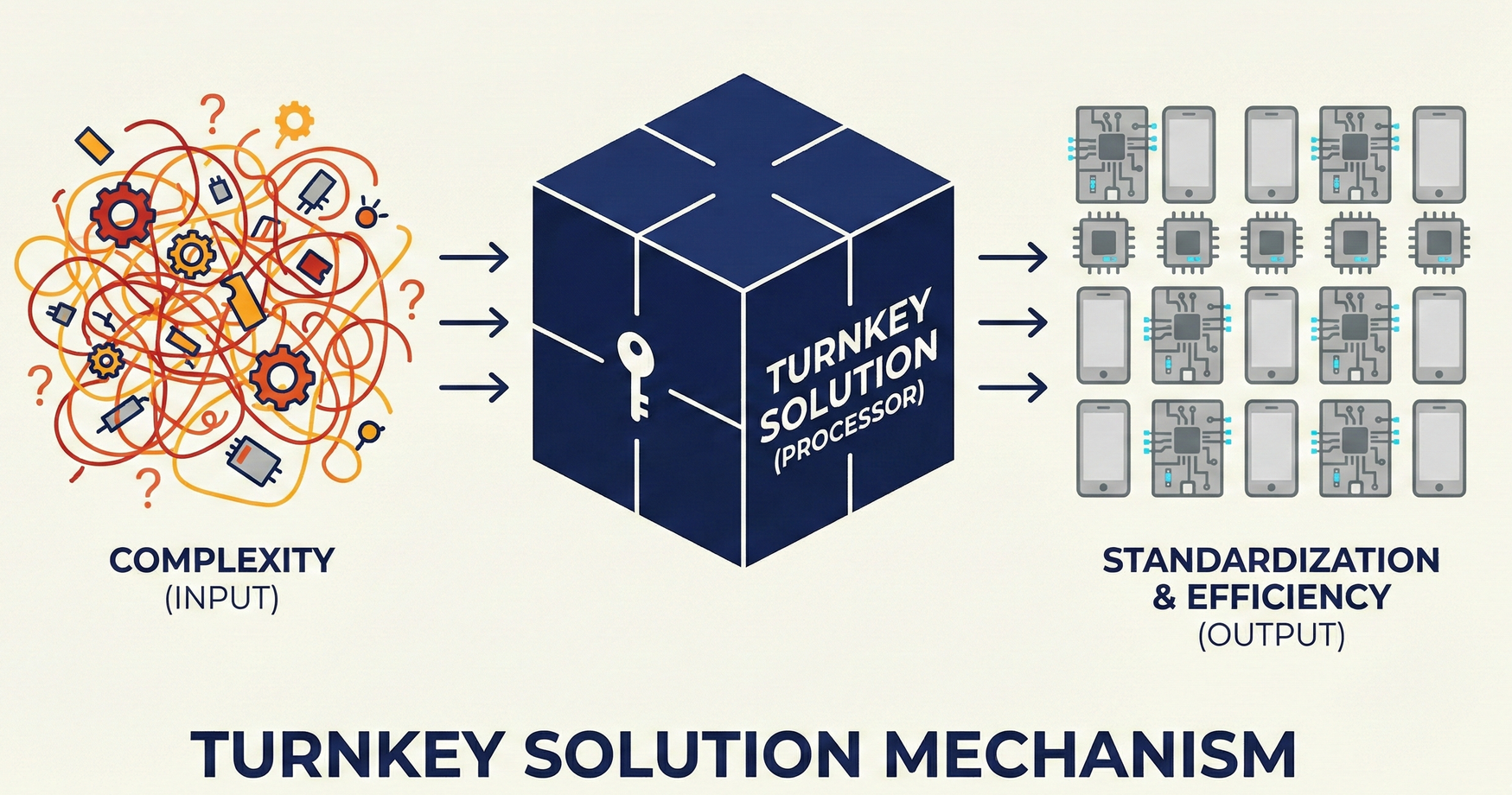
If "choosing the battlefield" was a strategic victory, then the Turnkey Solution was a tactical nuclear weapon. This represented MediaTek's greatest "disruptive innovation" for the global electronics industry supply chain.
What is Turnkey?
Before MediaTek, the barrier to entry for developing electronic products was extremely high. If you wanted to build a DVD player, you would need to:
Purchase chips from a chip manufacturer.
Assemble your own software team to write drivers and user interfaces.
Design your own printed circuit board (PCB).
Conduct your own compatibility testing.
This meant that only large corporations like Sony and Toshiba, capable of maintaining R&D teams of several hundred people, could produce DVD players.
MediaTek broke this rule. They didn't just sell chips; they bundled everything: "software (Firmware), reference design schematics (Reference Design), and test validation reports."
Customers who bought MediaTek's solution virtually required no R&D team. They only needed a "screwdriver" to assemble the casing and attach their own brand, and a DVD player was ready.
Turnkey from an Economic Perspective:
Supply-side Reform — MediaTek significantly lowered the entry barrier for "manufacturers"
Demand-side Explosion — When a thousand small factories in Shenzhen, China, could produce DVD players, fierce price competition caused DVD player prices to drop from $200 to $30, leading to a global demand explosion
📈
MediaTek's Profit Equation Turnkey empowers small and medium-sized manufacturers $\rightarrow$ Terminal product prices collapse $\rightarrow$ Product penetration increases $\rightarrow$ Chip shipments surge $\rightarrow$ MediaTek profits from economies of scale
This model debuted in the DVD era and achieved immense success. However, MK Tsai likely didn't foresee then how, a few years later, deploying this nuclear weapon to the "mobile phone" battlefield would drastically alter the global telecommunications industry landscape, even sparking panic at Qualcomm.
Chapter Two: Four Key Turning Points — The Long March from DVD to AI (2000-2019)
Success is the mother of failure. The weapons that won you the market in the past often become the reason you are slaughtered on the next battlefield.
MediaTek in the early 2000s was like a money-printing machine. The victory in the optical storage market provided it with abundant cash flow, but MK Tsai knew deeply that CD-ROMs were a dying industry. He needed the next big host. He chose mobile phones and embarked on a magnificent and breathtaking 20-year journey.
2.1 Turning Point One: The Shanzhai Frenzy — Defining the Extreme of "Disruptive Innovation" (2004-2010)
Background: A Closed Garden of Oligopoly
Before 2004, the mobile phone market was an exclusive domain of Texas Instruments (TI), Infineon, and Motorola. Mobile phone design at the time was extremely complex; Nokia, for example, needed to employ thousands of engineers and spend 18 months to develop a new phone.
Strategy: Replicating the Turnkey Model in the Communications Industry
MediaTek transplanted the Turnkey model, honed in the DVD battleground, to mobile phone chips (2G/2.5G).
They introduced a "System-on-Chip (SoC)" that integrated the baseband, radio frequency (RF), and power management IC (PMIC), and bundled it with a software system that was 90% pre-written (including communication protocols, Snake game, and MP3 player).
Effect: The Cambrian Explosion of Shenzhen Huaqiangbei
This chip (the famous MT6218) completely unleashed productivity.
White-box manufacturers in Shenzhen found that by simply buying MediaTek's chip, adding a battery, a screen, and a casing, they could produce a mobile phone. The R&D cycle was shortened from 18 months to 3 months, and the cost was only one-third of Nokia's.
This led to a "shanzhai phone" craze. Dual-SIM, extra-large speakers, sports car designs... all sorts of peculiar phones flooded China and emerging markets.
Cost: The Brand's Curse
MediaTek made a fortune, with its stock price soaring to NT$600, becoming the top stock in Taiwan. However, this also left a huge side effect: "Low-end."
In the eyes of consumers and mainstream media, MediaTek = Shanzhai = Low-end. This label, like a tattoo, deeply stung MediaTek for the next decade, hindering its efforts to enter the high-end market (such as its later collaboration with HTC).
2.2 Turning Point Two: The Pains of Smartphones — Drifting and the Valley of Death (2011-2017)
Misjudgment: The Unseen Black Swan
The iPhone was launched in 2007, and Android was born in 2008.
This was MediaTek's most dangerous moment in its history. Its decision-makers made a severe strategic misjudgment. They believed that smartphones were merely "phones with more features," and that they consumed too much power, were too expensive, and would not become widespread.
Consequently, MediaTek lagged behind Qualcomm by two full years in its investment in the Android system.
Counterattack and Defeat: The Core War
When MediaTek finally woke up and played catch-up, launching chips like the MT6575, Qualcomm had already dominated the high-end market.
To differentiate itself, MediaTek initiated the famous "multi-core war."
Logic: Consumers don't understand architecture, but they understand numbers. 8 cores must be better than 4 cores, and 10 cores must be stronger than 8 cores.
Disaster: Helio X20 (2016). MediaTek launched the world's first "deca-core" processor.
Result: Due to immature process technology and scheduling algorithms, this chip suffered from severe overheating issues. Netizens jokingly called it "one core in trouble, nine cores watching" (only one core was working, while the others were dormant due to overheating).
Financial Blow:
This series of product failures, coupled with Chinese mobile phone brands (Oppo, Vivo, Xiaomi) beginning to pursue brand upgrades and shifting to Qualcomm, caused MediaTek's gross margin to plummet from over 50% in 2010 to a battle to defend 35% in 2017. The stock price was halved again and again. Outsiders began to question: Is MediaTek going to follow in the footsteps of VIA?
2.3 Turning Point Three: The Grand Chess Game of M&A — The Underestimated "IP Arsenal" (2011-2015)
Just when outsiders thought MediaTek would only engage in price wars, MK Tsai executed a series of highly visionary acquisitions behind the scenes. The market at the time didn't understand, seeing them merely as "large fish eating small fish" to boost revenue. Little did they know that these moves would determine whether MediaTek could enter AI servers in 2024.
🎯
Three Critical Acquisitions: Collecting Infinity Stones A. Acquisition of Ralink - 2011 Surface purpose: Acquire Wi-Fi technology and integrate it into mobile phone chips Deeper meaning:Connectivity moat — becoming one of only two companies globally capable of perfectly integrating Wi-Fi, Bluetooth, and GPS into an SoC
B. Acquisition of MStar - 2012 (Crucial!) Surface purpose: Eliminate competitors and unify the TV chip market Deeper legacy:SerDes and analog talent — This group of talent later became the core force behind MediaTek's development of 112G/224G SerDes EDGE View: Without the MStar acquisition, there would be no MediaTek today capable of making TPUs for Google
C. Acquisition of Richtek - 2015 Surface purpose: Bundle power management chips with main chips for Turnkey solutions Deeper meaning:Entry ticket to high-power computing — possessing "server-grade" power delivery capabilities
These three acquisitions were like the process of collecting Infinity Stones in a Marvel movie. Although the gauntlet hadn't been worn at the time, the stones were already in the pocket.
2.4 Turning Point Four: The Iron Chancellor and the 5G Counterattack (2018-Present)
Personnel Change: The Rick Tsai Regime
In 2017, MK Tsai recruited the former TSMC CEO, Rick Tsai, known as the "Iron Chancellor," to serve as co-CEO.
Rick Tsai's mission was clear: stop the bleeding, instill discipline, and improve execution.
He cut unprofitable tablet and feature phone projects.
He strictly controlled R&D budgets, concentrating resources on 5G and AI.
He mended relations with TSMC (MediaTek had previously occasionally placed orders with UMC or GlobalFoundries to save costs).
Timeliness and Advantage: 5G Reset
Each generational shift in communication technology (3G $\rightarrow$ 4G $\rightarrow$ 5G) represents a reshuffling.
In 2019, the 5G era arrived.
Competitor's Error: Qualcomm initially chose Samsung's manufacturing process for 5G, which resulted in overheating and yield issues (Snapdragon 888 became known as "Fire Dragon").
MediaTek's Precise Strike: MediaTek's first 5G SoC, "Dimensity 1000," firmly opted for TSMC's 7nm process.
Result: Stable performance and excellent power efficiency. The Dimensity series made a name for itself, not only holding its ground in the mid-range but also truly breaking into the flagship phone market for the first time (Vivo and Oppo's flagship phones began adopting it).
Strategic Transformation: From Follower to Leader
From Dimensity 9000 to 9300, MediaTek was no longer just a "cheaper Qualcomm alternative." It began to make design choices that Qualcomm dared not (such as an all-big-core architecture). This marked MediaTek's emergence from a decade-long shadow of shanzhai and being a technological follower, finally gaining the ability to "define products."
Chapter Three: The Current Arsenal — Deconstructing the Four Major Technical Pillars (2020-Present)
The outcome of war is often determined by the depth of the arsenal before the battle even begins. In the past, MediaTek won by "human wave tactics" (Turnkey); now, MediaTek deters opponents with "strategic nuclear weapons" (Core IP).
After 20 years of crawling forward and M&A integration, MediaTek has finally completed a formidable technological puzzle. This puzzle allows it to expand from "consumer electronics" to "high-performance computing (HPC)" and "artificial intelligence (AI)."
We will deconstruct the secrets of this arsenal from four dimensions.
3.1 Mobile Battlefield: Dimensity's "All Big Core" Gamble
In the mobile chip sector, MediaTek once only picked up Qualcomm's scraps. But starting with Dimensity 9300, MediaTek made a decision that defied textbooks, a decision that not only shocked the industry but also forced Qualcomm to follow suit two years later.
1. The Myth of Traditional Architecture: big.LITTLE
Since ARM introduced the big.LITTLE architecture, the design logic for mobile phone chips has always been:
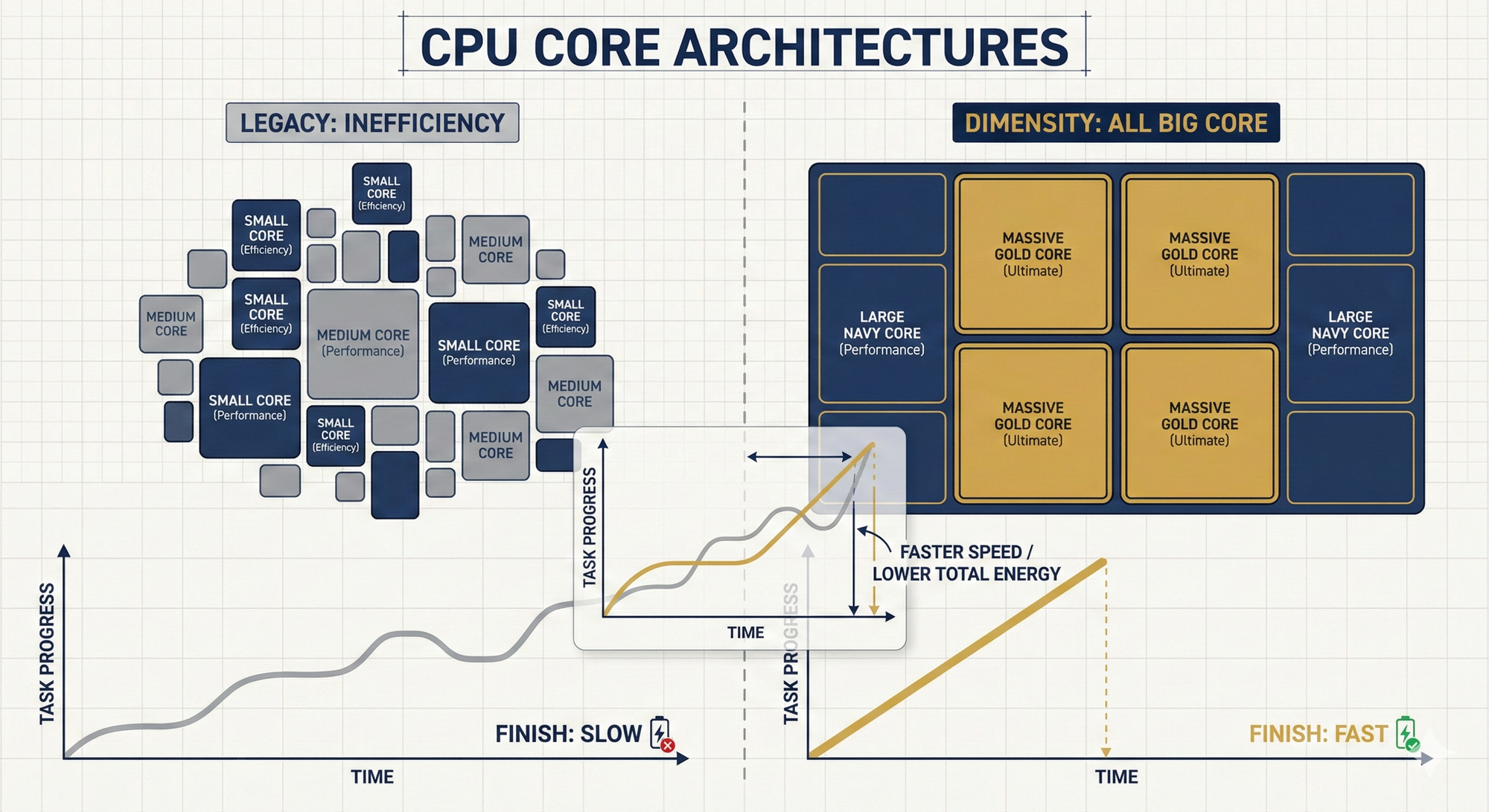
Configuration: 1 ultra-large core (captain) + 3 large cores (strongmen) + 4 small cores (child laborers)
Logic: Most of the time, phones are idle or scrolling through Instagram; why use a sledgehammer to crack a nut? Let the "child laborers (small cores)" handle it, as they consume less power.
2. MediaTek's Rebellion: All Big Core Architecture
MediaTek's engineers discovered a blind spot: as apps became increasingly bloated (Taobao, Facebook running more in the background), the "child laborers" could no longer carry the load. Small cores, in order to process these tasks, had to run at full capacity for extended periods, which paradoxically consumed more power.
Thus, the Dimensity 9300 proposed a radical design:
Configuration:4 ultra-large cores + 4 large cores (dismissing all small cores, keeping only the strongmen)
Physical Questioning: The industry was stunned. Everyone thought MediaTek had gone mad.
3. Reverse Thinking: "Race to Sleep (Finish quickly and go to sleep)"
⚡
Reverse Thinking on Energy Consumption Analogy: Moving 1000 bricks Small core (child laborer): Low strength, took 1 hour to move them. Although they consumed less "food" per minute, they consumed it for a full 60 minutes. Large core (strongman): High strength, finished in 5 minutes. Although they consumed a lot of "food" at once, they immediately powered down to sleep (Deep Sleep) after finishing. Total calculation: The total energy consumed by the strongman working for 5 minutes was actually less than the child laborer slowly working for 1 hour.
4. Outcome: Forcing Qualcomm's Hand
The success of Dimensity 9300/9400 proved this theory. Aided by TSMC's 4nm/3nm process, MediaTek not only avoided overheating but also surpassed Qualcomm in multi-core performance.
The greatest compliment came from the competitor's imitation: Qualcomm's Snapdragon 8 Elite, launched in 2024, also announced the elimination of small cores, adopting an all-big-core design. This marked the first time MediaTek won the architectural definition battle against Qualcomm.
3.2 Cloud Battlefield: ASIC and SerDes' Secret Weapon
This is key to MediaTek's valuation transforming from a "mobile stock (P/E 10-15x)" to an "AI stock (P/E 20x+)." Why would Google TPU and Meta's AI chips turn to MediaTek?
1. Core Technology: SerDes (Deserializer) — The Hidden Crown Remember the MStar acquisition mentioned in Chapter Two? That was for making TVs, but now it has become the key to AI.
What is SerDes? It is the high-speed transmission channel between chips. Imagine that AI chips (GPU/TPU) compute at extremely fast speeds; if the transmission channel is too slow, data will jam. SerDes is like the "light-speed zipper" of data centers.
Moat: As transmission speeds reach 112G and even 224G, signal attenuation becomes very severe, requiring highly sophisticated analog circuit technology to restore the signal. The number of companies globally capable of producing 224G SerDes IP can be counted on one hand: Broadcom, Marvell, Synopsys, Rambus, and MediaTek.
2. Business Model: Google's "Second Source"
Pain Point: Google's TPU is currently primarily designed with assistance from Broadcom. However, Broadcom charges extremely high fees and has an aggressive stance (dubbed the "landlord" of the semiconductor industry). To diversify risk and negotiate better terms, Google urgently needed a second supplier.
MediaTek's Entry Point:
Technical Competence: We possess top-tier SerDes IP inherited from MStar.
Capacity Advantage: We are TSMC's third-largest customer, giving us priority for CoWoS access.
Service-Oriented Mindset: We are cheaper than Broadcom, and we are willing to cooperate on architectural modifications (this is MediaTek's strongest service-oriented spirit).
Result: Market and supply chain sources indicate that some of Google's TPU projects and high-end Wi-Fi 7 main controller chips have been entrusted to MediaTek for design. This proves that MediaTek has obtained its ticket to the exclusive ASIC club.
3.3 Automotive Battlefield: Dimensity Auto and NVIDIA's Alliance
This is the handshake of the century between MK Tsai (MediaTek Chairman) and Jensen Huang (NVIDIA CEO). This is not just a shared Taiwanese heritage; it is the ultimate in business complementarity.
NVIDIA (Weaknesses):Communication is a blind spot. Cars need to connect to 5G, Wi-Fi, and Bluetooth, which NVIDIA cannot produce (they tried acquiring Icera in the past, but it failed, resulting in a write-off).
MediaTek (Strengths): Communication powerhouse. Globally leading in 5G modems, Wi-Fi 7, Bluetooth, and GPS.
2. Solution: Chiplet Packaging They are not "selling chips to car manufacturers separately," but rather "collaborating to create a super chip."
Technical Details: IO Die + GPU Die Analogy: "Iron Man's armor (NVIDIA) + Captain America's shield and communicator (MediaTek)." Using Chiplet technology, an NVIDIA GPU chiplet (responsible for running AAA games and AI dashboards) and a MediaTek SoC (responsible for CPU computing, 5G connectivity, and screen connection) are packaged on the same substrate. They are connected via UCIe (Universal Chiplet Interconnect Express), a chiplet interconnect standard, at speeds so fast it's like they're on the same chip.
3. The Lethality of Dimensity Auto Cockpit Once this chip was released, car manufacturers (such as Mercedes-Benz and NIO) were ecstatic.
Previously: Buying a Qualcomm Snapdragon for the cockpit + buying an external 5G modem + buying an NVIDIA Orin for autonomous driving. This resulted in complex circuit boards and high costs.
Now: MediaTek + NVIDIA handles everything in one chip. Lower cost, stronger performance, and direct access to NVIDIA's ecosystem in the car.
Strategic Significance: This directly threatens Qualcomm's monopoly in the smart cockpit market, representing a "dimension-reducing attack" by MediaTek on Qualcomm.
3.4 Power Management (PMIC) — The Forgotten Moat
Everyone looks at CPU/GPU, often forgetting how power gets into the chip. Remember the Richtek acquisition in 2015? This is the final puzzle piece.
1. The Power Supply Challenge in the AI Era AI chips (such as NVIDIA B200) can experience instantaneous power surges exceeding 1000W, with extremely rapid current changes. If the power supply is unstable, the chip can crash or even burn out. Ordinary power chips simply cannot handle it.
Strategic Significance: When MediaTek assists Google with ASIC design, it can leverage its most successful past strategy — "bundling power solutions with chips."
Bundled Sales: If you purchase our ASIC service, we will design the power management module for you as well. This not only increases customer stickiness (power suppliers are difficult to switch) but also boosts the overall gross margin.
Chapter Three Summary: The Complete Form is Born
MediaTek is no longer the "shanzhai king" of the past. If we use a diagram to summarize its "strategic transformation," you'll find that every piece has fallen into a critical position:
Battlefield
Product Code
Technology Source (M&A/R&D)
Competitor
Status
Mobile
Dimensity 9400
In-house R&D (All Big Core Architecture)
Qualcomm
Neck and neck. Successfully established in the flagship phone market.
Cloud
ASIC Service
MStar acquisition (SerDes IP)
Broadcom
Guerrilla breakthrough. Entered the supply chain of CSP giants (Google).
Automotive
Dimensity Auto
Alliance with NVIDIA (Chiplet)
Qualcomm
Strong alliance. Combining communication and computing power for a dimension-reducing attack.
Power
Server PMIC
Richtek acquisition (High-power PMIC)
MPS/Infineon
Hidden champion. Growing with the scaling of AI servers.
🎯
Strategic Transformation Summary MediaTek is transforming from "providing cheap chips" to "providing computing solutions." Each of its historical turning points now converges to form the foundation for its challenge to American giants.
Chapter Four: The End Game and Outlook — Valuation Metamorphosis in 2026 (Valuation Metamorphosis)
The highest realm of investing is not to buy when brilliance abounds, but to buy in the last darkness before dawn. While the market is still concerned about gross margin headwinds in the first half of 2026, smart money is already pricing in the ASIC explosion of 2027.
In the first three chapters, we deconstructed how MediaTek built its AI-era arsenal through a technological puzzle (all-big-core, SerDes, Chiplet, PMIC). In this chapter, we turn our attention to the capital market, combining the latest supply chain data and financial models to answer a fundamental question: What is this company really worth?
We believe MediaTek is undergoing a dramatic metamorphosis, from a "caterpillar to a butterfly."
This post is for subscribers only
Sign up now to read the post and get access to the full library of posts for subscribers only.