Realtek, the "mass-market tech" leader, dominates global PC audio/networking markets via extreme cost-performance & mixed-signal tech. It drives Wi-Fi 7 adoption, entered Tesla's supply chain with automotive Ethernet, and accessed NVIDIA via SSDs. Despite slowing 2026 growth, high ROE & 6% divide...
Introduction: Turning Aristocratic Technology into Everyday Meals
In the world of semiconductors, two distinctly different philosophies of survival exist.
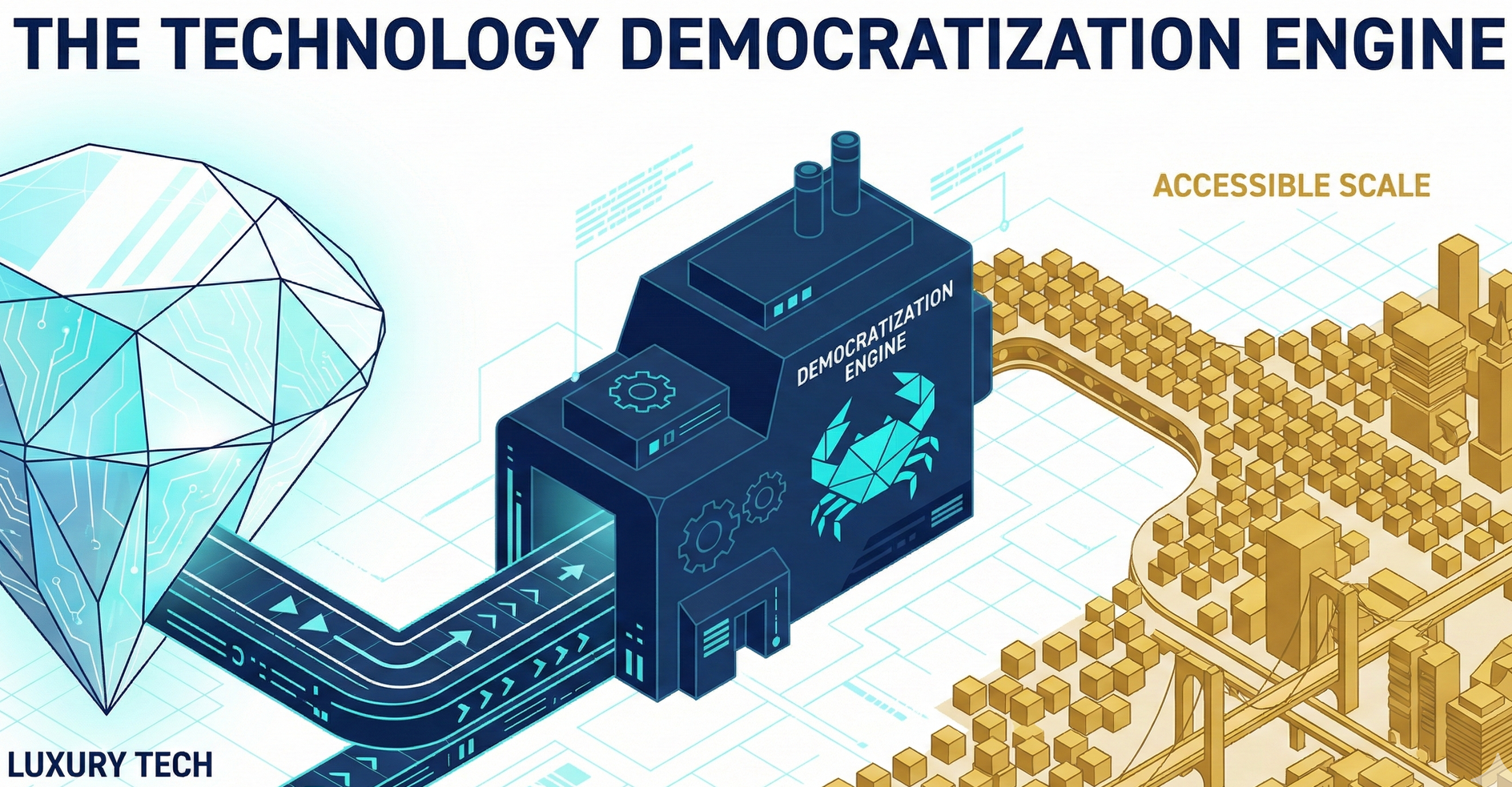
The first is the philosophy of U.S.-based Broadcom: "Michelin Three Stars". They produce the world's most high-end communication chips, with a single switch chip selling for hundreds of U.S. dollars. Their clients are cloud giants like Google and AWS, whose wealth rivals nations. Their strategy is to build extremely high patent walls and then extract excessive profits like landlords.
The second is the philosophy of Taiwan's Realtek: "Everyday Meals". They produce the world's most ubiquitous communication chips, with a single audio or network chip potentially selling for just 1 U.S. dollar, or even 0.5 U.S. dollars. Their clients include PC manufacturers, router manufacturers worldwide, and even white-box vendors in Shenzhen's Huaqiangbei.
The market often makes a mistake: underestimating "affordability". Investors, seeing Realtek's gross margin (approximately 42%-50%) lower than Broadcom's (around 70%), conclude that Realtek's technology is inferior. However, in reality, the difficulty of "making high-tech affordable while still earning substantial profits" is even greater than producing luxury goods.
This requires extreme scale economics, insane cost control, and profound mixed-signal design expertise.
Realtek's logo is a crab. This is a perfect metaphor:
Crabs possess immense vitality and high adaptability; they can thrive and dominate whether in clear streams (high-end markets) or muddy shoals (low-end red oceans).
Today, this crab has quietly occupied every corner of our lives. The sound from your laptop, the Wi-Fi emitted by your router, the network cable in your car—the presence of that crab is behind them all.
This report will dismantle how Realtek, through its "ant army" tactic, has built a "cost-effectiveness moat" that even Chinese manufacturers find difficult to breach, thriving amidst the giants.
🦀 Core Investment Thesis Realtek's success lies not in "being the best," but in "making high-tech affordable while still making a profit." This requires extreme scale economics, insane cost control, and profound mixed-signal design expertise—the combination of these three forms a technological moat that even Chinese manufacturers find difficult to overcome.
Chapter One: Audio Codec — Dominating the World's Sound
“In the digital world, the hardest part is not computation, but 'translation.' Realtek is great because it preserves the purest analog sound for us in a hell full of digital noise.”
1.1 The Terrifying Story of 90% Market Share
📊 Astonishing Data: 90% Market Share In the PC motherboard audio chip market, Realtek's market share reaches 90%—even more exaggerated than TSMC's market share in wafer foundry. This is a truly monopolistic position.
If you are reading this article on a desktop or laptop right now, please do an experiment: open your "Device Manager" and check "Audio inputs and outputs." There is a 90% chance you will see "Realtek High Definition Audio".
This history dates back to the early 2000s. The audio kingpin at the time was Singapore's Creative, whose Sound Blaster sound cards cost several thousand New Taiwan Dollars, symbolizing luxury.
Realtek did something: it condensed the functions of a sound card into a chip the size of a grain of rice, directly soldering it onto the motherboard, at a cost of less than 1 U.S. dollar. Result: Creative collapsed, and the discrete sound card market disappeared. Realtek, with its "Good Enough" philosophy, completed its dominance of the audio market.
1.2 Core Technology: The Art of Mixed-Signal
Many people believe Realtek won by being cheap; in fact, it won with its "anti-interference" capabilities.
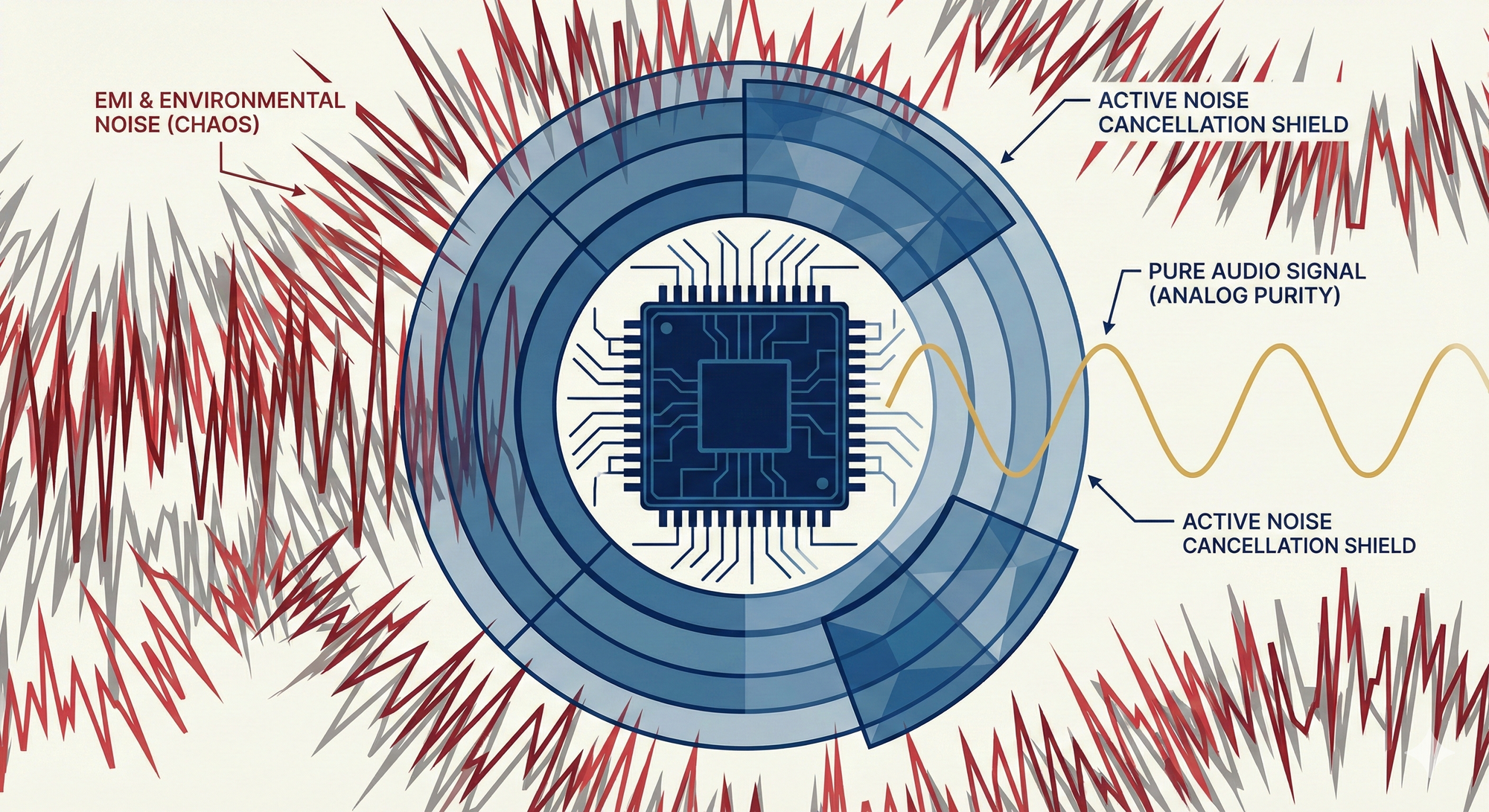
1. The Hell of Electromagnetic Noise (EMI Hell) Inside a computer chassis is a hell for analog signals.
The CPU performs high-frequency switching at GHz levels.
Fan motors rotate, generating magnetic fields.
Hard drive read/write heads move. These all generate strong Electromagnetic Interference (EMI).
2. Digital and Analog Translator (Codec) The function of an audio chip (Audio Codec) is to:
DAC (Digital-to-Analog Converter): Translate MP3 files (010101) from the CPU into current waveforms to drive speakers.
ADC (Analog-to-Digital Converter): Translate sound wave voltages received by the microphone into 010101 for storage in the computer.
3. Realtek's Unique Skill: Whispers in a Noisy Market To accurately transmit "weak sound wave signals (whispers)" in a "noisy market" like a computer, expensive shielding or audiophile-grade capacitors are usually required. However, Realtek's clients (such as ASUS, MSI) are unwilling to spend this money. They demand from Realtek: "Your chip must run exposed, but the sound must be clean."
Realtek's engineers demonstrated astonishing circuit layout capabilities. They utilize special grounding designs and filtering architectures to "filter out" noise within the chip itself. This allows Realtek's chips, despite their unassuming appearance, to achieve a Signal-to-Noise Ratio (SNR) of over 110dB, making background noise imperceptible to 99% of human ears. This is the pinnacle of mixed-signal design—solving the most complex physical interference with the most affordable manufacturing processes.
🎯 Technological Moat: The Art of Mixed-Signal Realtek's core competitiveness is not digital computation, but "analog signal processing." In harsh environments filled with electromagnetic interference (inside PC chassis, car engine compartments), how does one produce a chip with an SNR of 110dB using the most affordable manufacturing processes? This is a parameter library accumulated over 30 years, not something that can be replicated by poaching a few engineers.
1.3 Evolution: Edge AI, From "Sound Generation" to "Hearing"
As the PC market saturated, audio chips should have been a sunset industry. However, the 2020 pandemic and the AI wave gave this crab new pincers.
1. Video Conferencing: An Essential Need Zoom and Teams meetings became commonplace. The biggest pain point was no longer "sound quality," but rather "background noise." Crying children, neighboring renovation noise, keyboard clicks—these became new sources of interference.
2. AI Noise Reduction Traditional noise reduction relies on filters (cutting off high frequencies), which makes voices sound robotic. The new generation of noise reduction relies on AI models.
Realtek has embedded lightweight NPUs (Neural Processing Units) or DSPs (Digital Signal Processors) into its latest ALC audio chips.
Edge AI: This doesn't require using your 300W power-hungry NVIDIA graphics card, nor does it require uploading to the cloud.
Operating Principle: In the millisecond when the microphone picks up sound, the AI model within the chip identifies: "This is a human voice waveform, retain; this is a dog bark waveform, delete."
Strategic Significance: This marks Realtek's evolution from a mere "signal converter" to a "signal processor." This ability to "integrate AI into tiny chips" is key for Realtek to continuously increase its Average Selling Price (ASP Uplift) in the era of AI PCs and AI smartphones. It doesn't need to compete with NVIDIA in computing power; it merely needs to filter out junk information for the CPU at the very edge.
🤖 Edge AI Transformation: From Conversion to Processing Realtek is evolving from a "signal converter" to a "signal processor," embedding lightweight NPUs/DSPs in its audio chips to enable edge AI noise reduction. This is a key driver for ASP improvement and an entry ticket to the AI PC era.
Chapter Two: Wi-Fi 7 and Network Communication Breakthrough — The Path to Survival in Broadcom's Shadow
“If Broadcom is the aristocrat building 'F1 racetracks,' exclusively serving high-paying enterprise clients, then Realtek is the engineer constructing 'city roads.' Its mission is not to pursue ultimate speed, but to ensure uninterrupted daily connectivity for 8 billion people worldwide.”
In the world of network communication chips, the hierarchy is strict. At the top of the pyramid are Broadcom and Qualcomm, dominating the markets for high-end flagship smartphones and enterprise-grade routers. However, Realtek chose a different path: "King of the Consumer Market".
Why are most devices from TP-Link, D-Link, ASUS, and even the modems (often called "little turtles" in Taiwan) provided by your Internet Service Provider (ISP) powered by Realtek chips? Because Realtek holds the key to making Wi-Fi 7 widespread.
2.1 Pain Point: The "Traffic Jam" Hell of Wireless Networks
In the Wi-Fi 6 era, despite its speed, there was a fatal flaw: "single lane".
Your router broadcasts two frequency bands: 2.4GHz (good wall penetration but slow) and 5GHz (fast but poor wall penetration).
Your phone can only connect to one of them at a time.
Scenario: When you're gaming connected to 5GHz, if someone in the living room is downloading a 4K movie on 5GHz, that "lane" gets jammed by a truck. Your game's Ping value will instantly spike, and you'll get killed in the game.
This is why many gamers prefer plugging in an Ethernet cable rather than relying on Wi-Fi.
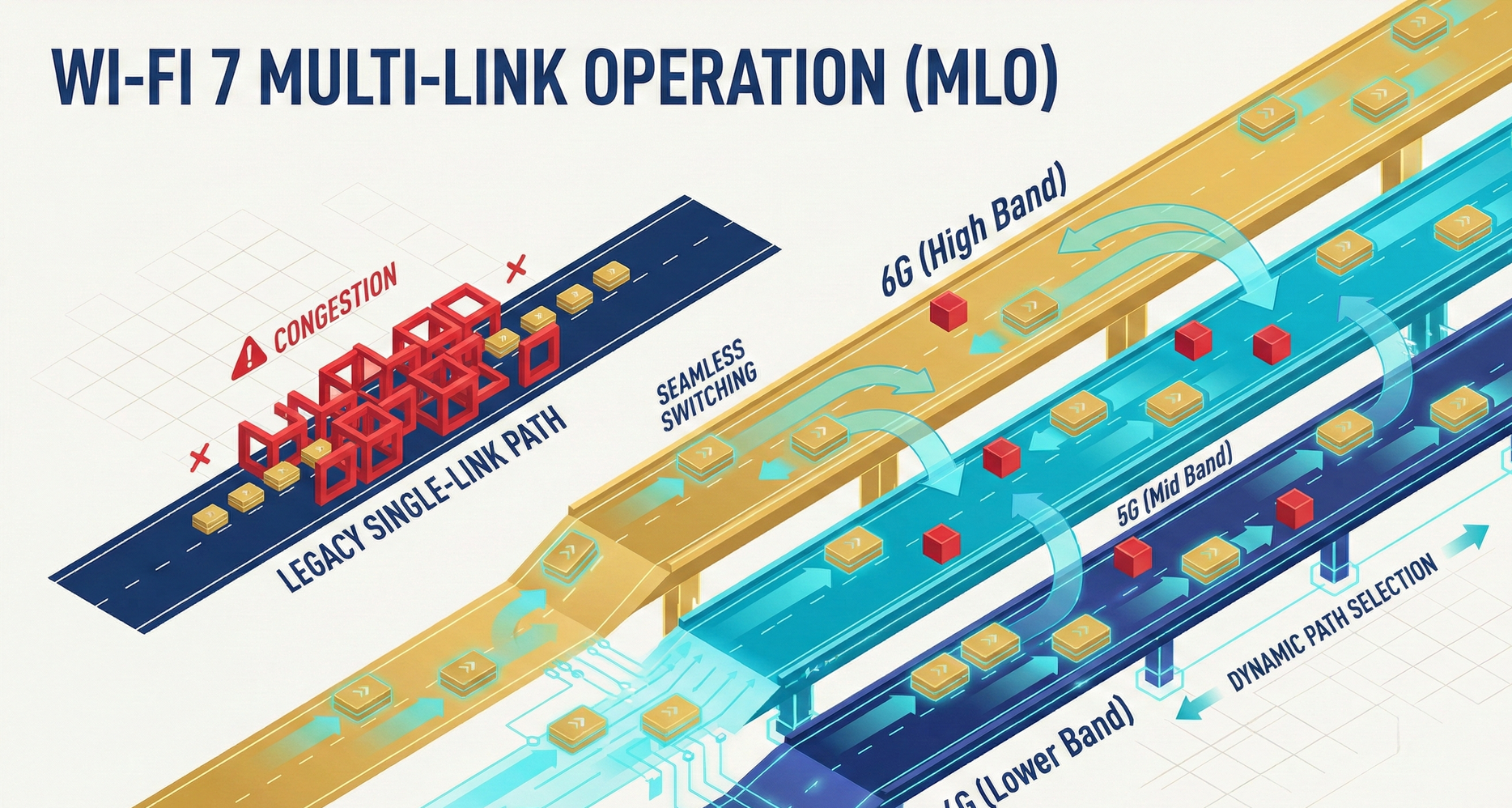
Wi-Fi 7 introduces a revolutionary technology: MLO (Multi-Link Operation). This is Realtek's most powerful weapon currently.
1. Transformer Truck Imagine your data as a vehicle.
Previously (Wi-Fi 6): You could only choose to drive on National Freeway 1 (2.4G) or National Freeway 3 (5G). Once chosen, you had to endure any traffic jams.
Now (Wi-Fi 7): Realtek's chip transforms your vehicle into a "Transformer." It's wide enough to simultaneously span and travel across three lanes: 2.4G, 5G, and even the latest 6G.
2. The Secret to Near-Zero Latency When the 5G lane is congested, Realtek's chip automatically redirects packets to the 6G or 2.4G lanes for transmission. Result: Throughput surges threefold, and more importantly, latency approaches zero. This is an absolute essential need for the currently popular VR/AR (Metaverse) and Cloud Gaming. Because if screen latency exceeds 20 milliseconds, users will experience dizziness.
🚀 Wi-Fi 7's Killer Application: MLO Multi-Link Technology Realtek's Wi-Fi 7 chip cansimultaneously use 2.4G, 5G, and 6G frequency bands to transmit data, boosting throughput threefold and bringing latency to near-zero. This is an essential technology for VR/AR and cloud gaming.
Everyone has the technology (Broadcom also has Wi-Fi 7), so why can Realtek win market share? The answer lies in: Integration.
1. Broadcom's Model: "Frankenstein Car" for Ultimate Performance Broadcom's design philosophy is "performance first." They typically sell a "family meal" package: a CPU chip + a separate Radio Frequency (RF) chip + a power management chip.
Pros: Unbeatable performance, super strong signal.
Cons: Extremely large circuit board, requires a large cooling fan, very high cost (a single router might cost 8000 New Taiwan Dollars).
2. Realtek's Model: "Monocoque Design" for Ultimate Cost-Effectiveness Realtek's philosophy is "ubiquity first." They leverage their strong mixed-signal technology to integrate the CPU, RF (radio frequency), Baseband, and Switch all into a single SoC (System on Chip).
Challenge: Digital circuits (CPU) can interfere with radio frequency circuits (RF). This is again Realtek's strongest battleground: "anti-interference."
Outcome: Router manufacturers receive Realtek's chip, allowing them to make circuit boards as small as a palm, without the need for expensive heat sinks.
Significance: This enables manufacturers to produce Wi-Fi 7 routers with a retail price below 2000 New Taiwan Dollars. This is the sweet spot for technology popularization.
2.4 Invisible Champion: The Dominance of Wired Ethernet
Don't forget, within that crab's belly, there's also the oldest but most profitable piece of meat—the Ethernet Network Interface Card (NIC).
Remember the "Everyday Meals" mentioned in the previous chapter? In the motherboard market, Realtek's "crab card" holds over 70% market share.
Intel NICs: Stable, but expensive, usually only found in high-end commercial machines.
Killer NICs: Specializes in gaming, even more expensive.
Realtek NICs: Affordable, unbeatable compatibility, found on almost all consumer-grade motherboards globally.
Upgrade Wave: From 1G to 2.5G For the past decade, our network port speeds have been stuck at 1Gbps. In the last three years, Realtek has driven a major upgrade to 2.5Gbps. This doesn't require changing cables (the original Cat5e network cables can handle it), only changing the chip. This is a perfect business for Realtek: cost has not increased much, but ASP (Average Selling Price) has risen, and every computer in the world needs to upgrade.
2.5 Moat: Why Haven't Chinese Manufacturers Broken In Yet?
You might ask: "Aren't Chinese manufacturers like HiSilicon or Airoha (under MediaTek) very strong in Wi-Fi and network cards?"
1. Driver Support Realtek has been making network cards for 30 years. Its drivers are built into Windows, Linux, MacOS, and even various peculiar embedded systems. This is a "software moat." If you're a motherboard manufacturer and use Realtek's chip, it's plug-and-play. Use a chip from a new vendor? You might spend three months debugging blue screen issues for customers.
2. The Black Magic of Analog RF Wi-Fi is radio waves, which fall into the analog signal domain. As mentioned in the Novatek chapter, analog circuits are difficult to miniaturize and copy. How to produce stable RF circuits with affordable materials using CMOS processes—this is Realtek's 30-year accumulated parameter library, not something Chinese manufacturers can instantly replicate by poaching a few individuals.
Chapter Three: The Automotive Nerve System Blood Transfusion — From CAN Bus to Automotive Ethernet
“The car of the future is essentially a 'server on wheels.' As a server, its internal communication language can no longer be the 'telegraph' of 40 years ago (CAN Bus), but must be the universal language of the modern internet—Ethernet.”
If Wi-Fi 7 is Realtek's present, then Automotive Ethernet is Realtek's next decade. This is not just about selling a few chips; it's a "nervous system transplant operation" for automotive electronic architecture. And Realtek is one of the chief surgeons in this operation.
3.1 Pain Point: The Clunky and Sluggish Old Nerves (The CAN Bus Bottle-neck)
1. Automotive Industry's Antique: CAN Bus Since the 1980s, in-car communication has primarily relied on CAN Bus (Controller Area Network).
Analogy:"Sending a telegram."
Capability: It is extremely reliable, but bandwidth is extremely low (only Kbps to Mbps levels).
Use: It is suitable for transmitting simple commands, such as "open window" or "turn on brake lights."
Defect: In the AI era, when cars need to transmit 4K reversing images, LiDAR's 3D point cloud data, or high-resolution map data, CAN Bus is like drinking bubble tea with a straw—completely clogged.
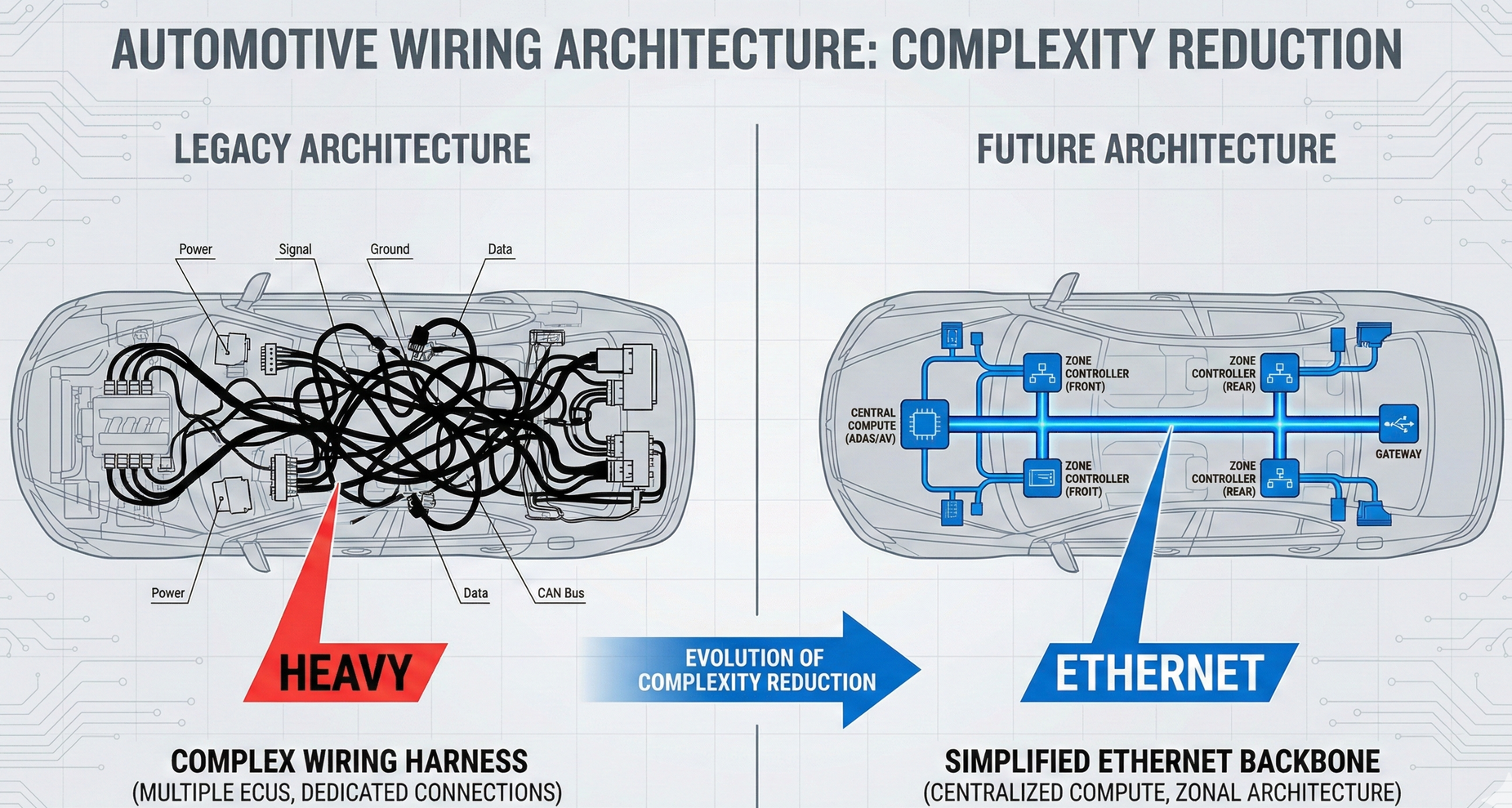
2. The Wiring Harness Nightmare To solve the bandwidth limitation, traditional car manufacturers' approach was to "add more wires." Need to transmit video? Run a dedicated coaxial cable. Need to transmit audio? Run a dedicated audio cable.
Result: The total length of wiring harnesses in a traditional internal combustion engine vehicle can reach 4 kilometers, weighing up to 50 kilograms.
Cost: Wiring harnesses are the third most expensive component in a car (after the engine and chassis), and due to their complex shape, they cannot be automated for production, requiring manual wiring. This is what Elon Musk most wants to eliminate.
3.2 Revolution: Automotive Ethernet
1. Down-Dimensional Attack: Bringing PC Technology to Cars Realtek's idea is simple: all computers worldwide use Ethernet for connection, which is fast, affordable, and standardized. Why not bring it to cars?
Analogy:"Fiber optic broadband" (although the physical layer still uses copper wires).
Advantage: A single twisted pair cable can achieve speeds of 1Gbps or even 10Gbps, and it weighs only 30% of traditional wiring harnesses.
2. Technical Barrier: Why Can't PC Network Cards Be Used Directly? You might ask: "Why not just install Realtek's PC network cards directly into cars?" No, that's not possible. This is where the technical barrier lies.
Harsh Environment: PCs are kept in air-conditioned rooms; automotive chips must be placed near the engine compartment. They must withstand temperature differences from -40°C to 125°C, and the huge electromagnetic pulses generated during engine ignition.
Reliability: If a PC network card crashes, you just restart; if an automotive network card crashes, the automatic braking system might fail.
3. Realtek's Killer Move: King of PHY (Physical Layer) Realtek leverages its powerful DSP (Digital Signal Processing) technology to redesign automotive-grade PHY chips.
Anti-interference (EMC/EMI): Realtek has transplanted the "audio noise reduction technology" mentioned in Chapter One. It can restore pure digital signals from signals filled with engine noise.
Low Power Consumption: Compared to competitors (Marvell, Broadcom) with high performance but high heat generation, Realtek's chips are known for "extreme power saving," which is crucial for electric vehicles that meticulously consider battery range.
3.3 Market Landscape: Realtek's Entry Point
In the automotive chip market, there are traditional strongholds like NXP and TI, and high-end dominators like Marvell. Where does Realtek fit in? The answer is: "The most cost-effective mass production king".
1. Endorsement from Tesla Tesla was the first car manufacturer to massively adopt Automotive Ethernet (to eliminate wiring harnesses). When Tesla was looking for suppliers, they found:
Marvell/Broadcom: Extremely powerful performance, but too expensive.
NXP: Stable, but slow in technology iteration.
Realtek: Half the price of competitors, sufficient performance, and infinite production capacity.
Thus, Realtek successfully entered Tesla's supply chain. This is a huge signal: as long as Realtek's products can pass Tesla's validation, car manufacturers worldwide will follow suit.
🚗 Strategic Breakthrough: Tesla Certification as a Benchmark Effect Realtek's Automotive Ethernet chip entered Tesla's supply chain. This is not just an order, but proof of technical capability—half the price of Marvell/Broadcom, yet having passed the world's most stringent automotive-grade validation. As Chinese electric vehicles (BYD, NIO) are exported globally, Realtek's automotive chip shipments will experience exponential growth.
2. Standard for Chinese Electric Vehicles Car manufacturers such as BYD, NIO, and Xpeng, which are extremely focused on cost control, are Realtek's strongholds. As Chinese electric vehicles are exported globally, Realtek's automotive Ethernet chip shipments are experiencing exponential growth.
3.4 Future Architecture: Zonal Architecture
The explosion of Automotive Ethernet is just beginning. Future cars will transition to a "Zonal Architecture".
Previously: Each function (windows, air conditioning, wipers) had its own wire connected to a central computer.
Future: The car is divided into several "zones."
All devices in the front-left zone are connected to a "Zone Controller."
The rear-right zone is connected to another controller.
These controllers are then connected back to the central computer via a robust Ethernet backbone.
What does this mean? This means that a large number of Switch chips will be needed in the car to distribute traffic. Remember what Realtek does? It is the global leader in consumer-grade Switch chips. This is another perfect example of technology reuse: Realtek is preparing to replicate its monopolistic position in the router market onto automotive zone controllers.
Chapter Four: Switch and IoT — Building AI's Capillaries
“If NVIDIA is AI's 'brain' and Broadcom is the 'heart' responsible for pumping blood through the major arteries, then Realtek is the 'capillaries' distributed throughout the body. No matter how smart the brain, without capillaries to transmit data from the peripheral nerves (sensors), AI is just a brain in a vat, cut off from its senses.”
In the landscape of network communication chips, the media spotlight always falls on Data Centers. That's Broadcom and Marvell's territory, where a 51.2T switch chip can sell for thousands of U.S. dollars.
But Realtek dominates another world: The Edge.
Your office, school, factory production line, and smart home. Here, there are no air-conditioned server rooms, budgets are limited, but the number of devices is thousands of times greater than in data centers.
4.1 The Forgotten King: The Edge Hegemony of Switches
1. Market Segmentation: Core vs. Access
Broadcom (Core Layer): Deals with traffic between hundreds of thousands of servers in Google and Meta data centers. Requirements are extreme throughput, without concern for power consumption (since there's data center cooling).
Realtek (Access Layer): Handles traffic from your PC, printer, IP Camera (surveillance camera), and Wi-Fi Access Point (AP).
Requirement One: Low power consumption. Many switches are tucked away in ceilings or low-voltage boxes, without fans. If the chip gets too hot, the entire device can burn out.
Requirement Two: Extreme cost-effectiveness. Small and medium-sized businesses (SMBs) cannot afford high-end equipment from Cisco; they buy Netgear, TP-Link, D-Link. Inside these machines, almost all are powered by Realtek's core.
2. Industry Upgrade: From Dumb Switch to Managed Switch
In the past, home switches were "dumb" (unmanaged switches), only responsible for forwarding packets.
Now, with the rise of smart factories and security surveillance, edge switches are becoming smarter.
PoE (Power over Ethernet): Surveillance cameras don't need a separate power cable; they receive power directly through the network cable. Realtek's chips integrate power control functions.
Management Features: Factories need to segment VLANs (Virtual Local Area Networks) to ensure that robotic arm networks are not interfered with by office traffic. Realtek embeds a lightweight CPU in low-end chips, allowing devices costing a few thousand New Taiwan Dollars to have enterprise-grade management features.
This is a classic "long-tail market." Individual customer orders are small, but the total number of customers is enormous. Realtek, through its dense network of distributors, has built a moat that Broadcom doesn't want to enter, and smaller manufacturers cannot breach.
4.2 Bluetooth and TWS: The Victory of the Ant Army
If a switch is a capillary, then Bluetooth is a nerve ending.
Realtek's claim to fame in the Bluetooth domain is TWS (True Wireless Stereo) earphones.
1. AirPods Disruptor
When Apple launched AirPods, they were a luxury item.
Realtek saw an opportunity. It launched a "white-label TWS solution".
Pain point: The hardest part of Bluetooth earphones is "left and right ear synchronization" and "uninterrupted connection."
Realtek's solution: It integrated reception, decoding, and charge management all into a single SoC.
Result: This enabled Shenzhen Huaqiangbei to produce Bluetooth earphones, costing only one-tenth of AirPods, within a few months. The rise of brands like Xiaomi and QCY is backed by Realtek.
2. AI-fication of Remote Controls
Today's TV remote controls and air conditioner remote controls are undergoing a qualitative transformation.
Voice control: You say to the remote, "Open Netflix."
Bluetooth Audio SoC: This requires the remote control to pick up sound, reduce noise, encode, and transmit data. Realtek integrates these functions into an ultra-low-power Bluetooth chip, allowing two batteries in the remote to last a year. This is another market with an astonishingly large volume.
4.3 Entry Point for AIoT (Internet of Everything)
In the AI era, data is oil. But oil doesn't flow into the refinery (cloud) by itself; it needs pipelines.
1. IP Camera (Network Camera)
This is currently the fastest-growing area for edge AI.
Realtek not only handles transmission but also produces ISP (Image Signal Processor).
AI Functions: Realtek's chips can directly determine "intrusion detected," "baby crying," or "package arrived" at the camera end.
Single-Chip Solution: Image processing + Ethernet transmission + storage control—Realtek handles it all with one chip.
2. Smart Home's Tower of Babel (Matter Protocol)
The biggest problem with smart homes in the past was "fragmentation" (Xiaomi doesn't connect to Apple, Apple doesn't connect to Google).
The new Matter protocol aims to unify everything.
Realtek is a core member of the Matter Alliance. Its Ameba series IoT chips support cross-platform connectivity. This means Realtek is becoming the "universal language translator" for the smart home.
4.4 Strategic Moat: The "PX Mart" of the Tech Industry
By now, you might have noticed a characteristic of Realtek: "an incredibly broad product line".
From audio, Wi-Fi, Ethernet, Bluetooth, switches to IoT controllers, it sells everything.
Battleground
Realtek's Weapon
Technical Barrier
Layman's Analogy
PC/NB
Audio Codec
Analog Noise Reduction Design
Everyday Meal (Dominance with 90% market share)
Wireless Network
Wi-Fi 7 SoC
MLO Multi-Band Integration
Three-Lane Highway Speed (High-speed road without traffic jams)
Automotive
Auto Ethernet
High Noise Immunity PHY
In-Car Fiber Optics (Replacing bulky old wires)
IoT
Switch/Bluetooth
Extreme Low Power Consumption
Capillaries of the IoT
This creates a "Supermarket Effect."
Suppose you are a network equipment manufacturer (like ASUS or TP-Link), and you need to design a new Wi-Fi 7 router.
You need:
Main chip (SoC) $\rightarrow$ Buy Realtek's.
Wi-Fi RF chip $\rightarrow$ Buy Realtek's.
Wired network port chip (PHY) $\rightarrow$ Buy Realtek's.
Bluetooth pairing chip $\rightarrow$ Buy Realtek's.
The Power of Bundling:
Realtek can tell you: "If you use all our products, we'll give you a 10% discount, and we'll integrate all the drivers for you, so you don't have to worry about compatibility."
Competitors (like MediaTek or Qualcomm) might be stronger in one particular product, but it's difficult for them to offer the "one-stop shopping" convenience that Realtek provides.
This is why Realtek has extremely high customer stickiness. Because replacing Realtek means you'd have to find three or four suppliers to substitute, and the procurement negotiations and software debugging alone would be exhausting.
🛒 Supermarket Effect: The Power of One-Stop Shopping Realtek's product line covers audio, Wi-Fi, Ethernet, Bluetooth, Switches, and IoT controllers. Customers (such as ASUS, TP-Link) can "buy everything from Realtek" and benefit from: 1. Price discounts (Bundle offers) 2. Perfect driver integration 3. Single vendor management This "PX Mart of the tech industry" model creates extremely high customer stickiness.
Chapter Five: 2026 Investment Outlook — Finding Solid Ground in the AI Bubble
This post is for subscribers only
Sign up now to read the post and get access to the full library of posts for subscribers only.