1-2-2-4 Phison — The 'Storage Strategist' Mastering the Data Deluge
Phison, AI storage leader via NAND tech, launched aiDAPTIV+ (SSDs for DRAM) to tackle AI memory wall. Challenges Samsung in enterprise SSDs/retimers. 2026 NAND shortages + NVIDIA alliance forecast double EPS, revaluing it as AI architect.
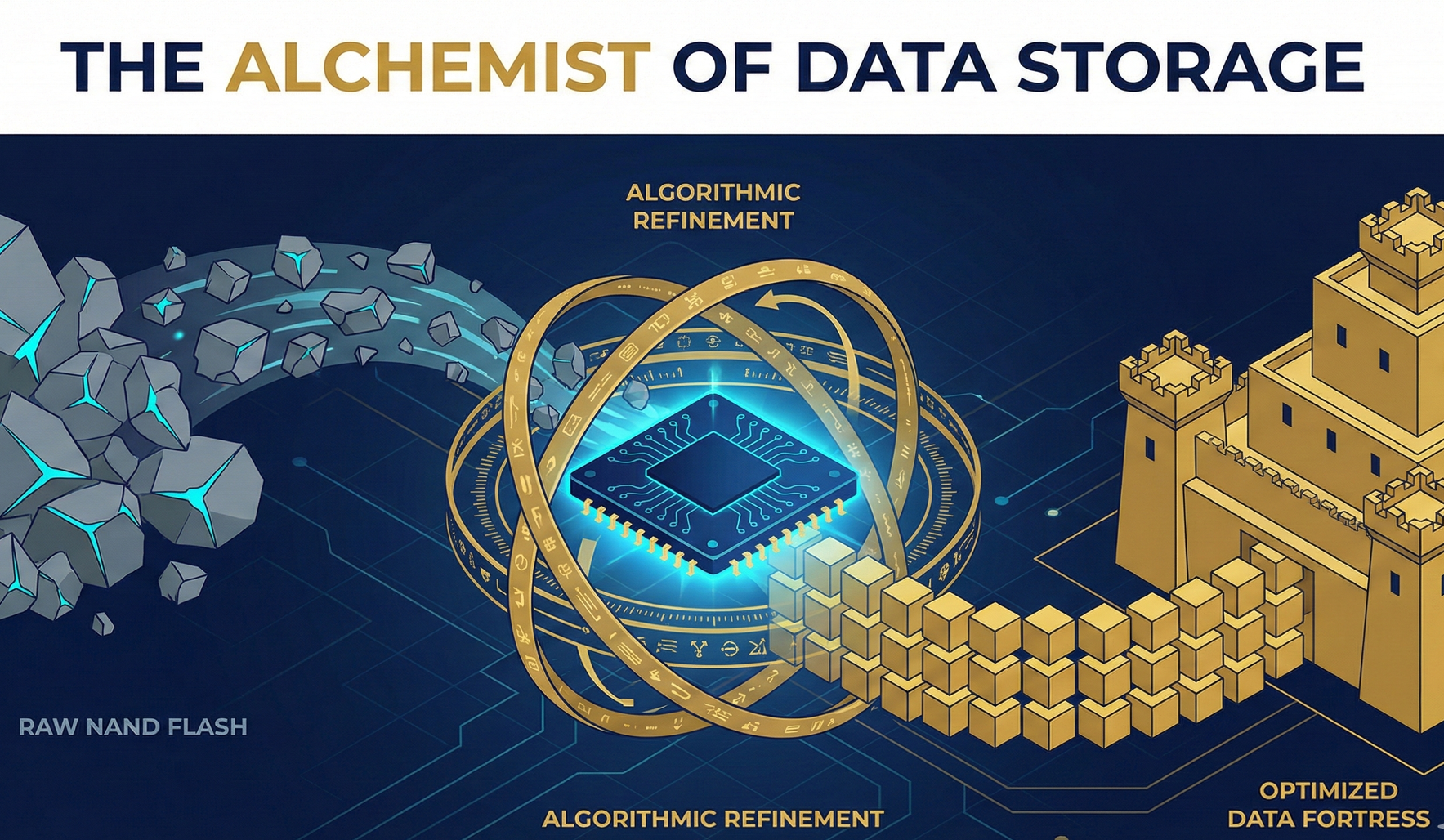
Foreword: The Alchemist Turning Sand into Gold (The Alchemist of Data)
In the periodic table of semiconductors, there is no material more temperamental than NAND Flash.
Although it is made of silicon (sand), just like a CPU, NAND Flash is inherently an "imperfect storage medium." If we liken storing data to "writing words in a book":
DRAM (Dynamic Random-Access Memory) is like a high-quality notebook; words written on it are clear, and erasing and rewriting is no problem, but the words disappear when the light is turned off (power is lost).
NAND Flash (Solid-State Drive), on the other hand, is like a piece of low-quality scrap paper.
Limited Lifespan: Erasing data (with an eraser) a few thousand times will cause the paper to tear (bad blocks).
Charge Leakage: If left untouched for too long, the ink will bleed on its own, and the words will become blurry (Data Retention Issue).
Interference Effect: Writing too hard on one page can even print through to the next page (Read/Write Disturb).
This is why, even though Samsung, SK Hynix, and Kioxia can manufacture 3D NAND with hundreds of layers, if these chips were used directly, the data stored on them would be corrupted within three days.
This is the value of Phison Electronics.
💡
Core Insight: Phison's value lies not in manufacturing memory, but in "taming" imperfect memory. It uses mathematical algorithms to combat physical limitations, transforming inexpensive, lower-grade Flash into high-performance storage solutions.
Phison's work is to design an exceptionally intelligent controller chip. It acts like a "library restorer." It understands every paper characteristic (physical defect) of this poor-quality book and, through powerful Error Correction Code (ECC), Wear Leveling, and Garbage Collection mechanisms, makes this flawed book read as stably, quickly, and durably as a hardcover encyclopedia.
Over the past 20 years, Phison has relied on this expertise to grow from a small company selling USB flash drives into the world's largest independent NAND Flash controller supplier. And in the AI era, as data volume explodes exponentially and GPU computing power becomes prohibitively expensive, Phison has once again unleashed its magic: it seeks to use inexpensive SSDs to simulate expensive DRAM, making AI training no longer solely a game for the wealthy.
This report will take you deep into Phison's "chameleon" business model, examining how it navigates between memory manufacturers and module makers, and how it has transformed from a consumer electronics player into a critical participant in AI infrastructure.
Chapter One: The Humble Beginnings and the Birth of USB (2000-2010)
In the tech industry, innovation comes in two forms: one is pushing manufacturing processes to their physical limits, like TSMC; the other is, like Phison, using a small chip to change the way humans carry data.
1.1 The Inventor of the Pen Drive
In 2000, five young graduates from National Chiao Tung University founded Phison Electronics in Hsinchu, Taiwan, near the agricultural surroundings of ITRI (Industrial Technology Research Institute). The leader was K.S. Pua, an overseas Chinese student from Malaysia.
At that time, data storage was still in the era of "floppy disks." Those 1.44MB magnetic disks, prone to moisture and mold, were a nightmare for all computer users. Although Flash Memory existed back then, transforming it into a portable product required complex circuit boards and card readers.
Phison achieved the first disruptive innovation in history: the world's first USB Flash Memory System on Chip (SoC). They integrated the USB interface, Flash Memory control interface, and microprocessor all onto a single chip.
Result: Significantly reduced in size, plug-and-play, no drivers required.
Product: The "Pen Drive".
This was a groundbreaking invention. It completely ended the floppy disk era and enabled Phison, a newly established small company, to turn a profit in its first year and achieve over NT$100 million in revenue in its second year.
🎯
Entrepreneurial DNA: Turning complex technology into simple products — this DNA has run through Phison's 20-year development trajectory.
1.2 The Unique "Chameleon" Business Model (The Hybrid Model)
However, inventing the pen drive did not allow Phison to rest on its laurels. Once the barrier was broken, competitors swarmed in. In the Flash Memory industry, IC design companies face a dilemma:
Pure Controller Design (e.g., Silicon Motion SMI): High gross margins but a low revenue ceiling, as you only sell components and cannot benefit from rising Flash prices.
Pure Module Manufacturing (e.g., ADATA): Large revenue but low gross margins (typically 3-4%). Furthermore, fate is in the hands of the original manufacturers (no chips during shortages, full of inventory during price drops).
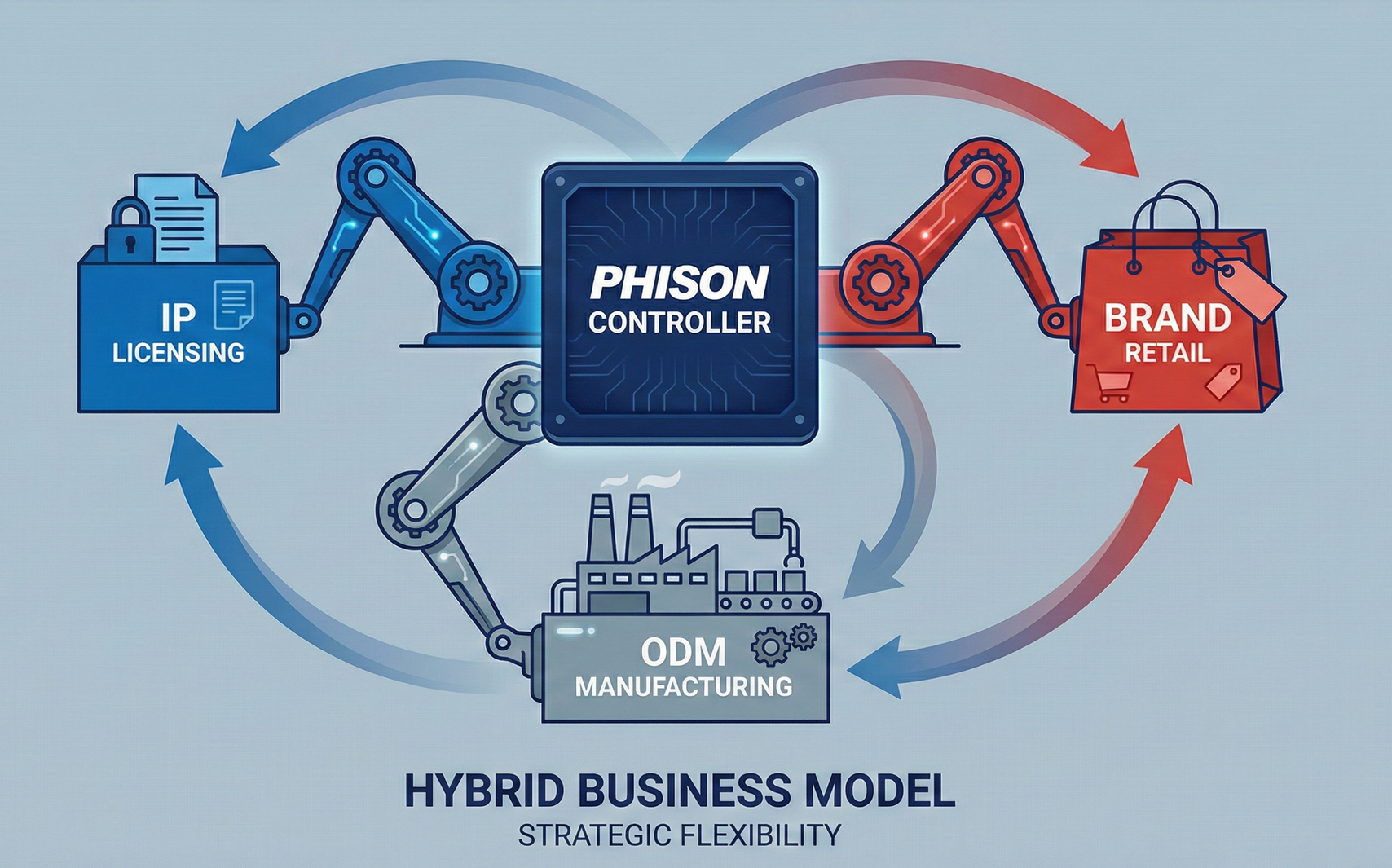
K.S. Pua chose an unconventional path: the Hybrid Model. This transformed Phison into a highly adaptable "chameleon."
Phison's Three Identities:
Identity A (IP Supplier): Selling controller chips to Kingston and Micron. Earning revenue from technology.
Identity B (ODM Manufacturer): Designing and producing complete SSDs for major brands, sold under their labels. Earning revenue from manufacturing.
Identity C (Brand Owner): Selling its own "Silicon Power" or industrial SSDs in emerging markets or e-commerce channels. Earning revenue from distribution.
Strategic Advantage: This model provides Phison with extremely high flexibility.
When Flash is in short supply, Phison's ODM business (helping major brands consume Flash) encourages original manufacturers to prioritize supplying Phison.
When Flash prices collapse, Phison can quickly convert inventory into finished products and distribute them through its extensive white-label channels.
1.3 The Iron Triangle Alliance: Toshiba and Kingston
Phison's survival to this day is even more critically due to K.S. Pua's "resource integration skills." He deeply understood that in the memory business, a lack of supply is a dead end.
He successfully persuaded two giants to become Phison shareholders:
Upstream Rich Parent: Toshiba (now Kioxia)
Significance: Toshiba is the inventor of NAND Flash. With Toshiba's investment, Phison gained a stable "granary." No matter how severe market shortages were, Phison always had chips available.
Downstream Rich Parent: Kingston
Significance: Kingston is the world's largest memory module manufacturer. With Kingston's investment, Phison gained a massive "outlet." The chips designed by Phison were directly installed in Kingston's SSDs and sold worldwide.
This "technology (Phison) + raw material (Toshiba) + channel (Kingston)" iron triangle built Phison's strongest moat in its early days. This also enabled Phison to stand firm in every memory market downturn and elimination race.
Chapter Two: NAND Controller — The Data Librarian's Restoration Art
NAND Flash is a "semiconductor with amnesia." Its physical nature is to forget and to degrade. Phison's value lies in using mathematical algorithms to combat physical laws, building a perfect data castle on imperfect sand.
If DRAM is a precise Swiss watch, then raw NAND Flash is like rough scrap paper. As semiconductor processes moved from 2D planar to 3D stacking, and even into the QLC (4 bits per cell) era, this "scrap paper" has become thinner and more prone to damage.
Without Phison's controller chip, modern 3D NAND would be unusable; stored data would turn into gibberish within minutes. Phison's role is that of a "librarian" with god-tier restoration abilities.
This post is for subscribers only
Sign up now to read the post and get access to the full library of posts for subscribers only.