Foreword: The Most Expensive Single Tool in Industrial History
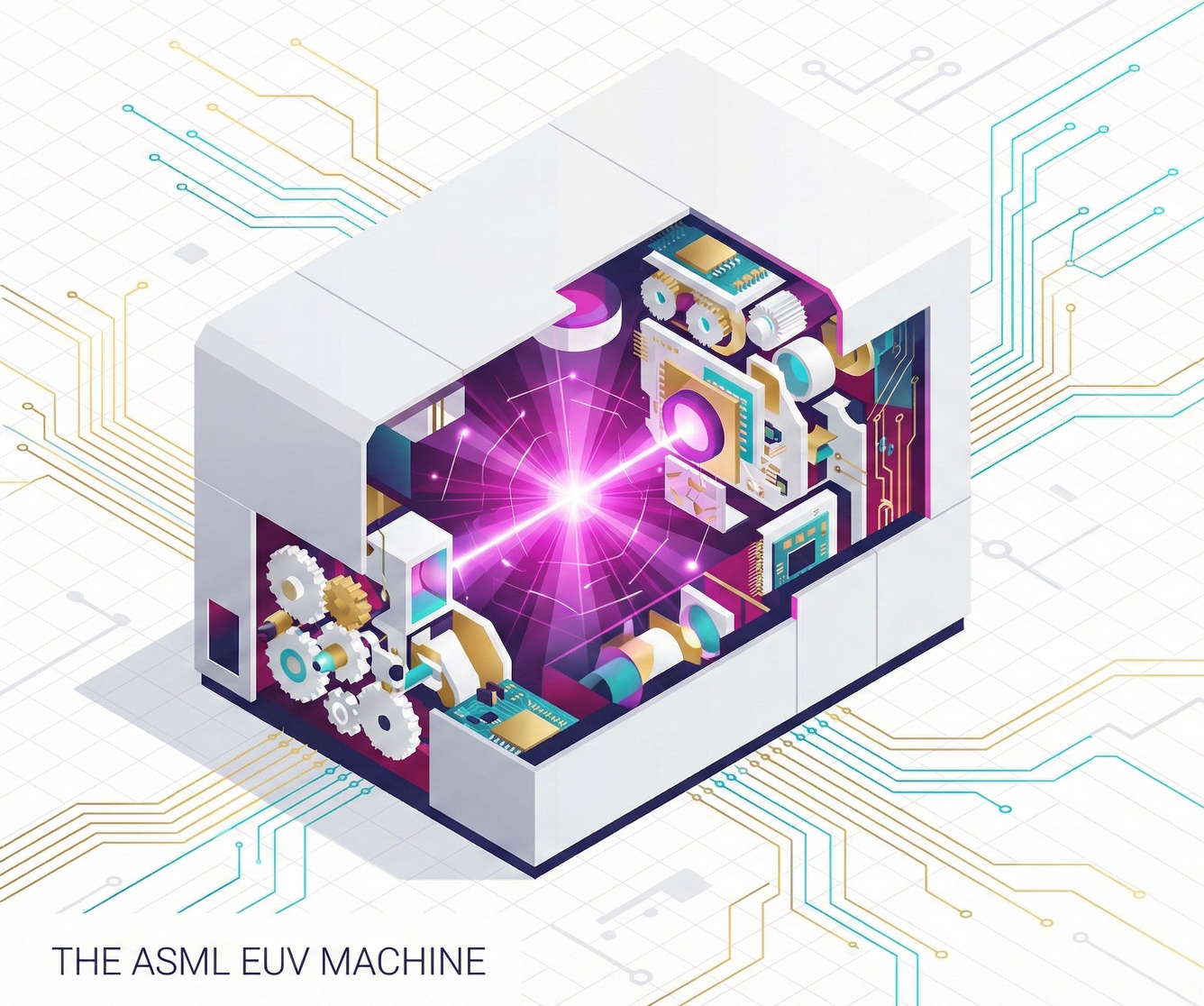
In the history of human industrial civilization, no mass-produced equipment has ever so perfectly merged the seemingly contradictory terms "precision" and "gigantic" as the EUV (Extreme Ultraviolet) lithography machine.
Imagine a monster like this:
- Weight: 180 tons. Equivalent to the weight of 30 adult African elephants, or a fully loaded Boeing 747.
- Complexity: It houses 100,000 high-precision components, with over 2 kilometers of cables.
- Price Tag: Starting from $150 million (approximately NT$4.8 billion). This amount is enough to buy several F-35 fighter jets.
- Status: It is the "Holy Grail" of the global semiconductor industry and its sole "bottleneck." On this planet, only the Netherlands' ASML can manufacture it.
The purpose of this behemoth is singular: to generate and control extreme ultraviolet (EUV) light with a wavelength of just 13.5 nanometers.
This light is the only elixir for extending Moore's Law. For advanced processes below 7 nanometers, traditional light sources are like trying to draw the Along the River During the Qingming Festival scroll with a thick marker—it's simply impossible. Only 13.5 nm EUV, like an ultra-fine needle pen, can engrave tens of billions of transistors onto a chip.
However, this light is also a physicist's nightmare. It is extremely delicate, instantly absorbed by everything in its path—including air, glass, and even gases. To harness this light, humanity is forced to challenge the limits of physics, enacting a brutal aesthetic.
🔦 Chapter 1: Light Source —— The Pinnacle of Brutal Aesthetics
Core Technology: LPP (Laser Produced Plasma)
Key Suppliers: Trumpf (Germany/laser), Cymer (US/light source, acquired by ASML)
Many people mistakenly believe that the "light" in a lithography machine is "shone" like a desk lamp.
That is entirely wrong. EUV light is "blasted" out with a laser cannon.
This isn't illumination; it's a miniature nuclear explosion occurring 50,000 times per second.
1. The Dance of Tin (The Dance of Tin)
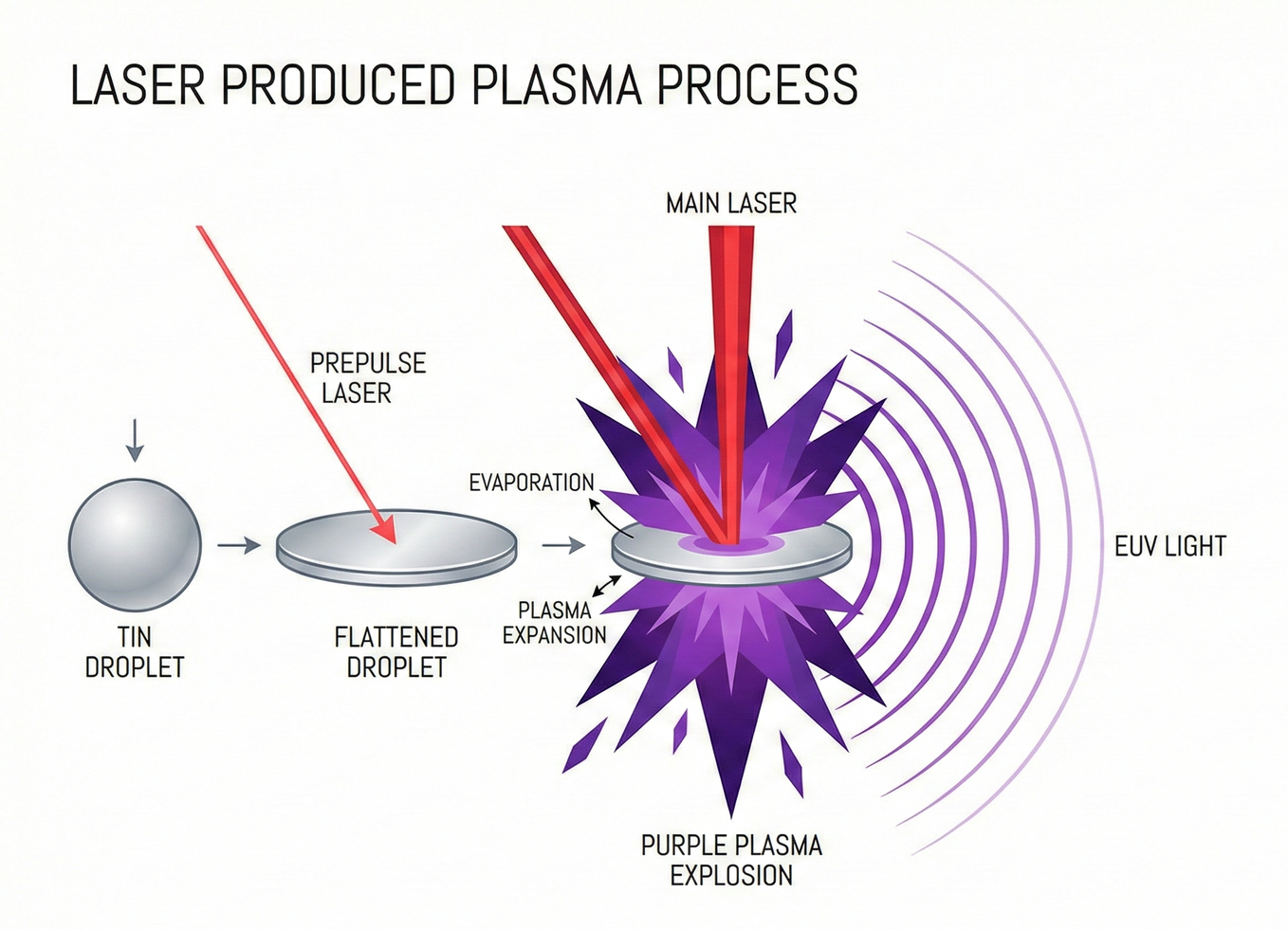
Scientists discovered that when metallic tin (Sn) is heated to hundreds of thousands of degrees into a "plasma state," it emits precious 13.5nm light waves. To obtain this light, ASML designed an incredibly intricate process. Let's slow down the flow of time by ten thousand times to witness this "dance of death":
Step One: The Drop (The Drop)
At the top of the vacuum chamber, a generator releases 50,000 liquid tin droplets downwards every second at an astonishing frequency.
These tin droplets are only 30 micrometers in diameter (thinner than a strand of hair). They fall at high speed like a precise metallic rain.
Step Two: Shaping (Pre-pulse) —— Making Pancakes
The moment the tin droplet reaches the target, a first "low-power laser" manufactured by Germany's Trumpf precisely strikes it.
The purpose of this shot is not to destroy it, but to "shape" it.
- Layman's Analogy: It's like a chef making pancakes. The originally spherical tin droplet is gently struck and instantly flattens into a disc-shaped "tin pancake."
- Physical Purpose: By becoming disc-shaped, its surface area increases, allowing it to absorb more energy when the main laser strikes later.
Step Three: Bombardment (Main-pulse) —— Vanished in Smoke and Dust
Just a few microseconds (millionths of a second) later, before the tin droplet has a chance to regain its shape, a second "high-power CO2 laser" immediately blasts it.
This time, the strike is devastating.
The tin droplet is instantly vaporized, its temperature skyrocketing to 220,000 degrees Celsius (40 times hotter than the sun's surface temperature). In this extreme state, tin atoms disintegrate into the fourth state of matter—plasma—and just before perishing, erupt into that precious 13.5nm blue-purple light.
2. Technical Difficulty: Sharpshooter in a Hurricane
You might think that sounds manageable? Look at the data again:
This "launch $\rightarrow$ shape $\rightarrow$ bombard" process must be repeated 50,000 times every second.
What concept is this equivalent to?
ASML engineers once described it this way:
"It's like being in a hurricane, holding a handgun, and hitting a high-speed flying housefly twice in quick succession. And you have to hit it 50,000 times a second, without missing the target."
- Just one mistake: The light intensity will fluctuate unstably, leading to uneven exposure.
- Cost: Hundreds of Apple A17 or NVIDIA H100 chips on that wafer could be rendered useless, resulting in tens of thousands of dollars in losses.
This is why ASML had to acquire light source manufacturer Cymer and deeply integrate with German laser giant Trumpf. Because there is only one company in the world capable of producing this "machine-gun-style laser cannon," and no other branches.
🪞 Chapter 2: Optics —— Zeiss's Serenity and the Cost of Reflection
Core Technology: Bragg Reflector
Key Suppliers: Carl Zeiss (Germany/lenses), Lasertec (Japan/inspection)
After the laser cannon in Chapter 1 blasted out that precious 13.5 nanometer EUV light, we immediately hit physics' second high wall: this light cannot penetrate glass.
In traditional cameras or lithography machines, we are accustomed to using lenses to refract light. But in the world of EUV, all glass lenses would act like brick walls, instantly absorbing all the light.
Therefore, ASML had only one path: abandon lenses and use mirrors for reflection instead.
These are no ordinary mirrors; this is the most expensive maze ever constructed by humans.
1. The Pinnacle of German Engineering: Zeiss's "Absolute Flatness"
This mirror system is exclusively crafted by the century-old German optical giant Carl Zeiss. They are deeply buried within the core of the lithography machine, the quietest yet most critical components of this apparatus.
To ensure light reflects precisely without scattering, the flatness requirements for the mirror surface reach an "anti-intuitive" level.
- Layman's Analogy: "Germany-Sized Mirror" Zeiss engineers describe their craft standard this way: "If this EUV mirror were magnified to the size of the entire German landmass (approximately 350,000 square kilometers), then from Hamburg in the north to Munich in the south, the difference between the highest mountain peaks and the deepest valleys on the surface could not exceed 1 millimeter."
This is why ASML cannot do without Zeiss. This atomic-level polishing technology is the crystallization of centuries of German manufacturing soul, and a moat that other countries find difficult to surmount.
2. The Death Journey of Light: The Cruel $0.7^{12}$
Even with Germany's miraculous mirrors, we still face physics' "tax."
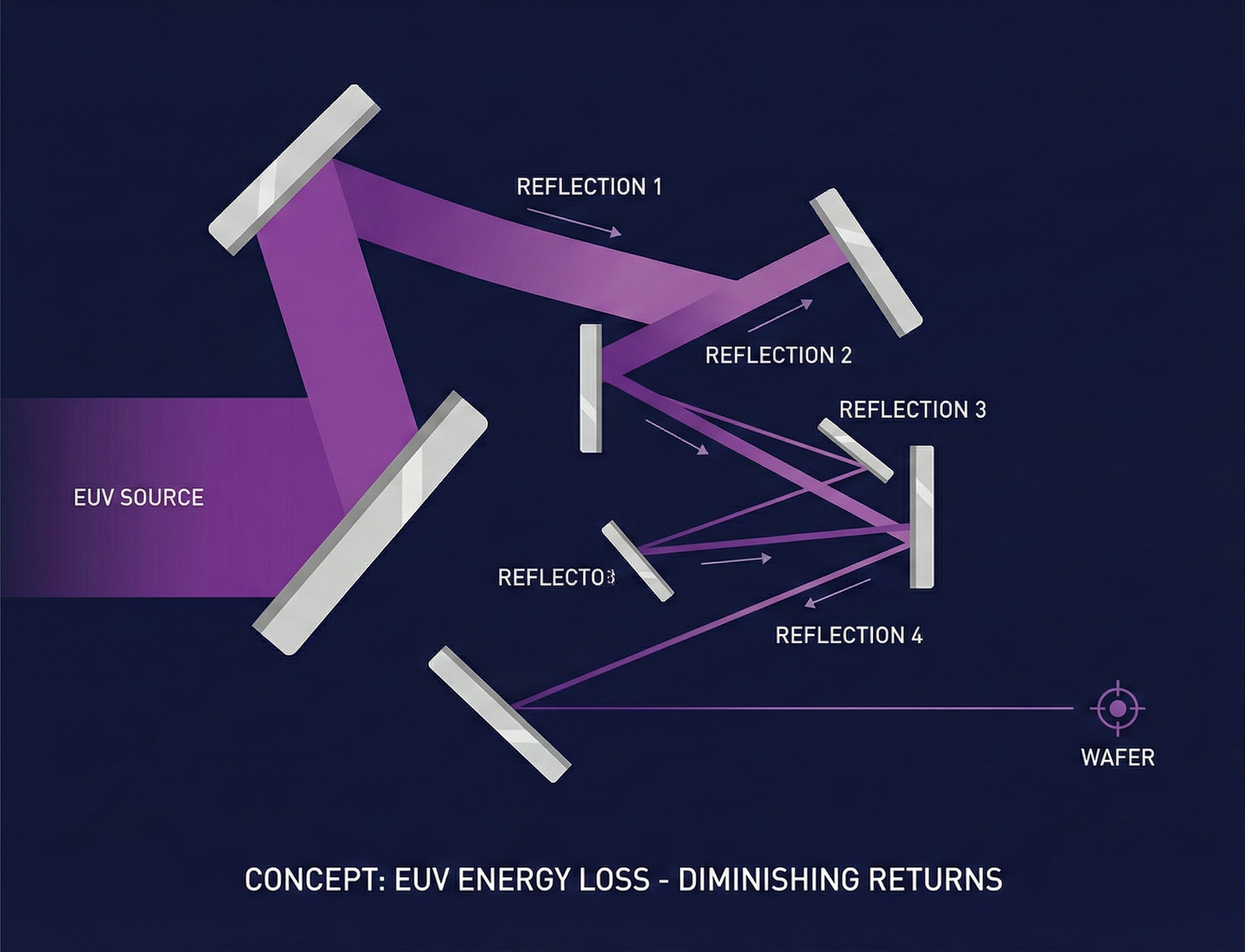
Ordinary mirrors rely on silver or aluminum for reflection, but these are ineffective for EUV. Zeiss must coat the mirror surface with 40 to 50 pairs of Molybdenum/Silicon (Mo/Si) thin films, forming what is known as a "Bragg reflector." Even when pushed to its limits, the theoretical maximum reflectivity of a single mirror is only 70%.
This means that with each reflection, 30% of the light energy is "consumed."
A Cruel Math Problem:
To guide, shape, and project the light onto the wafer, the EUV beam must undergo 10 to 12 consecutive reflections from mirrors.
Let's do the math:
$$0.7 \times 0.7 \times 0.7 ... \text{ (12 times)} \approx 0.7^{12} \approx 0.013$$
Conclusion:
This is a death march for light.
The light we blasted out in Chapter 1 with a laser cannon, consuming enormous power, after traversing this reflective maze, less than 2% of it actually reaches the wafer.
This is why EUV machines are so power-intensive (one factory might even need a dedicated power plant), because 98% of the energy disappears along the way. This is the expensive price humanity must pay to extend Moore's Law.
3. Invisible Kingpin Appears: Lasertec (6920.JP) 🌟
If ASML is selling shovels in a gold rush, then Japan's Lasertec is the tax collector standing at the mouth of the mine.
Role: The EUV photomask validation machine.
In the lithography process, the photomask (Mask) is like a negative. One EUV photomask costs as much as $1 million.
- Pain Point: If this million-dollar photomask has even a single speck of dust (even just a few nanometers in size), when projected, hundreds of millions of transistors on thousands of wafers will be completely rendered useless. The loss isn't just the cost of one photomask; it's hundreds of millions of New Taiwan dollars in product revenue.
Technical Moat: Actinic Inspection
In previous processes, optical microscopes were sufficient to inspect photomasks. But in the EUV generation, defects are so small that even electron microscopes struggle to determine "whether it will be printed."
Lasertec made a radical decision: "Since you use EUV to print chips, I will invent a machine that uses EUV light to inspect photomasks!"
This machine can simulate the environment of a lithography machine, precisely identifying those nanometer-sized defects that "will cause problems."
Investment Logic: 100% Absolute Monopoly
- Market Share: 100%. You read that right, a global sole proprietorship.
- Mandatory Binding: Regardless of whether it's TSMC, Samsung, or Intel, if you buy an ASML EUV lithography machine, you "must" also purchase Lasertec's inspection equipment; otherwise, you wouldn't dare to use your photomasks.
This transformed Lasertec from an obscure Japanese instrument manufacturer into a legendary "stock king" of the Japanese semiconductor sector, with its stock price soaring dozens of times within a few years. It is the invisible champion in this supply chain with the highest pricing power and most lucrative profits.
📦 Chapter 3: Logistics —— The Bulletproof Armored Car
Core Technology: EUV Pod (Extreme Ultraviolet Photomask Carrier)
Key Supplier: Gudeng Precision (3680.TW)
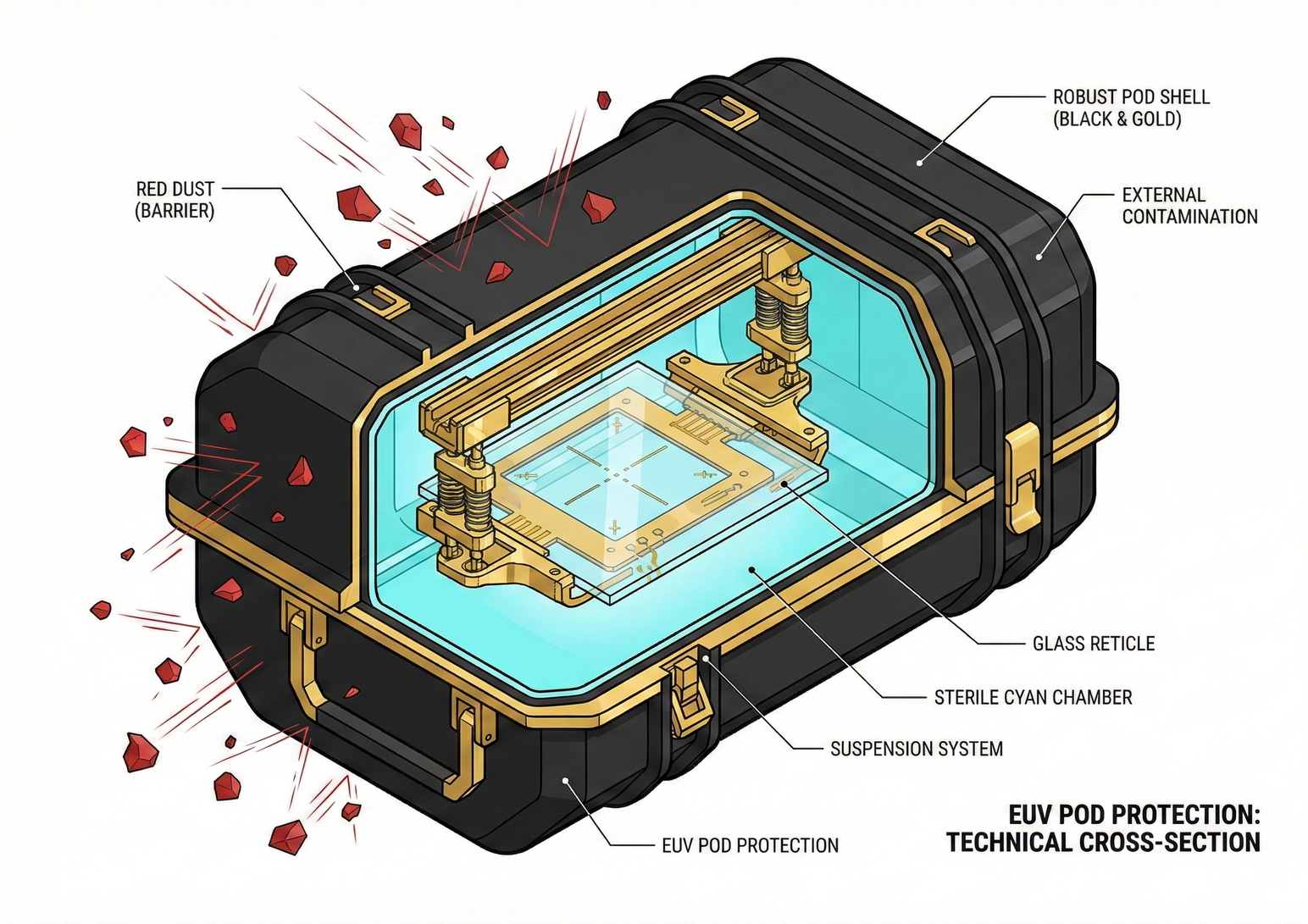
As mentioned in the previous chapter, an EUV photomask is worth $1 million. It is both incredibly expensive and incredibly fragile.
When moving at high speed on the automated tracks of a fab, it absolutely cannot come into contact with any speck of dust, nor can it experience any excess vibration. If the photomask is damaged during transport, it represents a disaster worth hundreds of millions of New Taiwan dollars.
Who is responsible for transporting this "jewel in the crown"?
1. Taiwan's Legend: Gudeng Precision (Gudeng) 🌟
In this world-leading supply chain, in addition to TSMC, there is another name from Taiwan that cannot be overlooked—Gudeng.
Role: The "bulletproof armored car" for EUV photomasks.
Many people see this product and might assume it's just a plastic box. This is entirely wrong.
Technical Content: It is a sealed, miniature environment filled with nitrogen, absolutely anti-static, and extremely clean.
- Material Challenge: ASML's certification for this box is almost pathologically strict. Why? Because the EUV environment is a vacuum. If the material of the box itself outgasses in a vacuum, or if a single, microscopic flake of paint falls off, the entire NT$4.8 billion machine will be contaminated.
Monopoly Status: Taiwan's Pride
Only two companies globally have passed ASML's hellish certification: one is the American giant Entegris, and the other is Taiwan-native Gudeng.
- Market Share: In TSMC's advanced processes, Gudeng holds a market share as high as 80-90%. This means that almost every time TSMC produces an Apple or NVIDIA chip, its photomask is transported in a Gudeng carrier.
Investment Logic:
This is a perfect "consumables" business.
As TSMC's 3nm and 2nm production capacity expands, the frequency of photomask use increases, requiring these expensive carrier boxes to be constantly replaced and cleaned. This is not a one-time equipment sale, but a continuous stream of cash flow.
🌍 Chapter 4: System Integration —— Why Can't China Build It?
Having discussed this, a common question arises: Since we understand the principles of "tin droplets," "mirrors," and "boxes," why, with all the collective effort in China, has it still not been able to produce an EUV lithography machine?
The answer lies in the fact that ASML's success is not merely the success of one nation, the Netherlands, but the culmination of Western industrial civilization.
1. The Power of Open Innovation
ASML realized early on that no single company could build such a miraculous device. So, it adopted an "architect" strategy:
- It does not produce all components: Only 15% of the core components are self-manufactured; the other 85% come from the world's top suppliers (German Zeiss for lenses, American Cymer for light sources).
- Shared interests: It even allowed clients (TSMC, Samsung, Intel) to take equity stakes, tying everyone's fate to the same boat. This is not a simple buyer-seller relationship, but "co-development."
2. China's Predicament: It's a Symphony of 100,000 Components
Can China build a laser? Yes, it can.
Can China build a high-reflectivity mirror? Yes, it can.
But the difficulty of a lithography machine lies not in "single-point breakthroughs" but in "system integration."
- Challenge: An EUV machine has 100,000 high-precision components.
- Collaboration: These components must operate synchronously in an ultra-high vacuum environment, with nanometer-level precision, at a laser bombardment frequency of 50,000 times per second.
- Durability: This extreme operation must be maintained for 20 years without failure, or capable of immediate repair if it does fail.
This requires decades of accumulated data (Know-how), countless failures, and adjustments. This cannot be learned by "reverse engineering" and disassembling a machine; it's like taking apart a Ferrari – you still couldn't assemble an F1-winning race car in your garage.
📊 Strategic Summary: EUV Investment Map
This table is the essence of this article series, integrating technical moats with investment targets. This is not merely a supply chain; it is the "power list" of the global tech industry:
| Role | Company Name | Stock Ticker | Core Technology | Moat and Status |
|---|---|---|---|---|
| The Sole King | ASML | ASML (US/EU) | System Integration | Infinite. The lifeline of global semiconductors, no substitute. As long as Moore's Law exists, it is god. |
| Mask Inspection | Lasertec | 6920 (JP) | Actinic Inspection | 100% Monopoly. The only validation machine for EUV photomasks, an invisible champion with extremely strong profitability. |
| Mask Protection | Gudeng | 3680 (TW) | EUV Pod | TSMC's exclusive supplier. High market share, a consumables stock growing with advanced process capacity expansion. |
| Optical Lenses | Carl Zeiss | (Unlisted) | Mirror System | German Engineering. ASML's soulmate, owner of atomic-level polishing technology. |
| Mask Substrate | HOYA | 7741 (JP) | Mask Blanks | Extremely High. One of only two global manufacturers capable of producing perfectly flawless EUV glass substrates. |
Conclusion
ASML's standard EUV (0.33 NA) is already a miracle of human physics.
But that's not enough.
Even as we speak, Intel, in its bid to overtake TSMC at the 2nm process node, is pushing ASML to build an even larger, more expensive, and more precise monster—High-NA EUV.
That will be the next new chapter in the interplay of physics and business. But no matter who wins, the companies on this list will be the arms dealers of that war.
In-depth Research · Quantitative Perspective
Want more quantitative semiconductor research insights?
【Insight Subscription Plan】Break Free from Retail Investor Mentality: Build Your Alpha Trading System with "Quantitative Chips" and "Consensus Data"EDGE Semiconductor Research
📍 Series Map — Navigate the Complete EDGE Semiconductor Research →


