🧪
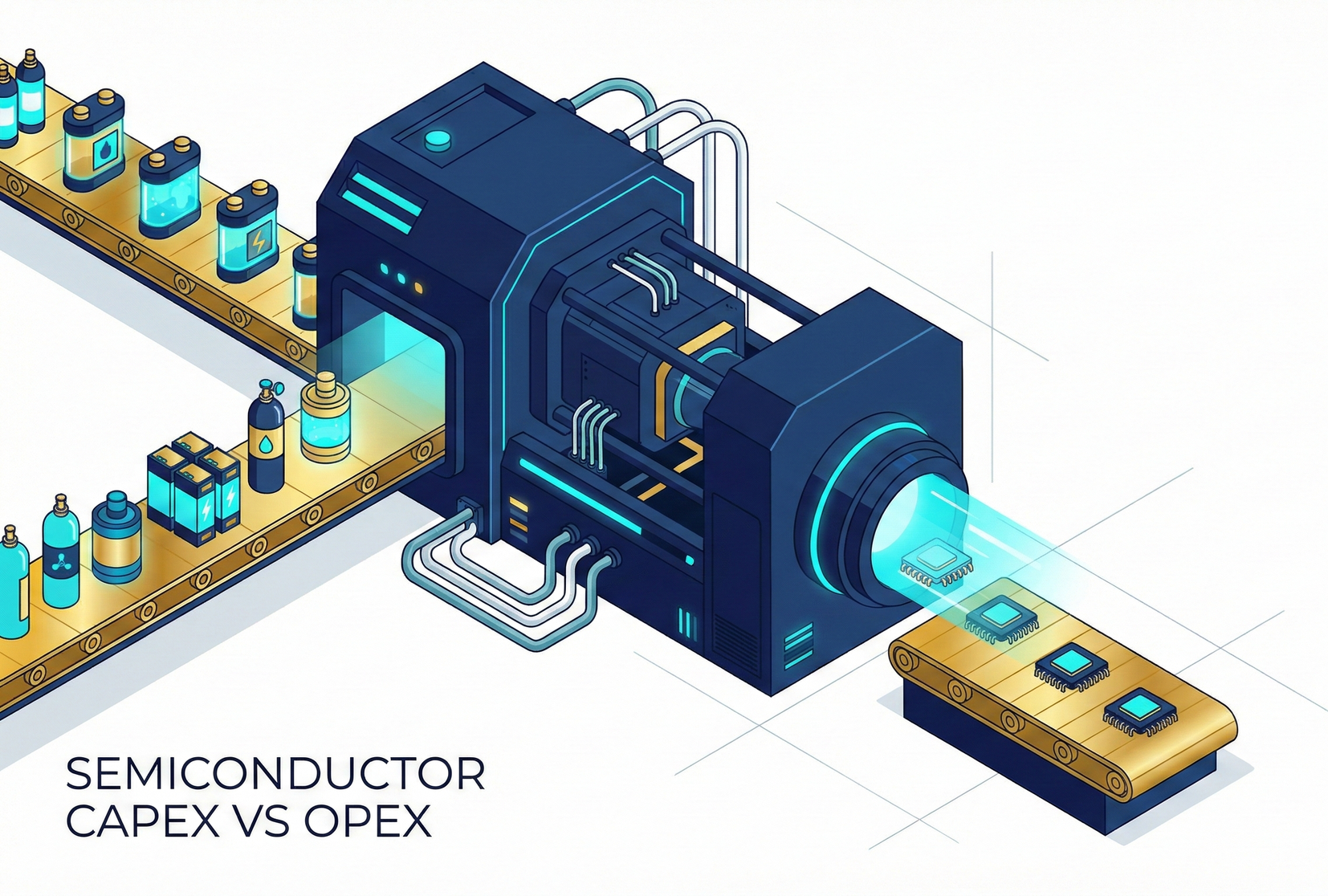
In a nutshell: Equipment are 'weapons' (Capex), and materials are 'ammunition' (Opex). Materials have long certification cycles and high stickiness, making them the battleground where 'compounding cash flow' hidden champions are most likely to emerge within TSMC's supply chain.
📝 Preamble: Soft Power vs. Hard Power — When 'Weapons' Meet 'Ammunition'
In the logic of capital markets, the semiconductor industry supply chain is often broadly divided into two major camps: Equipment and Materials.
- If ASML lithography machines and Applied Materials' etchers are the 'heavy weaponry' in this war,
- then JSR's photoresists and Linde's specialty gases are the continuous supply of 'precision ammunition'.
1) Fundamental Differences in Business Models: Capex vs. Opex
Equipment stocks (ASML, AMAT) profit from 'Capital Expenditure (Capex)':
- Lump-sum, high-value transactions
- Revenue surges during capacity expansion
- Orders freeze when Capex is cut, highly cyclical
Material stocks (JSR, Shin-Etsu, Linde) profit from 'Operating Expenditure (Opex)':
- Continuous consumption
- As long as production lines are running, photoresists need to be applied, developers need to be used, and gases need to be supplied.
🛡️
Investment Moat: Long material certification cycle (typically 1–2 years)
Once a material is qualified, wafer fabs typically do not switch suppliers unless a major disaster occurs, leading to more stable cash flow and higher stickiness.
2) Full Mobilization of the Periodic Table
- 1980s: Processes used only about 10 elements (mainly silicon, aluminum, oxygen)
- 2024 2nm generation: Mobilizing over 50 elements
- From fluorine (F) to hafnium (Hf)
- From xenon (Xe) to ruthenium (Ru)
Each element introduced marks the rise of a company and the start of a patent war.
This article organizes the chemical material supply chain into five special forces units, beginning with a review of the most critical: the 'Lithography Royal Guard' and the 'Gas Air Force'.