
Foreword: The Extreme Tug-of-War Between Performance and Efficiency
Sir, in the HBM battlefield of the previous chapter, we witnessed a group of 'performance monsters' that would stop at nothing to achieve their goals. For the ultimate bandwidth, HBM spares no expense, disregards thickness, and even requires liquid cooling systems to suppress its terrifying heat generation.
This is feasible for cloud AI servers, which often cost millions to build. But what if the scenario shifts to the smartphone in our pocket, or the thin and light laptop in our briefcase (Edge Devices)?
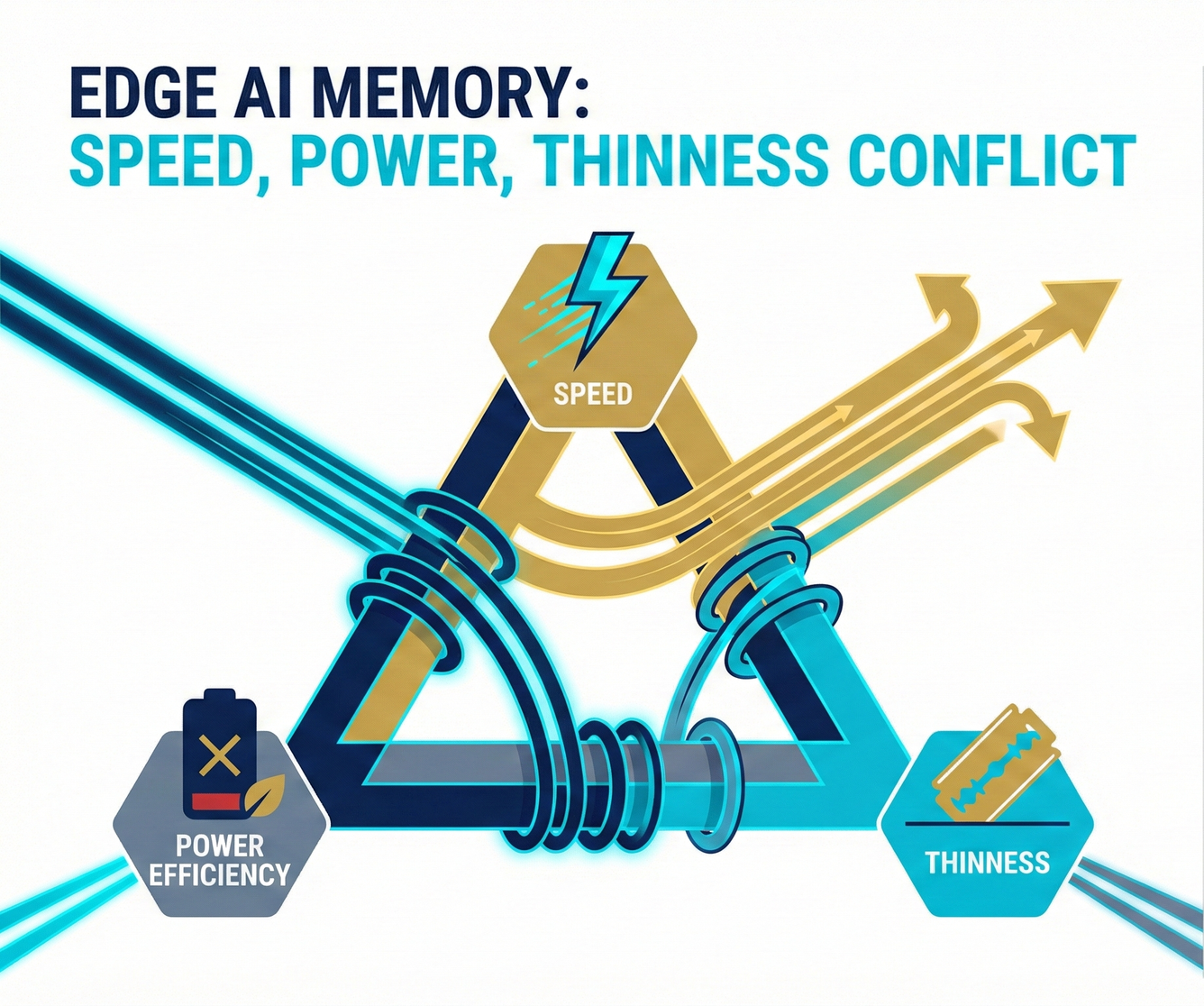
For edge devices, our demands on memory have reached an extremely stringent, even contradictory, 'impossible triangle':
- Speed: The NPU (Neural Processing Unit) in smartphones needs to process tens of GBs of data per second to generate AI images.
- Power Efficiency: We absolutely cannot let the user's battery drain and overheat within an hour.
- Thinness: Laptop and smartphone industrial designs are increasingly pushed to be thinner and thinner.
Traditional standard memory (such as DDR used in desktop PCs) simply cannot meet these three requirements. To strike a balance between these conflicting demands, the memory industry has branched into two special forces: LPDDR and LPCAMM2, which is poised to disrupt the laptop market.
📱 Chapter 1: LPDDR5X —— The Special Force Soldered onto the Motherboard
Full Name: Low Power Double Data Rate 5X
Main Battlefield: High-end AI smartphones (iPhone 16 Pro, flagship Android), thin and light laptops (MacBook Air/Pro)
LPDDR5X is currently the absolute mainstream for Edge AI. In pursuit of ultimate power efficiency and speed, it has paid a heavy price: loss of freedom.
1. The Physical Cost of Being Soldered onto the Motherboard
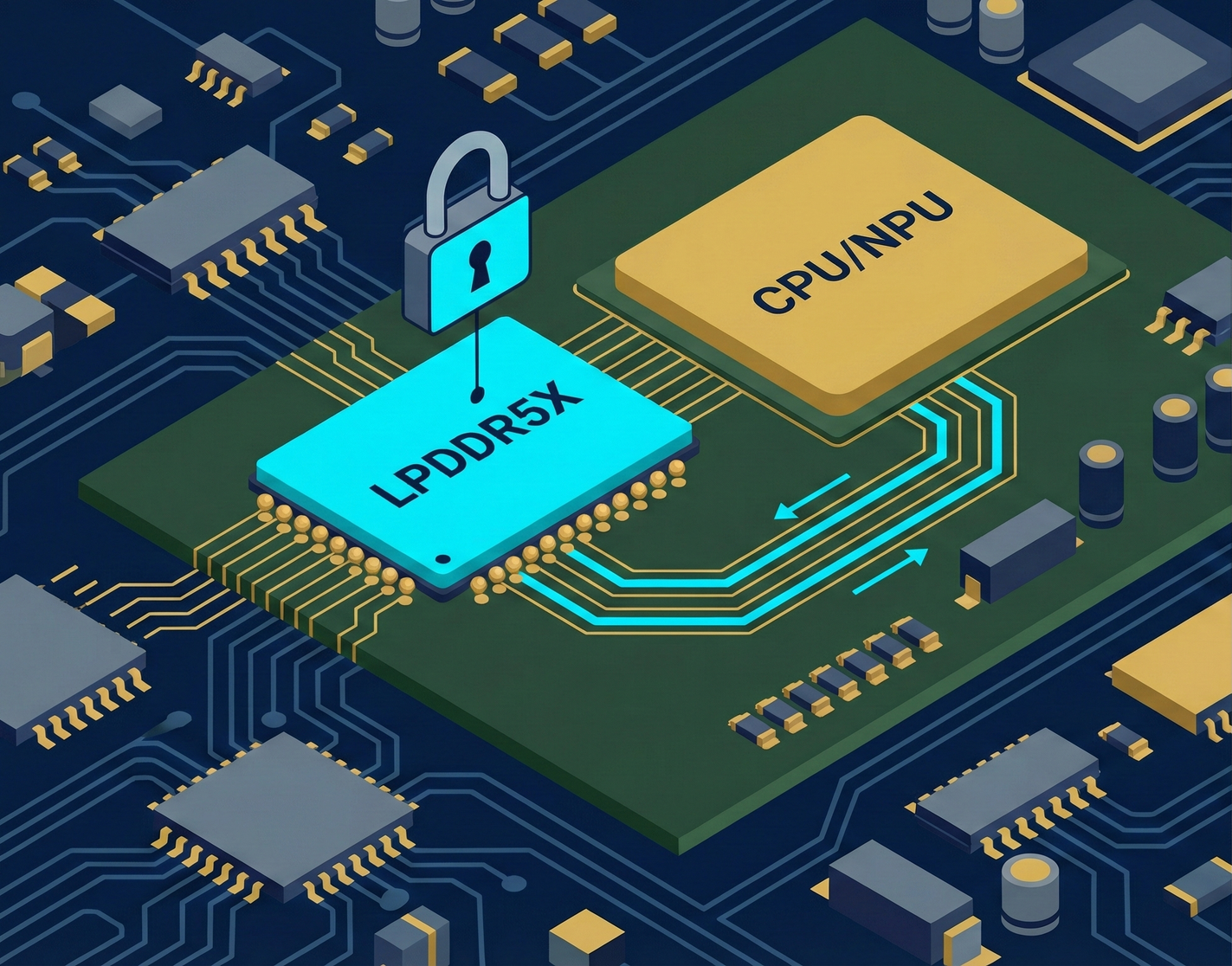
- Characteristic: If you look for a memory slot in a MacBook Air, you will find none. This is because LPDDR chips are directly 'soldered down' onto the motherboard, or even packaged together with the CPU on the same substrate (Package-on-Package, PoP).
- Physical Reality: For Signal Integrity. When data transmission speeds skyrocket to 8533 Mbps and even approach 9600 Mbps, any tiny physical gap in a metal contact point will lead to fatal signal attenuation and noise. Soldering memory as close as possible to the CPU ensures the 'shortest path and lowest resistance,' allowing speeds to reach their maximum potential while being extremely power-efficient.
- Consumer Cost: Uncompromising Class Stratification. If you chose 8GB when buying a MacBook Air to save money, that computer will be 8GB for its entire life. This is the hardware cost consumers must bear in pursuit of ultimate thinness, lightness, and speed.
2. The Cruel Ticket to AI Smartphones
By the end of 2024, generative AI officially landed on smartphones (e.g., Google Gemini Nano or Apple Intelligence).
- Surging Capacity Thresholds: To smoothly run an LLM with billions of parameters locally on a smartphone, 8GB is already the breathless limit. 12GB is the basic threshold for the Android camp, while 16GB is the comfortable zone for smooth operation.
- Bandwidth Thirst: Qualcomm Snapdragon 8 Elite and MediaTek Dimensity 9400, the two major new-generation flagship SoCs, are both aggressively supporting the highest specifications of LPDDR5X. This is because they deeply understand the principle mentioned in 3-0: **no matter how powerful the NPU's computing capability, if the LPDDR cannot feed data fast enough, it's all in vain.**
💻 Chapter 2: LPCAMM2 —— The Biggest Revolution in Laptop Memory in 20 Years 🌟
Sir, what follows is a multi-billion dollar hardware specification reshuffle.
For the past 20 years, if we wanted to upgrade memory in a Windows laptop, the standard procedure was to buy a long SO-DIMM stick and plug it into a slot. However, in the era of AI PCs and DDR5, the veteran SO-DIMM has officially been sentenced to death.
1. Why Must SO-DIMM Die?
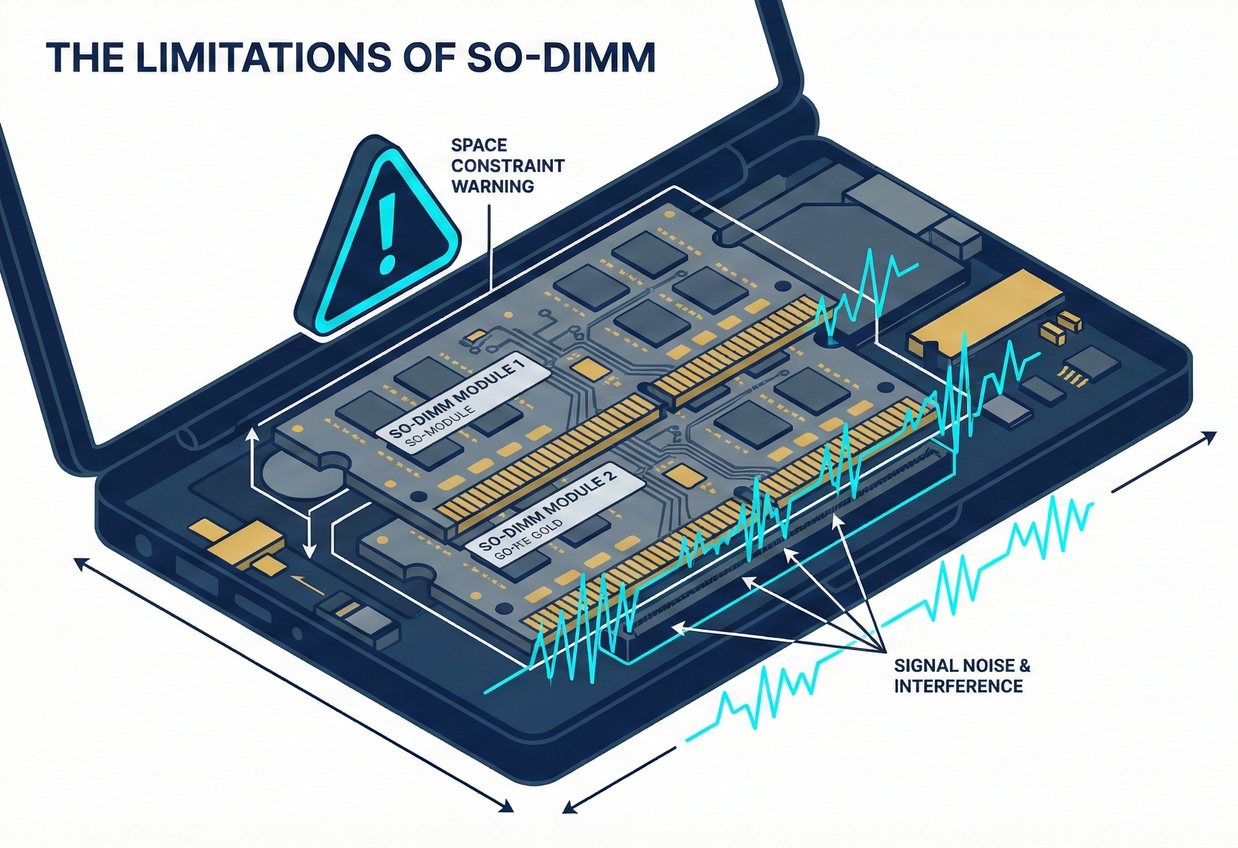
- Hitting Physical Limits: The long row of 'gold fingers (contact points)' at the bottom of SO-DIMM has too long a path. When memory speeds exceed 6400 Mbps (DDR5 specification), high-frequency signals on that long slot generate severe electromagnetic noise and interference.
- The Original Sin of Thickness: Traditional laptops, for dual-channel performance, had to stack two SO-DIMMs on top of each other. This occupied a significant amount of vertical space inside the laptop, an intolerable waste of space in modern thin and light AI laptops where every millimeter of thickness is critical.
2. The Savior Arrives: LPCAMM2
Full name: Low Power Compression Attached Memory Module. It was initially developed by Dell, and due to its excellent design, it was later adopted directly by JEDEC (Joint Electron Device Engineering Council) as a global industrial standard.
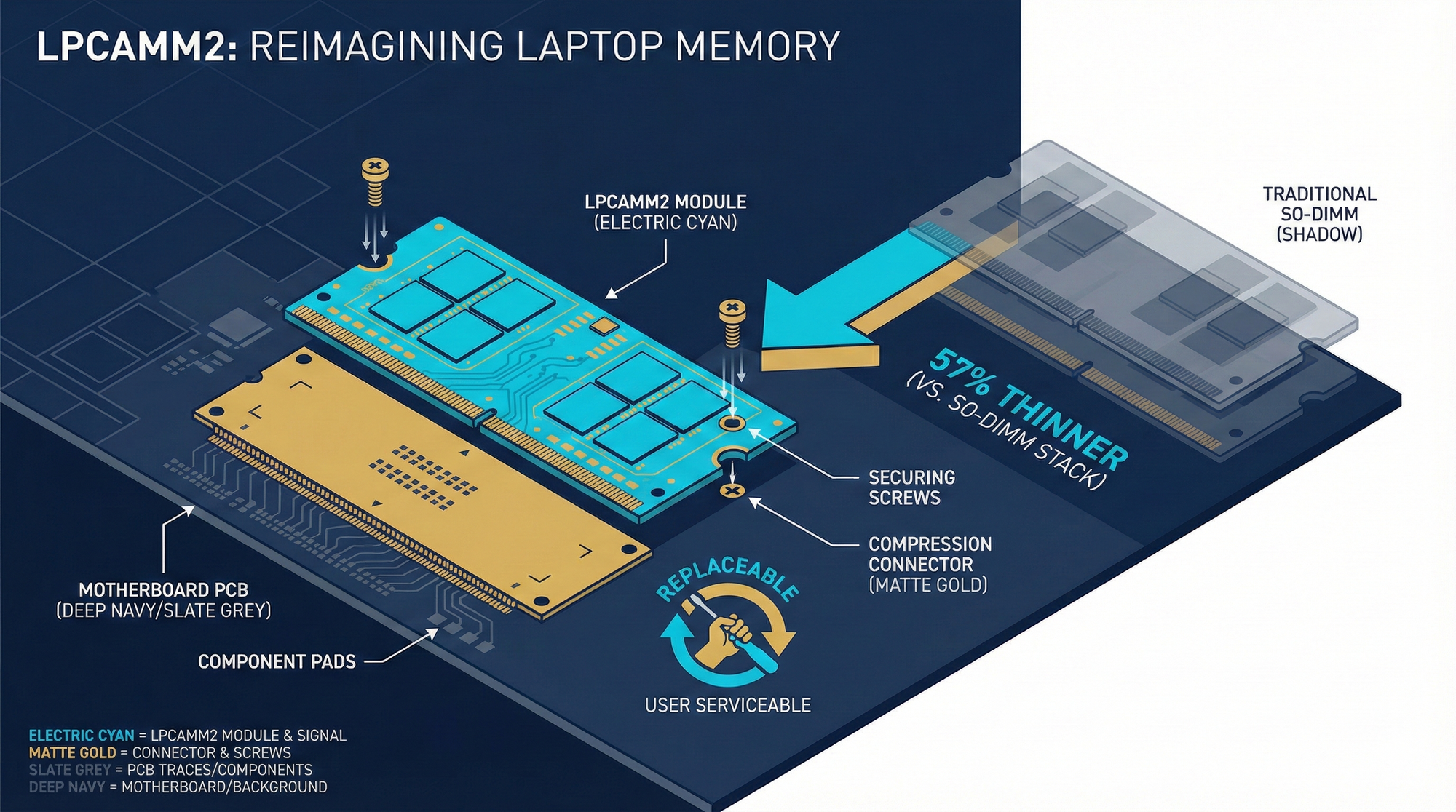
It performed a perfect hardware magic trick: transforming LPDDR chips, which previously had to be 'soldered down,' into a 'thin board that can be screwed on.'
- Revolutionary Structure: Instead of 'inserting' it sideways into a deep slot, it lays flat on the motherboard, like a building block, and is 'pressed down' onto a specialized connector (Compression Connector) with screws.
- Unbeatable Advantages:
- Extremely Thin: Compared to two traditional SO-DIMMs stacked, LPCAMM2 is 57% thinner. This frees up significant internal space for larger batteries or cooling modules.
- Extremely Fast: Because it features LPDDR5X chips, speeds can easily reach 7500 to 9600 Mbps (a level unattainable by traditional SO-DIMMs).
- Extremely Power-Efficient: Power consumption is over 50% lower than standard DDR5.
- Redemption of Replaceability: It completely breaks the decade-long curse of 'thin and light laptops = non-upgradable memory'!
- Strategic Significance: This is the ultimate standard equipment for future Windows AI PCs. Top-tier business laptops, from ThinkPad to Dell XPS, are fully engaging in an arms race to adopt LPCAMM2.
🔌 Chapter 3: The Golden Opportunity for Taiwan's Connector Manufacturers
In the investment market, once the LPCAMM2 specification is established, the impact on memory module manufacturers (such as ADATA, TeamGroup) is actually neutral (since they just buy chips and assemble them, it's merely a change of form, not substance).
However, for component manufacturers in Taiwan specializing in 'connectors (Socket / Connector),' this is a huge windfall.
1. The High Barrier of Compression Connectors
Previous SO-DIMM slots were very inexpensive, had extremely low technical barriers, and were typical red ocean markets.
But the base of LPCAMM2 is completely different. It requires a high-precision spring plate covered with hundreds of tiny metal contact points.
When you screw down the memory board, these hundreds of spring contacts must maintain perfect physical elasticity and extremely low-resistance electrical contact, even under uneven pressure.
Technical Barrier: Extremely High. If the metal fatigue of the spring contacts is not properly calculated, or if the force distribution is uneven, it will lead to poor contact and a blue screen of death on the laptop.
2. Beneficiary Special Forces in Taiwan: A-Tek (3217), Aces Electronics (3605), JPC (3533)
These Taiwanese manufacturers have specialized for years in the research and development of high-frequency, high-speed connectors and CPU sockets.
As memory slots for hundreds of millions of laptops worldwide begin a complete transition from inexpensive SO-DIMM to CAMM2 connectors, which have extremely high unit prices and stringent technical requirements, this will create a new, high-margin blue ocean market for high-end components for Taiwanese supply chain players like A-Tek.
This is also a hidden beneficiary of AI PCs that hardware analysts in Taiwan's stock market are closely watching.
📊 3-2 Strategic Summary: The Form Factor War of Memory
Sir, through this strategic summary table, you will be able to see at a glance what kind of memory "soul" is housed within all future computing devices:
| Memory Type | HBM3e / HBM4 | LPDDR5X (On-board) | LPCAMM2 | DDR5 (Traditional SO-DIMM) |
|---|---|---|---|---|
| Main Battlefield | Cloud AI Servers | High-end Smartphones / MacBook Air | AI PCs / Premium Business Laptops | Older Laptops / Desktop PCs |
| Physical Form Factor | 3D Vertical Stacking (Cube) | Soldered onto Motherboard (BGA) | Modular Thin Board (Screw-attached) | Long Cartridge (Side Slot) |
| User Replaceable? | No | No | ✅ Yes | ✅ Yes |
| Maximum Speed | Extremely Fast (measured in TB/s) | Fast (8533~9600 Mbps) | Fast (7500~9600 Mbps) | Medium (4800~6400 Mbps) |
| Physical Thickness | Extremely Thick (requires large heatsink) | Extremely Thin (flat single layer) | Thin (57% thinner than traditional) | Thick (dual-channel requires stacking) |
| Strategic Trend Assessment | Undersupplied King | Baseline for Smartphone AI Compute | 🔥 Explosive Growth Star | Gradually Being Marginalized and Phased Out |
Conclusion:
- The Last Piece of the AI PC Puzzle: LPCAMM2 perfectly solves the laptop's long-standing 'trilemma' of needing power efficiency, high speed, and reparability. It will become the invisible driver behind the Windows ecosystem's upgrade cycle.
- Finding the 'Shovel Sellers' in the Supply Chain: In this wave of hardware form factor revolution, instead of betting on which memory manufacturer's chips will sell well, it is better to focus on the key component manufacturers in Taiwan capable of producing 'high-frequency, high-speed compression connectors.' They are the quietest and most stable beneficiaries of this specification transition.
In-depth Research · Quantitative Perspective
Want more semiconductor quantitative research insights?
[Insight Subscription Plan] Bid Farewell to Retail Investor Thinking: Build Your Alpha Trading System with 'Quantitative Chips' and 'Consensus Data'EDGE Semiconductor Research
📍 Series Map — Navigate the Complete EDGE Semiconductor Research →


