
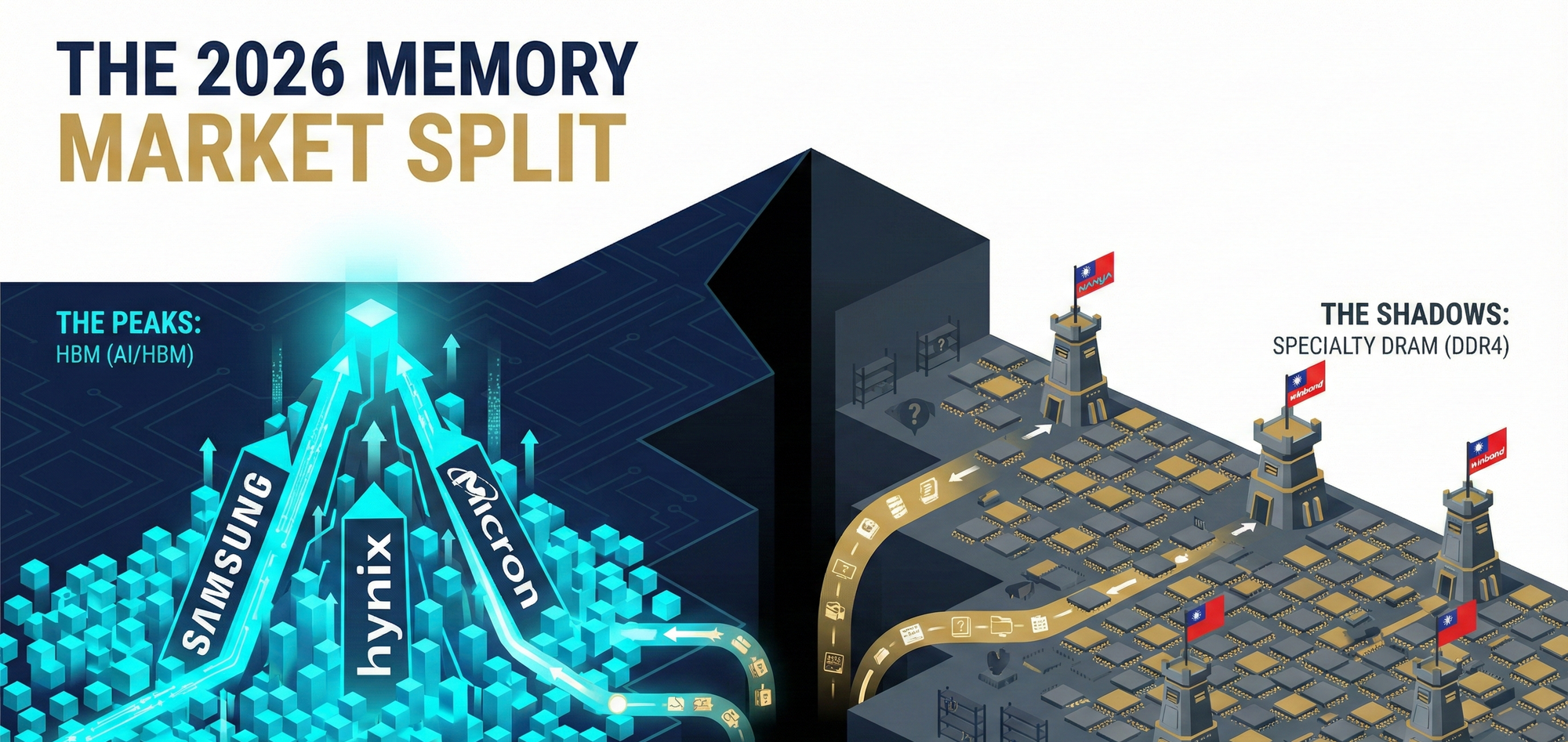
At this juncture in 2026, the memory industry is experiencing an unprecedented 'structural fracture'. While the global capital markets are captivated by the explosive growth of HBM (High Bandwidth Memory) and DDR5, Taiwan's memory industry is undergoing a silent but critical transformation. This is not a battle for the most cutting-edge computing power, but a protracted war concerning 'physical inventory, specification monopolization, and technological sovereignty'.
Chapter One: The Era of Great Divergence — The Forgotten 'Shadow Battlefield'
The DRAM market in 2026 exhibits extremely polarized characteristics. On one hand, there is the insatiable demand for HBM from AI servers; on the other hand, there is Specialty DRAM, which supports the infrastructure of the Internet of Things, smart TVs, and Wi-Fi 7.
- Strategic Retreat of the Giants: The three major original manufacturers (Samsung, Hynix, Micron) are, in pursuit of AI dividends, heavily allocating their advanced process capacities, such as 1α, 1β, and even 1γ, to HBM and advanced server DDR5 products. This has led to a physical 'dislocation' in the supply of traditional DDR4 and LPDDR4 products.
- The Emergence of Structural Shortages: Despite the slow recovery of consumer electronics, due to the supply side decreasing much faster than the demand side, Specialty DRAM experienced a 'structural supply-demand imbalance' in early 2026. Market estimates suggest that the average selling price (ASP) increase for traditional DRAM in Q1 2026 could be as high as $55\% \sim 60\%$. This has created substantial profit margins for Taiwanese manufacturers remaining in the DDR4 battlefield.
Chapter Two: Nanya Technology (2408)'s 1B Gamble — The Rebirth of Technological Sovereignty
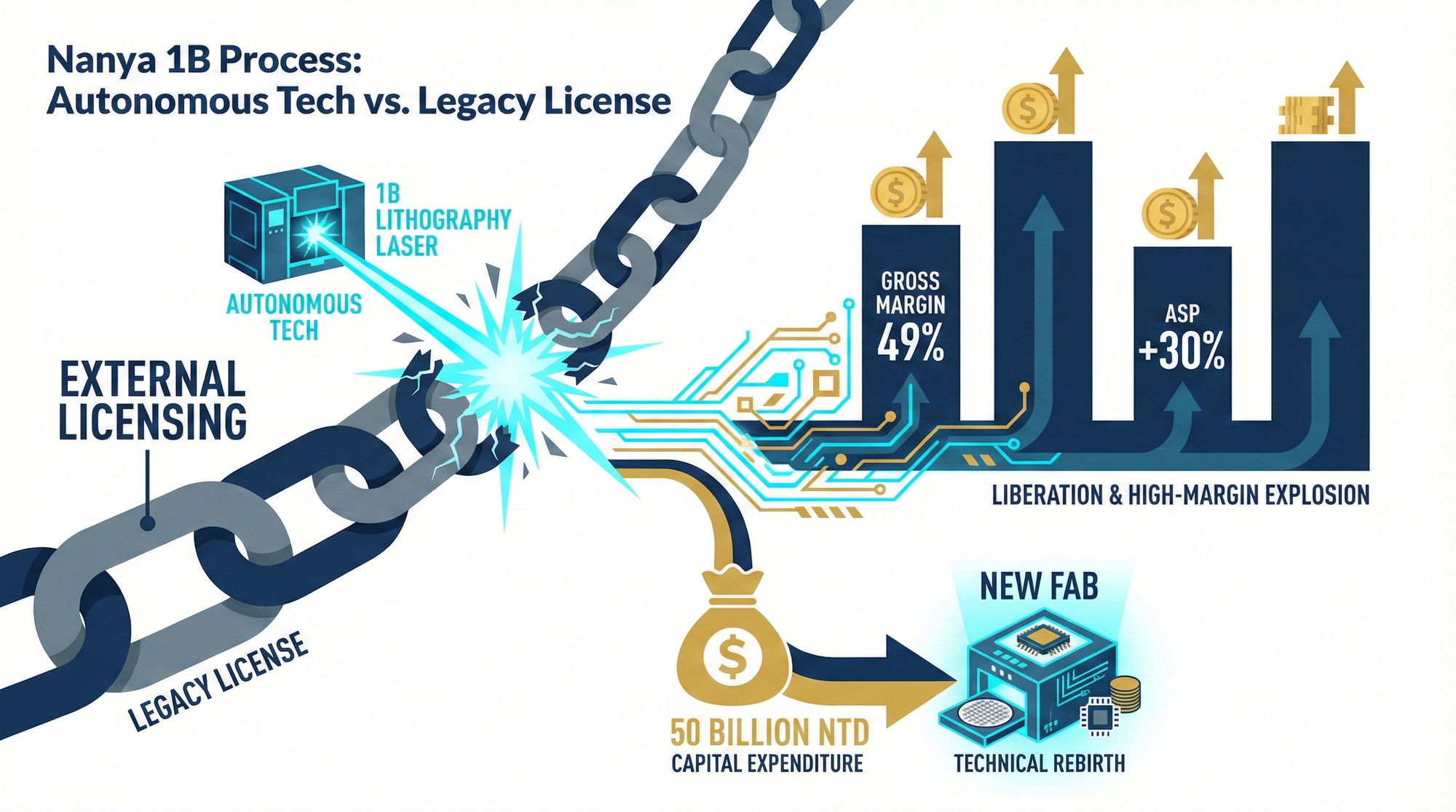
Nanya Technology's current strategic focus is on the full-scale ramp-up of its 1B (second-generation 10nm-class) process. This is not merely a capacity upgrade, but a crucial battle for Nanya Technology to break away from Micron's technological framework and achieve 'technological independence'.
- Efficiency Dividends from Process Transition: Nanya Technology's profit growth from 2025 to 2026 primarily stems from an increase in ASP and optimized depreciation expenses. 4Q25 data indicates that Nanya Technology's gross margin surged from $18.4\%$ in 3Q25 to $49\%$, mainly due to a quarter-on-quarter ASP increase of over $30\%$ and a significant $20\%$ decrease in depreciation expenses.
- The Economics of the 1B Node:
- Process Advantage: The 1B process represents the most advanced capability for Taiwanese manufacturers in the specialty market. Nanya Technology is utilizing the 1B process to optimize DDR4 and LPDDR4 products, meeting the demand for low power consumption and high-density storage from consumer electronics (which accounts for $65\%$ of its revenue) in 2026.
- Capital Expenditure Strategy: Nanya Technology anticipates significantly increasing its capital expenditure for 2026 to NT$50 billion, a $273\%$ increase from 2025. Of this funding, $70\%$ is allocated to new fab cleanroom facilities and $30\%$ to procuring more advanced equipment, aiming to achieve a monthly production capacity of $15K \sim 20K$ wafers by 1H27.
- Geopolitical Dividend: Avoiding US Tariffs: In 2026, with escalating global trade barriers, non-US-based memory manufacturers face challenges. However, Nanya Technology, with a very low proportion of direct exports to the US, is minimally impacted by tariffs. This makes it a preferred choice for non-standard product demands from Asian and European CSPs (Cloud Service Providers) amidst the trend of supply chain diversification.
Chapter Three: The Moat of Small Densities — Winbond's 16nm Expansion and Monopolization
As we delve deeper into Taiwan's Specialty DRAM industry, we find that it is not a monolithic market, but rather a trench warfare centered on 'capacity segmentation'. While Nanya Technology and Winbond both operate in the specialty segment, their strategic deployments in 2026 exhibit distinctly different 'physical dimensions'.
Unlike Nanya Technology, which attempts to contend with the giants at the edge of 10nm-class processes and $8\text{Gb}/16\text{Gb}$ standard products, Winbond's strategy leans more towards 'micro-monopolization'.
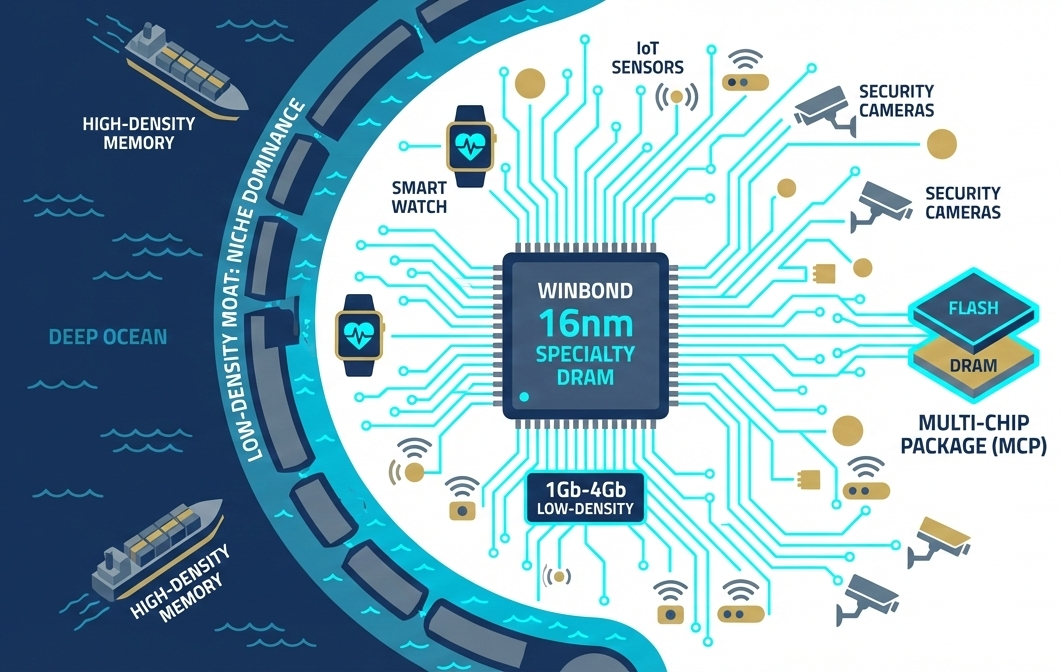
- Kaohsiung Fab's 16nm Surprise Attack: According to industry surveys in early 2026, Winbond plans to increase the capacity of its Kaohsiung fab by $10\text{K}$ in 2H26, and after all capacity is in place, fully transition to the 16nm process. This move will double its DDR4 supply by the end of 2026.
- Edge Advantage: Sidestepping 'Brute-Force Computing': Winbond's core competitiveness lies in low-capacity ($1\text{Gb} \sim 4\text{Gb}$) specialized DRAM. In the AI era, these products will not be found alongside NVIDIA's GPUs, but rather in hundreds of millions of IoT sensors, wearables, and smart access control systems. This 'small density' strategy effectively circumvents direct competition with Samsung and Micron, as for the giants, the return on investment (ROI) for developing such fragmented specifications is extremely low.
- Synergies from Packaging Integration: Winbond leverages its dual presence in Flash memory and DRAM to offer Multi-Chip Package (MCP) solutions. Amidst the trend of mobile device miniaturization in 2026, this 'one-stop supply' capability makes Taiwanese manufacturers irreplaceable in the specialty market.
Chapter Four: The Valuation Paradox — When 'Specialty' Valuation Exceeds 'AI Hegemons'
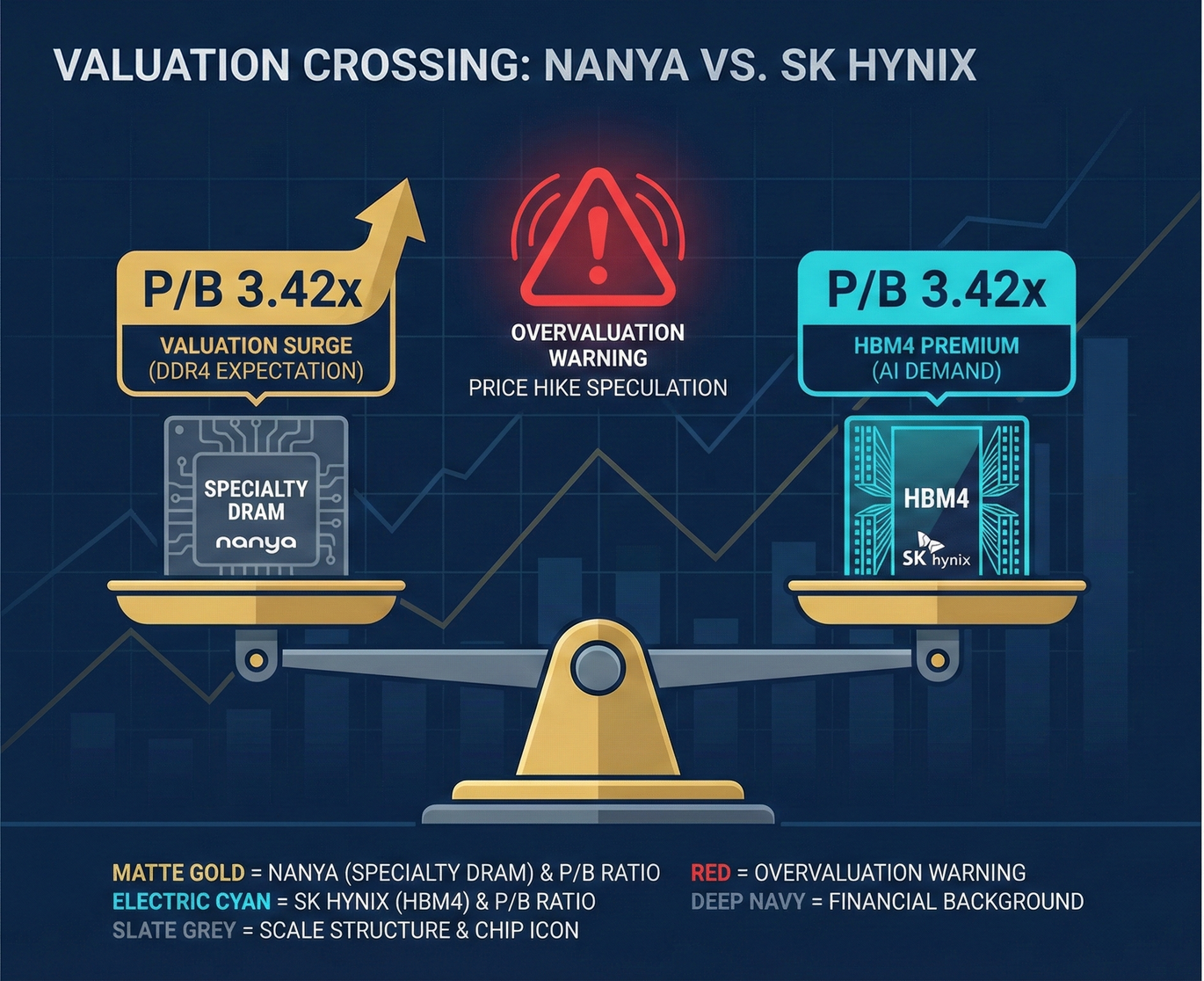
We must discuss the most peculiar phenomenon in the 2026 memory market: Nanya Technology's P/B (Price-to-Book ratio) was once on par with SK Hynix.
- The Stark Contrast in Data:
- Profit Surge: Benefiting from both increasing sales volume and prices, Nanya Technology's operating profit in 4Q25 reached NT$11.78 billion, a quarter-on-quarter increase of $953\%$. The market generally anticipates its 2026 EPS to reach levels between NT$21.57 and NT$25.68.
- Valuation Warning: However, Nanya Technology's P/B valuation in 2026 was once even higher than that of AI memory hegemon SK Hynix. This implies that the market has already pre-emptively priced in the expected price increases for Specialty DRAM. Investors must pay close attention to whether the year-on-year growth rate of shipments can be maintained at a healthy $10\% \sim 20\%$ in 2H26 to support the high stock price performance.
- The Essence of the Premium: This reflects the market's high expectations for 'economic recovery' and 'geopolitical hedging'. Investors believe that with HBM capacity locked in, the shortage of standard DDR4 will grant 'pure DDR4 players' like Nanya Technology more aggressive pricing flexibility.
- Strategic Warning: Nanya Technology's profit growth in 2026 is highly dependent on the sustained increase in ASP (with estimated year-on-year shipment growth of only $10\% \sim 20\%$). If the price increase in 1H26 falls below the anticipated $50\% \sim 60\%$, its high valuation will face severe correction pressure.
Chapter Five: 2026: The Final Battle — Inventory Cycle and Structural Gaps
The conclusion of this survival strategy hinges on the tilt of the supply-demand balance in 2H26.
- Permanent Shift in Supply Side: The three major original manufacturers are shifting capital expenditure towards advanced processes and HBM; this is not a short-term adjustment, but a permanent withdrawal. This means that DDR4 and LPDDR4 will become a 'scarce commodity' in 2026.
- Long-Tail Recovery in Demand Side: Although consumer electronics (accounting for $65\%$ of Nanya Technology's revenue) are currently only slowly recovering, the enhancement of memory specifications in AI PCs and AI smartphones will accelerate the obsolescence of older specialty products, thereby driving an upgrade cycle for Specialty DRAM.
- Return of Capital Expenditure: Nanya Technology plans to invest NT$50 billion in capital expenditure in 2026, with $70\%$ allocated to new fab construction. This indicates that Taiwanese manufacturers are prepared to face the next generation of 1C/1D process competition in 2027.
🏆 3-5-1 Strategic Summary: Taiwanese Memory's 'Shadow Survival Strategy'
Nanya Technology and Winbond's survival strategy in 2026 is to transform themselves into 'stabilizers' for the global computing power ecosystem. While the three major giants dance on the volcano of HBM, Taiwanese manufacturers, at the foot of the mountain, are harvesting the vast specialty markets abandoned by the giants, utilizing their independent 1B and 16nm processes.
- Short-Term Gains: Capitalizing on the ASP surge dividends brought by the structural shortage of DDR4.
- Long-Term Moat: Establishing an irreplaceable position in the Edge AI era through independent 10nm-class technology (Nanya Technology) and monopolization of small-density specifications (Winbond).
- Risk Management: Monitoring the risk of a high P/B valuation correction in 2026, and closely tracking the pace of DDR4 production line transitions by the three major original manufacturers.
In-depth Research · Quantitative Perspective
Want more quantitative research insights on semiconductors?
[Insight Subscription Plan] Bid Farewell to Retail Investor Mindset: Build Your Alpha Trading System with 'Quantitative Chips' and 'Consensus Data'EDGE Semiconductor Research
📍 Series Map — Navigate the Complete EDGE Semiconductor Research →


