
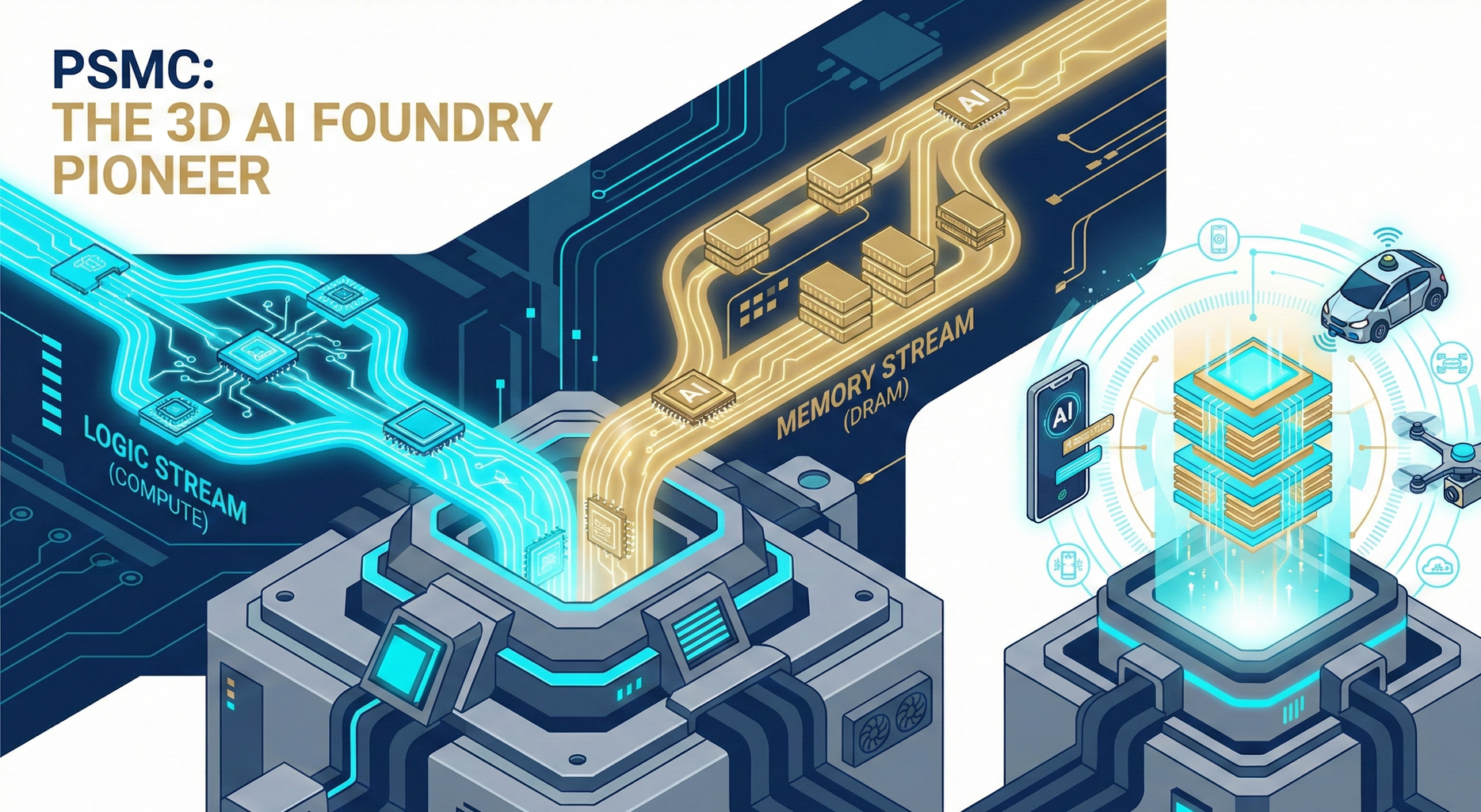
In early 2026, the news that most caught short sellers off guard in the semiconductor market was the full recovery of Powerchip (6770.TW). In the latest report, its rating was directly upgraded from "underweight" to "overweight," with a significant increase in its target price. This is not due to a natural market recovery, but because Powerchip is at the epicenter of an "across-the-board shortage."
Chapter One: Capacity's Dramatic Surge — From 'Oversupply' to 'Demand Outstripping Supply'
For a long time, market concerns about Powerchip centered on its mature process technologies facing price war pressure from Chinese manufacturers. However, the reality of 2026 has challenged this consensus:
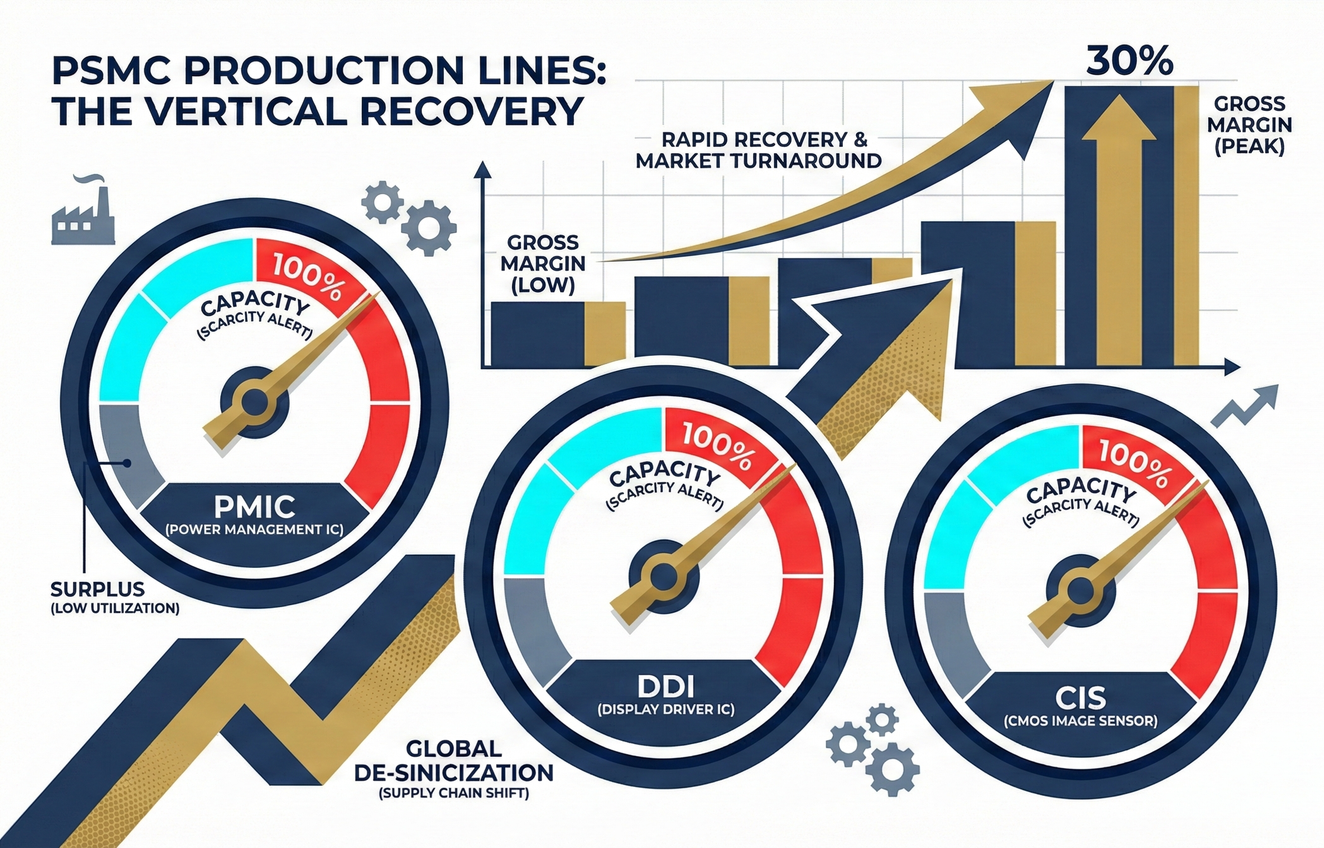
- Critical capacity shortage across all lines: Powerchip is currently facing severe supply shortages in PMIC (Power Management IC), DDI (Display Driver IC), CIS (CMOS Image Sensor), and even Power (power components). This shortage has not only driven up ASP (Average Selling Price) but also rapidly pushed its capacity utilization towards full load.
- Synchronized Resonance of Memory and Logic:
- Logic side: Benefiting from demand in automotive electronics and industrial control, PMIC order visibility extends to 2H26.
- Memory side: As the three major players exit the low-end DDR4 market to focus on HBM, what was once an oversupply of Specialty DRAM has become a scarce resource.
- Geopolitical Dividend: The 'Non-China' Option: US-based customers are accelerating the shift of orders from China-based foundries to Taiwan to diversify risk. Powerchip, as an independent foundry with large-scale mature process technology capacity, has become the biggest beneficiary of this "de-Sinicization of the supply chain."
Chapter Two: The Economics of 12-inch Wafers — Structural Leap in Gross Margin
Powerchip's financial model is undergoing a dramatic recalibration.
- Jump in Revenue Growth: Powerchip's year-on-year revenue growth rate in 2026 is projected to reach an impressive $25\% \sim 30\%$, significantly above the industry average.
- Crossing the Break-Even Point: Once capacity utilization surpasses the 80% threshold, fixed costs are substantially absorbed, and each additional wafer produced contributes almost entirely to net profit. Its gross margin is expected to recover from its previous subdued state to between $25\% \sim 30\%$ in 2026.
- Revitalization of Cash Flow: With profitability turning positive, Powerchip can more confidently invest in the next phase of 3D packaging and heterogeneous integration R&D, creating a positive feedback loop.
Chapter Three: The Tactical Significance of Logic and Memory 'Cross-Domain' Integration
Why does Powerchip claim to be a "hybrid"? This stems from its unique foundry background.
Most foundries (such as UMC) specialize only in logic, or like Nanya Technology, only in memory. Powerchip is one of the few companies that simultaneously possesses large-scale logic and memory foundry production lines. This characteristic allows it to conduct vertically integrated R&D directly within the same factory when developing Edge AI (Edge Artificial Intelligence) chips. This is not just a cost issue; it also offers physical advantages in signal transmission efficiency and bandwidth.
While the market is still debating the oversupply of mature process technologies, Powerchip has quietly completed a leap in "physical dimension." The core of this revolution is no longer circuit scaling (Scaling), but vertical stacking (Stacking). By performing atom-level stitching of memory (DRAM) and logic chips (Logic), Powerchip is providing a high-performance, low-power ultimate solution for Edge Computing (Edge AI).
Chapter Four: WoW (Wafer-on-Wafer) Revolution — Breaking Physical Boundaries
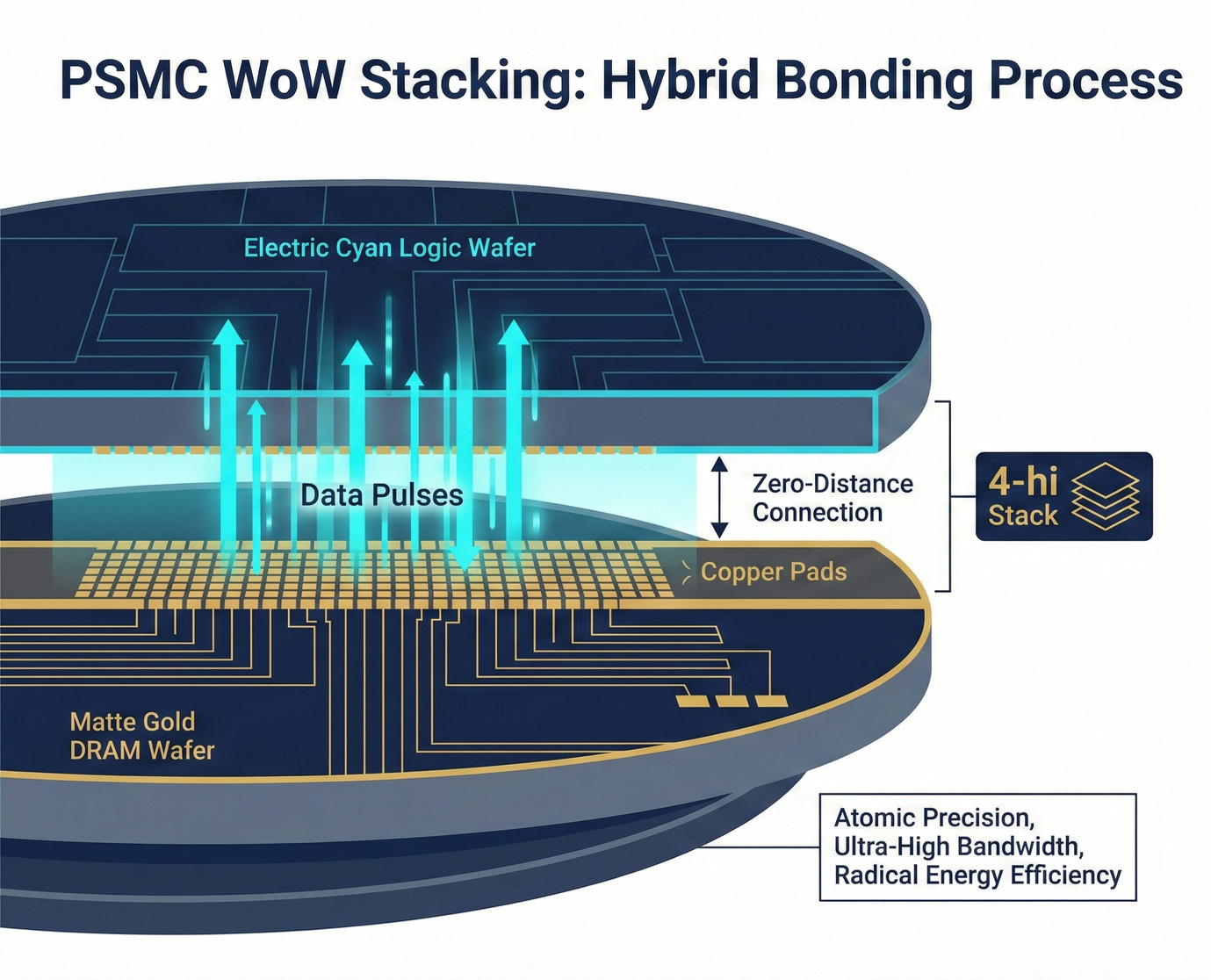
Powerchip's trump card in advanced packaging is its independently developed 3D WoW technology. The biggest difference between this technology and traditional packaging is that stacking is completed at the wafer stage, achieving true "zero-distance" communication.
- Hybrid Bonding's Physical Interconnection: Through Hybrid Bonding technology, Powerchip can directly connect the copper pads of two wafers. This increases the data transmission bandwidth between memory and logic chips by hundreds of times, while reducing power consumption by over 50%.
- 4-hi and 8-hi R&D Timeline: According to the latest progress, Powerchip's 4-hi WoW (four-layer stacking) products have entered the customer qualification phase (Qualification), and higher-tier 8-hi WoW is also under intensive development. This technology primarily targets AI image processing and edge servers, addressing the "power wall" problem caused by repeated data migration between storage and computation.
- 3D AI Foundry's Revenue Target: Company management has set an ambitious goal: within the next three years, the 3D AI Foundry business, including 3D advanced packaging and interposers (Interposer), will account for $20\%$ of total revenue. This marks Powerchip's transformation from a pure-play foundry into a technology platform with System-in-Package (SiP) capabilities.
Chapter Five: Strategic Alliance with Micron (Micron) — The Driving Force Behind HBM
Powerchip's most strategically significant move in 2026 is its deep strategic alliance with global memory giant Micron (Micron, MU).
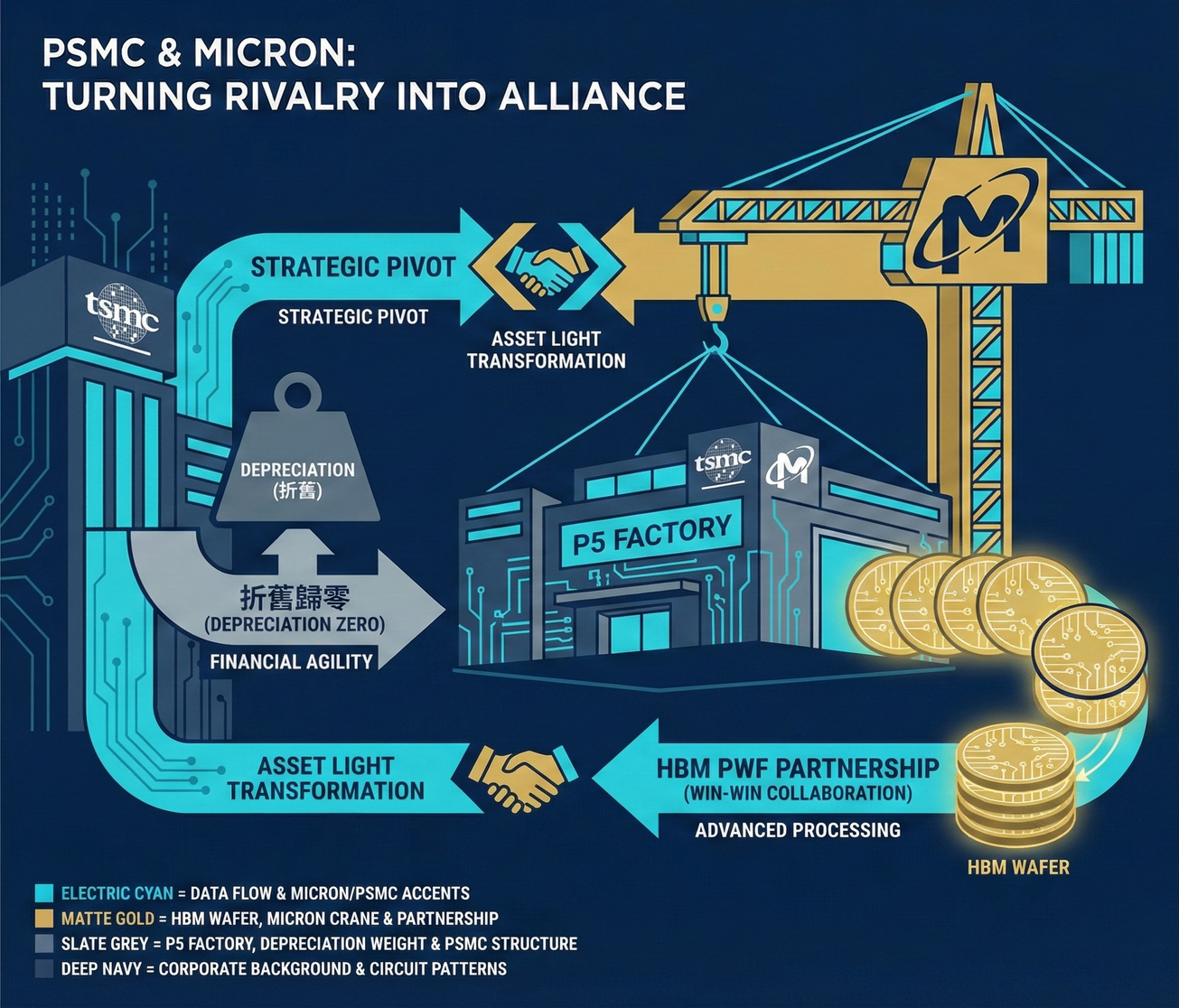
- HBM PWF Foundry Role: Powerchip is currently providing HBM Pre-applied Wafer Fabrication (PWF) services for Micron. This means that before Micron produces HBM chips, some critical wafer-level pre-processing steps are handled by Powerchip. This collaboration allows Powerchip to indirectly enter the global supply chain for the scarcest AI memory.
- P5 Fab's Asset Transformation: Powerchip's decision to sell its P5 fab (Tongluo fab) to Micron is a clever "asset-light" strategy.
- Financial Burden Reduction: Proceeds from the fab sale will be used to repay debt, and the original annual depreciation expense of NT$4.5 billion to NT$5 billion will be eliminated within 1.5 years.
- Capacity Adjustment: Powerchip is simultaneously converting part of its 8-inch production line space at the Zhunan fab into 12-inch advanced packaging production lines, demonstrating its firm commitment to the 3D AI business.
🏆 3-5-2 Strategic Summary: Frank Huang's Ultimate Transformation
Powerchip's survival and rise in 2026 is a microcosm of the "resilient transformation" of Taiwan's semiconductor industry.
- Short-Term Wins: Capitalizing on the vacuum in mature process technology created by the three major players shifting to HBM, Powerchip is rapidly repairing its balance sheet through across-the-board price increases in PMIC, DDI, and niche DRAM.
- Long-Term Moat: Through 3D WoW and AIM technologies, Powerchip is merging the dual-line DNA of "memory foundry" and "logic foundry," providing low-power architectures for AI PCs and AI smartphones.
- Strategic Position: Selling a fab to Micron and acting as a foundry for HBM PWF has transformed Powerchip from a competitor into an ally, officially securing a position in the edge ecosystem of the NVIDIA/Micron system.
In-depth Research · Quantitative Perspective
Want more insights into semiconductor quantitative research?
[Insight Subscription Plan] Bid Farewell to Retail Investor Mindset: Build Your Alpha Trading System with 'Quantitative Capital Flows' and 'Consensus Data'EDGE Semiconductor Research
📍 Series Map — Navigate the Complete EDGE Semiconductor Research →


