After understanding Ajinomoto's plastic film magic and the "mille-feuille hell" of substrate manufacturing, where yields can easily drop to zero, you must be asking: Given how difficult it is to produce this micron-level "mattress," who in the world possesses the capability to manufacture these top-tier AI substrates for Intel, NVIDIA, and AMD?
The answer lies not in Silicon Valley, nor in Taiwan's Hsinchu Science Park, but in Japan's Gifu and Nagano Prefectures.
Two century-old establishments have, over the past two decades, stood as insurmountable gatekeepers, firmly controlling the chokehold on the world's highest-end ABF substrates. Taiwan's "Big Three" substrate manufacturers could only struggle to catch up behind them for a long time.
All of this began in the golden age when Intel absolutely dominated the PC and server markets.
👑 Chapter One: Intel's Dedicated Guards — Ibiden and Shinko Electric Industries
In the early 2000s, to push CPU clock speeds to their limits, Intel decided to adopt the new "Ajinomoto ABF film" and invented a high-end packaging technology called FC-BGA (Flip Chip-Ball Grid Array). However, Intel did not produce these substrates itself; it needed to find a contract manufacturer.
Intel surveyed circuit board manufacturers worldwide and ultimately selected two Japanese companies. These two firms not only became Intel's "dedicated guards" but later collaborated to monopolize the global high-end server substrate market.
1. Technology Emperor: Ibiden (4062.JP)
Ibiden is a "Technology Emperor" that evokes a look of awe from executives at all substrate manufacturers in Taiwan whenever its name is mentioned. However, you might find it hard to imagine that this giant, which currently controls the chokehold on the world's most powerful AI computing, was founded in 1912 as a hydroelectric power plant and building materials supplier.
- A Century of Grand Transformation: Initially named "Ibikawa Electric," it used vast hydroelectric power to produce calcium carbide (acetylene), later transforming to manufacture melamine building materials. By the 1970s, they ingeniously transferred their "lamination technology" used for building materials to printed circuit boards (PCBs).
- The Battle for Godhood: In the late 1990s, when Intel sought suppliers for its new FC-BGA concept, most manufacturers hesitated due to the immense technical difficulty and substantial investment required. Ibiden chose to "go all-in," dedicating its entire corporate strength to an extremely deep co-development effort with Intel.
- Absolute Moat: Ibiden perfectly adapted to Intel's renowned and stringent "Copy Exactly" standard. Intel even stationed numerous engineers at Ibiden's Gifu Prefecture factory, working through nights together. This allowed Ibiden to master the planet's most extreme laser drilling and plating processes for "large-area, ultra-high layer count, and extremely fine-line circuits." Today, when NVIDIA needs a B200 substrate approaching 100x100mm and 20 layers high, Ibiden is always Jensen Huang's first point of contact.
2. Traditional Powerhouse: Shinko (Shinko Electric Industries, 6967.JP)
If Ibiden is the Technology Emperor, then Shinko (Shinko Electric Industries), located in Japan's Nagano Prefecture, is another indispensable heavy infantry by Intel's side.
- Lighting Up Nagano: Founded in 1946, Shinko started by recycling discarded light bulbs and manufacturing lighting filaments (which is why "Electric Industries" is in its name). It was later acquired by Japanese tech giant Fujitsu, becoming its core subsidiary.
- Material Artist: From glass and metal sealing technologies used in light bulbs, Shinko honed a profound foundation in materials science. They first dominated the early lead frame market, then followed in Intel's footsteps, making a decisive entry into the high-end ABF substrate sector. Over the past decade or so, the substrate orders for the most expensive Intel Xeon server processors in global data centers have been almost entirely divided between Ibiden and Shinko, operating as a duopoly.
🧱 Chapter Two: The Wall of Despair — Why Taiwanese Manufacturers Couldn't Catch Up Back Then?
You must be asking: With Taiwan's PCB industry being so strong (e.g., Unimicron, Nanya PCB), why, for a long time, could it only watch the Japanese duopoly feast on the high-end ABF market, without even a chance to sip the soup?
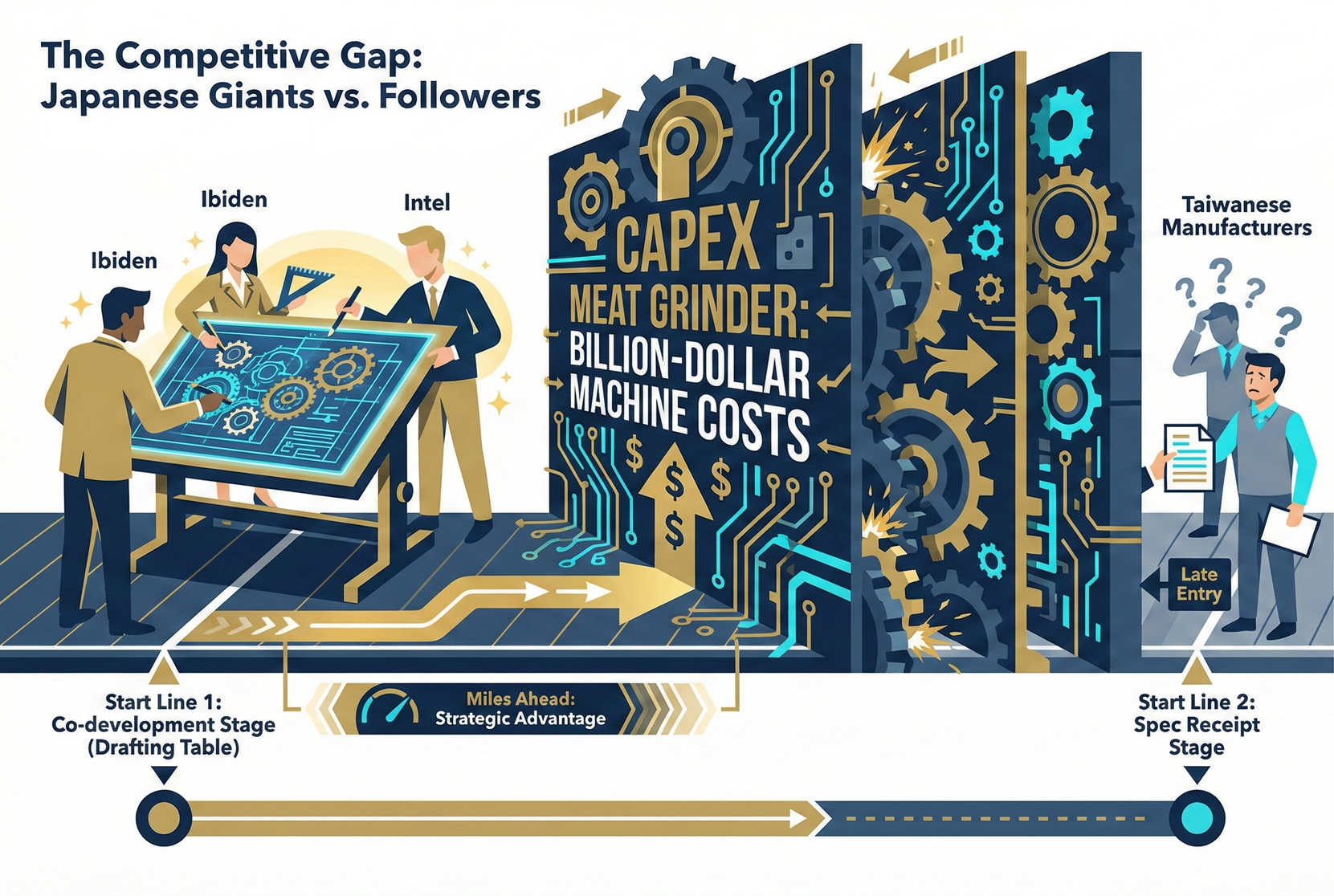
Because between the Japanese duopoly and Intel, a wall of despair was built, named "Specification Co-development" and "Capital Meat Grinder."
- Specification Co-developers (Co-development): Ibiden and Shinko were already involved in the "drawing board stage" for what Intel's CPUs would look like in the next three to five years and how many substrate layers they would require. By the time Intel officially launched a new generation of CPUs, the Japanese duopoly's production lines and yields were already optimized; meanwhile, manufacturers in Taiwan were only just receiving the specification documents, effectively losing three years right from the starting line.
- Capital Meat Grinder (Capex Meat Grinder): The machinery for high-end substrates is extremely expensive. Japanese manufacturers, with Intel's long-term "capacity booking" commitment, dared to invest tens of billions of Japanese yen in equipment without hesitation. However, if manufacturers in Taiwan had blindly expanded capacity at that time and failed to secure top-tier orders, the enormous depreciation costs of the machinery would have instantly devoured their company profits. This led to manufacturers in Taiwan mostly taking on "mid-to-low-end PC substrates" or "network communication substrates" that the Japanese companies passed on before 2018.
Thus, under Intel's patronage, the Japanese duopoly enjoyed nearly two decades of easy profits. It was not until the explosion of the AI era that this comfort zone was completely shattered.
📉 Chapter Three: Financial Turbulence and Intel's "Squeeze Effect"
The comfort zone established by the Japanese duopoly under Intel's patronage faced relentless challenges from 2024 to 2026.
With the advent of the AI era, cloud giants' capital expenditures were entirely absorbed by NVIDIA's GPUs, leading to a stagnation in traditional CPU demand. Coupled with Intel's painful transformation in wafer foundry and advanced process technologies, Ibiden, as Intel's largest supplier, faced unprecedented "AI anxiety." This anxiety was fully revealed in Ibiden's latest Q3 FY2025 (October-December) financial report.
- Earnings Miss: Ibiden's operating profit (OP) for the latest quarter was only JPY 12 billion. While this figure barely met the company's internal low-end guidance, it fell far short of market's initial optimistic expectations of JPY 13.7 billion to JPY 15 billion. The earnings release immediately triggered a sharp short-term correction in the capital markets.
- Where's the Fatal Flaw? A deeper breakdown of revenue performance across product lines reveals that the problem was not with AI at all. Demand for high-end AI server substrates related to NVIDIA remained extremely strong. The real "earnings poison" was the weak demand for "traditional PC and general-purpose servers."
- Intel's Squeeze Effect: Delving into the underlying supply chain truth, this was actually caused by Intel's capacity prioritization. Due to extremely tight internal 18A advanced process capacity, Intel's senior management decided to "sacrifice the pawns to save the king," prioritizing all scarce internal wafer capacity for the most profitable Data Center and AI (DCAI) division. This directly led to severe restrictions on chip shipments for Client Computing Group (CCG) PCs. When the city gate catches fire, the fish in the moat suffer. With PC chips unable to ship, Ibiden's capacity utilization rate for PC-related substrates significantly declined, becoming the main culprit dragging down overall gross margins.
If you only look at these short-term financial figures, you might think Ibiden's heyday is over. But don't be fooled by the recent turbulence. At the latest earnings call, Ibiden dropped a business bombshell that shocked the semiconductor industry.
💰 Chapter Four: JPY 500 Billion Epic Expansion and "Cash Booking"
At a time when its traditional business faced headwinds and short-term profits were below expectations, Ibiden's management not only did not scale back investments but instead announced an almost insane capital expenditure plan:
Ibiden decided to invest a staggering JPY 500 billion (approximately USD 3.3 billion) in capital expenditure over three years from FY2027 to FY2029!
- Where will this JPY 500 billion be spent?
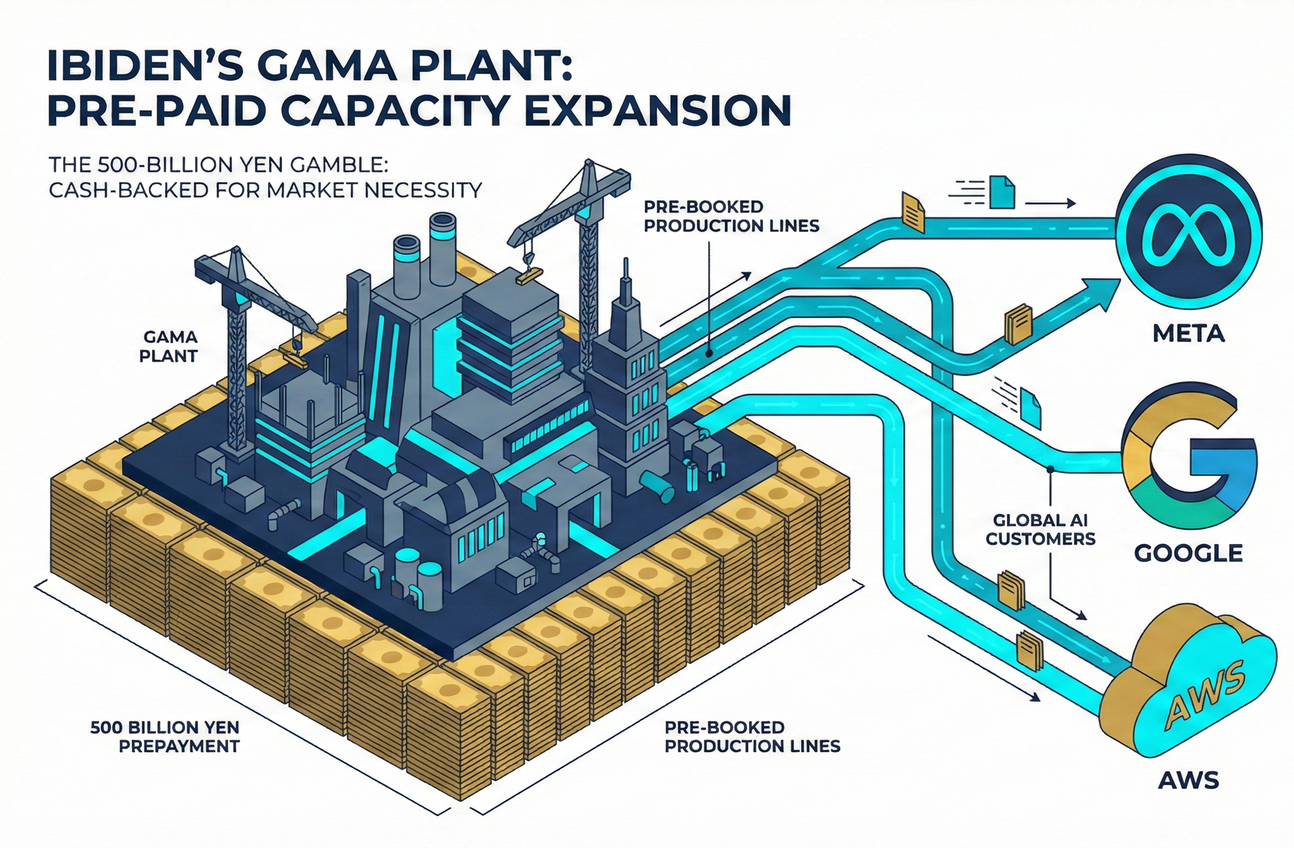
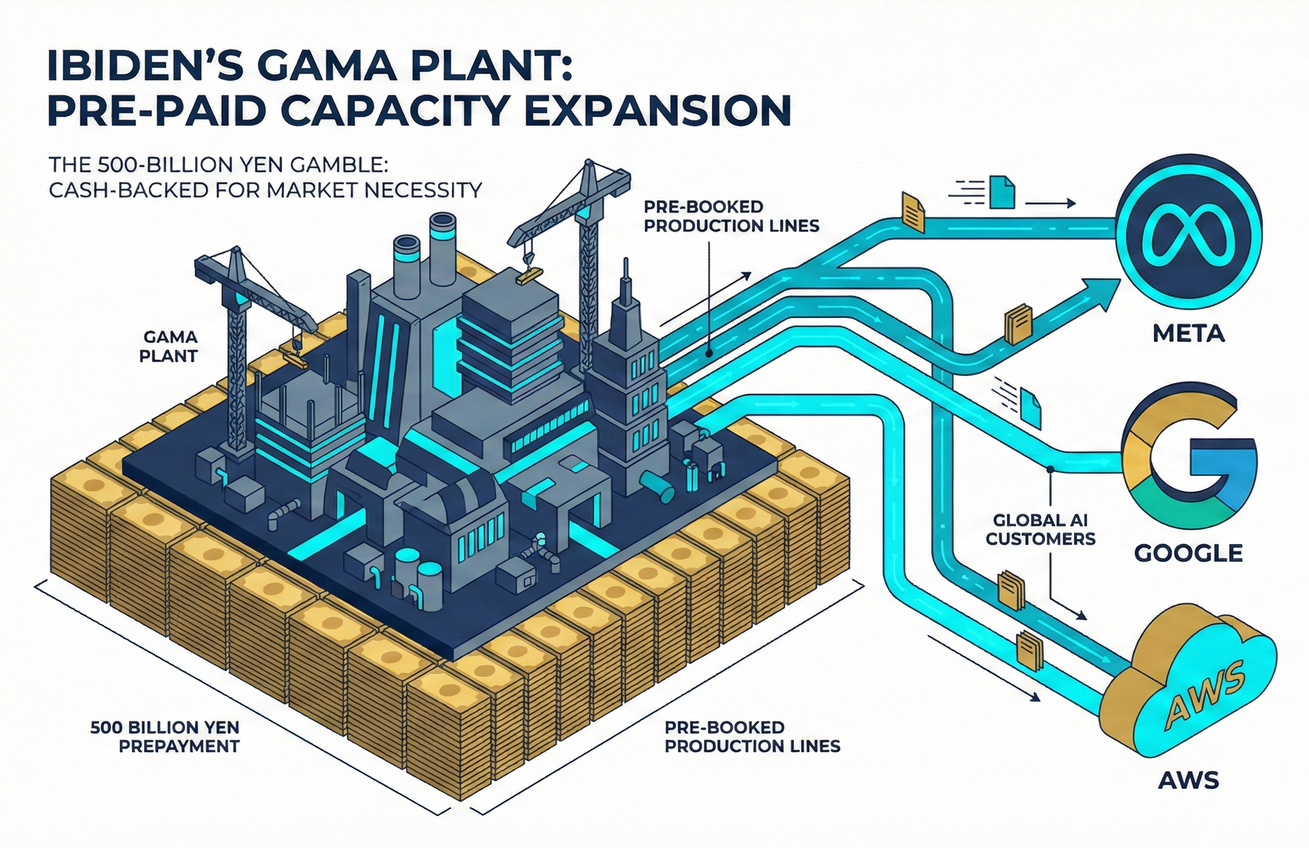
- Gama Plant (New Gama Plant): A hefty JPY 220 billion will be invested, with operations expected to begin and mass production to ramp up in phases starting FY2028.
- Ono Plant: The remaining approximately JPY 280 billion will be used to continuously expand capacity for the highest-end substrates.
This is a highly counter-intuitive strategic decision. At a time when traditional CPU substrate demand is sluggish, why would Ibiden dare to invest JPY 500 billion in building new plants? The answer lies in the next stage of AI computing power development: AI ASIC (Application-Specific Integrated Circuit) and 2.5D Advanced Packaging.
- Gama Plant's Ultimate Mission: The EMIB-T Revolution While NVIDIA's GPUs are powerful, they are extremely expensive and power-hungry. All cloud giants (Google, AWS, Meta) are now frantically developing their own AI ASIC chips. To achieve ultimate computing power, these gigantic ASIC chips are fully transitioning to 2.5D advanced packaging. The establishment of the Gama plant is specifically tailored for Intel's latest "EMIB-T" advanced packaging technology. Future ASIC chips will incorporate TSVs (Through-Silicon Vias) within Silicon Bridges. This means that future substrates will not merely be simple plastic insulating boards; they must also accommodate high-difficulty chip bonding and pad connections. This pushes the unit price and technical threshold of substrates sky-high once again.
- The Ultimate Display of the Moat: Customers "Begging with Cash" for Expansion Is this JPY 500 billion gamble high-risk? A closer look at the capital flow in the industry chain reveals an astonishing business detail: the vast majority of this massive investment is being financed by customer "Prepayments." Due to the extreme shortage of the world's highest-end substrate supply, several top-tier AI customers, to ensure their ASIC capacity for the second half of 2026 will not fall short, are willingly offering large sums of cash as prepayments to Ibiden to help them build factories!
Strategic Convergence: Ibiden's Grand Transformation
From a broader strategic perspective, Ibiden is undergoing a brutal yet absolutely necessary period of specification upgrade growing pains. It is powerfully evolving from "Intel's dedicated traditional CPU substrate manufacturer" into "the strongest firepower support for global AI ASICs and EMIB-T advanced packaging."
Once the Gama plant's capacity comes online, this JPY 500 billion infrastructure will transform into massive high-margin cash flow, thoroughly leaving behind those struggling to improve yields by several streets.
🇯🇵 Chapter Five: The National Team's Heavy Blow — Shinko's Privatization and the Semiconductor Defense Battle
If you have been following the Japanese stock market, you will notice that Shinko (6967.JP)'s stock ticker is about to become history.
This top-tier supplier, which controls half of the global high-end server substrate market, is a subsidiary of Japanese IT giant Fujitsu. In recent years, to transform into a pure software and cloud services company, Fujitsu decided to divest Shinko, its hardware manufacturing cash cow, for cash.
This news immediately caused a stir in global capital markets. At the time, top-tier private equity funds (PE Funds) from the United States, and even overseas competitors, were lining up with pockets full of cash, ready to acquire the company.
But the Japanese government absolutely would not allow this to happen.
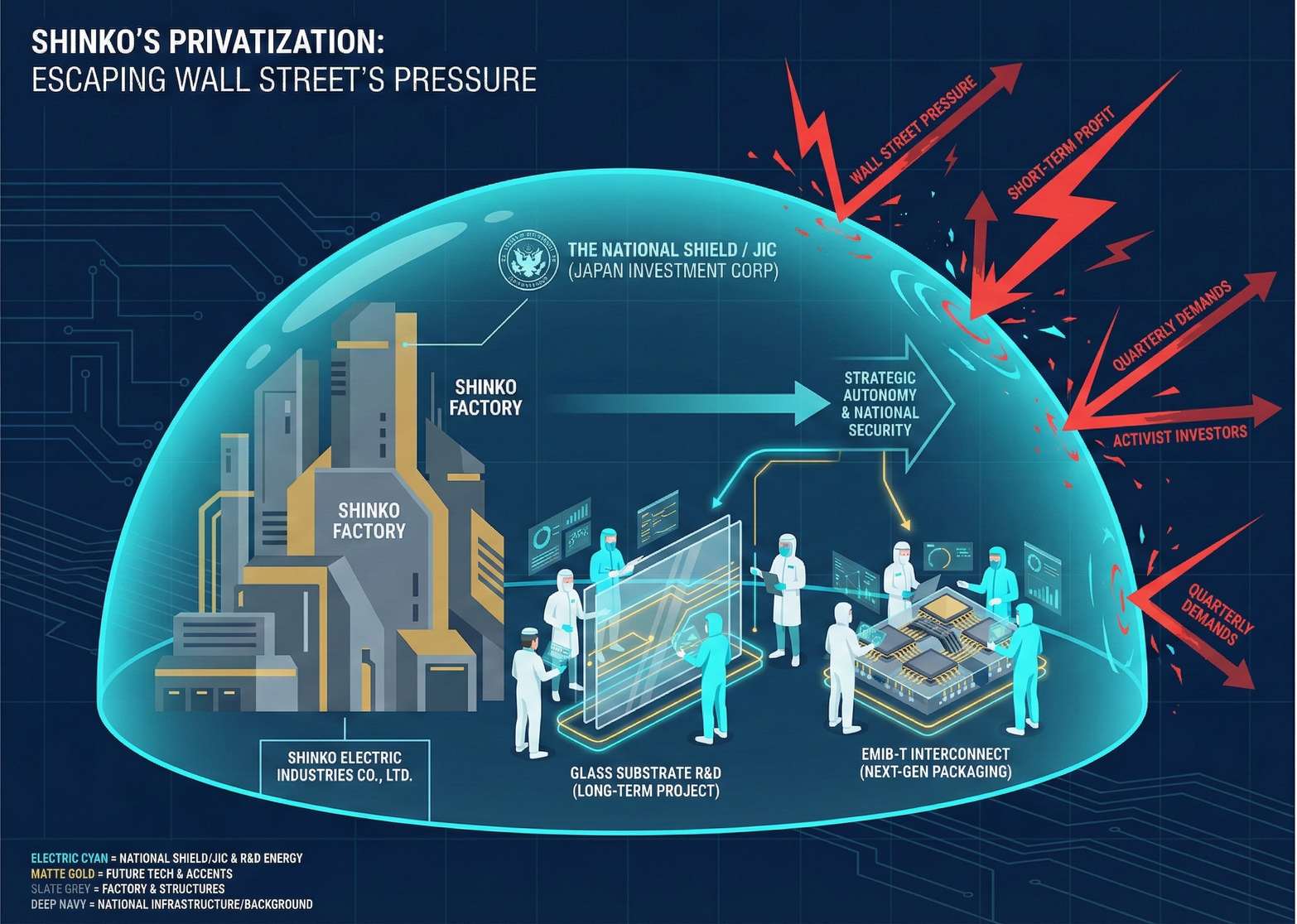
- "Japan Inc.'s" Strategic Net: At a critical juncture where AI computing power is set to determine national strength, high-end ABF substrates and advanced packaging technology have become "strategic materials" vital to national economic security. The Japanese government understood that if Shinko fell into foreign hands, Japan would lose its absolute command over the global semiconductor supply chain. Consequently, the JIC (Japan Investment Corporation), representing the Japanese national team, intervened forcefully. JIC, in collaboration with domestic giants such as Dai Nippon Printing (DNP) and Mitsui Chemicals, formed an all-Japanese acquisition consortium, spending nearly JPY 700 billion (approximately USD 4.7 billion) to forcibly acquire and "privatize and delist" Shinko with overwhelming state capital.
- Why the Delisting? To Avoid Wall Street's Short-sightedness: The business logic behind privatization is extremely cold. In the specification battle for AI and advanced packaging (such as the aforementioned EMIB-T), the future capital expenditures of substrate manufacturers will be astronomical. If Shinko remained on the public market, as soon as it announced plans to invest JPY 500 billion in building new plants, with profits only recoverable after three years, Wall Street and retail shareholders would immediately dump its stock due to "short-term profits being eaten by depreciation" (this is precisely the pressure Ibiden is currently facing). Delisting is to remove the shackles of short-termism. Under the national team's protective umbrella, Shinko will be able to unreservedly execute ultra-long-term R&D and epic expansions spanning 5 to 10 years, focusing on enduring this "capital bleeding period" of the next-generation substrate war.
📊 4-1-2 Strategic Summary: The Limits of the Plastic Throne and Future Foreshadowing
We have reviewed how Ibiden and Shinko, Intel's two dedicated guards, built technological and capital barriers that left manufacturers in Taiwan in despair over the past two decades. We have also understood how, in today's AI-hungry era, they defend their plastic throne through two vastly different extreme methods: "customer cash booking" and "national team privatization and delisting."
However, both of these giants currently face the same suffocating physical limitation.
No matter how precise Ibiden's laser drilling is, and no matter how substantial Shinko's state capital, their core material remains "plastic (ABF film + fiberglass)."
- The Cry of Physical Limits: As we mentioned earlier, the NVIDIA B200's dimensions are already approaching 100x100mm, which is almost the limit for plastic substrates. Plastic is inherently heat-sensitive, and when this colossal AI chip, costing millions and consuming up to 1000 watts, operates at full speed, the plastic substrate can experience severe "warpage" due to thermal expansion and contraction. If the board even slightly bends or deforms, the densely packed micron-level circuits will instantly break, rendering the entire chip unusable.
For AI chips to continue growing and accommodate more transistors, the semiconductor industry must completely abandon the plastic foundation that has accompanied us for twenty years. We must seek an ultimate material that possesses "absolute flatness," extreme heat resistance, and excellent signal transmission rates.
One of humanity's oldest inventions is about to stage its most sci-fi comeback in the nanometer era.
In-depth Research · Quantitative Perspective
Want to gain more semiconductor quantitative research insights?
[Insight Subscription Plan] Bid Farewell to Retail Investor Mentality: Build Your Alpha Trading System with "Quantitative Chips" and "Consensus Data"EDGE Semiconductor Research
📍 Series Map — Navigate the Complete EDGE Semiconductor Research →


