In the previous article, we witnessed how the Japanese giants (Ibiden, Shinko) dominated the global high-end ABF substrate market for the past two decades, relying on Intel's patronage.
Facing this desperate barrier built by "specification-setting power" and a "capital intensive meat grinder," substrate manufacturers in Taiwan were, for a long time, only able to pick up the mid-to-low-end orders that Japanese manufacturers left behind in the red ocean. However, one Taiwanese enterprise, through extraordinary resilience and incredibly aggressive capital expansion, managed to punch a massive hole in this high wall.
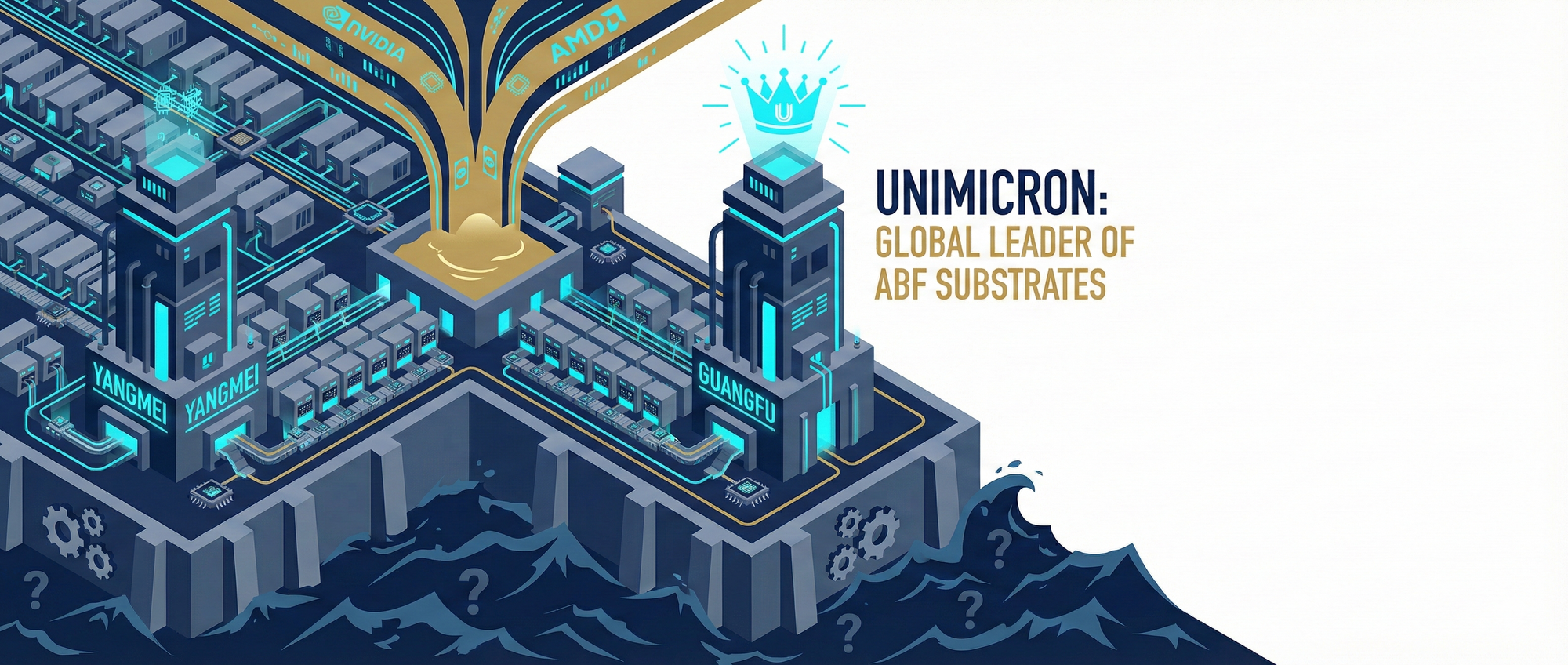
This enterprise is none other than the current world's largest IC substrate manufacturer, Unimicron Technology Corporation (3037.TW), known as the "Capacity King."
🏭 Chapter One: UMC DNA and a Decade of "Bottoming Out"
Unimicron Technology Corporation has the DNA of the UMC Group, Taiwan's pioneering pure-play foundry. In its early days, Unimicron was primarily a manufacturer of traditional PCBs (Printed Circuit Boards) and HDIs (High-Density Interconnects).
When ABF substrate technology emerged in the 2000s, Unimicron quickly entered the market, but it faced an extremely painful "bottoming-out period."
- High-end market blockade: At that time, the most profitable server and PC CPU substrates were tightly bound to Intel and the Japanese giants. Although Unimicron was keen to enter this segment, it often could not obtain the cutting-edge specifications, leading to yields that could never compete with major Japanese manufacturers.
- Relentless depreciation drain: The substrate industry is a cruel, "asset-heavy" business, with building a single plant often costing tens of billions of New Taiwan Dollars. Without "capacity reservation" commitments from top-tier clients, every expansion by Unimicron brought massive machinery depreciation costs that would devour the company's hard-earned profits. This resulted in Unimicron's gross margin consistently trailing its Japanese peers for a long period.
🍎 Chapter Two: Apple's Nurturing and the Ultimate Training in HDI
During the years when it was unable to directly break through the Japanese manufacturers' defenses, Unimicron adopted a strategy of "outflanking." They turned their attention to the consumer electronics market, which Japanese manufacturers disdained but which offered extremely large volumes and stringent requirements, especially for Apple.
- King of mobile phone substrates: Unimicron secured orders for the extremely compact BT substrates and high-end HDIs (and later, SLP-like substrates) found in iPhones. While the gross margins for these products were not as astonishing as those for server ABF substrates, Apple's astronomical shipment volumes provided Unimicron with a continuous stream of substantial cash flow and operational confidence.
- Cultivating ultimate mass production capabilities: By serving a client like Apple, known for its extremely meticulous demands on quality and delivery times, Unimicron honed its "yield control" and "large-scale mass production capabilities" to perfection. This period of endurance and training laid the crucial groundwork for its future breakout.
👑 Chapter Three: The Explosion of AI Computing Power and the Coronation of the "Capacity King"
As the 2020s arrived, the wave of cloud computing and AI officially ignited. The world of chips underwent a revolutionary transformation: giants like NVIDIA, AMD, and Broadcom rose powerfully, and Intel's absolute dominance began to crumble.
At this juncture, the entire semiconductor industry discovered a terrifying truth: the production capacity for high-end ABF substrates was simply insufficient.