
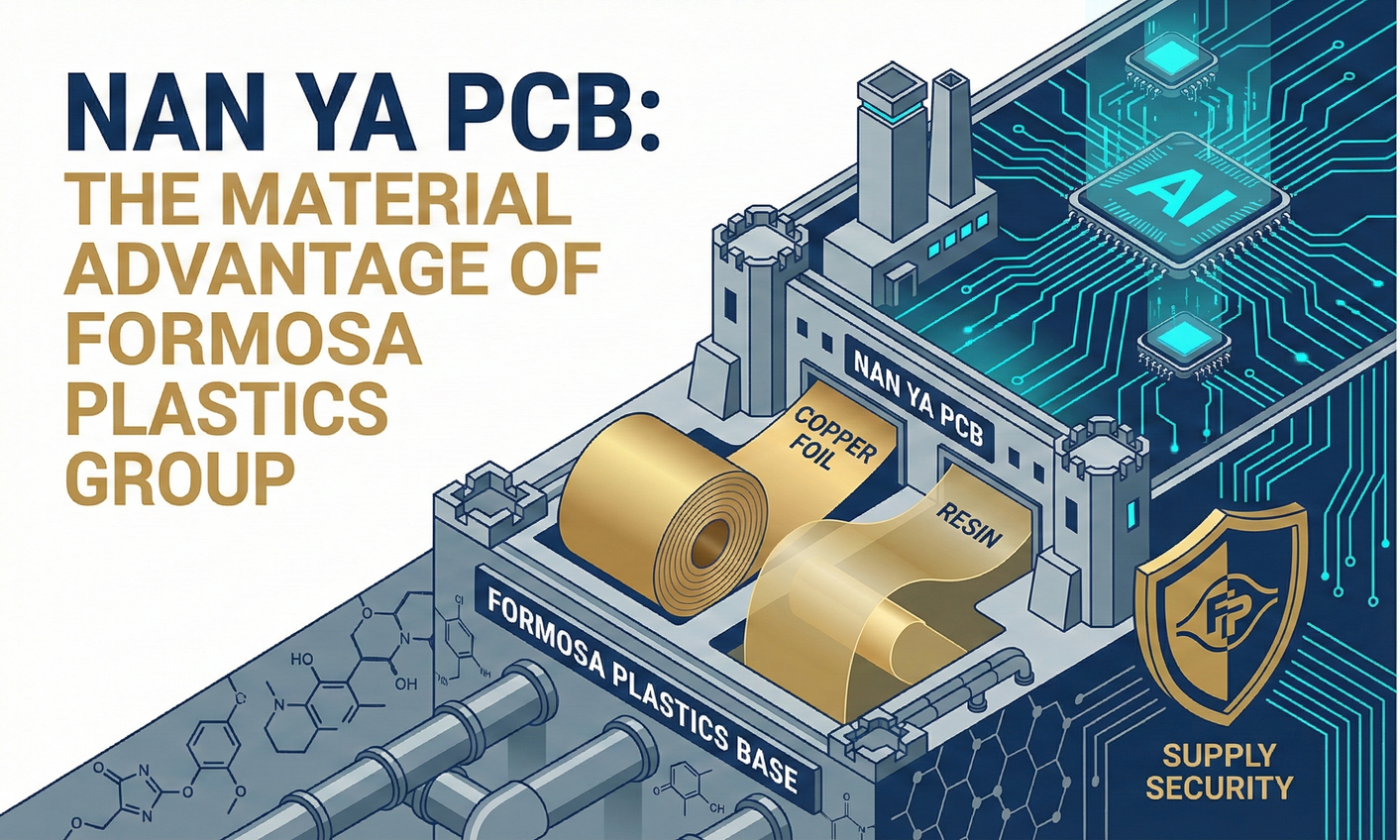
While the capital market's spotlight is almost entirely focused on Unimicron and the two Japanese giants, we absolutely must not underestimate Nanya PCB, a beast currently in hibernation. To understand Nanya PCB's current headwinds and future explosive potential, we must first comprehend how it previously reigned supreme in another arena.
👑 Chapter One: The Pride of Formosa Plastics — The Undisputed King of Networking and PC Substrates
In the 2010s, before AI servers became mainstream, Nanya PCB enjoyed a period of highly profitable "golden years" in the traditional substrate market. They built deep moats in two major areas: PC (Personal Computers) and Networking Equipment.
- The Ultimate Foundation of Vertical Integration: Behind Nanya PCB stands the vast Formosa Plastics Group (whose parent company is Nanya Plastics). Substrate manufacturing requires large quantities of basic chemical materials such as copper foil, glass fiber cloth, and resin. The Formosa Plastics Group can produce all of these itself! This vertical integration capability, "from upstream materials to downstream substrates," gives Nanya PCB the strongest cost control advantage in the industry.
- Dominator of the Networking Market: In the markets for 4G/5G base stations, enterprise-grade routers, and switches, Nanya PCB is an undisputed king. Although networking substrates also have many layers, their area is typically moderate. Nanya PCB optimized the yield and efficiency of this product line to the extreme, generating very high and stable cash flow for the group.
This was a perfectly functioning comfort zone. Until Jensen Huang, with NVIDIA's giant GPUs, kicked open the door to the AI era.
🧱 Chapter Two: Missed Opportunities — The "Yield Wall" for Giant AI Substrates
As 2023 transitioned into 2024, AI computing power exploded. Cloud giants stopped purchasing traditional servers, diverting their entire budgets towards AI servers equipped with high-end GPUs. At this juncture, Nanya PCB encountered two critical strategic headwinds:
1. The Ruthless Destocking of Traditional Markets (Inventory Correction)
Due to the fading pandemic dividend, the PC and traditional networking equipment markets experienced severe inventory gluts. Nanya PCB's two most profitable cash cows saw orders instantly freeze.
2. The Fundamental Physical Challenges of Large-Area AI Substrates
Since traditional networking products were struggling, why didn't Nanya PCB immediately pivot to producing AI substrates?
The answer: They couldn't produce them; they hit a yield wall.
This is the most brutal aspect of semiconductor manufacturing.
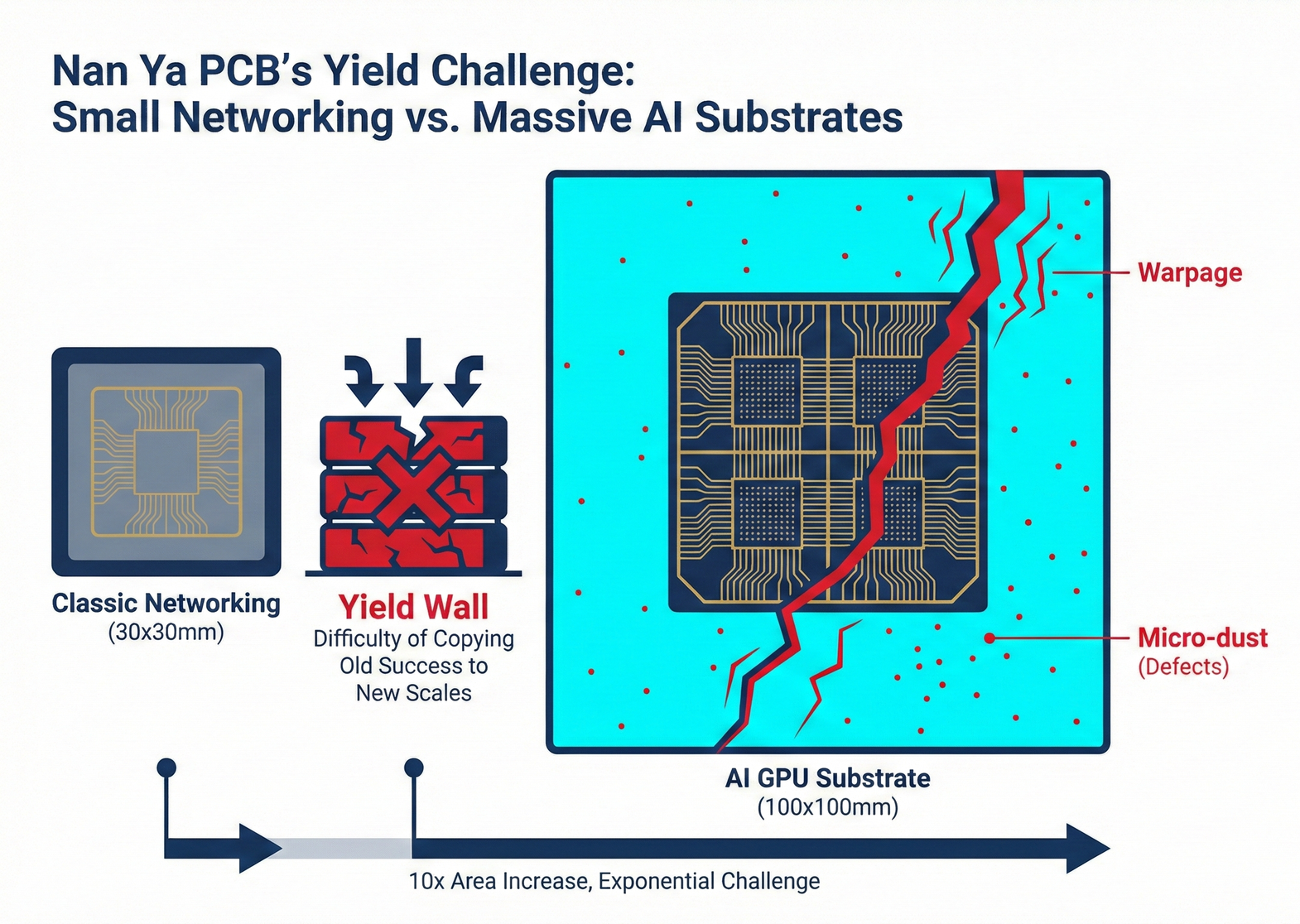
Previously, the networking substrates Nanya PCB specialized in were approximately $30\text{mm} \times 30\text{mm}$ in size; however, NVIDIA's high-end AI substrates often approach $100\text{mm} \times 100\text{mm}$, representing a tenfold increase in area, and their layer count can reach 16 to 20 layers or more!
- The Curse of Area: As we mentioned in [4-1-1], the larger the substrate area, the higher the chance that a single dust particle can render the entire board unusable.
- Experience Cannot Be Replicated: Nanya PCB engineers were dismayed to discover that their accumulated yield control experience from networking substrates proved entirely ineffective for these "giant, ultra-multilayer" AI substrates. Severe warpage and alignment shifts in plastic materials during high-temperature lamination led to abysmal yields for Nanya PCB during the initial trial production of high-end GPU substrates.
Short-term Shock and Growing Pains:
While Unimicron (3037), leveraging its high-end capacity built years ago by shouldering substantial depreciation, aggressively captured NVIDIA orders amidst the AI wave, Nanya PCB, due to being a step late in establishing top-tier capacity, found itself caught in a double bind: "old products couldn't sell, and new products couldn't be made." This explains why Nanya PCB's financial performance and stock price have been relatively subdued, and the market spotlight dim, for some time.
🏭 Chapter Three: Shulin Plant's Counterattack — The Ultimate Weapon Tailored for High-End HPC
Nanya PCB understood deeply that to bridge the yield gap for giant AI substrates, they could no longer fight with Stone Age weapons; a complete upgrade of infrastructure was necessary. To this end, Nanya PCB initiated its largest capital expenditure in recent years, not only upgrading its Kunshan plant in China but also heavily investing in building entirely new "Shulin Plant One and Two" at the border of Taoyuan and Shulin in Taiwan.
This is not an expansion of traditional capacity, but rather a "next-generation combat zone" custom-built exclusively for high-end HPC (High-Performance Computing) advanced packaging.
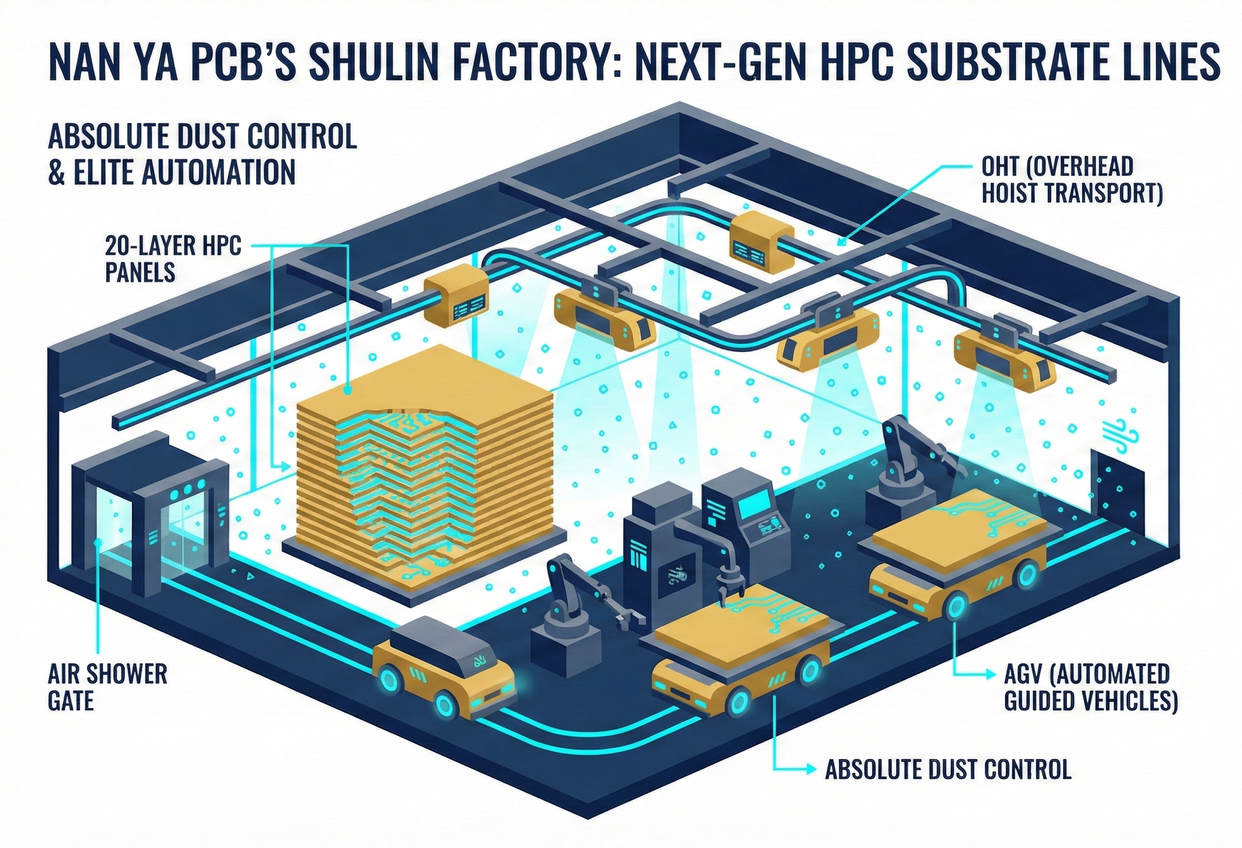
- Extreme Micro-dust Control: To combat the "micro-dust curse" of large-area substrates, the new Shulin plant introduced the industry's highest-grade cleanroom specifications and fully automated material handling systems (AGV/OHT) to minimize human intervention-induced contamination.
- Specialization in High Layer Counts and Large Areas: The equipment configuration at the Shulin plant was designed from the outset to produce extremely large, high-end ABF substrates with 16 to 20 layers or more. The commissioning of this new plant signifies Nanya PCB's official acquisition of the hard power to challenge Unimicron and the two Japanese giants at the top-tier AI substrate table.
⚔️ Chapter Four: Differentiated Counterattack — Avoiding Direct Competition in GPUs, Focusing on AI Networking and ASICs
This represents Nanya PCB's most intelligent strategic pivot. In the business arena, rather than fiercely competing in the GPU domain where others have already established dominance, it's wiser to bring the battle back to its "absolute home turf."
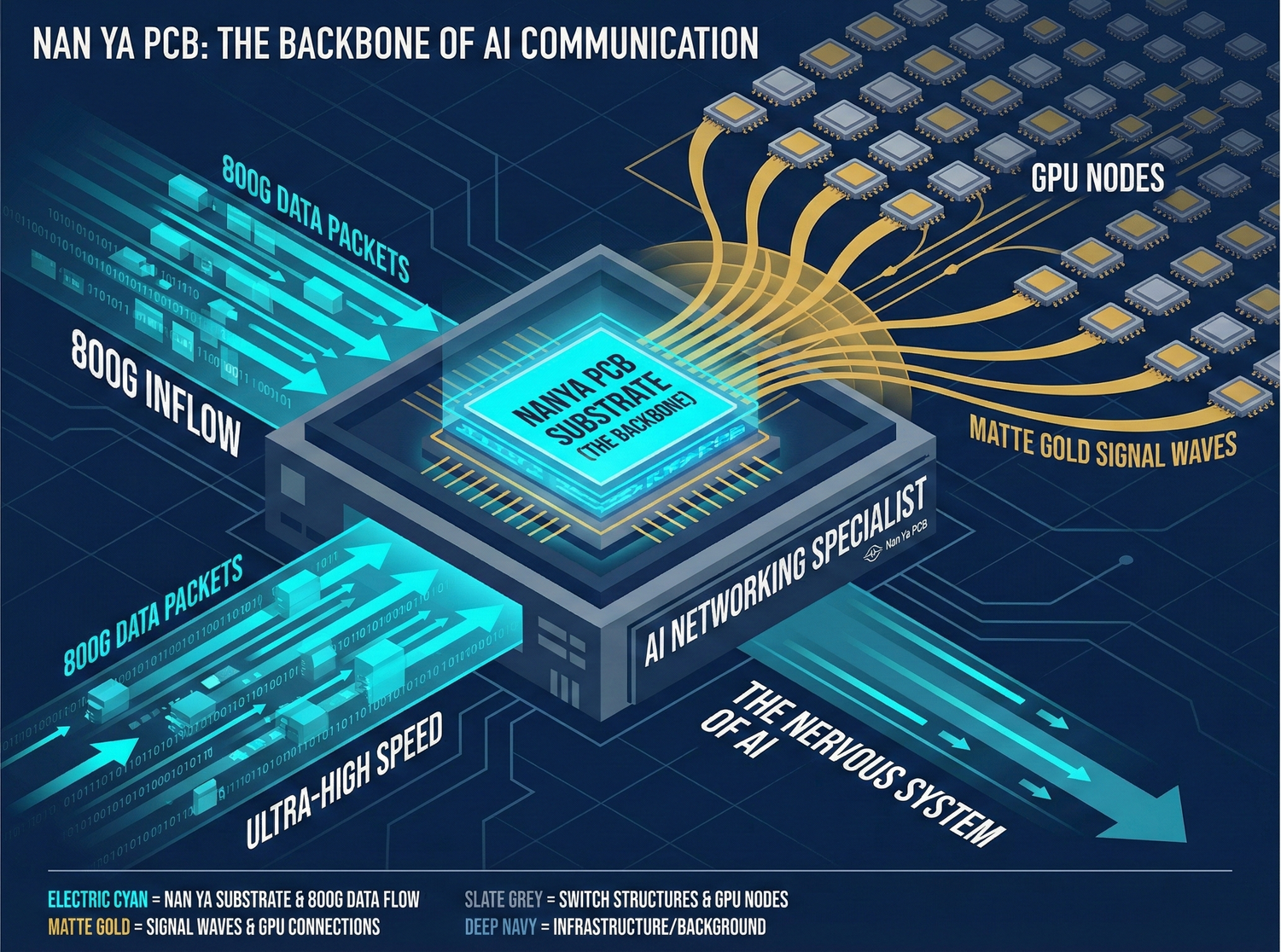
AI servers not only require GPUs for "computation" but also demand extremely massive data "transmission." When tens of thousands of GPUs are computing simultaneously within a data center, they must communicate with each other via ultra-high-speed networks. This has given rise to another explosive market: high-end AI networking equipment.
- Dominator of 800G Switches: To support the massive data traffic of AI, data center switches are undergoing a comprehensive upgrade from 400G to 800G and even future 1.6T. These high-end switch chips similarly require extremely large-area, ultra-high-layer-count ABF substrates. This is precisely Nanya PCB's core business, cultivated for over a decade! Leveraging its unparalleled experience in "high-frequency, high-speed signal control" on networking substrates, Nanya PCB easily captured the most lucrative profits from this wave of AI networking upgrades.
- Harvester of ASICs (Application-Specific Integrated Circuits): As we previously mentioned, cloud giants (such as AWS, Google, etc.) are aggressively developing their own AI ASIC chips to reduce their dependence on NVIDIA. The designs of these ASIC chips are diverse and have extremely high customization requirements for substrates. Leveraging its newly commissioned Shulin plant capacity, Nanya PCB successfully avoided the GPU red ocean and instead deeply integrated with these CSPs (Cloud Service Providers), becoming a core supplier of AI ASIC substrates.
🛡️ 4-1-5 Strategic Summary: The Formosa Plastics Group's Ultimate Foundation of Vertical Integration
In the future substrate business battles, Nanya PCB might not be the one rushing to the front or making the most noise, but it will certainly be the "heavy infantry with the longest endurance and strongest defense." This confidence stems from the Formosa Plastics Group's irreplaceable advantage of "vertical integration."
While global substrate manufacturers are scrambling due to shortages of upstream glass fiber cloth, copper foil, or special resins, and are even forced to accept price increases from suppliers, Nanya PCB only needs to turn to its parent company, Nanya Plastics, which can provide the most stable and lowest-cost support for basic chemical materials.
Nanya PCB's breakthrough formula is very clear:
Endure the inventory destocking pains of traditional PCs and networking $\rightarrow$ Utilize the cutting-edge capacity of the new Shulin plant to overcome large-area yield barriers $\rightarrow$ Launch a differentiated surprise attack in the AI networking (800G Switch) and customized ASIC fields.
As long as AI infrastructure construction extends from "pure computation (GPU)" to "massive transmission (Networking)," Nanya PCB's golden era is just about to restart.
In-depth Research · Quantitative Perspective
Want to gain more insights into semiconductor quantitative research?
[Insight Subscription Plan] Bid Farewell to Retail Investor Mindset: Build Your Alpha Trading System with "Quantitative Chips" and "Consensus Data"EDGE Semiconductor Research
📍 Series Map — Navigate the Complete EDGE Semiconductor Research →


