4-2-2 The Hegemon's Formidable Moat —— Elite Material (2383)'s Halogen-Free Offensive and M8 Absolute Dominance
Elite Material (2383), using its "halogen-free" formula, solved M8 PPO brittleness in HDI, securing ~70% AI GPU board monopoly. With 40% capacity, it earns "asymmetric super-profits" exceeding rivals. Yield/cost advantages secure dominance against second-source fears, launching next-gen M9 (EM-89...
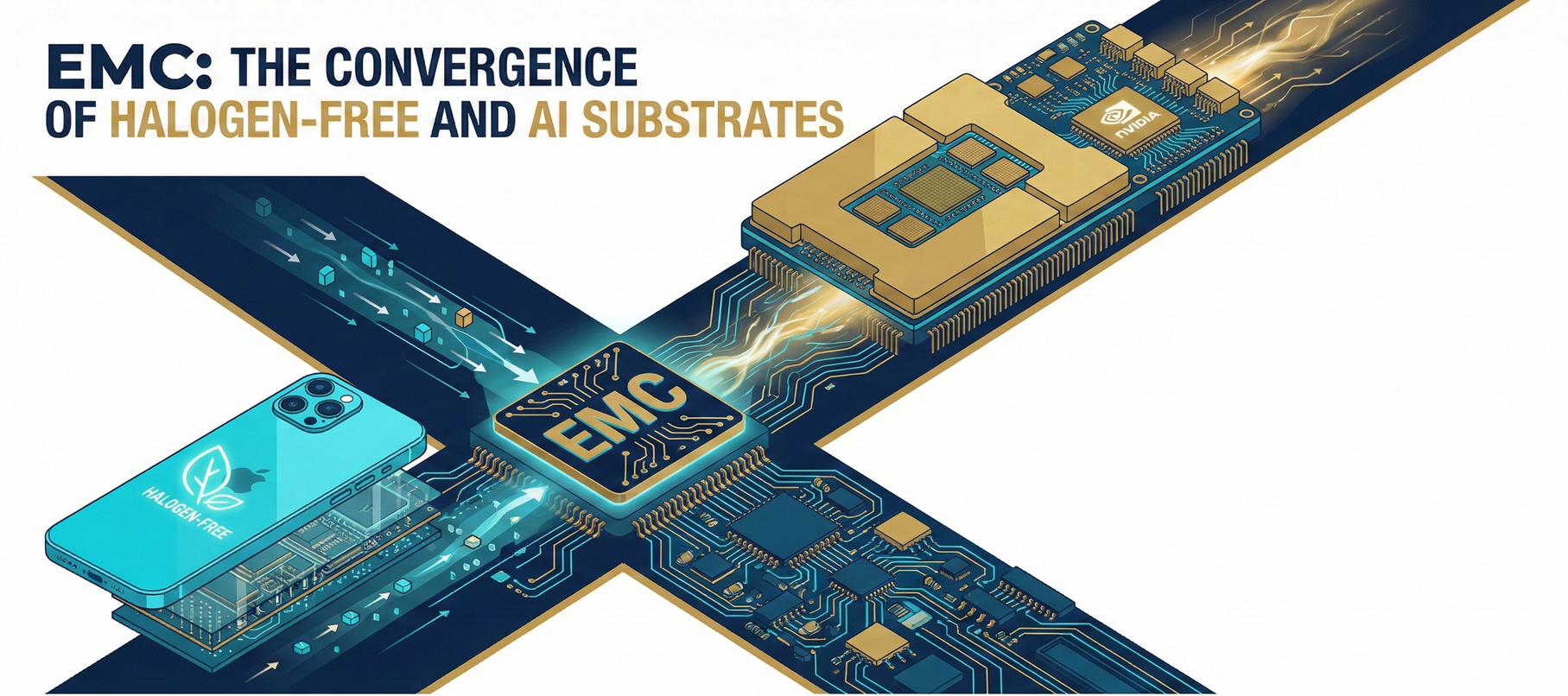
In the long history of semiconductor materials, "domination" often relies not just on heavy R&D investment, but on a fateful "convergence of technologies."
When we examine the current global market share landscape for AI server CCL (Copper Clad Laminates), Elite Material (EMC) is undeniably a presence that instills despair in its competitors. In the NVIDIA H100 and B200 generations, Elite Material has captured a staggering market share of approximately 70% in the highest-grade M8 level materials.
How can a CCL manufacturer in Taiwan command such reliance from Jensen Huang's AI empire? The answer must begin with a "fastidious requirement" from Apple more than a decade ago.
🍏 Chapter One: It Began with Apple's Fastidious Requirement — A Decade of Halogen-Free Development
For a long time, CCL manufacturers, to address the issue of circuit boards "easily catching fire," would add "Halogen" to their resin formulations as a flame retardant. This practice was inexpensive and effective, serving as the industry's standard formula.
However, Apple, in its pursuit of extreme environmental friendliness, issued a strict mandate: All HDI (High-Density Interconnect) mobile phone motherboards entering Apple's supply chain must be 100% "Halogen-free."
At the time, this was a tremendous chemical challenge. Removing halogen drastically alters the resin's properties, making the boards prone to moisture absorption and extremely susceptible to brittle cracking during lamination. Many traditional large CCL manufacturers chose to give up, but Elite Material decided to persevere. After a decade of arduous research and development, Elite Material successfully formulated a globally unique "halogen-free environmentally friendly resin formula," thereby becoming the undisputed leader in HDI substrate materials for smartphones worldwide.
At that time, Elite Material was labeled in the industry as the "king of mobile phone board materials," with no one associating it with "servers" or "supercomputers."
⚡ Chapter Two: The Fateful Intersection — When AI Servers Met HDI
Fast forward to 2023, and AI computing power exploded. NVIDIA's GPU performance grew exponentially, but this also introduced an extremely tricky hardware problem: the wiring on the OAM (Accelerator Module) and UBB (Universal Baseboard) underneath the GPU was simply too dense.
Failure of Traditional Server Boards: Traditional server motherboards use mechanical drills to "penetrate" the entire board for electrical conduction (PTH plated through-hole). However, in AI servers, GPU pins are extremely dense; if traditional drills were used to create holes, the board would shatter like a honeycomb, making it impossible to lay out circuits.
Servers Forced to Adopt Mobile Phone Technology: To pack an enormous number of micro-fine lines into an extremely small area, AI server motherboards were compelled to adopt HDI (High-Density Interconnect) technology, originally used only in high-end mobile phones, shifting to "laser blind and buried via" for layer-by-layer lamination.
This was the moment Elite Material experienced a "divine beginning."
👑 Chapter Three: The Perfect Solution for Both Low Loss and HDI
Please recall the concept we discussed in [4-2-1 Physics Edition]: AI servers require Ultra Low Loss M7 or M8 materials, which means using PPO resins that are extremely difficult to process.
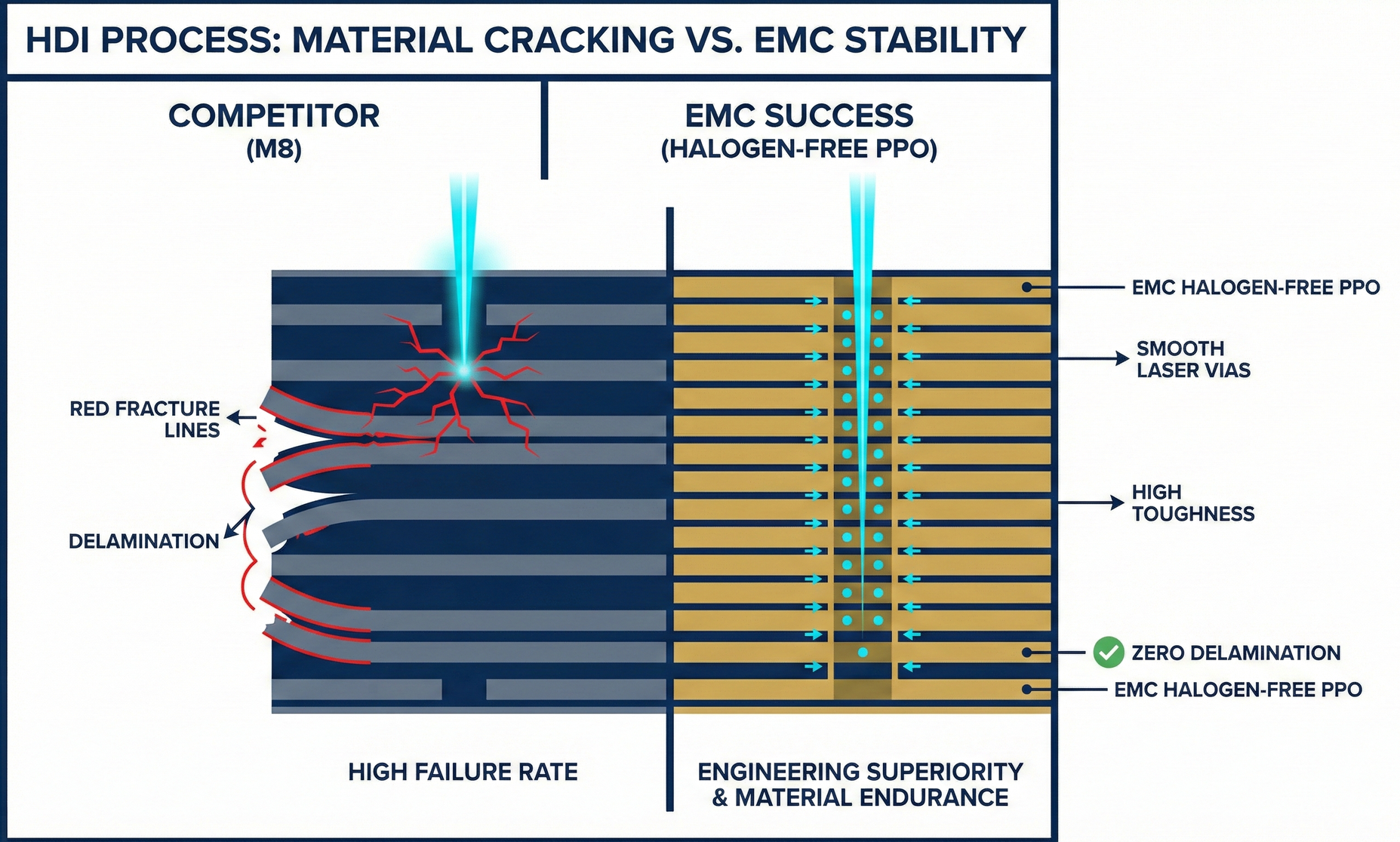
When traditional major server CCL manufacturers (such as Japan's Panasonic and Taiwan's ITEQ Corporation) enthusiastically presented their proud M8 materials, ready for use in AI server HDI processes, disaster struck. They discovered that traditional M8 materials experienced rampant delamination, stratification, and cracking when subjected to the rigorous HDI process of "multiple laser drilling and repeated high-temperature lamination."
At this point, NVIDIA's engineers turned and saw Elite Material. Elite Material presented their "halogen-free formula," refined over a decade, perfectly combined with M8-grade PPO resin. This proprietary chemical cross-linking technology created an industry miracle: this board not only achieved an ultra-low signal loss of Df < 0.002, but it was also extremely robust, perfectly adapting to the multiple high-temperature lamination processes of HDI!
This was no coincidence; it was a dimensional strike. Elite Material directly applied its decade-long accumulated halogen-free lamination expertise from the mobile phone HDI sector to AI giant server boards requiring HDI processes, instantly outcompeting all traditional server material manufacturers. This chemical moat is so deep that competitors, even with identical raw materials, cannot achieve the same yield rates.
💰 Chapter Four: Asymmetric Super-Profits — Earning More with 40% Capacity Than the Rest Combined
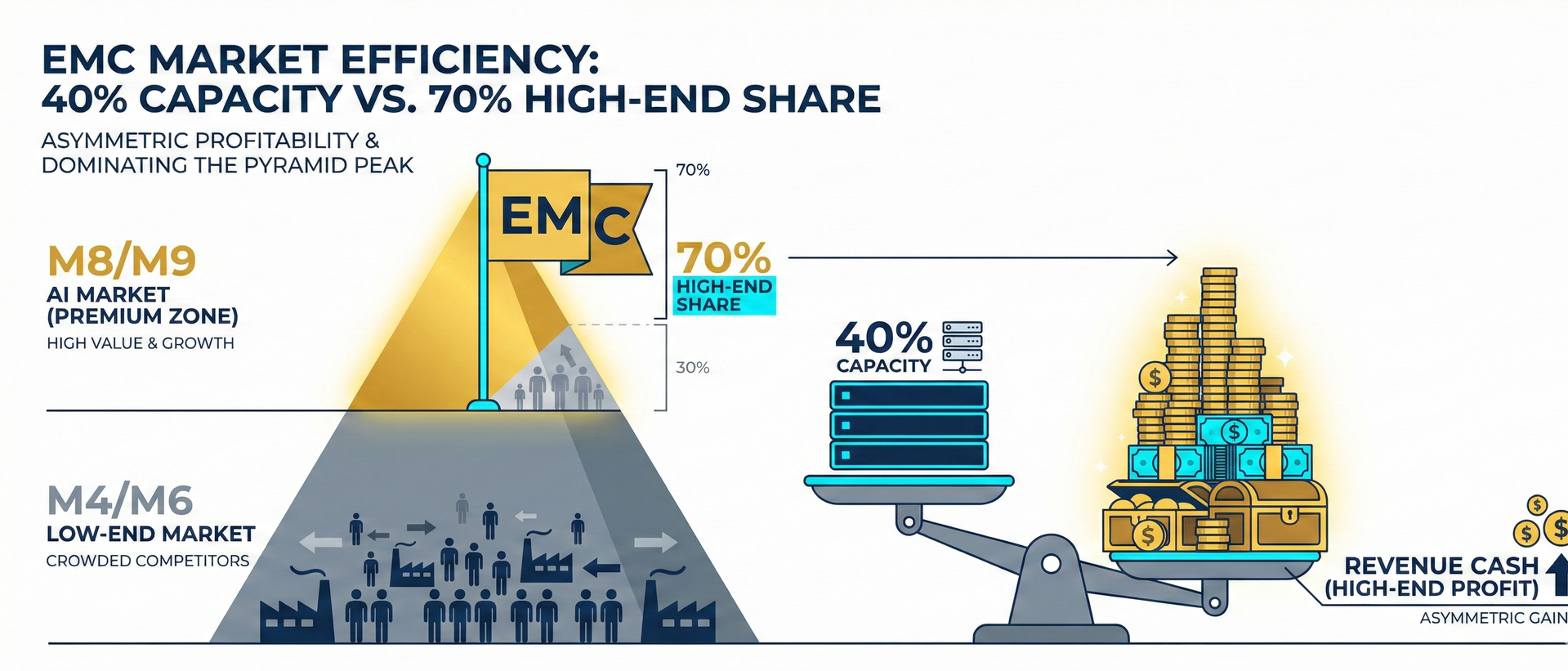
To measure a company's monopoly in an industry, one cannot solely look at "capacity," but rather the "efficiency of converting capacity into revenue." In the current competitive landscape of the top four global high-end CCL suppliers (Elite Material, TUC, Panasonic, Doosan), Elite Material demonstrates textbook "asymmetric super-profits."
Terrifying Data Comparison: According to the latest industry assessment, Elite Material's capacity accounts for only approximately 40% among these "four titans." However, in the 2024 full-year revenue settlement, Elite Material alone generated revenue that was "10% higher than the combined total" of the other three competitors!
Underlying Logic: Monopolizing the Most Profitable Segment. Why can a company with less than half the capacity dominate in revenue? Because Elite Material virtually monopolizes the very top of the pyramid—the most expensive M8 grade materials—with a market share of approximately 70%.
While peers are engaging in price wars for M6 or even M7 level orders, Elite Material exclusively supplies OAM/UBB substrates for NVIDIA GPUs and top-tier ASICs with extremely high gross margins. This "top-of-the-food-chain" pricing power is currently unattainable for other CCL manufacturers.
🤔 Chapter Five: The Myth of the Second Source and the Basis of Our Defense
Of course, no business maintains a monopoly forever. With the AI server market's TAM (Total Addressable Market) projected to surge another 35% from 2025 to 2026, reaching a staggering $2.5 billion, voices of extreme concern have begun to emerge: "Cloud giants will surely foster second sources to drive down prices, so is Elite Material's market share about to collapse?"
This is a business reality that must be confronted, but market panic is overly amplified.
1. Why is a Second Source Essential? Project Scale is Too Large to Bear Risk
In the era of traditional servers, the CCL procurement amount for a single project was at most around $100 million; but in the era of AI mega-chips, the CCL procurement amount for a single top-tier project has directly surpassed $500 million! Facing such massive sums and delivery pressures, CSPs (Cloud Service Providers) cannot possibly stake everything on one supplier to prevent supply chain disruptions; a multi-vendor sourcing strategy is an inevitable trend.
2. Elite Material's Confidence: Yielding the Edges, Guarding the 70% Absolute Core
As we track the supply chain, we have indeed found that, for example, on AWS's Trainium chip project, as specifications gently upgrade from M8.3 to M8.5, Elite Material's market share may slightly decrease from the original 70%~80% to 60%~70%. But please note that even with the introduction of South Korea's Doosan or TUC to share orders, Elite Material, as long as it deems the project strategically valuable, can still firmly secure an absolute dominant share of over 70%.
3. Yield Rate is the Real Devil: Competitors May Get Orders, But Not Necessarily Make Money
This is the most brutal truth. AI server motherboards are progressing towards 18 to 26 layers, and even structures exceeding 30 layers in the future. Additionally, future designs will necessitate the use of mixed materials (Hybrid materials) for lamination, which will lead to a staggering decline of over 10 percentage points (10ppts) in the overall manufacturing yield rate for PCB factories. The poorer the yield, the more boards are scrapped; the more scrap, the more CCL materials PCB manufacturers will need to consume for rework.
In this "yield rate purgatory," Elite Material's unit cost control is more than 5 percentage points ahead of its peers, and its materials exhibit excellent compatibility with HDI lamination processes, making downstream PCB manufacturers more willing to prioritize Elite Material's materials. Even if competitors obtain Second Source qualification, they often face yield rate bottlenecks that prevent them from smoothly converting capacity into cash.
☢️ Chapter Six: The Next-Generation Nuclear Catalyst — M9 Ultimate Material and the 40-Layer Board Limit
The evolution of technology is relentless; the M8 crown has barely settled before the M9 war has already begun.
This post is for subscribers only
Sign up now to read the post and get access to the full library of posts for subscribers only.