
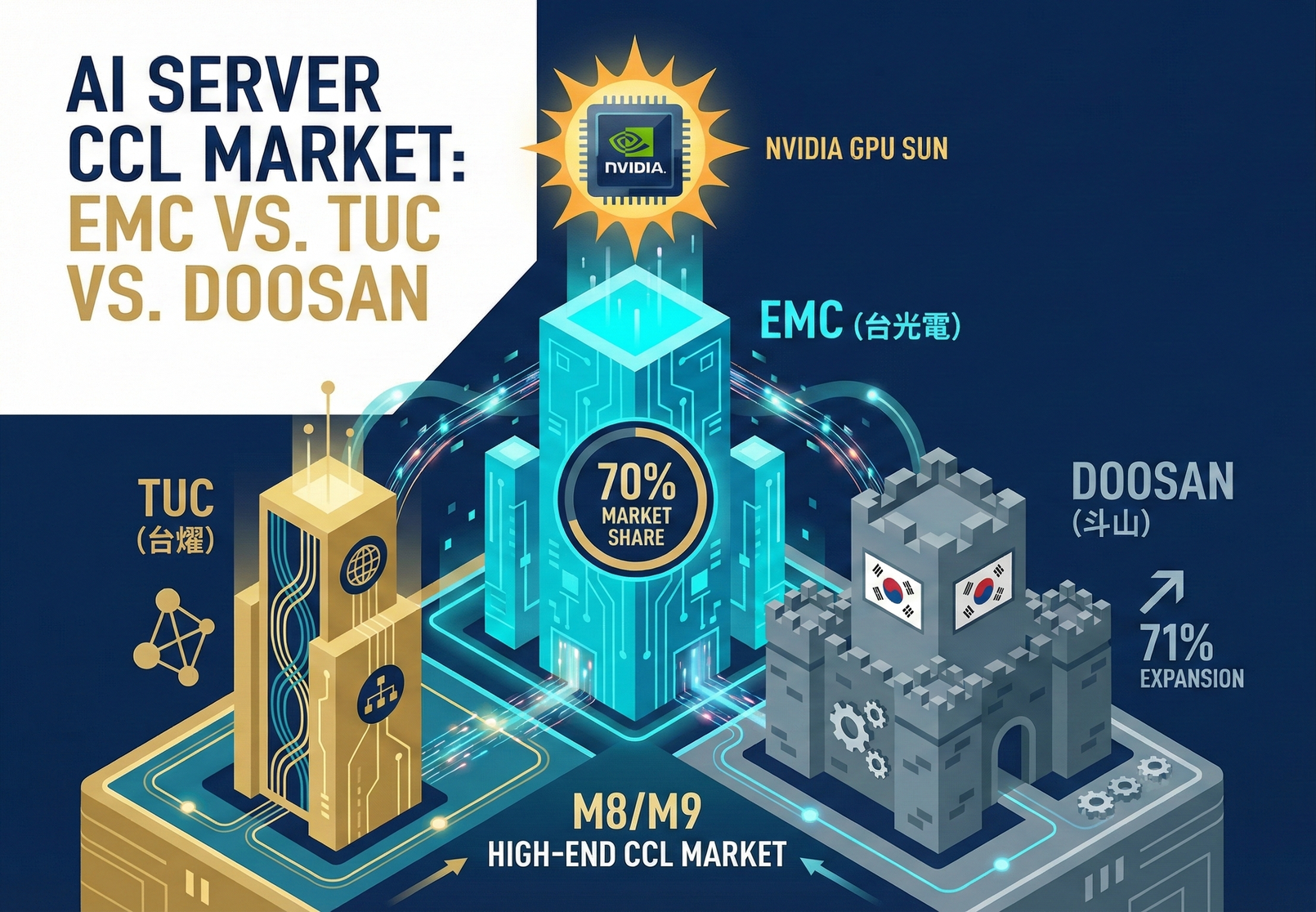
While we marveled at Elite Material (EMC)'s formidable 70% market share in M8 high-end materials in our previous article, we must now shift our perspective to that of AI titan NVIDIA.
If you were Jensen Huang, when the procurement cost for copper clad laminates (CCL) for a single AI server project (such as GB200 NVL72) directly exceeds $500 million, would you allow one supplier to hold 80% of your throat? The answer is absolutely not. "Cultivating strong second sources to create a cruel balance of price and production capacity" is an immutable law in the hardware supply chain.
In this balancing act, two wolves are particularly vexing Elite Material: one is Taiwan's second-largest player with a strong networking background, Taoyo (TUC, 6274.TW), and the other is the Korean state-capital-backed giant, Doosan.
Let's first look at how Taoyo launched its counterattack from its "absolute home ground" in Taiwan.
🌐 Chapter One: The Networking Champion's Foundation — Competing on "Transmission", Not Computation
If Elite Material has dominated the "GPU compute board (OAM/UBB)" market with its halogen-free formulas for smartphone HDI, then Taoyo's confidence stems from its more than ten years of deep cultivation in the "high-frequency, high-speed networking board (Networking)" sector.
In the world of AI clusters, for tens of thousands of GPUs to work collaboratively, an extremely massive and complex network data transmission is required. At this point, the high-end switch responsible for signal transmission becomes critical in determining whether computing power can be fully utilized.
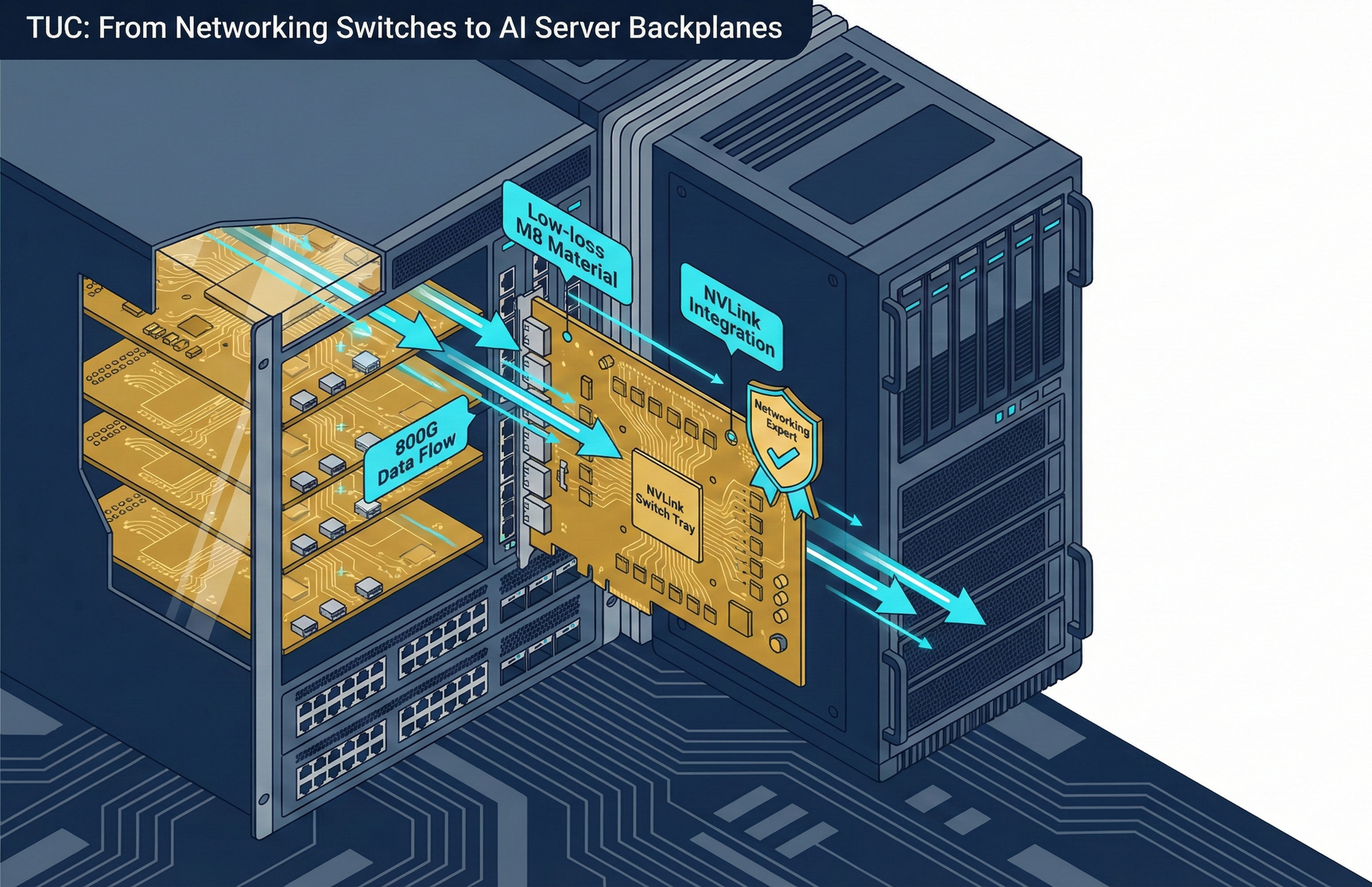
- Veteran in Ultra-Low-Loss: Taoyo entered the data center backplane and switch market very early. These networking boards are characterized by "extremely high layer counts and very long signal traces," demanding extremely stringent "low signal loss (Low Loss)" from materials. Taoyo has long accumulated profound fundamental expertise in Ultra-Low-Loss (M7 level) and Extreme-Low-Loss (M8 level) resin material formulas.
- Golden Home Ground for 800G Switches: As AI drives network specifications from 400G to 800G (and even 1.6T in the future), the CCL materials inside switches must be fully upgraded to M8 level. This is exactly the battlefield where Taoyo is most familiar and boasts the highest yield rates! In this field, Taoyo has not only not fallen behind but also holds extremely high market share and customer trust.
⚔️ Chapter Two: Counterattacking Servers from Switches — Taoyo's "Encirclement Strategy"
Taoyo's senior management is very shrewd; they understood that directly confronting Elite Material on GPU baseboards (UBB/OAM) would not only entail facing patent barriers for HDI processes but also risk becoming a victim of ruthless price wars. Therefore, Taoyo adopted a circuitous strategy of "encircling computation from networking":
1. Dominating NVLink Switch Trays
In NVIDIA's latest GB200 NVL72 super-rack, in addition to compute trays for GPUs, there are up to nine dedicated NVLink Switch Trays responsible for chip interconnection. These switch boards are enormous in area, have extremely high layer counts, and require top-tier M8 materials. Leveraging its strength as a networking champion, Taoyo successfully secured a significant share as a second source (and even primary supplier in some projects) for this highly valuable component.
2. Breakthrough in AI ASIC Servers
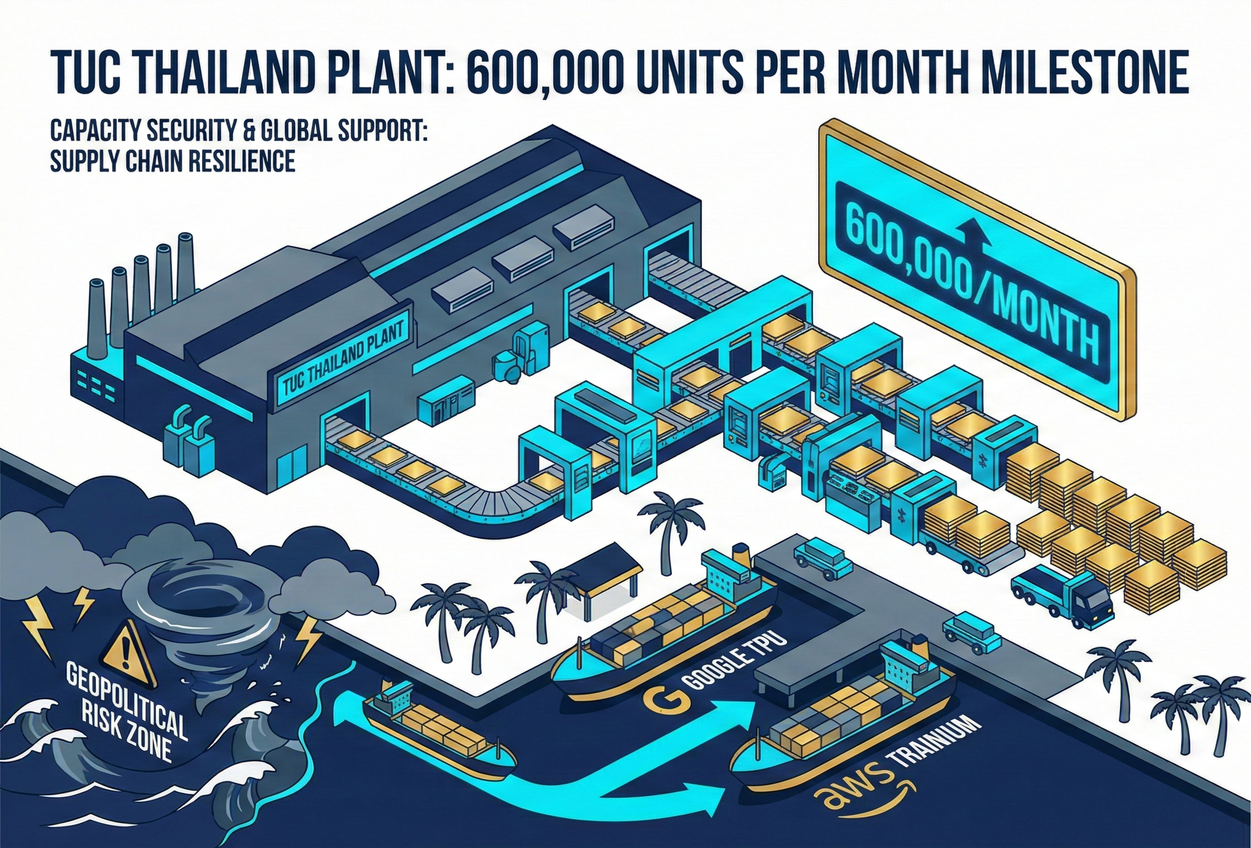
Beyond NVIDIA, global cloud giants (such as Google TPU, AWS Trainium, and Meta MTIA) are furiously developing their own AI ASIC chips. The substrate designs for these customized chips are diverse and flourishing. Taoyo is aggressively pushing its M8 and M7 series high-end materials into the certification systems of these Cloud Service Providers (CSPs), expecting significant volume ramp-up in the second half of 2025.
🏭 Chapter Three: Major Expansion in Thailand — The Production Capacity to Ride the AI Wave
To be a qualified second source in the AI era, technology alone is not enough; you must also possess "massive production capacity that reassures customers" and a strategy for "diversifying geopolitical risks."
- Capacity Leap: To accommodate the massive orders for 800G switches and AI servers, Taoyo is not only continuously optimizing its production lines in Taiwan and China (Kunshan, Dongguan) but has also heavily invested in a new factory in Thailand.
- Confidence for 600,000 Sheets: The Thailand factory is slated for trial production in Q2 2025, officially entering mass production in Q4, with plans to double its capacity from an initial 300,000 sheets per month to 600,000 sheets/month.
- This new Thailand factory is Taoyo's ultimate statement of confidence to NVIDIA and US cloud giants: "Not only do I possess M8-level technology, but I also have massive overseas production capacity, undisturbed by the US-China trade war, ready to provide full support for your AI computing power at any time."
Financially, Taoyo's revenue year-over-year growth for the first three quarters of 2025 reached an impressive 26.6%, with gross profit margin stably holding at a high of 25.7%. This networking material champion has officially secured its ample chips at the high-end CCL table for AI servers.
🇰🇷 Chapter Four: NVIDIA's Geopolitical Insurance Policy — Korean Giant Doosan
Amidst the frenzy of AI chip shortages, what is NVIDIA's greatest fear? Not competition from AMD, but "geopolitical risk."
When over 80% of the world's high-end AI server CCL materials are controlled by Elite Material and Taoyo in Taiwan, any ripple in the Taiwan Strait would instantly break Jensen Huang's AI empire supply chain. Therefore, finding a supplier of "non-Taiwanese origin, possessing profound financial strength and technological expertise" has become NVIDIA's highest guiding principle for supply chain management.
Doosan Corporation Electro-Materials, representing Korea's national capital, has thus perfectly positioned itself at this strategic inflection point.
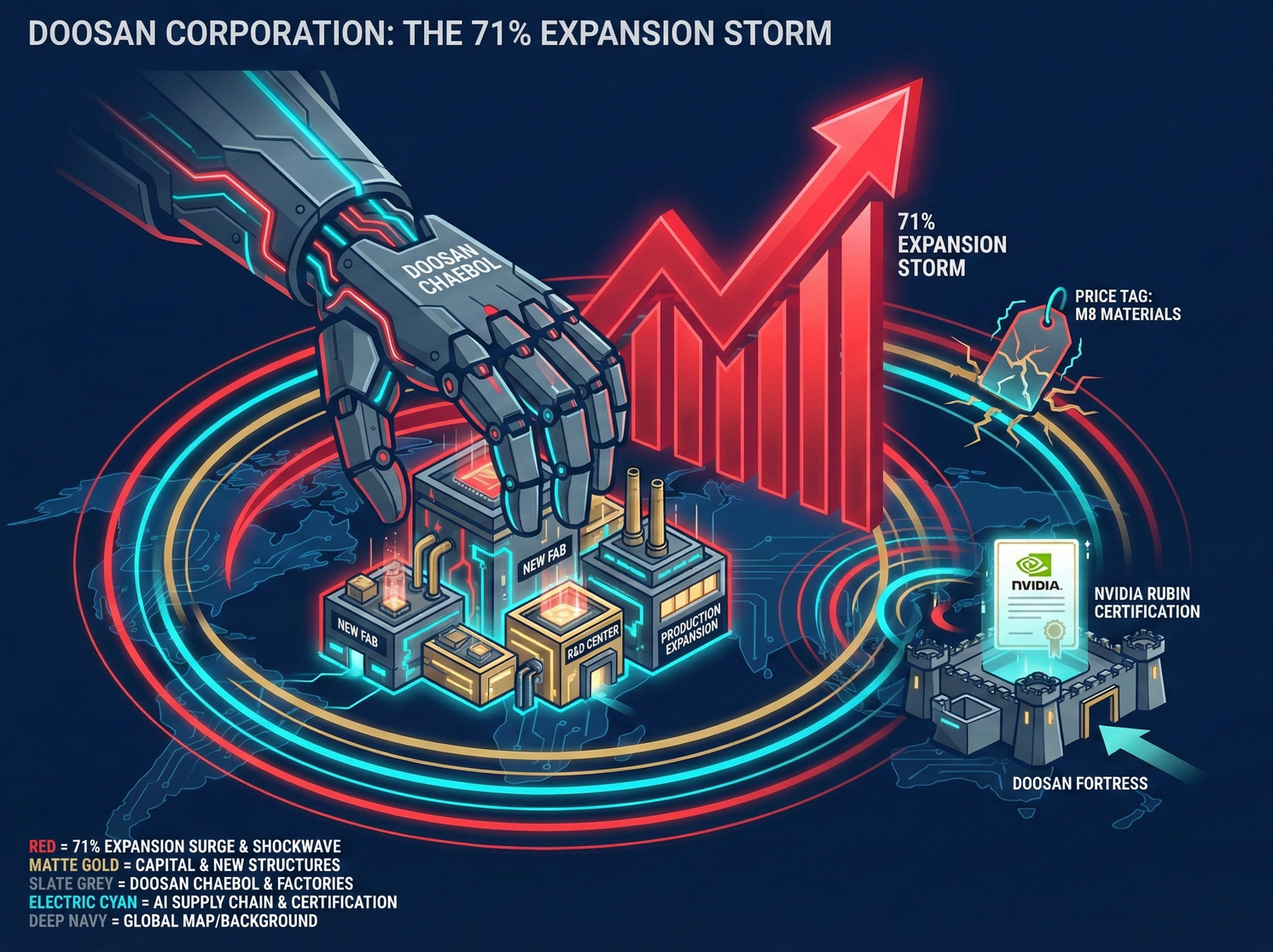
- Chaebol-level Capital Support: CCL is an extremely capital-intensive industry. As one of South Korea's top-tier chaebols, the Doosan Group not only possesses its own chemical resin R&D centers but also has unparalleled capital deployment capabilities. While manufacturers in Taiwan are meticulously calculating depreciation and expansion risks, Doosan can directly leverage group resources to launch a "saturation attack" that disregards short-term losses.
- Under-the-Radar Development of M8 Materials: Over the past few years, Doosan has maintained low-key R&D in high-frequency materials at Ultra Low Loss (M7) and Extreme Low Loss (M8) levels. Leveraging its experience in substrate materials accumulated from serving South Korea's memory giants (Samsung, SK Hynix), it successfully overcame the processing challenges of high-end PPO resins and secured an entry ticket to NVIDIA's laboratories.
🌪️ Chapter Five: The Order Grabbing Storm for GB300 and Rubin Platforms
Next is the shockwave from the forefront of the supply chain. Doosan's threat is no longer theoretical but a real-world scramble for orders.
From late 2024 to early 2025, while Elite Material and Taoyo in Taiwan were fully stretched, struggling to cope with immense B200 and GB200 orders, NVIDIA quietly gave the green light to Doosan in its next-generation development projects.
- Strategic Window of Opportunity: According to reliable supply chain intelligence, during the specification definition period for the upcoming GB300 (an upgraded version of B200A) and the ultimate weapon, the Rubin platform, expected to launch in 2026-2027, NVIDIA significantly increased the certification weight and testing priority for Doosan's materials.
- Underlying Logic of Order Grabbing: Why does NVIDIA dare to let Doosan in? Because the Rubin architecture will challenge the physical limits of 30 to 40-layer boards. NVIDIA must leverage Doosan's involvement to compel Elite Material to offer more favorable quotes, while also ensuring sufficient "material spares" to compensate for scrapped losses during the initial trial production phase when yield rates are extremely low.
💥 Chapter Six: Horrific 71% Capacity Surge — The Tectonic Shift of 2026
Merely acquiring a few certifications is not enough to constitute a storm. What truly sent shivers down the spines of Taiwan's two CCL giants is Doosan's subsequent announcement of its expansion plan.
- 71% Capacity Monster: According to Doosan's recent capital expenditure strategy, they anticipate a substantial expansion of their total high-end CCL production capacity by a staggering 71% before the end of 2026!
- What does this mean? This expansion is definitely not for South Korea's domestic networking demand. This staggering 71% of new capacity is every inch aimed at AI server orders from NVIDIA and US cloud giants (CSPs). When this massive wave of capacity is unleashed onto the market like a caged tiger in late 2026, it will undoubtedly exert highly destructive pricing pressure on global high-end M8 and even M9 level CCL quotes.
📊 4-2-3 Strategy Summary: A "New Three Kingdoms Era" with One King and Two Strong Contenders
【4-2-3 Caught Between a Networking Champion and a Korean Dark Horse】concludes here.
We now understand that the AI server CCL material market is evolving from an oligopoly dominated by Elite Material to a brutal "Three Kingdoms" battle with "one king (Elite Material) and two strong contenders (Taoyo, Doosan)."
- Elite Material (Defender): Holding a 70% baseline market share and a yield rate moat, it is trying to shake off pursuers with more advanced M9 (EM-896K3) and CPX copper cable backplanes.
- Taoyo (Attacker One): Leveraging its home ground advantage in 800G networking switches and the confidence of its 600,000-sheet capacity from the new Thailand factory, it is launching a circuitous encirclement from NVLink Switch and ASIC projects.
- Doosan (Attacker Two): Armed with Korean chaebol capital and NVIDIA's "insurance policy" advantage for diversifying geopolitical risk, it is making a forceful entry into the GB300 and Rubin supply chains with a terrifying 71% capacity surge.
In this highest-specification M8/M9 battlefield, only giants with extreme financial power and chemical expertise are qualified to remain at the table.
In-depth Research · Quantitative Perspective
Want to gain more insights into semiconductor quantitative research?
【Insight Subscription Plan】Bid Farewell to Retail Investor Mindset: Build Your Alpha Trading System with "Quantitative Chips" and "Consensus Data"EDGE Semiconductor Research
📍 Series Map — Navigate the Complete EDGE Semiconductor Research →


