
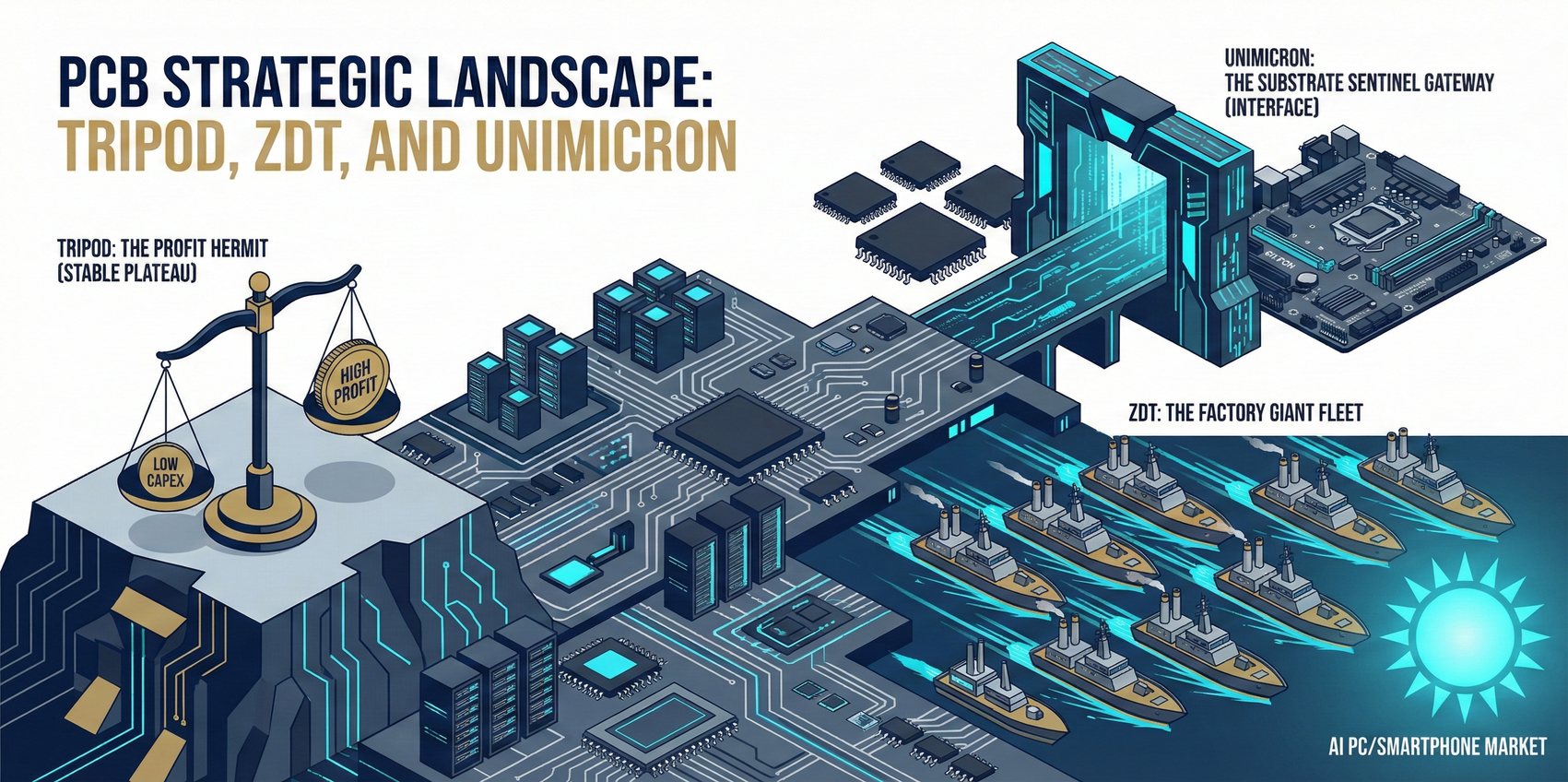
On the battlefield of AI server PCBs, everyone is frantically chasing NVIDIA's GPU compute boards (UBB/OAM), even investing over 20% of annual revenue in capital expenditure to expand factories and secure orders. Amidst this clamor, one company stands out. It hasn't even secured any core NVIDIA AI motherboard orders, yet institutional investors are exclaiming that its "profit growth performance is no different from that of AI leaders."
This is Tripod Technology (3044.TW), an ultimate management master known as the "profit reclusive" in the PCB industry.
🧗 Chapter One: The "Reverse Aesthetics" of the AI Era — Avoiding Reefs, Silently Making a Fortune
While peers (such as GCE Holdings and Compeq) are grappling with the ultra-high difficulty technologies (44-layer boards, 5-stage HDI) for Rubin or Blackwell platforms, and even facing the risk of gross margins being dragged down by depreciation due to the rush for capacity, Tripod Technology has chosen a path that appears ordinary but is in fact extremely clever.
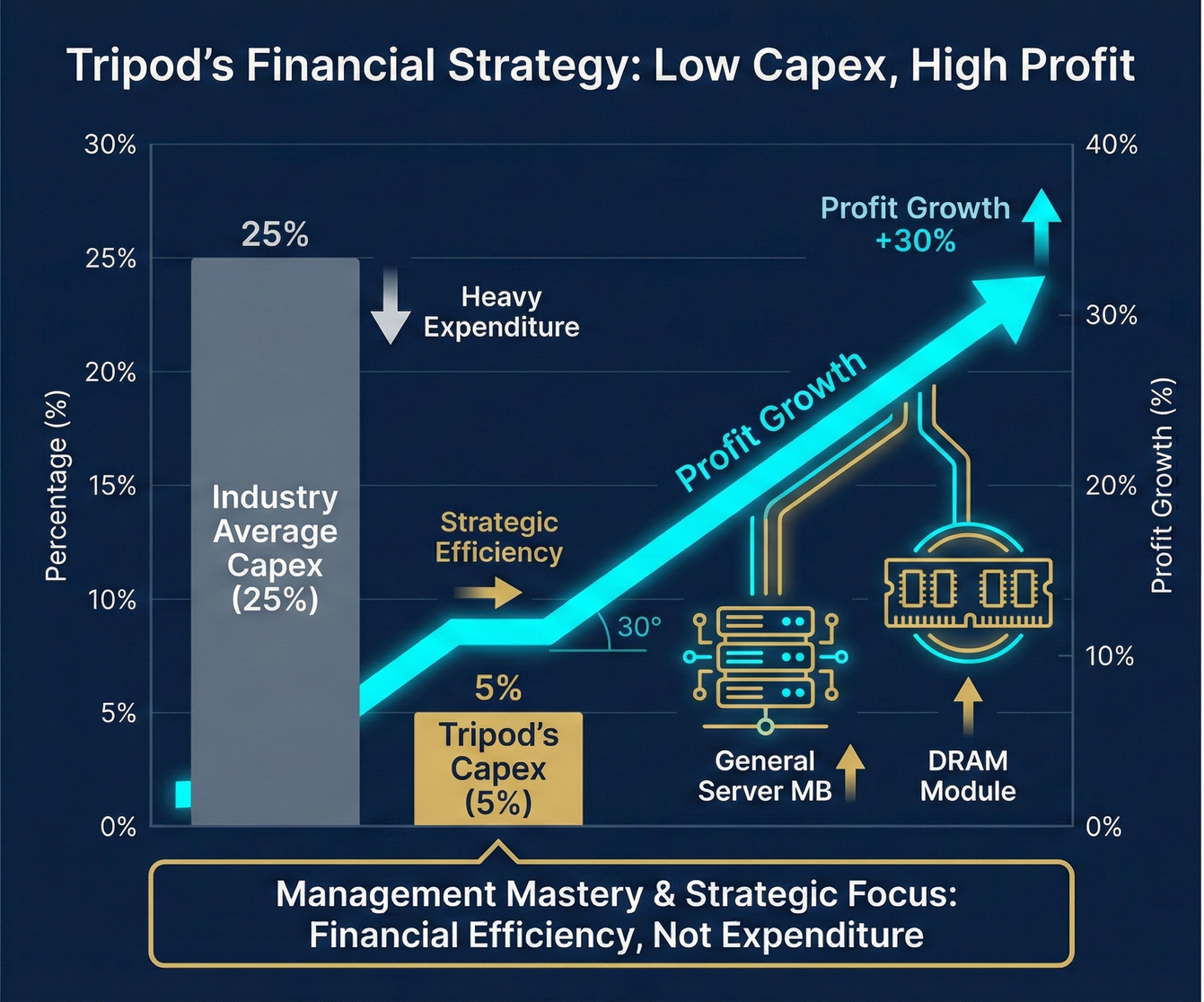
- AI-like Profit, No AI Risk: According to the latest production survey data, although Tripod Technology has lower exposure to AI server core mainboards, its earnings compound annual growth rate (CAGR) for 2023-2025 is as high as 30%. This growth rate is comparable to that of competitors with a full slate of AI orders.
- The Miracle of Ultra-Low Capital Expenditure: This is what makes competitors envious. In the current AI PCB manufacturing chain, to cope with demanding specifications, manufacturers often invest 20-25% of their annual revenue in laser drilling machines and laminating presses. Tripod Technology's capital expenditure ratio, however, has consistently remained around 5%.
- The Logic is Simple: Tripod Technology doesn't compete in the high-difficulty, low-yield "high-wire acts." Instead, it chooses to take on the "big tonic" projects — those that are technically mature, high-volume, and offer stable profits, which have been abandoned by competitors.
🧠 Chapter Two: The Invisible Overlord of General-Purpose Servers — The Pricing Power of the "Bargain King"
Why can Tripod Technology earn AI-level super-profits? The answer lies in the general-purpose server and memory (DRAM) landscape.
- Dividend from Competitors' Retreat: When dominant players like GCE Holdings shifted all their high-end capacity to produce NVIDIA's UBB/OAM, a significant supply gap emerged in the original general-purpose server motherboards (Intel/AMD platforms).
- Quiet Monopoly of Market Share: Tripod Technology seized the opportunity to sweep the market, becoming the undisputed global leader in general-purpose server motherboards (35-40% market share) and server DRAM module PCBs (50-55% market share).
- Underlying Dividend from Specification Upgrades: The upcoming PCIe 6.0 upgrade wave in 2026 will lead to general-purpose server motherboards also upgrading to 20-24 layers (using M7 materials), significantly increasing their PCB value by 15-20%. Tripod Technology does not need to bear the R&D risks of AI; it can simply wait for this wave of specification upgrades to automatically boost its output value.
📈 Chapter Three: Gross Margins Driven by Management — High-Purity Profits Comparable to AI Projects
Tripod Technology's most crucial moat lies in its formidable "production efficiency" and "cost control."
- Astonishing Gross Margin: Conventional wisdom holds that general-purpose server board profits are certainly lower than AI servers. However, data disproves this: Tripod Technology's gross margin (GM) for general-purpose server PCBs is surprisingly around 35%, which falls within the same range as the profit levels of its AI peers producing top-tier AI substrates!
- Procurement Advantage as a Non-Mainland China Manufacturer: In the geopolitical context, Tripod Technology, as one of the few large non-Mainland Chinese PCB manufacturers, has gained high reliance from major U.S. cloud service providers (CSPs) and memory giants (such as Micron and Samsung). This "management premium" has allowed Tripod Technology to expand its gross margin by 7 percentage points since 2023 without incurring exorbitant capital expenditures, fully keeping pace with its AI peers.
🛡️ Chapter Four: The Behemoth's Strategic Pivot — From Smartphone Dominator to All-Round AI Armaments Supplier
To understand Zhen Ding Technology, one must first recognize its standing: according to Prismark statistics, Zhen Ding Technology has held the top position globally in PCB output value for eight consecutive years. For a long time, the market perceived Zhen Ding Technology as "the largest board supplier for iPhones," with up to 90% of its revenue historically relying on smartphones and consumer electronics.
However, amidst the AI wave, this elephant is pivoting at an extremely rapid pace:
- Dramatic Increase in AI Revenue Contribution: The proportion of Zhen Ding Technology's internal AI products (including server PCBs and substrates) has rapidly grown from a marginal 8% in 2023 to 45% in 2024. According to the company's latest strategic goals, this proportion is projected to further expand to 70% in 2025.
- Shedding the "Smartphone Manufacturer" Label: In January 2026, Zhen Ding Technology reported a record-high revenue of NT$13.56 billion for the same period. During the traditional off-season for smartphones, both its "server/optical communication" and "IC substrate" divisions saw their revenues grow by over 60% year-on-year, becoming the core engines driving this behemoth's acceleration.
💰 Chapter Five: A War Chest of Four Hundred Million US Dollars — Substrate Ambition and "Ten Factories Simultaneously"
Zhen Ding Technology deeply understands that to gain influence in the AI era, it cannot merely produce "boards"; it must penetrate the core of semiconductor packaging — IC substrates.
- Largest Fundraising in History: In September 2025, Zhen Ding Technology successfully issued overseas convertible bonds (ECBs) totaling an impressive US$400 million (approximately NT$13 billion). This became the largest fundraising effort by a Taiwan-based PCB manufacturer at the time.
- Targeting Substrate Capacity: This enormous war chest has been precisely directed towards expanding substrate capacity in Huai'an, Jiangsu, and Thailand. Zhen Ding Technology's ultimate strategic goal is to become one of the top five global substrate suppliers by 2030.
- "Ten Factories Simultaneously" Scale War: To meet AI demand, Zhen Ding Technology currently has 10 new factories in Huai'an, Thailand, Kaohsiung, and other locations simultaneously under construction or in the equipment installation phase. This "saturated expansion," launched with the group's financial strength despite short-term economic conditions, is a final positioning maneuver for the "scale dividends" anticipated after the full explosion of AI applications in 2026.
🕸️ Chapter Six: Foxconn Empire's System-Level Encirclement — The "Praetorian Guard" Advantage for GB200
Zhen Ding Technology's most formidable "invisible weapon" lies in its status as a core member of the Foxconn Group. This grants it a system-level advantage in the battle for NVIDIA's GB200 that other manufacturers find hard to match:
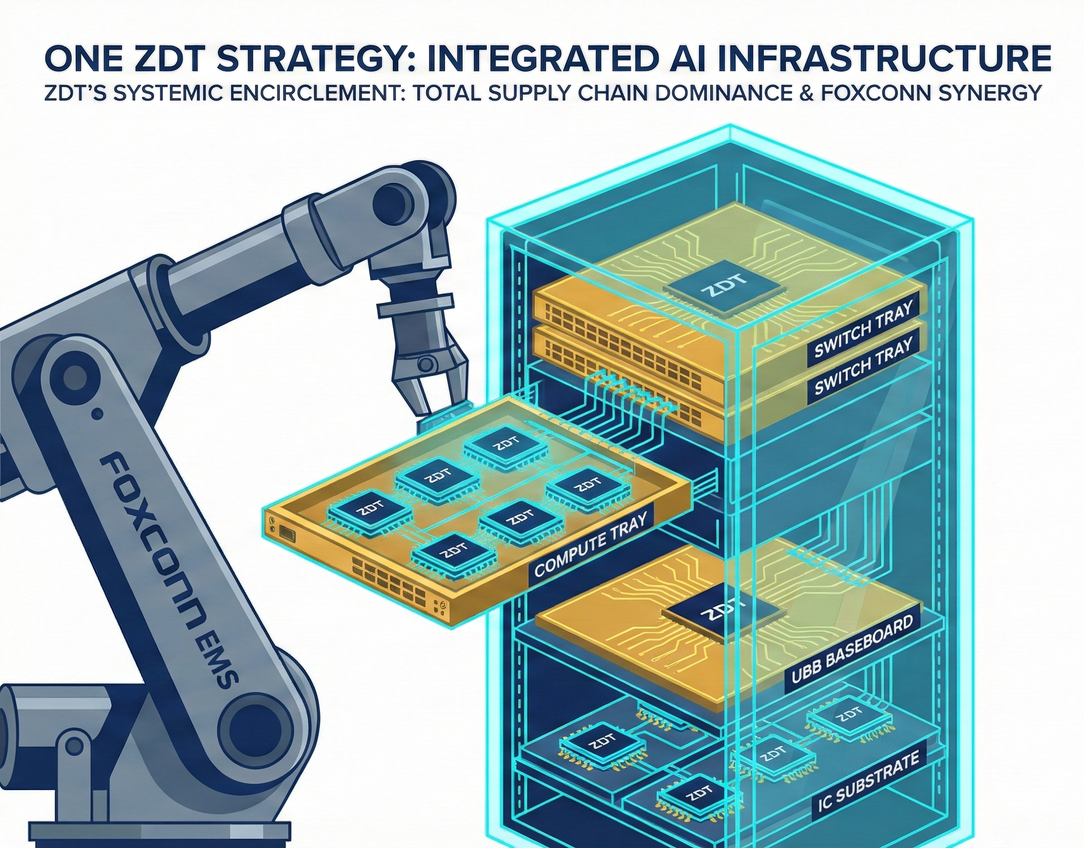
- One-Stop Shop (Integrated Solution): Zhen Ding Technology implements the "One ZDT" strategy, enabling it to simultaneously provide integrated technical solutions for AI servers, including OAM (Open Accelerator Module) and UBB (Universal Baseboard), and even covering MSAP (Modified Semi-Additive Process) and high-layer count HLC processes.
- Free-Rider Effect from Foxconn's System-Level Shipments: As parent company Foxconn monopolizes the complete assembly of GB200 super-racks (including liquid cooling systems, connectors, high-voltage cables, etc.), Zhen Ding Technology, as the group's PCB "Praetorian Guard," can gain preferential and comprehensive certification opportunities for products ranging from chip substrates and compute trays to network boards.
- This is not merely product competition; it's a "system-level" encirclement. While other PCB manufacturers are still striving to enter the supply chain of a single cloud customer, Zhen Ding Technology, with Foxconn's EMS backing, has already integrated its materials and processes into every aspect of AI infrastructure.
👑 Chapter Seven: The Semiconductor "Chokepoint" Player — Unimicron (3037)'s All-Round Encirclement and Substrate Backfill
In the PCB industry supply chain, Unimicron's role is very unique. It doesn't just produce "circuit boards"; it acts more like a "gatekeeper" standing at the interface between chips and motherboards.
- Dual Hegemony in Substrates and PCBs: Unimicron's most critical moat is ABF substrates (IC Substrate). After chips emerge from TSMC, they must first be "mounted" onto a substrate to communicate with the motherboard. In the most advanced AI server substrate sector, Unimicron and Japan's Ibiden have effectively formed a "global duopoly." This position grants Unimicron a "god's-eye view" that other PCB manufacturers can only dream of – it knows what astonishing changes are happening to NVIDIA's or AMD's chip specifications earlier than anyone else.
- Substrate Advantage "Backfilling" High-End PCBs: Unimicron is leveraging its accumulated ultra-fine line (MSAP) technology in the substrate domain to, in turn, strengthen its capabilities in the high-end PCB battleground. Unimicron's board of directors has approved a budget expenditure of up to NT$25.4 billion for 2026. This substantial investment is not only aimed at solidifying its position in the substrates required for CoWoS advanced packaging but also at expanding its Any-layer HDI capacity, which can seamlessly interface with AI OAM modules.
- Structural Pivot: Unimicron Chairman Tseng Tzu-chang publicly stated that by 2029, the output value of AI-related applications will for the first time surpass that of smartphone boards. This is not just a prediction but Unimicron's current strategic core. Unimicron expects its AI-related revenue contribution to rise to 60-70% in 2025. Although it still faces the challenge of a shortage of critical upstream material, "T-glass (low-expansion coefficient fiberglass cloth)," in 2026, as a Tier-1 manufacturer, Unimicron enjoys absolute priority in material allocation, allowing it to maintain highly efficient operations even during a major material shortage year.
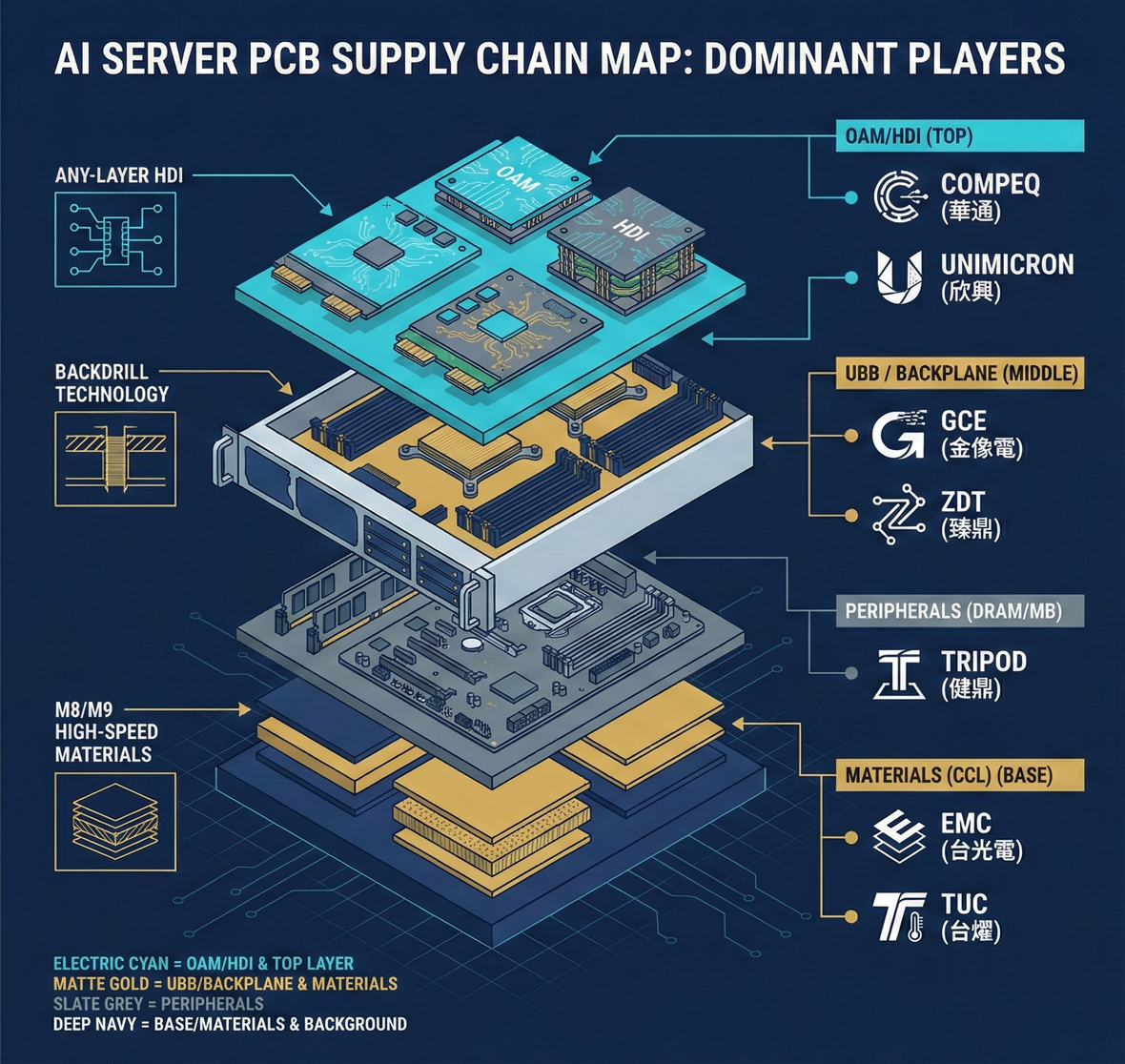
🛡️ Chapter Eight: 4-2 Battlefield Ultimate Strategic Map (The Ultimate Battlefield Map)
Through the following table, we can instantly grasp how the multi-billion dollar framework of AI servers (taking the GB200 NVL72 as an example) is divided among these Taiwanese armaments suppliers:
🏆 Chapter Nine: 4-2 Signal Superhighway — Ultimate Summary and Strategic Logic
The entire chapter of "【4-2 Signal Superhighway】" officially concludes here.
From materials (CCL) to manufacturing (PCB), this is a brutal showdown concerning "physical limits" and "large-scale manufacturing yield."
- No Materials, No Compute Power: 2026 is a "big year of material shortages" driven by technology. From HVLP copper foil to T-glass fiberglass cloth, tensions in the upstream supply chain will further raise technical barriers. Major Taiwan-based manufacturers with "vertical integration" and "material bargaining power" (such as Unimicron and Zhen Ding Technology) will have significantly higher profit stability than Tier-2 manufacturers.
- Period of Soaring Profits from Specification Jumps: As layer counts move towards 34-50 layers and materials advance to M9, PCBs are no longer cheap carriers but core components that determine computing efficiency. The surge in unit prices will offset the depreciation pressure brought by capacity expansion.
- Geopolitical Insurance Policy: Factories in Thailand have become a standard requirement for all major manufacturers entering the final round of AI server orders in 2026. GCE Holdings, Compeq, Iteq, and Zhen Ding Technology are all heavily investing in Southeast Asia. This is not merely capacity expansion but also to meet the political demands of U.S. cloud service providers (CSPs) for "resilient supply chains."
💡 The smoke of the PCB battlefield has cleared, and the outcome is decided. This multi-million dollar PCB framework has completed all internal compute power scheduling within the chassis. However, when this massive computing power needs to extend beyond the chassis to connect thousands of GPUs, forming "supercomputing clusters," traditional copper cable transmission will hit a wall called "physical attenuation."
We are about to formally enter 【4-3 The Aircraft Beyond the Motherboard — Optical Transmission and CPO Ultimate Packaging】.
In the upcoming 【4-3-1 The Twilight of Copper Cables: The 224Gbps Physical Wall and LPO Bridge】, we will reveal: Why does a copper cable become "hot scrap metal" if it exceeds 2 meters at 224Gbps speeds? And why will 800G and 1.6T optical modules become the most expensive consumables in data centers in 2026?
In-depth Research · Quantitative Perspective
Want more semiconductor quantitative research insights?
【Insight Subscription Plan】Say Goodbye to Retail Investor Mindset: Build Your Alpha Trading System with "Quantitative Chips" and "Consensus Data"EDGE Semiconductor Research
📍 Series Map — Navigate the Complete EDGE Semiconductor Research →


