
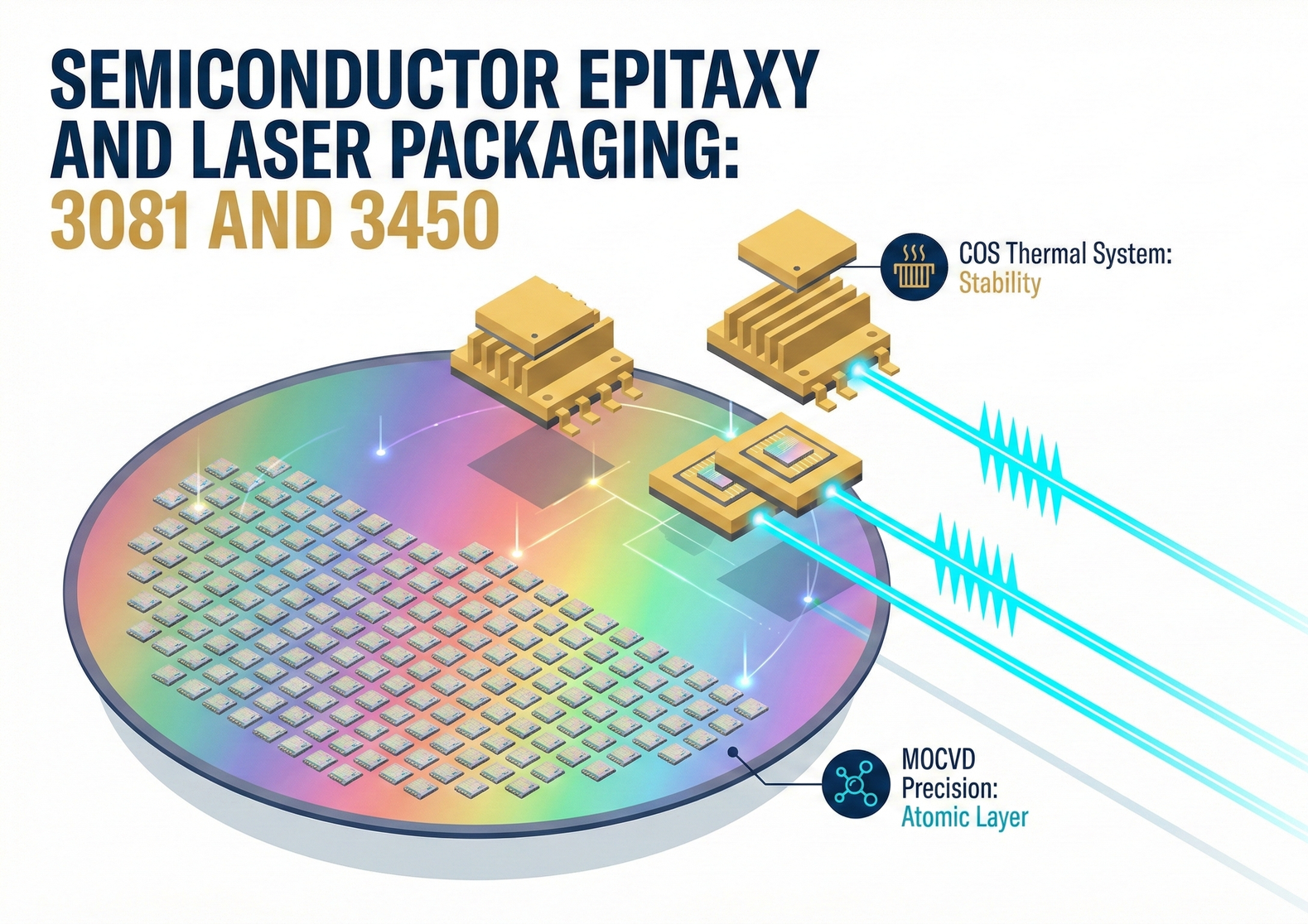
In the universe of optical communication, all signals begin with "light." If we liken an optical module to a vocal system, then epitaxy is the vocal cord of this voice. Without high-quality epitaxial wafers, there would be no laser chips capable of emitting pure 1.6T signals.
In the global market for III-V compound components, Arima Lasers (3081.TW) in Taiwan occupies an extremely unique strategic position: It is one of the few, and indeed the first in Asia, independent suppliers capable of mass commercially producing high-end indium phosphide (InP) and gallium arsenide (GaAs) epitaxial wafers.
🧪 Chapter 1: MOCVD's Atomic-Level Surgery — Arima Lasers' Technological Moat
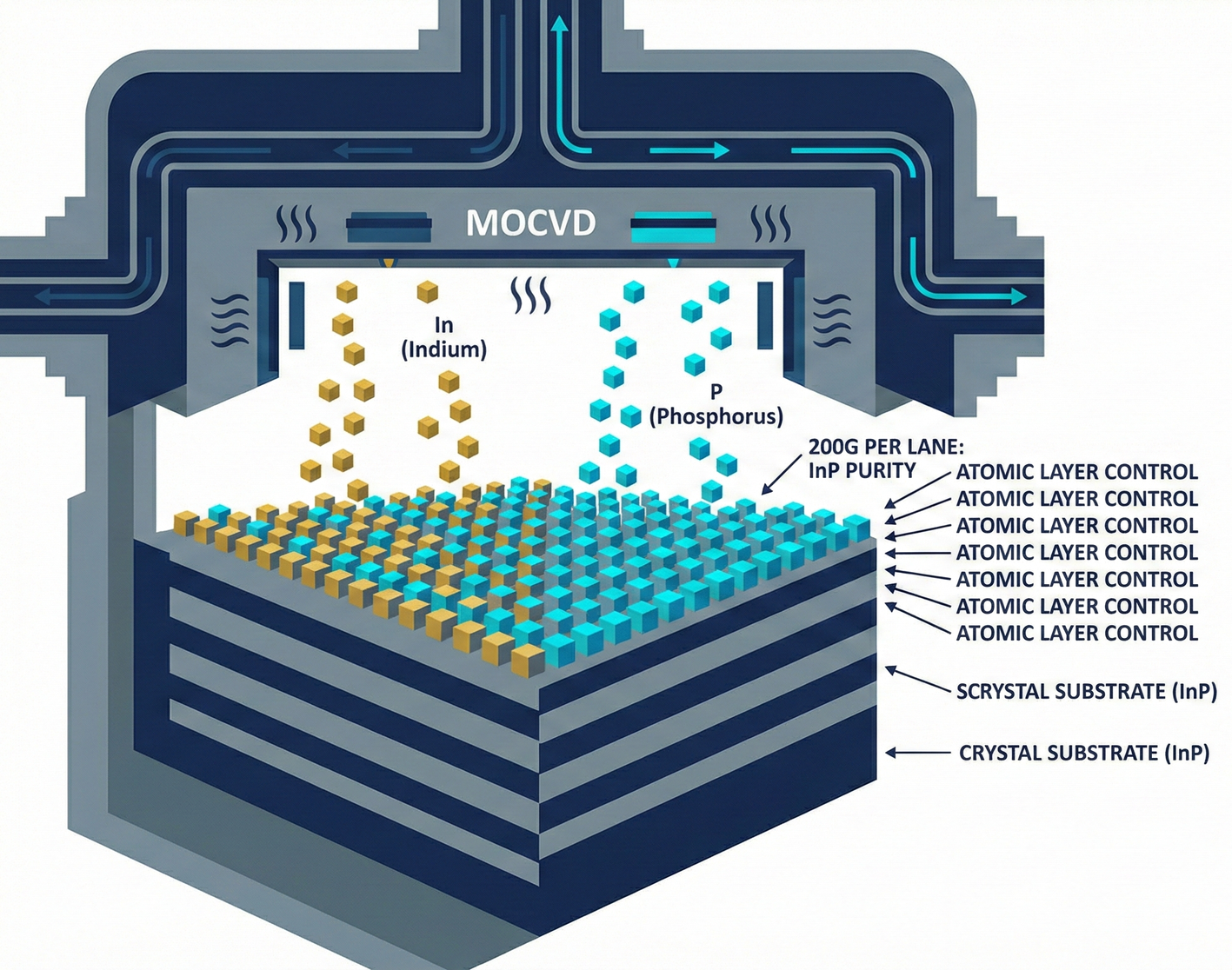
Arima Lasers' core competence lies in its masterful command of MOCVD (Metal-Organic Chemical Vapor Deposition) technology.
- The Art of Atomic Layer Stacking: Arima Lasers uses MOCVD equipment to heat substrates in a chamber, stacking III-V elements layer by layer, one atomic layer at a time, to form epitaxial layers. In the 1.6T era, with data rates per lane soaring to 200G, this demands an almost obsessive level of precision for the epitaxial layer's "atomic-level flatness" and "doping concentration control."
- The Physical Supremacy of Indium Phosphide (InP): Why is Arima Lasers indispensable in the 1.6T era? Because when transmission distances exceed 2 meters (for inter-rack connections), long-wavelength lasers at 1310nm or 1550nm must be used, which is precisely where InP material excels. Arima Lasers possesses a full spectrum of InP epitaxy capabilities, from telecom-grade to data center-grade, making it the physical foundation that defines "light speed."
🛡️ Chapter 2: The Spark of AI — Arima Lasers' Crucial Position in the NVIDIA and CSP Ecosystems
Arima Lasers' most coveted role in 2026 is that of an invisible enabler of the Silicon Photonics (SiPh) revolution.
- Silicon Photonics' "External Battery": While silicon photonics chips are powerful, "silicon" itself does not emit light. Therefore, every 1.6T silicon photonics module requires an external CW (Continuous Wave) laser source. Arima Lasers is the ultimate core supplier to the world's top four Cloud Service Providers (CSPs), providing the high-power CW laser epitaxial wafers needed for silicon photonics modules.
- NVIDIA's Invisible Alliance: As NVIDIA's AI clusters continuously evolve towards Scale-Across (inter-data center connectivity), the demand for optical fiber communication is increasing exponentially. According to industry chain sources, the market is closely monitoring Arima Lasers' progress in the 1.6T generation; the technical difficulty of its 200G components is extremely high, making it a critical variable determining whether NVIDIA's 1.6T network can achieve smooth volume production.
📉 Chapter 3: 2026 Scale Benefits — 3-inch Wafer Transition and Capacity Explosion
Arima Lasers is undergoing a qualitative transformation from "laboratory" to "industrialization":
- The Economics of 3-inch Wafers: Arima Lasers is actively transitioning its manufacturing process from 2-inch wafers to 3-inch wafers. While this process transition may impact gross margins in the short term, once yields stabilize, it will significantly boost capacity and reduce per-wafer costs. This is the only way to thrive in 2026, a year expected to see an explosion in 1.6T demand (with estimated 1.6T module shipments reaching 13 million units).
- High Capacity Allocation: Currently, Arima Lasers' high-end InP capacity is extremely constrained. According to investment research forecasts, as the revenue contribution from 800G and 1.6T products officially surpasses 50% in 2026, Arima Lasers' profitability is set to erupt from the trough of the telecom industry downturn.
🏆 Industry Strategic Conclusion: Whoever Controls the Material Controls the Light
The case of Arima Lasers (3081) demonstrates that at extreme technology nodes like 1.6T, "owning capacity" is no longer enough; "owning materials that meet specifications" is paramount. Arima Lasers holds the "seed of light speed" at the very source of the optical communication industry chain. While the world debates when CPO will commercialize, Arima Lasers is quietly "injecting soul" into these future technologies through its MOCVD machines in its Tainan facility.
If Arima Lasers (3081) is the producer of light, then this 1.6T AI spark would merely be an unusable semiconductor material without precise packaging technology to guide it, dissipate heat, and integrate it into circuitry. In Taiwan's optical communication packaging and testing sector, Lingsen Precision (3450) is playing this crucial role as a critical enabler. This company, once considered a veteran in traditional packaging, is undergoing a magnificent transformation in 2026, leveraging its COS (Chip on Submount) and ELS (External Light Source) technologies, a transformation worthy of the history books.
🛡️ Chapter 4: COS Technology — The Physical Armor for 1.6T EML Lasers
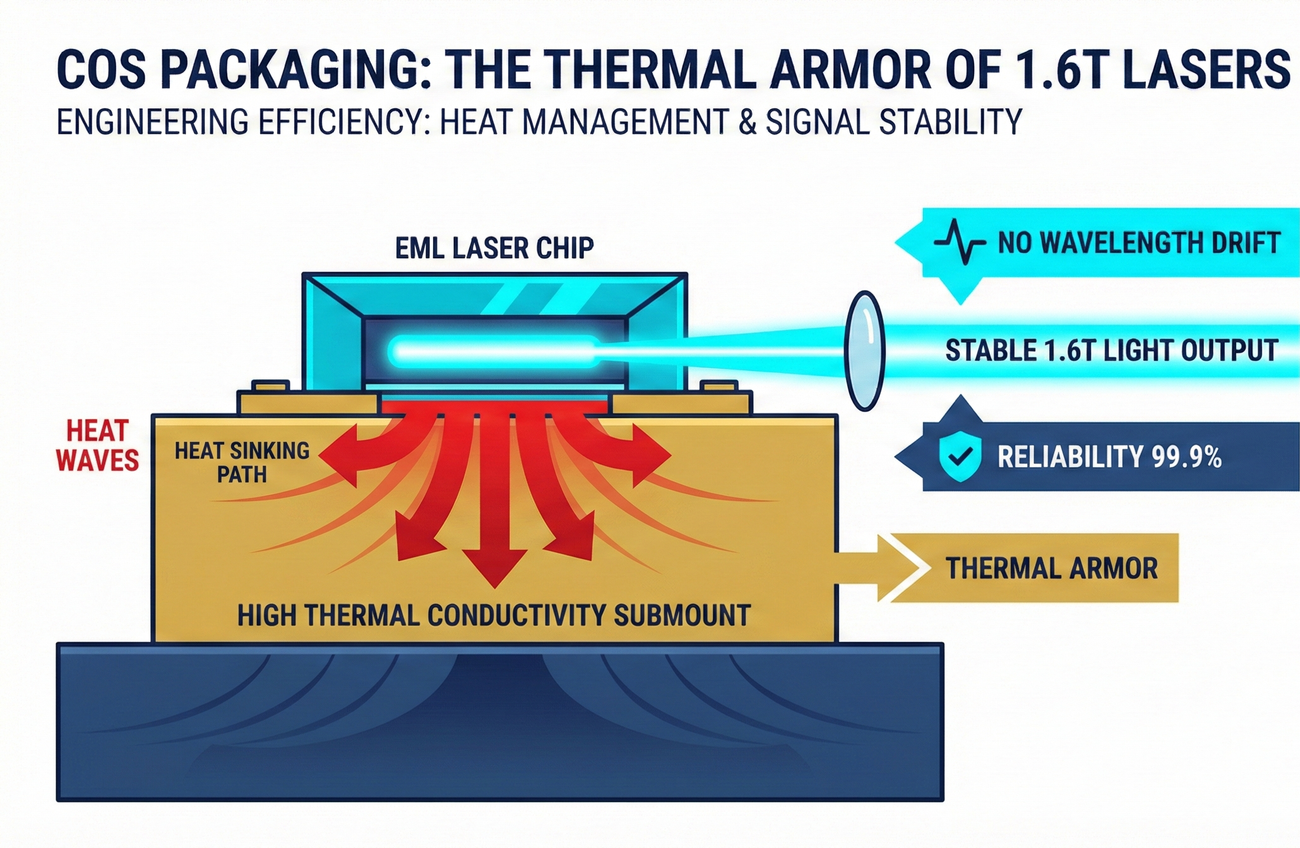
In the 1.6T arms race, the packaging demand for EML (Electro-absorption Modulated Laser) has exploded due to the establishment of the 200G/lane specification. Lingsen Precision, with its COS (Chip on Submount) packaging technology, has become a heavyweight player in this battle:
- The Ultimate Solution for High-Frequency Heat Generation: 1.6T modules are extremely compact, and if the heat generated by EML chips operating at ultra-high frequencies cannot be dissipated quickly, it leads to signal wavelength drift and communication disruption. Lingsen Precision's COS technology pre-packages laser chips onto highly thermally conductive substrates. This is not just a protective casing but also a "miniature cooling system," ensuring the stability of 1.6T signals even under full load operation in hyperscale data centers in 2026.
- Improving 1.6T Mass Production Yields: For downstream optical module manufacturers, directly handling extremely fragile high-end bare dies carries significant risks. Lingsen Precision provides pre-packaged COS components, allowing subsequent assembly plants to bypass the most challenging laser alignment and packaging steps. This enables them to achieve higher yields in 1.6TbE product production, making Lingsen Precision an indispensable strategic partner for major IDM manufacturers and cloud giants amidst the tight capacity environment in 2026.
🏗️ Chapter 5: ELS External Light Source — Proactively Capturing the 'Outdoor Unit' Market for CPO
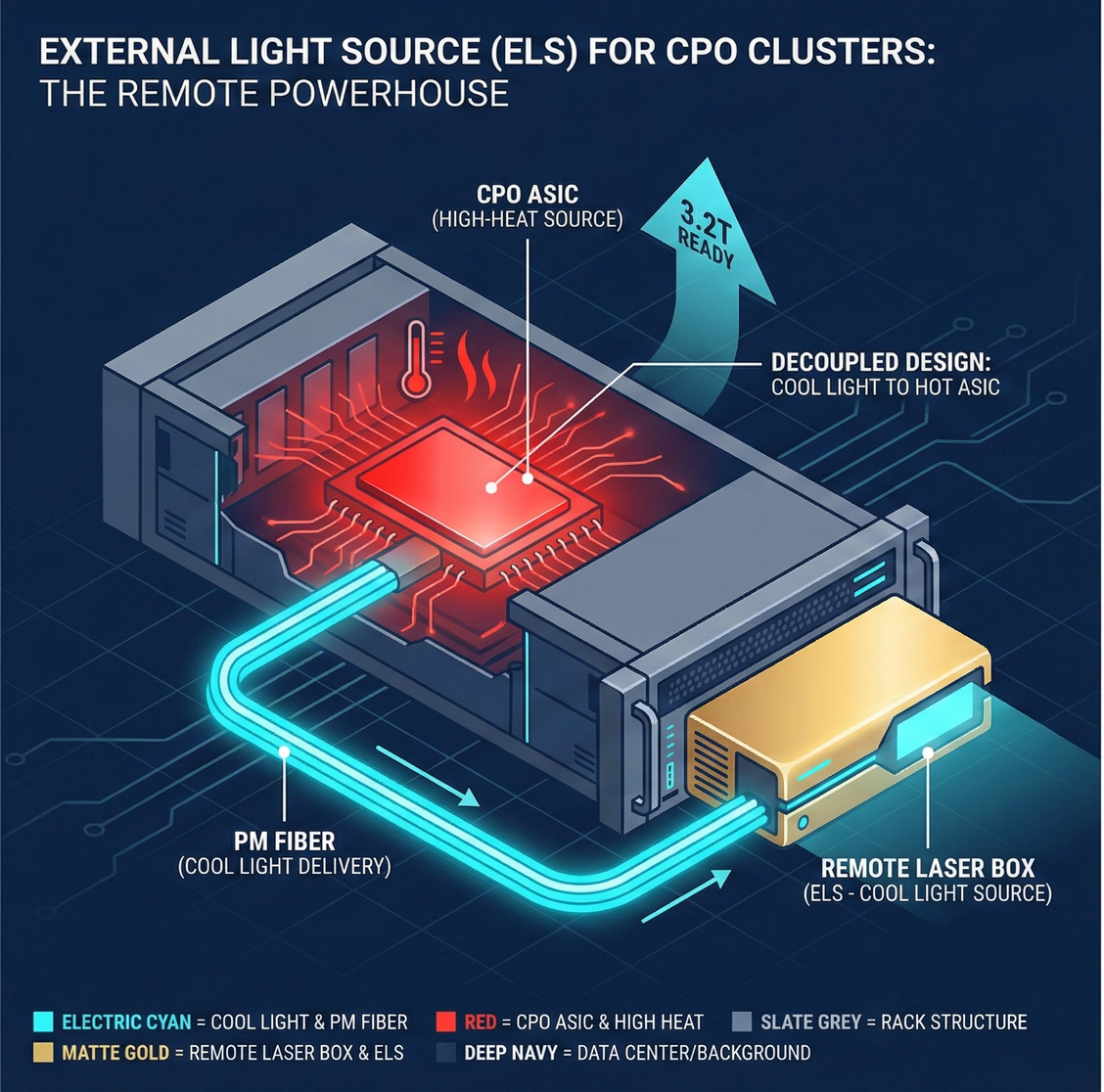
To address the physical pain point of "lasers being sensitive to heat" in CPO (Co-Packaged Optics) architectures, ELS (External Light Source) has become a core blue ocean market in the optical communication industry chain after 2026. Lingsen Precision has designated ELS as a key growth engine for the company:
- Strategic Repositioning: Lingsen Precision's transformation logic lies in moving beyond miniaturized packaging within modules to providing "system-level" light source equipment. This is akin to moving an air conditioner compressor outdoors; Lingsen Precision is responsible for developing and manufacturing this "outdoor light source unit," providing stable optical energy for high-heat core computing chips (GPUs/ASICs).
- Precise Alignment Technology: ELS systems require extremely high-density Polarization-Maintaining (PM) Fiber precise alignment, a technology with very high barriers to entry. Leveraging its decades of accumulated experience in automated alignment for laser diode packaging, Lingsen Precision has successfully entered the CPO switch supply chain, solidifying its leading position when CPO enters large-scale commercialization after 2027.
📉 Chapter 6: Qualitative Change in Financial Health — The Profit Harvesting Period of 2026
Lingsen Precision's strategic transformation is tangibly reflected in the qualitative change of its profit structure:
- Significant Improvement in Operational Efficiency: According to 2025 financial data, Lingsen Precision's gross margin for the first three quarters of that year had risen to 31%, and its operating profit margin (OPM) reached a high level of 20%. This indicates that the company has successfully moved away from low-margin traditional telecom-end businesses and transitioned to high-value 800G/1.6T high-end optical communication packaging.
- High-End Profitability in 2026: As 1.6T modules officially enter their mass production explosion year in 2026, Lingsen Precision's COS and high-end module packaging production lines will maintain high utilization rates for an extended period. Amidst the trend of American clients seeking to diversify supply chain risks, Lingsen Precision, as a major packaging and testing (OSAT) provider with the capability for "American chips made in Taiwan," will see its capacity premium further re-evaluated by the market in 2026.
🏆 4-3-7 Strategic Conclusion: Gatekeepers of the Light Speed Gateway
To summarize the entire 4-3-7 section, Arima Lasers (3081) and Lingsen Precision (3450) together define the "optical lower bound" for AI computing infrastructure in 2026:
- Arima Lasers (3081): Controls upstream InP epitaxy; without its materials, AI cannot be brought to life.
- Lingsen Precision (3450): Controls midstream COS packaging and ELS light sources; without its craftsmanship, optical signals cannot be transmitted.
These two companies demonstrate that in the face of extreme specifications like 1.6T, the value of "material sources" and "precision craftsmanship" will return to its peak. While the world debates the commercialization timeline of CPO, Arima Lasers and Lingsen Precision are quietly imbuing these future technologies with substantial operational essence in their facilities in Tainan and other locations across Taiwan.
In-depth Research · Quantitative Perspective
Want to gain more insights from quantitative semiconductor research?
【Insight Subscription Plan】Bid Farewell to Retail Investor Mentality: Build Your Alpha Trading System with 'Quantitative Capital Flows' and 'Consensus Data'EDGE Semiconductor Research
📍 Series Map — Navigate the Complete EDGE Semiconductor Research →


