5-1-10 OSAT Giants' Counterattack Defense Line: ASE Technology Holding (ASE) and Amkor's VIPack
OSAT firms counter TSMC's lead & China's price wars. ASE builds a moat via LEAP/VIPack, with flexible capacity & heterogeneous integration. Amkor targets high-end auto/US clients; Powertech focuses on HBM. All shift to system integration, pursuing AI breakthroughs.
Finally, concluding with the "Good Enough" high-end market, and setting the stage for the next section's "two disruptive forces" (FOPLP cost disruption, TGV performance leap).
The Despair of the Sandwich: OSAT Caught in a Two-Front Squeeze in the AI Era
If there's one phrase to describe the predicament of traditional Outsource Semiconductor Assembly and Test (OSAT) companies in the AI era, it's definitely "the despair of the sandwich."
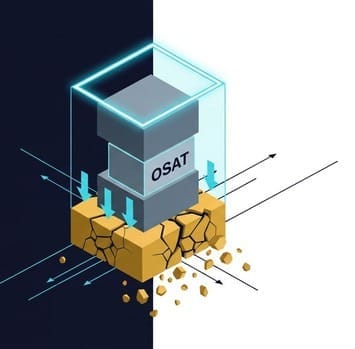
For the past thirty years, OSATs were the final stage of semiconductor manufacturing, holding absolute sway over capacity and yield. However, after TSMC opened the door to "wafer-level packaging" with InFO and CoWoS, OSAT companies suddenly found themselves caught in an extremely perilous two-front squeeze:
The ceiling above is sealed off: The packaging of the world's most powerful and technologically advanced AI training chips (such as NVIDIA's H100/B200) has been "taken entirely" by TSMC, along with 3nm/5nm wafer foundry services. At the most extreme microscopic scales, traditional OSAT companies are simply unable to compete with wafer foundries' nanometer-level lithography equipment.
The floor below is collapsing: In the battlefield of traditional low-to-mid-end packaging (such as wire bonding and mature Flip Chip), China's OSAT giants—JCET, Tianshui Huatian, and Tongfu Microelectronics—are leveraging vast national resources and a large domestic market to aggressively secure orders through extremely brutal "price wars."
Above is TSMC's technical high wall, below is the scorched-earth battle waged by Chinese manufacturers. If ASE and Amkor continue to operate within their comfort zones, focusing on traditional packaging services, their room for survival and technological influence will inevitably be completely eroded.
Facing this existential "sandwich dilemma" crisis, the world's largest OSAT company, ASE Technology Holding (3711), decided to launch an upgrade battle based on fundamental logic—transforming itself from a "component assembly service provider" into a "system-level heterogeneous integration master."
🛡️ ASE's Technological Awakening: The LEAP Strategy and Reshaping the Moat
ASE understood very clearly that directly competing with TSMC for the most advanced AI training chip packaging was unrealistic.
However, with the full-scale explosion of Chiplet technology, a huge vacuum emerged in the market—one that TSMC's capacity cannot fully address, and one that Chinese manufacturers' technology cannot yet achieve.
To address this, ASE has fully mobilized its R&D and upgrade efforts, concentrating them on a strategic roadmap called LEAP (Leading Edge Advanced Packaging).
The core of this LEAP strategy is no longer about competing on the packaging speed of individual chips, but rather on the "extreme craftsmanship of assembling a puzzle." When MediaTek, Qualcomm, AMD, or major global automotive manufacturers want to compress logic computing chips, HBM memory, and even future silicon photonics (CPO) optical communication modules all onto a single substrate, they face unprecedented physical challenges (such as thermal expansion and stress warping of different materials).
What they need is an integration expert with highly customized capabilities, capable of stably controlling complex physical variables.
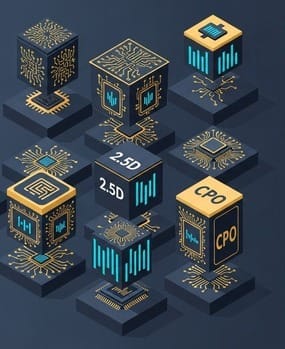
ASE has built a technological moat within its factories by extensively introducing a new generation of advanced packaging equipment, comprising the following capabilities:
2.5D / 3D Packaging
High-density Fan-out Packaging
Co-Packaged Optics (CPO)
This moat is specifically designed to capture the vast number of IC design customers who "cannot get access to TSMC's top-tier capacity but desperately desire advanced packaging performance."
However, to win over these discerning global top-tier chip designers, ASE cannot merely offer a single technological highlight. Instead, it must present an ultimate solution that allows customers a "painless transition" and offers "flexible options to suit various needs."
🍱 VIPack's Commercial Gambit: From "Single Point Breakthrough" to a "Full Feast"
In the advanced packaging battlefield, TSMC's strategy is to offer "boutique products" of ultimate performance (such as CoWoS), but the price of such premium products is that they are extremely expensive and capacity is perpetually scarce.
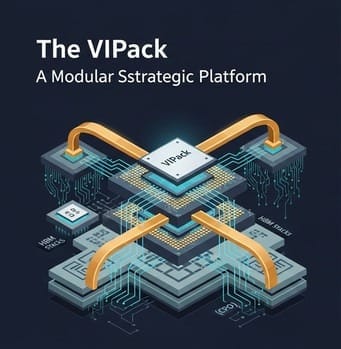
ASE seized on this pain point. Instead of launching a single technology to directly compete with CoWoS, it unveiled a collaborative integration platform called VIPack (Vertical Integrated Packaging).
Note: Please do not regard VIPack as a single "packaging technology." It is more akin to a "platform-based business package" tailored for major IC design companies.
Within this platform, ASE showcases all its cutting-edge arsenal:
FO-EB (Fan-out Embedded Bridge): A killer application designed to replace expensive "silicon interposers." It embeds tiny silicon bridges into the substrate, allowing two chips to communicate at high speed, but at a cost significantly lower than TSMC's CoWoS-S.
FOPLP (Fan-out Panel-Level Packaging): Specialized for extreme mass production solutions requiring large areas, high capacity, and low cost.
2.5D / 3D Integration and HBM Memory Stacking: Essential technologies for AI edge computing and high-end networking and communications.
CPO (Co-Packaged Optics): A neural network pre-laid for the era of optical communication.
Through VIPack, ASE's strategic message to global IC design giants is very clear:
"You don't need to put all your eggs in TSMC's crowded basket. From the highest-end AI to edge computing, I offer a full range of modular packages, flexible and ready-to-use, catering to all needs."
The reason this VIPack strategy successfully wins over customers is that ASE also holds two "ultimate trump cards" that TSMC cannot easily replicate.
🃏 ASE's Two Ultimate Trump Cards: Capacity Throughput and Revolutionary Rapport
This post is for subscribers only
Sign up now to read the post and get access to the full library of posts for subscribers only.