
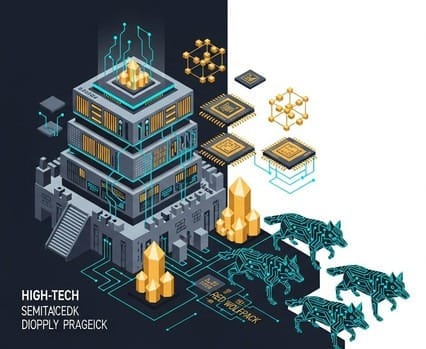
Positioning: This section concludes the "OSAT Chapter" by:Identifying the three asymmetrical strategies (scale, deep-tying, cost reduction) of the Chinese OSAT supply chain.Mapping packaging technologies from Traditional → 2.5D → 3D → Next-Gen in a single table.Finally, distilling the entire chapter into one sentence: Packaging has upgraded from "dressing" to "brain surgery."The Illusion on the City Walls: The Red Wolf Pack Beneath the High-End Fortress
As we saw in the previous section, ASE and Amkor, through their "VIPack suite" and "geopolitical ties," successfully carved out a high-end market fortress, aptly named "good enough," under TSMC's dominance.
But as the OSAT giants in Taiwan and the U.S. stand atop this high-end wall, a glance downwards reveals a pack of wolves gathering beneath, their eyes red and their equipment growing increasingly sophisticated.
These wolves are the nightmare that awakens ASE and Powertech Technology in their deepest slumber—China's "Red OSAT supply chain."
In the past, the market generally believed that Chinese OSAT firms only handled low-end wire bonding and relied on government subsidies for price wars.
However, a closer examination of the recent strategic layouts of these "red" giants reveals that they have transformed, developing a highly lethal "asymmetrical warfare" model.🐺 JCET: No Longer Just a Price Destroyer, but the "Number One Tangible Threat"
As the world's third-largest and China's largest OSAT giant, JCET (600584.SS) is no longer content with traditional assembly and packaging services.
Through prior in-depth decoding of foreign intelligence, JCET is rapidly accelerating its capacity ramp-up in 2.5D advanced packaging (CoWoS-like architecture).
While JCET still struggles to compete with TSMC for the most cutting-edge AI training chips, its foundational capabilities accumulated through the acquisition of STATS ChipPAC have enabled it to challenge ASE in Fan-Out packaging and chiplet heterogeneous integration.
For global IC design companies, JCET offers a highly attractive option:High-end yield approaching ASE + unparalleled cost advantages in mainland China
This makes JCET ASE's most direct and potent tangible threat in the mainstream and high-end packaging markets.🐺 TFME: The "Brutal Aesthetics" of Deep Tying
If JCET's upgrade relies on its own scale, then TFME (002156.SZ) showcases another extreme survival strategy: "As long as the backer is strong enough, technology can be nurtured."
TFME's most daunting moat against its rivals is its profound and unbreakable tie-in with the world's second-largest CPU/GPU giant, AMD (Advanced Micro Devices).
In its early years, TFME boldly acquired AMD's packaging and testing plants in Suzhou and Penang, subsequently becoming AMD's most critical packaging base.
As AMD expanded its market share globally using Chiplet technology, TFME concurrently secured massive CPU/GPU advanced packaging orders.
Recently, TFME initiated a substantial private placement exceeding several billion RMB, fully concentrating its resources on expanding OSAT capacity for HPC (High-Performance Computing) and advanced memory.
TFME's existence proves that by maintaining a close alliance with a global giant that holds technological leadership, an OSAT's technological ceiling can be continuously raised.🐺 Forehope: The "Dark Destroyer" of Panel-Level Cost Reduction Wars
While the industry stalwarts battle it out in the 2.5D and Chiplet arenas, the more recently established Forehope (688362.SS) has chosen a perilous strategy for a curved-road overtake.
As mentioned in the previous section, Powertech Technology in Taiwan is preparing to initiate a cost revolution using FOPLP (Fan-Out Panel-Level Packaging).
And Forehope is precisely the most dangerous potential competitor for Taiwanese firms in this particular race.
Forehope is aggressively deploying large-size panel-level packaging technology, attempting to bypass the equipment barriers of traditional 12-inch silicon wafers and directly capture a significant share of the edge AI and consumer electronics packaging market with "dimension-reduced manufacturing costs."🗺️ The Future Blueprint of Packaging: Understanding Semiconductor's Spatial Magic in One DiagramRecommendation: Use this table as a "packaging navigation map." It represents both the evolution of the past thirty years and a roadmap for capital flows in the next decade.💡 Strategic Summary: From "Dressing" to "Brain Surgery"
Looking at this map, we can draw a conclusive strategic insight that spans the entire Chapter 5-1:
For the past four decades, the essence of the packaging industry was simply "dressing" the chips (protecting them from external interference and leading out their pins). Since it was about dressing, the sole KPI was "cheap and durable" (cost-oriented). This is why traditional OSATs' gross margins consistently hit a ceiling.
However, as Moore's Law confronts physical limits, the very nature of packaging has undergone a profound transformation.
Today's advanced packaging is no longer about dressing chips; it's about performing "brain surgery" on the most sophisticated AI chips: engineers must cut open the brain (Chiplet), flip it (Flip Chip), and then stitch them together with extremely tiny neural networks (CoWoS / SoIC).In summary: The ultimate mission of packaging has evolved from "protecting chips" to "extending Moore's Law" (performance-oriented).
This is precisely why TSMC has entered the arena directly. Any company associated with "advanced packaging" is likely to experience a structural re-evaluation of its P/E ratio and valuation.
EDGE Semiconductor Research
📍 Series Map — Navigate the Complete EDGE Semiconductor Research →


