5-2-6 CoWoS's Hidden Defense Line: The US-Japan Chemical Chokehold Battle and Wah Lee (3010), Hong Teng (7751)'s Cutting-Edge Thermal Management Technology
US/Japan monopolize CoWoS packaging's underfill & TIMs, essential for AI chip stability, thermal limits, and yield. Distributors like Wah Lee & Chang Hwa, with strict cold chain & local support, build moats as indispensable advanced process gatekeepers, given high replacement costs.
🧱 The Master Skill of "Liquid Concrete": Underfill
Recall the "grilled squid" disaster mentioned in 5-2-5. When silicon chips and PCB substrates cool and contract inconsistently, the internal pulling forces can tear tens of thousands of tiny metal connections.
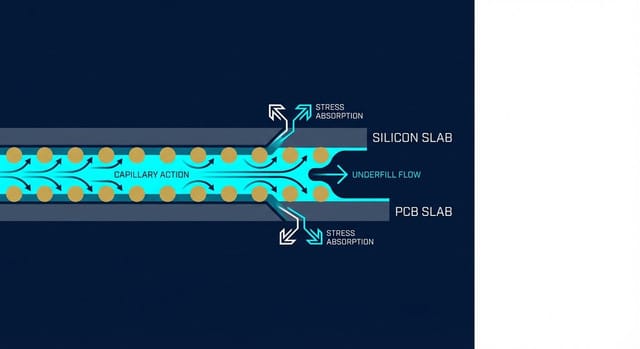
To solve this problem, Manz's dispensing machine must inject a chemical called Underfill into the bottom of the chip.
The Limit of Micro-Flow: This layer of adhesive must perfectly penetrate a tiny gap of only 10 to 30 $\mu m$ (micrometers) using capillary action, leaving no air bubbles.
A Dual-Nature Defense Line: It is liquid when injected, but after being baked and cured in C-Shine's oven, it transforms into a "liquid concrete" as hard as steel, firmly gripping every metal ball and absorbing all thermal expansion and contraction stresses.
Why is this a "Chokehold" Technology?
The formulation of this adhesive is extremely tricky: it must adhere strongly, its expansion coefficient must precisely match that of the silicon chip, and its chemical properties must be extremely stable, without corroding the circuits. Currently, the most advanced CoWoS and HBM-specific Underfill solutions globally are almost entirely monopolized by chemical giants like Japan's Namics (Showa Denko). Without this "glue," even TSMC's expensive production lines would have to halt operations.
🔥 The Core of the Thermal Armor: TIM (Thermal Interface Material)
Just when we managed to solve structural stability, the next enemy is the hellish high temperature of $1000W$ to $1600W$.
As we mentioned in 5-2-4, Manz's equipment applies metal heat spreaders (lids) to the chips. However, between the scorching GPU and the cold metal lid, there are countless microscopic "air gaps." Air is a terrible conductor of heat, and if these gaps are not filled, the GPU would instantly burn out upon startup.
This is where we need TIM (Thermal Interface Material).
Microscopic Thermal Paste: Traditionally, this is similar to the thermal paste we apply when building a DIY computer, but AI-grade TIM requires entirely different properties.
Leap in Thermal Conductivity: To cope with the terrifying power consumption of the B200, TIM must incorporate a high proportion of silver powder, graphite, or special thermally conductive ceramic particles.
Currently, this market is dominated by companies such as the US-based Laird, and Japan's Sumitomo and Shin-Etsu Chemical. These companies control the molecular structure and mixing ratios of the materials, making them the true invisible landlords in the AI supply chain.
🛡️ Materials Are the "Ultimate Arbiter" of Yield Rates
This is why we call it the "invisible defense line."
In the yield rate equation of advanced packaging, equipment manufacturers determine "stability," but material suppliers determine the "ceiling."
If the viscosity of the Underfill changes even slightly, the chip will develop air bubbles (Voids), leading to cracks.
If the thermal conductivity of the TIM drops by $5\%$, the server will automatically throttle due to overheating, instantly reducing computing power.
The characteristic of this "chemical chokehold" is: the validation time is extremely long, and once customers (TSMC and NVIDIA) become accustomed to using a material, they absolutely dare not casually switch suppliers. This is because changing a material requires redoing all backend baking curves and dispensing parameters.
🌡️ The Delicate "Low-Temperature Lifeline": Why Do Logisticians Have a Moat?
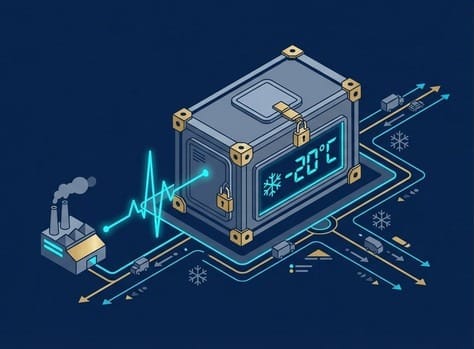
Imagine if you had to transport a barrel of chemical adhesive, which must be strictly maintained at -20 degrees Celsius and is extremely sensitive to environmental humidity and vibration, from a factory in Japan to TSMC's production lines in Chiayi or Tainan in the scorching summer heat in Southern Taiwan, on time, and where a power outage of just one hour during transit would render the entire barrel, worth millions of New Taiwan Dollars, unusable.
The difficulty of this task far exceeds ordinary logistics.
1. Physical Barriers of Cold Chain and Hazardous Materials Management: Most Underfill materials or molding compounds used in advanced packaging are highly chemically reactive. To prevent them from pre-curing or deteriorating during transport, distributors must establish a "ultra-low temperature warehousing and cold chain fleet" costing hundreds of millions of New Taiwan Dollars. Moreover, many of these chemicals are flammable or corrosive hazardous materials, presenting extremely high barriers to entry in terms of storage space, ventilation systems, and legal compliance within factory premises.
2. 24-Hour "Technical Emergency Room": TSMC's CoWoS production lines operate 24 hours a day, non-stop. If, at 3 AM, microscopic air bubbles appear after a batch of adhesive is dispensed, or if abnormal stress is detected after curing, TSMC's engineers will not call Japan for help but will instead contact the distributor directly. The engineering teams of Wah Lee (3010) and CWE (8070) are directly "stationed" around the customer's (TSMC's) facilities. They must possess the ability to diagnose yield problems on the front line and assist customers with parameter fine-tuning. This technical flexibility, which demonstrates "a deeper understanding of on-site operations than the original manufacturer," has fostered deep personal and process ties between distributors and wafer fabs.
💎 Wah Lee (3010): The "Invisible Navigator" of Advanced Processes
In the semiconductor materials distribution industry in Taiwan, Wah Lee (3010) holds an exceptionally prominent position. It is not merely a logistics provider; it is TSMC's "designated partner" during the early stages of research and development for each generation of advanced processes.
Gatekeeper for Photoresists and Specialty Gases: Wah Lee has long been the agent for products from leading chemical manufacturers such as Japan's JSR and Tokyo Ohka Kogyo (TOK). From 7-nanometer all the way to 2-nanometer, almost all critical chemicals required for each photolithography process enter TSMC's production through Wah Lee's supply system.
Materials Layout for Advanced Packaging: In the CoWoS ecosystem, Wah Lee has secured positions for several key materials, including specialized dry films required for substrate processes and high-end polymer materials used for stress buffering. This agency model, synchronized with "process R&D," provides Wah Lee with extremely high order visibility. As long as TSMC's advanced capacity continues to expand, Wah Lee's tollbooth will always thrive.
📦 CWE (8070): The "Omnipresent Steward" of Packaging Materials
If Wah Lee specializes in front-end processes, then CWE (8070) dominates the logistics supply chain for OSATs (Outsourced Semiconductor Assembly and Test) in Taiwan.
Taiwan Distribution Rights for Sumitomo Electric: CWE holds the key distribution rights for Japan's Sumitomo's high-end encapsulation resins, Underfill, and lead frames. In the materials list for advanced packaging, Sumitomo's market share is formidable, and CWE is the sole distributor for this powerful entity in Taiwan.
From Distribution to Vertical Integration: CWE's most impressive aspect lies in its "investment acumen." They not only act as a distributor but also venture into material manufacturing through equity investments (e.g., CWE Technology, 6548). This has transformed CWE from a mere distributor into a comprehensive materials supplier with "localized blending and production capabilities." When the market demands "supply chain localization" due to geopolitical factors, CWE's value increases rather than decreases.
📉 The Stable Profit Code: Why Do Customers Dare Not Switch Materials?
The core competitiveness of the distributor business can actually be summarized in one phrase: "High Switching Cost."
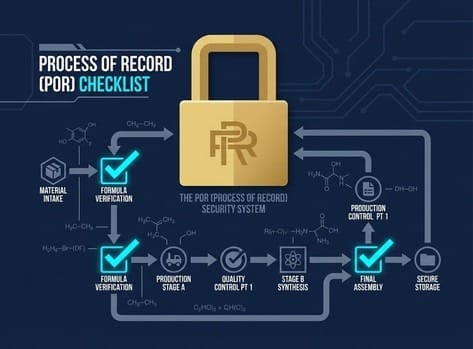
In the semiconductor industry, there is a formal process list called POR (Process of Record). Once a material from a specific distributor is written into the POR, it becomes an integral part of TSMC's production flow. If you wanted to save a small distribution fee and switch Sumitomo's adhesive, distributed by CWE, to another supplier. This would mean:
You would need to spend 6 to 12 months on yield qualification.
All oven baking curves (e.g., for C-Shine's equipment) would have to be readjusted.
All dispensing paths and pressures (e.g., for Manz's equipment) would have to be rewritten.
For TSMC, which pursues maximum production capacity, the "risk" and "time cost" of switching materials far outweigh the minor price difference in materials. This is why Wah Lee and CWE can maintain extremely stable profit structures. While their gross margins may not reach 50% like those of IC design companies, their customer stickiness and market dominance are envied by many major tech firms.
🌋 AI's High-Temperature Bottleneck: Why Is "Thermal Paste" Almost Burnt Out?
Before delving into Hotron's core technology, we must first understand the true nature of this high-temperature crisis.
For the past thirty years, our approach to chip cooling has essentially been no different from changing the thermal paste in your home computer. We've applied a layer of gel-like TIM (Thermal Interface Material) between the GPU and the heatsink. This gel is filled with ceramic powder or silver powder to fill microscopic air gaps.
But now, this method is no longer effective.
As the computing power density of AI chips escalates exponentially, the rate of heat generation has surpassed the conduction speed of liquid adhesives. This is akin to trying to drain a reservoir's floodwaters with a single straw. Worse still, under continuous high-temperature baking, liquid thermal paste can experience "pump-out effect" or cracking, leading to a rapid decline in thermal performance within months.
To prevent a $40,000 GPU from turning into a piece of charcoal, NVIDIA and TSMC have been forced to adopt the "ultimate form" of thermal materials: abandoning liquid adhesives in favor of "solid metal armor."
This post is for subscribers only
Sign up now to read the post and get access to the full library of posts for subscribers only.