
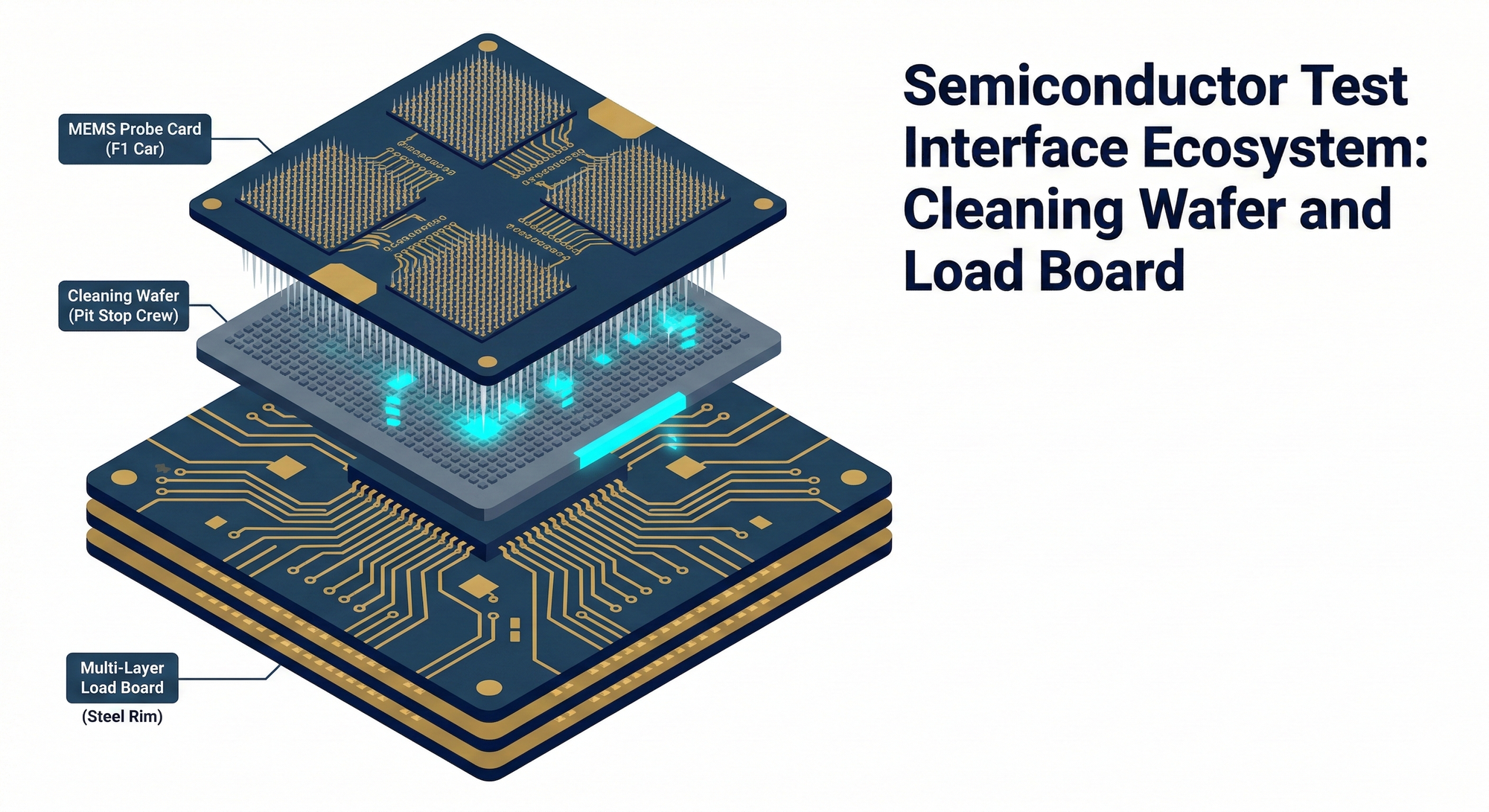
5-4-2 Probe Card War of Attrition: Santest (3595)'s Probe Cleaning Magic and Youngz Technology (6683)'s Hybrid Steel Ring
This article builds upon the strategic framework of [5-1-3] Probe Cards, focusing on two often-overlooked consumables/interfaces that directly determine test yield and cost: Cleaning Wafers/Sheets and High-Frequency Load Boards / Probe PCBs.
🧠 Strategic Awakening: Revisiting 5-1-3's "Microscopic Assassin" and F1 Tires
Before we delve into this microscopic battle, let's recall the strategic context from the [5-1-3] "Probe Card" battlefield:
- As AI chips transition to Chiplets, the industry must more aggressively pursue KGD (Known Good Die).
- When transmission frequencies soar to 112G PAM4, traditional probes suffer from fatal antenna effects, forcing the industry to adopt MEMS (Micro-Electro-Mechanical Systems) probe cards fabricated using semiconductor lithography processes.
- The probe card sector has formed a "duopoly":
- MPI Corporation (6223), which adopts a "Toyota strategy" dominating with vast production capacity.
- Chunghwa Precision Test (6510), which adopts a "Porsche strategy" specializing in flagship AI chips.
If you have forgotten some of the technological foundations and capacity expansion logic of these two companies, it is recommended to refer back to 5-1-3 at any time.
We already know that MEMS probe cards are like "F1 racing tires" on a test machine: high unit price, limited lifespan, and requiring regular replacement.
However, when an F1 car races on the track, in addition to changing tires, it must also pit for cleaning and maintenance. In the extremely microscopic world of semiconductor testing, there is also a group of invisible and fatal "debris." If these are not removed, even the most expensive probe cards will quickly become unusable.
🏎️ Fatal Microscopic Adhesion: Why Do Probe Cards "Go on Strike"?
Imagine the actual physical reactions during a probe card's "touchdown":
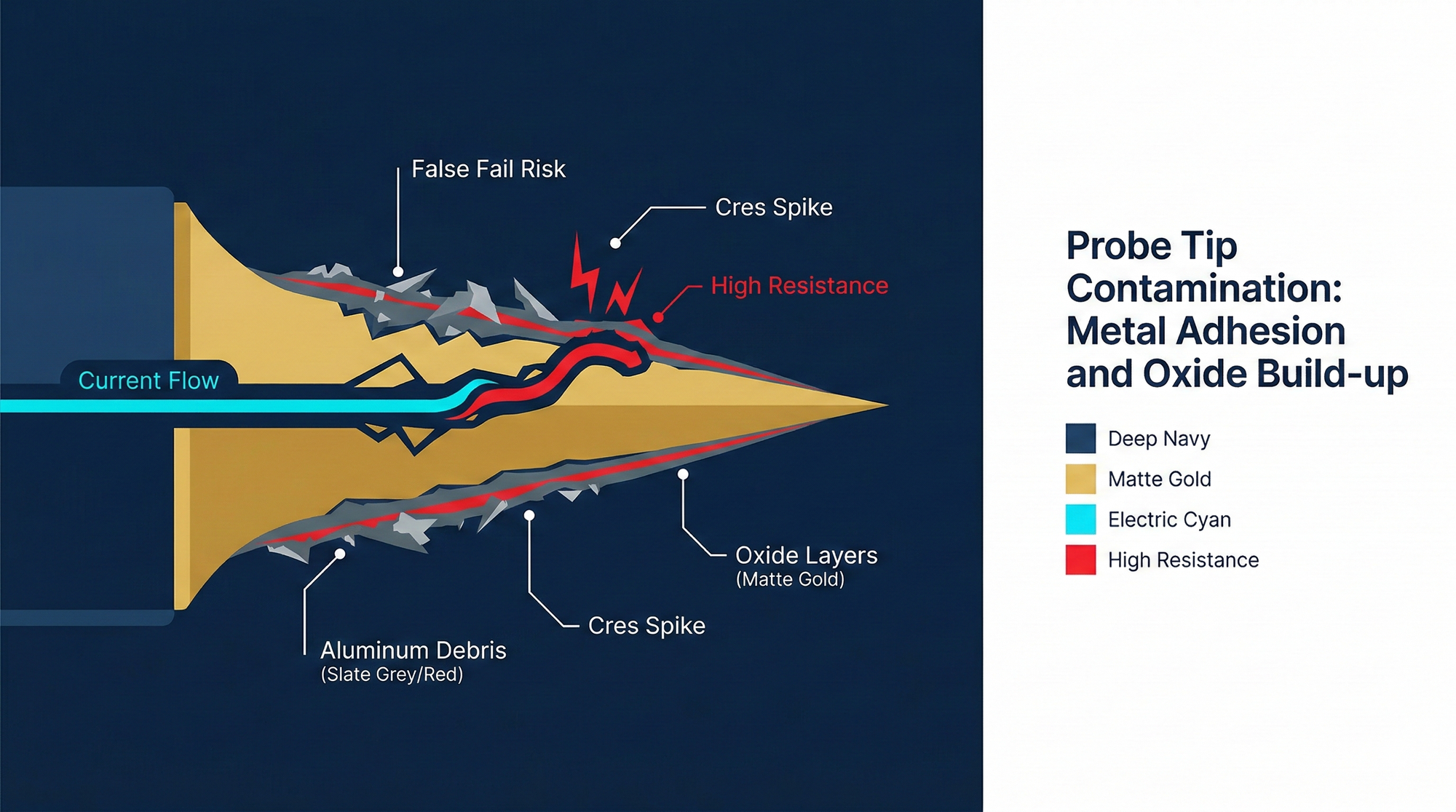
Wafer pads are mostly aluminum or copper, whose surfaces instantly form a hard oxide layer in the air. When the tiny probe tip punctures this oxide layer with immense pressure and a high-voltage current required by AI chips passes through, a very high microscopic temperature is generated at the probe tip.
This leads to a fatal phenomenon: metal adhesion and oxide accumulation.
- With each touchdown, the probe tip accumulates a small amount of aluminum debris or oxides.
- After hundreds of insertions and removals, the probe tip becomes coated with non-conductive contaminants.
- Contact Resistance (Cres) will skyrocket.
The result is that the machine mistakenly believes that the extremely valuable, perfect AI bare die in front of it is faulty. This is known in the industry as a "False Fail".
If left unaddressed, not only will client yield numbers plummet, but the probe card will also prematurely become unusable due to probe tip burn-out.
🧽 The "Car Washers" of the Microscopic World: The Essential Demand for Cleaning Wafers / Sheets
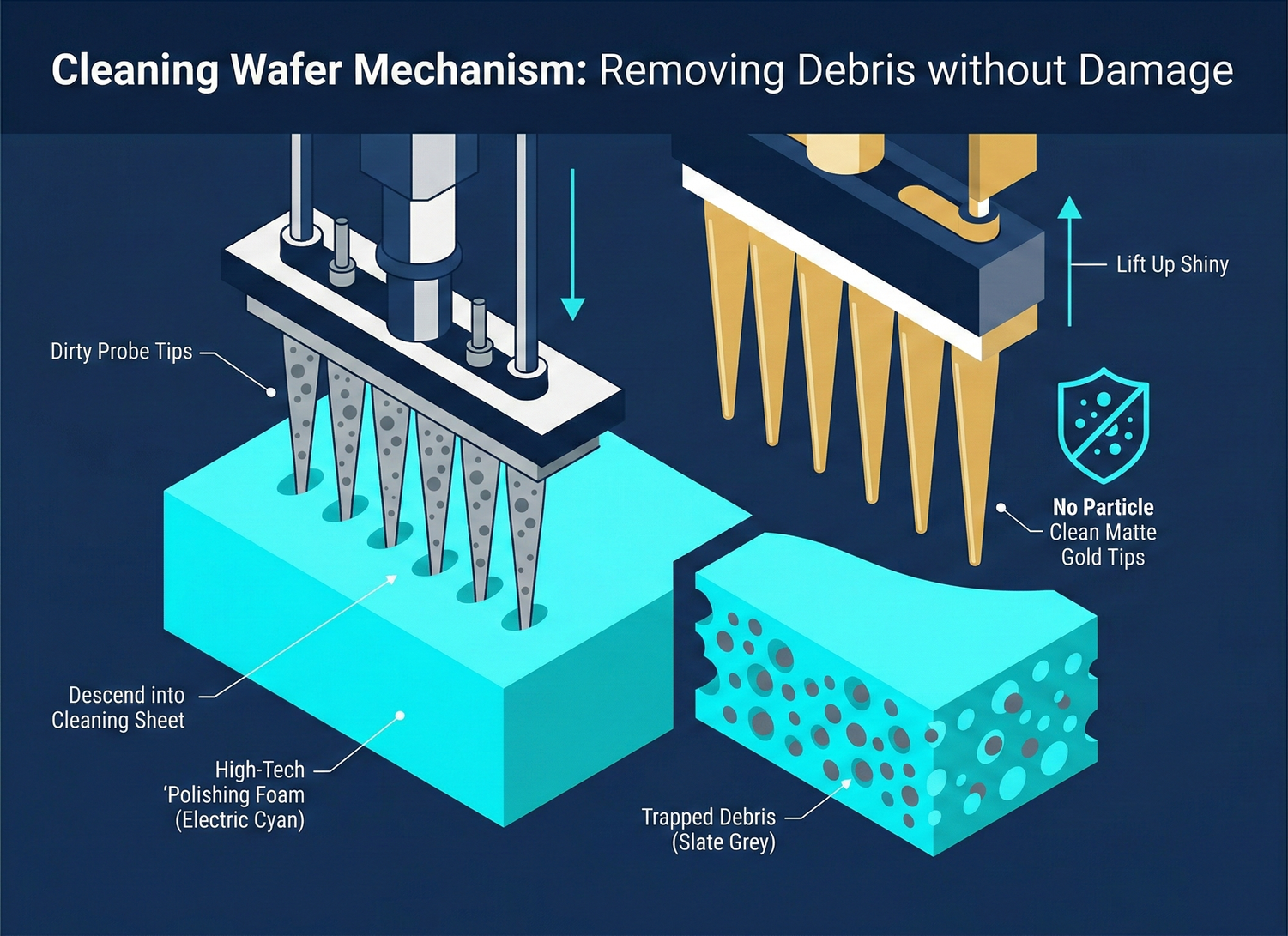
It's certainly not feasible to discard an entire dirty probe card. To extend the lifespan of these "expensive tires," test machines are equipped with a seemingly inconspicuous but indispensable consumable: Cleaning Wafers / Cleaning Sheets.
The operating principle is simple yet ingenious:
- After testing several wafers, or when the machine detects that resistance begins to rise.
- A robotic arm moves the probe card aside.
- It then repeatedly "touches down" dozens of times onto a cleaning wafer covered with a special abrasive material.
The cleaning wafer acts like "high-tech chewing gum with abrasive properties," capable of adhering to and lightly polishing off metal debris and oxides from the probe tips, restoring them to a clean, conductive state.
🪄 Santest (3595)'s Exclusive Profit: Without It, Production Lines Halt Immediately
In this extremely niche, invisible market, the hidden champion in Taiwan with pricing power is Santest (3595).
Many people assume that cleaning wafers are "just sandpaper that collects dust." However, in the microscopic battlefield of 112G high-frequency and AI chips, it is, in fact, a demanding discipline of materials chemistry:
- Must not damage probes: MEMS probes are as fine as hair and expensive. Material that is too hard will break the probes, while material that is too soft cannot remove high-temperature sintered oxides.
- Cleanroom taboo: Absolutely no dust or particles should be generated the moment it is punctured, otherwise they will fly onto the wafer and directly kill other chips.
Santest has mastered advanced dust-free polymer foaming technology and precision coating processes, successfully entering the supply chains of TSMC and global top-tier outsourced semiconductor assembly and test (OSAT) companies.
Insight (The ultimate embodiment of risk premium):
For OSAT companies, a probe card costs millions, while cleaning wafers are just a fraction of that. No one would take the risk of damaging a probe card, or even halting a production line, just to save on consumables.
Therefore, the longer AI chips are tested, the more touchdowns occur, and the more severe the adhesion, the exponentially faster cleaning wafer consumption will rise, allowing Santest to quietly rake in substantial profits.
🛞 The Invisible Steel Ring: Without It, Even the Top Probes Are Just Scrap Metal
Many people, when looking at test interfaces, only focus on the forefront "Probe Head" or "Socket," overlooking the heavy Load Board / Probe PCB beneath it.
This is not an ordinary green PCB.
When AI chip frequencies reach 112G PAM4, the wiring complexity of a test load board is like designing tens of thousands of non-interfering highways in an extremely small city.
- Any single copper trace with impedance mismatch.
- Any single micro-via deviating by one micron.
High-frequency signals will suffer severe attenuation, leading to completely failed test results.
Designing and manufacturing this "high-frequency steel ring" is a black technology that integrates microwave electromagnetics, polymer materials science, and extreme PCB lamination processes.
🦅 Youngz Technology (6683)'s "Amphibious Strategy": Dominating Both Front-end and Back-end
Among the "four champions" of test interfaces in Taiwan (MPI Corporation, Chunghwa Precision Test, WinWay Technology, and Youngz Technology), Youngz Technology (6683) has the most unique positioning: one of the few capable of an "amphibious strategy" covering both "front-end + back-end."
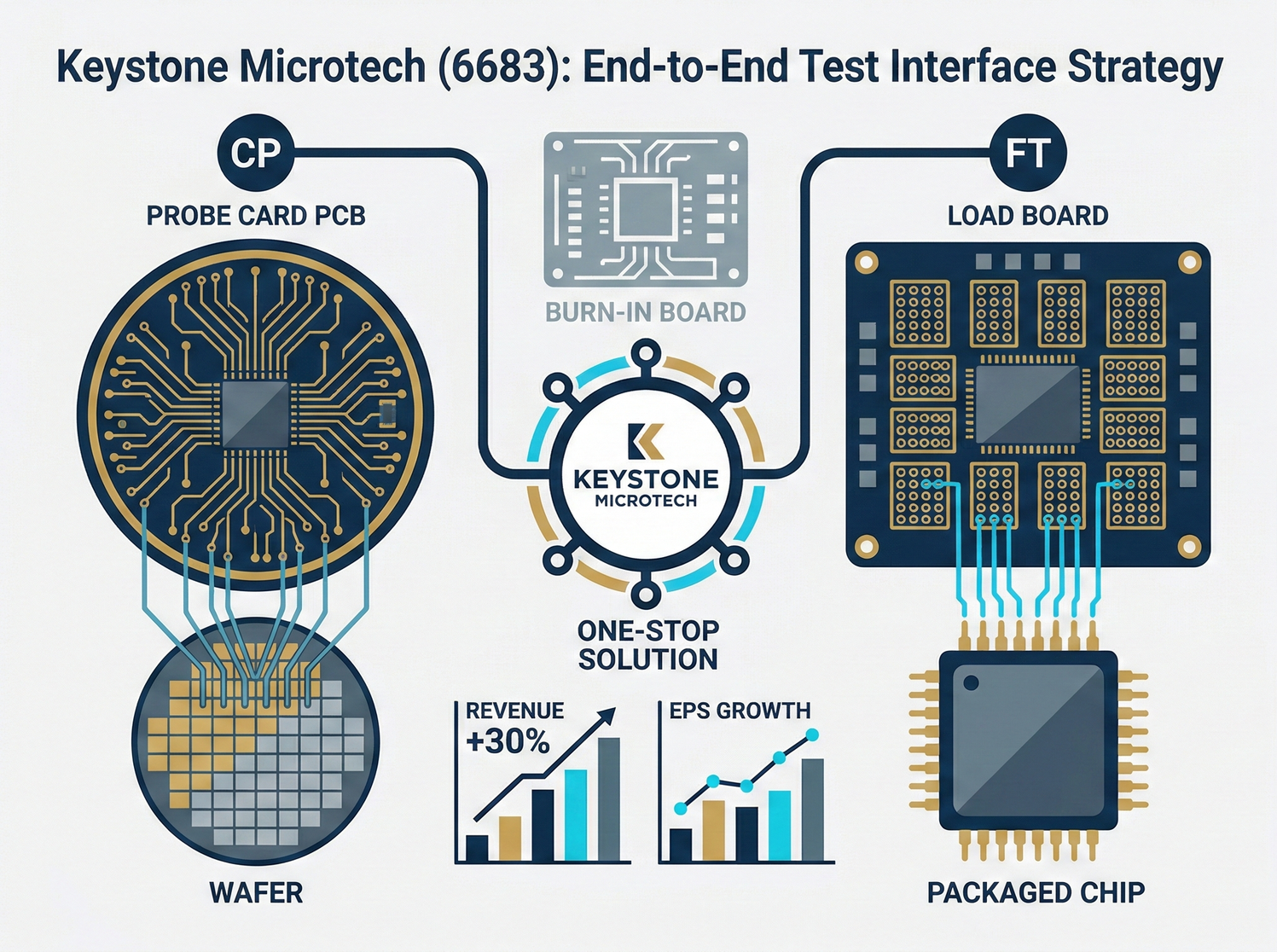
Generally, there is a clear distinction between CP (Chip Probing) wafer testing (probe cards) and FT (Final Test) finished product testing (load boards). However, Youngz Technology spans the entire test ecosystem:
- Front-end CP: Probe Card PCBs and interposers for probe cards.
- Back-end FT: Load Boards for final testing.
- Extreme conditions: Even Burn-in Boards, used for placing chips into 125°C ovens, are a strong suit.
Today, when IC design clients launch a System-on-Chip (SoC), it often integrates networking, automotive, multimedia, and AI control functionalities simultaneously. Clients prefer a "one-stop-shop" test interface solution rather than seeking different providers for front-end and back-end testing.
Youngz Technology's amphibious capability gives it strong exclusivity when securing new projects with major clients.
📈 Top Secret Decoding: 2026's Davis Double-Whammy and ASP Surge
Why bring Youngz Technology into the strategic spotlight at this juncture? Because Youngz Technology stands at the golden cross-point of "specifications upgrade" and "capacity ramp-up":
- 1) AI drives a violent ASP revaluation: The testing schedules for 3nm/2nm and AI peripheral chips have been extended. To handle massive I/O throughput, the number of layers in test load boards has drastically increased, leading to a significant jump in the unit prices (ASP) of Load Boards and Probe PCBs.
- 2) Robust 2026 growth guidance: Analyst tracking indicates that, benefiting from demand from clients in Taiwan and the United States, Youngz Technology's 2026 revenue growth target is set for the High-20%s (approaching 30%).
- 3) Learning curve breakthrough, profits up to 45%: Gross profit has recently been under short-term pressure due to the outsourcing of some probe heads; however, with scaling up and learning curve improvements in 2026, gross profit is expected to recover. Under the dual engines of "30% revenue growth + gross profit expansion," the industry estimates that 2026 net profit after tax could see an annual increase of 45%, with EPS reaching a new historical high.
In summary, while market attention often focuses on the forefront probes and sockets, Youngz Technology, through its global presence and integrated solution capabilities, is quietly securing large development projects from European, American, and Asian clients, establishing itself as the most stable and fundamentally sound key piece in the test interface sector.
In-depth Research · Quantitative Perspective
Want to gain more insights from semiconductor quantitative research?
【Insight Subscription Plan】Break Free from Retail Investor Mentality: Build Your Alpha Trading System with "Quantitative Chips" and "Consensus Data"EDGE Semiconductor Research
📍 Series Map — Navigate the Complete EDGE Semiconductor Research →


