5-4-3 Yingwei (6515)'s Golden Consumables War: FT Test Sockets and Extreme Cooling
Yingwei built tech barriers with FT and SLT test sockets. As AI chip power exceeds kW, its thermal fluid engineering & coaxial shielding effectively solve extreme heat & signal interference. Benefiting from surging SLT demand, high-priced HyperSocket will scale up in 2026. In an era of expensive ...
In an era where AI chip power consumption and high frequencies are simultaneously pushing physical limits, sockets are no longer mere carriers. They have become high-value consumables that can determine yield, test throughput, and even the fate of individual chips. eTest's (6515) advantages stem from two technological barriers: thermal management/materials/mechanical design and coaxial shielding, anticipating a multiplier effect with the ramp-up of SLT.
0. Aligning the Scene: The Third Gauntlet, FT (Final Test)
Welcome to the third gauntlet for AI chips: FT (Final Test).
In the first two stages, tests are performed on uncut "wafers." Now, the chip has been diced, tightly packaged with HBM (High Bandwidth Memory), and enclosed in a robust casing, transforming into a super AI behemoth valued at tens of thousands of US dollars.
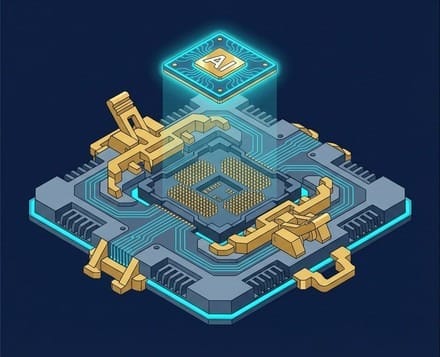
At this point, probe cards are no longer useful. To test this packaged product, test facilities must use a specialized consumable called a "Socket (test socket)".
What is a Socket?
It looks like a small box with precise latches.
A robotic arm places the chip inside, and the lid is pressed down.
Tens of thousands of spring-loaded pins (Pogo Pins) at the bottom align with the solder balls for full functional power-on testing.
In the era of consumer electronics, a socket was merely an ordinary plastic and metal carrier. But in today's world of surging AI computing power, this small box has become a "fiery dragon throne."
1. 🐉 The Fiery Dragon Throne: 1000W Power Consumption and 150°C Physical Limits
Imagine the state of a top-tier AI chip operating at full speed during testing.
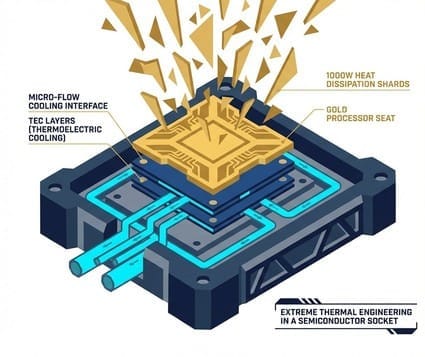
When the test machine instantly injects hundreds of amperes of furious current, the chip's power consumption will surge past 1,000W. This is equivalent to concentrating all the heat of a household microwave oven onto a square block smaller than the palm of your hand.
Within a few seconds, the chip's surface temperature can skyrocket to over 150°C. The "dragon throne" (socket) holding the chip faces a hellish challenge:
Must not melt or deform
The body material must maintain rigidity under extreme high temperatures.
Even micrometre-level thermal expansion or warping will misalign the spring-loaded pins with the solder balls.
Result: The entire test fails immediately.
Extreme cooling requirements
If heat cannot be dissipated, the chip might be directly damaged within the socket.
eTest (6515) dominates the high-end socket market, and its first moat is its world-leading foundation in "thermal fluid engineering and polymer materials science."
They can design specialized thermal test sockets with micro-channel liquid cooling, and even integrate advanced Thermoelectric Coolers (TEC), tailored to the heat generation characteristics of different AI chips, ensuring that chips do not self-ignite under extreme stress.
2. ⚡ Microscopic Shielding for Signals: Coaxial Socket Black Technology
However, high temperatures are not the most terrifying challenge; the most fatal nemesis is high-frequency electromagnetic interference.
When AI chips transmit signals externally at extremely high frequencies like 112G PAM4, the tens of thousands of densely packed traditional metal spring-loaded pins inside the socket instantly transform into tens of thousands of mutually interfering "broadcast antennas." High-frequency signals undergo intense crosstalk between pins, causing the waveforms received by the machine to become a jumble of noisy static.
To solve this physical dead-end, eTest (6515) deploys its ultimate weapon—the "Coaxial Socket."
Intuitive Analogy: Shrinking a Coaxial Cable Ten Thousand-fold
Have you seen the "coaxial cable" for cable TV at home?
Inner copper wire: Signal
Outer insulation: Isolation
Outermost metal mesh: Grounding shield, anti-interference
What eTest does: They scale this structure down to the size of a "pin" and pack them into a high-density arrangement.
In eTest's top-tier coaxial sockets, each signal pin, as fine as a strand of hair, is precisely wrapped:
With an extremely thin Teflon insulation layer
And an outermost metal tube for grounding shielding
Moreover, these three layers must be inserted flawlessly into tiny holes with a pitch of only 0.5mm.
This is a dual technological marvel, combining "high-frequency microwave electromagnetics" with "extreme precision mechanical machining."
Currently, looking globally, the number of manufacturers capable of mass-producing ultra-high-frequency coaxial test sockets that meet the stringent standards for yield and high-temperature lifespan set by top-tier GPU manufacturers can be counted on one hand. eTest (6515) is the undisputed leader among them.
3. ⚔️ Written Test vs. Field Exercise: The Essential Differences Between FT and SLT
In the semiconductor testing domain, FT can at best be considered a "written test."
During the FT stage, the test machine merely sends standard voltages and logic signals to confirm whether the chip responds and if the circuits are intact. Passing FT means the chip is "physically" sound.
However, when an AI GPU, valued at tens of thousands of US dollars, is delivered to a Microsoft or Google data center, plugged into a motherboard, and powered on to run real large language models (LLMs), will it crash? This cannot be determined by a written test.
It must undergo a brutal "field exercise"—SLT (System Level Test).
In the SLT stage, test houses (such as KYEC) will insert the chip onto a "real server motherboard," load a real operating system, and have it run actual software at full speed.
Why must SLT be 100% full inspection?
If a chip fails in a client's data center, the cost could be a devastating disaster involving millions of server outages.
Therefore, top-tier AI GPU manufacturers have issued a strict mandate: SLT must provide 100% coverage, with no random sampling allowed.
4. 🌌 The Terrifying Multiplier Effect: Why is the SLT Market 4 to 5 Times Larger than FT?
This is the underlying mathematical secret behind the "drastic re-evaluation" of eTest's profit forecasts:
The total addressable market (TAM) for SLT test sockets is approximately 4 to 5 times larger than that for FT.
This post is for subscribers only
Sign up now to read the post and get access to the full library of posts for subscribers only.