
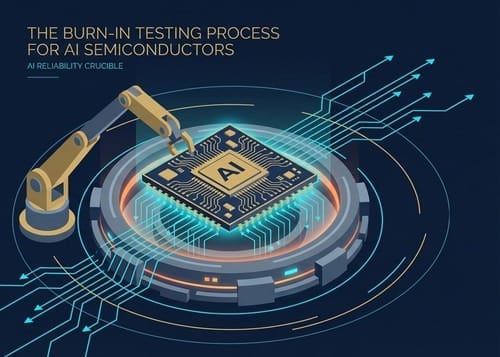
Welcome to the final 'purgatory' before AI chips leave the factory.
In the previous stage, inside Chroma's SLT machine, the chip successfully endured a 'real-world exercise' of 1000W power consumption, proving it wouldn't crash and its logical operations were completely correct in a real environment. But can this chip truly be installed in Google or Microsoft servers and reliably operate at full speed for three, five, or even ten years?
It's important to know that the microscopic world of semiconductors harbors an extremely cruel law of destiny: the 'Bathtub Curve'.
💀 Infant Mortality: The Semiconductor's Most Fragile Moment
If you look at the graph showing the failure rate of any electronic component over time, it looks just like a bathtub:
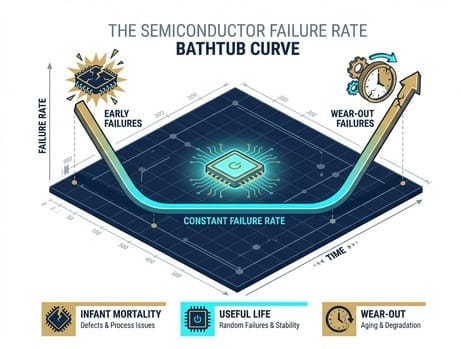
- Early Failure (Infant Mortality): When a chip first leaves the factory, its failure rate is extremely high. Tiny imperfections from the micro-manufacturing process (such as extremely thin oxide layers or microscopic cracks in metal lines) can rapidly worsen during initial powered operation, leading to a short circuit. This is like the chip's 'infant mortality'.
- Random Failures: Chips that survive the infant mortality period enter a long and stable mature period, with an extremely low failure rate.
- Wear-out: After several years, due to physical limitations and electromigration phenomena, the chip's lifespan reaches its end, and the failure rate surges again.
NVIDIA and TSMC cannot change the laws of physics, but they must guarantee to cloud giants: 'The chips delivered to you will absolutely not experience infant mortality!'
To address this fear, test houses must employ the most time-consuming and aggressive form of 'punishment': 'Burn-in'.
Engineers take these batches of top-tier GPUs, each costing tens of thousands of US dollars, and place them into a 'hellish sauna' (burn-in oven) reaching temperatures as high as 125°C or even 150°C, while simultaneously applying extreme voltage and current, continuously 'baking them to death' for tens of hours!
This is like using an extremely harsh environment to forcibly press the 'fast-forward button' on the chip's lifecycle. The sole purpose is to 'kill off' those weak 'bad apples' with microscopic defects directly within the factory, absolutely preventing them from leaving the plant alive!
📉 Dramatic Shift in Demand Structure: From 'Optional (Sampling)' to 'Standard (100% Inspection)'
In the past era of PCs and consumer electronics, burn-in was actually an "optional" step. If a consumer-grade IC, costing a few tens of US dollars, genuinely failed in the hands of a consumer, the worst-case scenario was replacing it with a new one for the customer, making RMA (return merchandise authorization) costs extremely low. Therefore, test houses at the time typically performed burn-in "sampling" on only 1% to 5% of chips.
However, in the era of AI and high-end automotive chips, this economic formula has been completely shattered!
If a Blackwell chip, valued at $30,000, was not screened out by burn-in and was installed in an AI data center cluster costing hundreds of millions of US dollars, and then experienced "infant mortality" a few days later, this failed chip would cause the entire neural network training to halt, and could even lead to hundreds of servers crashing.
This is known as "Downstream Failure Cost (including compensation for breach of contract, downtime losses, and reputation damage)", and it can be 5 times, or even more than 10 times, the selling price of the chip itself!
No chip design company can afford the devastating risk of such a field failure.
Consequently, a "structural transformation" that has shaken the semiconductor testing industry has occurred: burn-in testing for high-end AI and automotive chips has officially transitioned from "sampling" to "100% absolute screening"!

Companies would rather spend an extra $100 in testing fees to bake the chips for a few days in the factory than risk hundreds of thousands of dollars in downstream claims. This "insurance policy," known as burn-in, has since become a mandatory standard for AI chips before they leave the factory.
🦾 Micro-Surgery in the Oven: The Physical Deadlock of Thermal Expansion
On a real burn-in production line, we need to precisely press thousands of AI chips, each costing tens of thousands of US dollars, into the "Burn-in Board" (the domain of Unimicron Technology) mentioned in the previous chapter. Then, they are sent into the oven, and after testing is complete, the good and bad chips are sorted out.
All of this cannot be done manually; it must rely on a massive automated mechanical equipment called a "Handler" (sorter).
However, in a burn-in environment, the handler faces an ultimate physical deadlock based on fundamental physics: "Thermal Expansion of Metals".
The temperature inside the burn-in oven can reach as high as 125°C or even 150°C. Under such extreme high temperatures, the steel structure, robotic arms, and even drive shafts inside the handler will undergo uncontrollable physical expansion and deformation.
The precision required to press an AI chip into a test socket is "±10 micrometers (several times finer than a human hair)".
If a robotic arm expands by several tens of micrometers due to high temperatures, the moment it clamps and presses the chip down, it will no longer be precisely aligned, but will instead "crush" this chip, worth tens of thousands of US dollars, on the spot.
🪄 Hongjing (7769)'s Extreme Magic: Micrometer-Level Handling at 125°C
This is the absolute moat that allows Hongjing (7769), the invisible giant that has just listed on the emerging stock market and sparked extreme capital market fervor, to dominate the world!
Hongjing does not make ovens; it is the global leader in "Burn-in Handlers" (burn-in sorters).
This company possesses incredibly advanced precision machinery and dynamic thermal compensation black technology. Their equipment can precisely calculate the expansion coefficient of each metal arm in extreme high-temperature environments of 125°C to 150°C, and perform "real-time micrometer-level dynamic calibration" through software and micro-servo motors.

This enables Hongjing's machines to clamp, press, and sort thousands of AI chips at extremely high speeds and with zero error in hellish high-temperature ovens, completely avoiding the tragedy of crushing or misalignment.
🏰 Think Tank Strategy Roundup: The Ultimate Infrastructure Provider for "Risk Outsourcing" in the AI Era
When we elevate the business logic of this company to a strategic level, you will find that Hongjing (7769)'s positioning far exceeds that of a typical equipment manufacturer.
Under the strict mandate of "100% full inspection Burn-in" for AI chips, if King Yuan Electronics and ASE Technology Holding want to accept NVIDIA's orders, they must fill their entire factories with burn-in production lines. And as long as they expand capacity, they "must and can only" purchase these extreme heat-resistant handlers from Hongjing.
Hongjing (7769) has essentially become the underlying infrastructure supplier for the global AI chip "risk outsourcing industry."
It is like a "toll booth" with extremely high technological barriers established on this highway to the peak of AI computing power. Every chip that fears premature death in data centers must dutifully pay the toll, carried by Hongjing's robotic arms, to pass through this burning execution ground.
This is the underlying logic for why it commands such a high valuation premium and P/E ratio upon listing on the capital market!
In-Depth Research · Quantitative Perspective
Want more insights into semiconductor quantitative research?
【Insight Subscription Plan】Break Free from Retail Investor Mindset: Build Your Alpha Trading System with "Quantitative Chips" and "Consensus Data"EDGE Semiconductor Research
📍 Series Map — Navigate the Complete EDGE Semiconductor Research →


