
Key Takeaways
- Traditional data centers' "energy conversion tax" stems from multiple AC/DC conversions and waste heat.
- HVDC utilizes 380V DC throughout the data center, combined with "centralized rectification" to reduce losses.
- Two major hard thresholds: parallel current sharing (risk of circulating current) and DC arc suppression (hot-swapping arc).
- 48V is merely a transitional phase; facing 100–120kW cabinets, 800V and SiC power delivery chains will be forced to upgrade.
To understand this massive power shake-up, which involves hundreds of billions of New Taiwan Dollars, we must first start with the "large power grid" outside the data center. In traditional data centers, there is an extremely absurd "energy conversion tax" that people have historically had to silently endure.
💸 The Evil Conversion Tax: Computing Power Devoured by Waste Heat
When Taipower's alternating current (AC) enters a data center, it embarks on a wasteful journey: from AC/DC conversion within the UPS (Uninterruptible Power Supply), to stepping down into 12V direct current within the server power supply unit (PSU), and finally to 0.7V direct current required by chips on the motherboard.
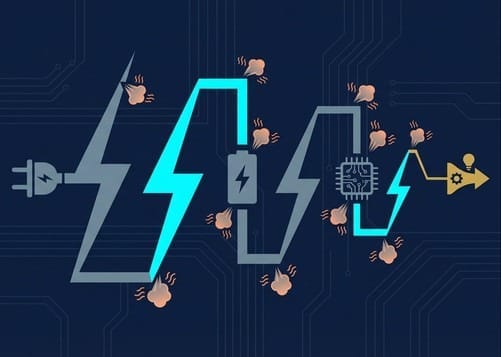
This is an absurd "AC \rightarrow DC \rightarrow AC \rightarrow DC" relay.
In fundamental physics, **each AC/DC conversion loses 3% to 5% of power in the form of "waste heat."** In the AI era, when a data center's power consumption routinely starts at 1 GW (gigawatt), this conversion tax becomes so expensive that even cloud giants like Google and Meta can no longer tolerate it. This is because the waste heat generated also requires even more air conditioning power to dissipate!
🗡️ The Giants' Overt Strategy: HVDC and the Technical Deep Water of "Centralized Rectification"
To completely eliminate this conversion tax, cloud giants have jointly driven an infrastructure revolution named **HVDC (High Voltage Direct Current)**.
Their strategy is remarkably simple and direct: **"outsourcing" all AC conversion tasks centrally, and directly using 380V high-voltage direct current throughout the entire data center!**
This introduces the first stringent technical barrier—**[Centralized Rectification]**.
In the past, each server housed its own small power supply unit (PSU). However, under the HVDC architecture, these small power supplies are all removed, and all AC-to-DC conversion tasks are centrally consolidated in "giant power shelves" at the front end of the data center. This is not as simple as merely bundling a few power supplies together. When dozens of high-power supply modules must operate in "parallel" to collectively output hundreds of kilowatts of immense DC power, even a slight voltage instability in just one module can generate a terrifying "circulating current," leading to the collapse of the entire cabinet's power. This severely tests the "current sharing technology" and system-level parallel stability of major manufacturers like Delta Electronics and Lite-On Technology.
🔥 The Fear of Arc Suppression: DC's Physical Retribution and the Materials Science Revolution
However, what truly makes engineers dread HVDC is the second fatal physical impasse: **[DC Arc Suppression Technology]**.
Nature is fair. Although alternating current (AC) has poor conversion efficiency, its voltage waveform is a sine wave, featuring 120 "zero-voltage" instances per second. Therefore, when we unplug an AC cord, it's very easy to disconnect without significant danger.
However, direct current (DC) is a high-voltage straight line that never returns to zero!
What happens if you forcefully disconnect a 380V DC connector (hot-swapping) while a server is running at full speed, carrying hundreds of amperes of high current?
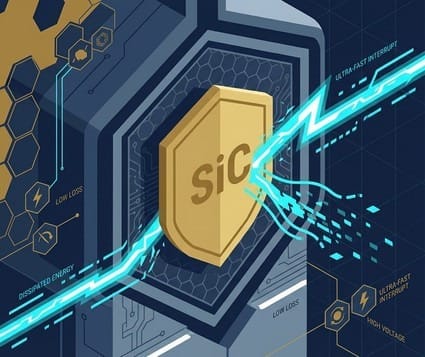
The air will instantly be ionized by the powerful high voltage, creating a plasma that generates a "high-temperature arc" (Arcing) reaching thousands of degrees, dazzling like an electric weld! This terrifying arc can not only severely burn the operating engineer but also instantly melt the connector's metal contacts into molten metal, potentially even causing a data center fire.
To resolve this fatal threat, major power supply and connector manufacturers have been forced to embark on an extreme revolution in materials and semiconductors:
- Solid-State Circuit Breaker (SSCB): Traditional mechanical switches are too slow. Now, solid-state circuit breakers made from power semiconductors like silicon carbide (SiC) must be used to electronically sever the current the instant an arc forms, within "microsecond-level" timing.
- Spark-less Blind Mate Connectors: The metal contacts and plastic insulation layers of connectors must employ specialized composite materials that are extremely resistant to high temperatures and arc erosion. This ensures that even after thousands of aggressive insertions and removals, no arc leakage will occur.
This is the cruel physical cost behind the HVDC architecture. This revolution has directly eliminated smaller manufacturers who only assembled low-end power supplies, leaving behind top-tier players with deep expertise in high-voltage electrical engineering and materials science.
🔋 The False Sense of Security of 48V and the Merciless Backlash of I^2R
Before delving into NVIDIA's ambitious plans, we must first understand the "12V to 48V" transition period currently underway in the server industry.
For the past decade or so, the standard power supply voltage for server motherboards has been 12V.
As AI chip power consumption began to rise, 12V encountered a fundamental physical limitation: **Joule's Law (Heat Loss $= I^2R$)**.
To transmit the same power ($P=IV$), the lower the voltage ($V$), the larger the current ($I$) must be; and the larger the current, the "waste heat ($I^2R$)" generated in copper wires during transmission will exponentially increase at a "squared rate".
To address this issue, Google spearheaded the OCP architecture, raising the power distribution voltage inside server cabinets from 12V to **48V**.
This was a very clever mathematical salvation: with the voltage quadrupled, the current decreased to 1/4; and the heat loss on the copper busbar instantly dropped to **1/16** of its original value! This brought a sigh of relief to the entire server industry, which believed 48V would safely navigate the next decade of AI.
But NVIDIA knows this sense of security is false. 48V won't even last until the next generation!
🐉 The 2500 Ampere Monster: Melting Busbars and the Ultimate 800V Antidote
When Blackwell GB200 NVL72 cabinets debut, and even when future Rubin generations arrive, the total power consumption of a single cabinet will easily exceed **100kW or even 120kW**.
Let's do the cruel math again:
If we insist on using 48V to transmit 120kW of power, how high will the current be?
120000 \div 48 = 2500 Amperes!
2500 Amperes! This is a terrifying number, capable of instantly vaporizing ordinary metals.
To withstand 2500 Amperes of current, the copper busbars responsible for power delivery inside the cabinet would have to be thicker than an adult man's arm! But even if made extremely thick, such immense current during transmission would still generate astonishing waste heat, even triggering the "skin effect," causing the busbar's transmission efficiency to plummet drastically and directly melting connectors.
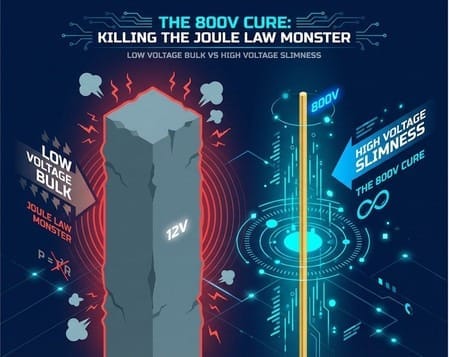
Joule's Law has cornered NVIDIA into a physical dead end. To eliminate the 2500 Ampere monster, the only viable path is to **continue wildly increasing the voltage!**
NVIDIA's ultimate ambition is to directly draw inspiration from "electric vehicles (EVs)."
When Porsche and Tesla upgraded their EV systems from 400V to 800V to solve the issue of "supercharging cables melting," NVIDIA is now preparing to do the exact same thing: **they intend to directly raise the main busbar voltage inside AI server cabinets to 800V!**
This means that in the future, 380V or higher voltage DC entering the cabinet will no longer be stepped down to 48V. Instead, it will maintain an extremely high voltage, approaching the GPU's "doorstep," with step-down conversion occurring only at the very last moment. This will instantly reduce the current inside the cabinet to just over a hundred amperes, completely eliminating cumbersome busbars and massive transmission heat losses.
⚡ 800V's Industry Chain Reaction: Dielectric Breakdown and SiC's Complete Takeover
However, integrating 800V into an extremely crowded server chassis filled with precision chips is an engineering nightmare. It will trigger a complete shake-up across two major industrial chains:
- Safety Regulations and Insulation Materials Rewrite (Creepage & Clearance):
Under the extreme high voltage of 800V, the PCB (Printed Circuit Board) and connector spacing originally suitable for 48V will experience terrifying "dielectric breakdown." High voltage electricity will directly bypass air or insulation, striking adjacent low-voltage signal lines. This means that all connectors, PCB materials, and insulation coatings within servers must be comprehensively upgraded to "automotive-grade" or even "industrial-grade" standards.
- The Aggressive Takeover by Third-Generation Semiconductors (SiC's Profitable Prelude):
This is the most fatal blow. In an 800V high-voltage environment, traditional "silicon-based" power semiconductors (MOSFETs) will directly burn out due to their inability to withstand the high voltage. **To control 800V power switches, the only antidote is extremely expensive, high-voltage, and high-temperature resistant "silicon carbide (SiC)"!**
NVIDIA's 800V ambition will aggressively compel server power modules to fully adopt SiC power semiconductors.
🚪 Think Tank Perfect Transition: Who is Helping NVIDIA Build This High-Voltage Empire?
From 380V HVDC (6-1-1) to the 800V rack ambition (6-1-4), we have fully understood this "voltage surge battle" against Joule's Law.
However, NVIDIA is responsible for chip design; they do not produce these large and complex power conversion systems themselves.
In this massive energy shake-up, from the "data center grid" to "inside the cabinet," who can take on these multi-hundred-kilowatt super power supply orders? Who can solve the technical impasses of parallel current sharing, DC arc suppression, and 800V conversion?
In Taiwan, two power supply giants have provided distinctly different answers.
In-depth Research · Quantitative Perspective
Want to gain more insights into quantitative semiconductor research?
【Insight Subscription Plan】 Bid Farewell to Retail Investor Mentality: Build Your Alpha Trading System with 'Quantitative Flows' and 'Consensus Data'EDGE Semiconductor Research
📍 Series Map — Navigate the Complete EDGE Semiconductor Research →


