
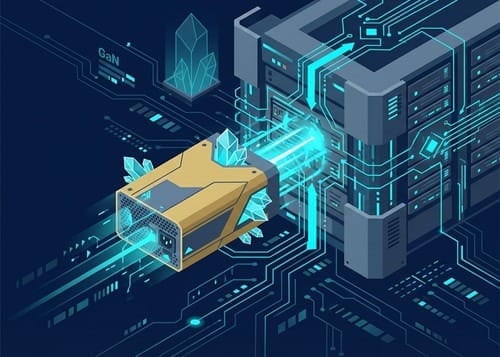
In the first part of the duel between the two giants, we saw Delta Electronics (2308) acting like a massive infrastructure beast, dominating the macro world from power grids to server racks with its 'one-stop-shop' system integration capabilities.
If you were a decision-maker at Lite-On Technology (2301), facing such a massive opponent with full defensive capabilities, how would you fight this battle? Competing on transformers? Competing on entire server rack cooling solutions? That would be akin to using your weaknesses against someone else's impenetrable moat.
Lite-On Technology chose an extremely sharp, completely opposite 'assassin's path'. It ignored the large power grids outside the data center and instead concentrated all its R&D firepower and capital on the precious, confined space inside the server chassis. Its strategy was singular: 'Make the internal DC-DC converters and power modules within the server extremely small and extremely efficient!'
🗄️ The Zero-Sum Game of Space: The "Real Estate" War in the Server Rack
To understand the value of this assassin strategy, we must shift to the perspective of an NVIDIA server architect.
In a standard 19-inch server rack, space is absolutely limited 'scarce real estate'. By the Blackwell generation, this zero-sum game of space has become extremely brutal: GPU chip areas are growing, and the high-bandwidth memory (HBM) modules attached alongside them are increasing in number. Even more daunting, to suppress the high temperatures generated by 1000W of power, the cold plates covering the chips and the intricate network of water pipes occupy an astonishing volume.
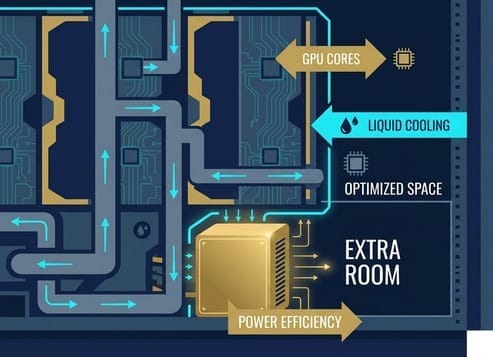
When these 'compute power and cooling' heavy-duty components fill the rack, very little space remains for the 'power supply unit (PSU)'. If power supply manufacturers cannot miniaturize 5.5kW or even higher-power modules, NVIDIA faces a painful choice: either reduce the number of GPUs in the server or sacrifice space for the liquid cooling pipelines. For the AI industry, where computing power is paramount, this is an absolutely unacceptable compromise.
⚡ The Assassin's Finishing Move: Ultimate "Power Density"
This is the perfect opening for Lite-On Technology's surprise attack. Lite-On Technology's strongest KPI in the AI era is not the size of the server rack, but 'Power Density' (the wattage that can be output per unit volume).
Lite-On Technology's engineers are tackling extreme physical miniaturization. They must stably output several kilowatts of massive power within a metal enclosure smaller than a traditional shoebox, absolutely without internal components becoming too crowded and causing high-temperature spontaneous combustion. When Lite-On Technology successfully shrunk the power supply's volume by 20% or even 30%, it essentially conjured extremely valuable physical space out of thin air for cloud giants in their crowded server racks!
This extra space allows NVIDIA to fit in more GPUs, enables cooling manufacturers to install counter-rotating fans with stronger air pressure, or deploy thicker liquid cooling pipelines. On the surface, Lite-On Technology sells power supplies, but in the eyes of cloud giants, it sells 'space-unlocking magic' within the server rack!
⚡ The Limits of Silicon and the Switching Frequency Dilemma
All power supplies are essentially 'ultra-high-speed electronic switches'. They chop up the input voltage through tens of thousands of 'on-off' cycles per second, then convert it into the stable DC power required by servers.
In the past, this switching was handled by traditional 'Silicon-based MOSFETs'. If we want to reduce the size of a power supply, the most direct physical principle is to 'increase the switching frequency'. This is because the faster the switching, the smaller the 'magnetic components' (such as inductors and transformers) responsible for storing energy can be made.
However, this runs into the 'physical wall' of traditional silicon materials: Switching Loss. As soon as the switching speed of silicon material increases, each on-off transition generates significant waste heat due to friction. If one insists on raising the frequency to shrink the inductor, the additional waste heat would then require larger heat sinks, ultimately preventing the power supply's volume from decreasing at all!
💎 The Assassin's Ultimate Weapon: The Miniaturization Magic of GaN (Gallium Nitride)
To untangle this deadlock, Lite-On Technology launched an extremely aggressive materials revolution: the full adoption of GaN (Gallium Nitride) third-generation wide-bandgap semiconductors!
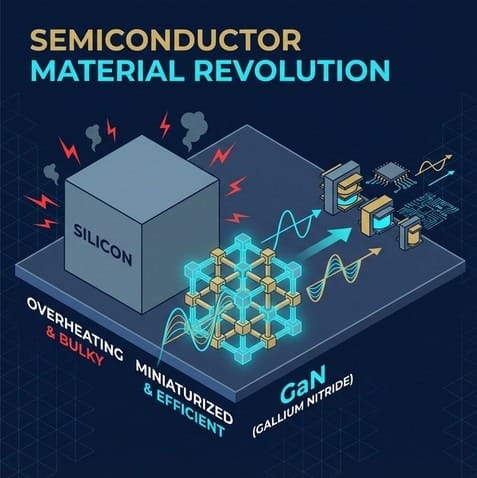
Compared to conservative traditional major manufacturers, Lite-On Technology has pushed the application of GaN to the extreme in high-end AI power supplies. GaN is a nearly perfect switching material. Its electron mobility is extremely high, meaning it can switch furiously at extremely high frequencies (up to hundreds of kHz or even MHz levels) with virtually no additional switching waste heat generated!
This is the underlying physics of Lite-On Technology's 'miniaturization magic':
- Drastic Shrinkage of Magnetic Components: Because GaN enables ultra-high-frequency switching, the volume of internal transformers and inductors within the power supply has been drastically reduced by over 30% to 50%!
- Liberation of Cooling Space: Because GaN generates minimal heat, the large extruded aluminum heat sinks that previously occupied significant space can be substantially thinned or even removed.
Through this extreme engineering process of 'trading high frequency for space', Lite-On Technology successfully created astonishingly small AI server power modules.
🏆 Titanium Level Conversion: Over 96% Extreme Efficiency
However, Lite-On Technology's assassin nature isn't finished yet. Even if the power supply is miniaturized, if its conversion efficiency is too low, generating too much waste heat, it will still overheat the adjacent GPUs.
Under the stringent standards for AI servers, cloud giants demand the highest level of '80 Plus Titanium' certification. This means that at 50% load, the power supply's conversion efficiency must be over 96%! In other words, for every 100 watts of input power, less than 4 watts are converted into waste heat.
This is an extremely demanding engineering challenge. Leveraging its exclusive digital power control architecture (DSP Controller) and perfect tuning of GaN components, Lite-On Technology has not only met the 96% Titanium standard but is even pushing towards the physical limit of 97.5% in its latest generation of products. This 1% to 2% efficiency improvement, for a 120kW power-consuming server rack, is equivalent to eliminating thousands of watts of waste heat out of thin air! This is the ultimate strength that makes NVIDIA and Microsoft highly reliant on Lite-On Technology.
🛡️ Escaping "Vendor Lock-in": The Cloud Giants' Most Coveted "Strongest Second Source"
Please put yourself in the shoes of the Chief Procurement Officer at Microsoft, Google, or NVIDIA.
When Delta Electronics or Vertiv takes care of all 'power supplies, server racks, and liquid cooling' and provides a perfect single-point responsibility warranty, can you truly sleep soundly at night? The deepest fear in business is called 'Vendor Lock-in'.

Once your billion-dollar AI data center, from software protocols to hardware pipelines, is entirely tied to a single giant, three years later, when that giant decides to raise prices by 20%, you will be powerless to resist because you won't even have an alternative solution.
Cloud giants urgently need to cultivate a 'powerful, lightning-fast, and highly compliant' second source supplier.
Lite-On Technology perfectly occupies this strategically valuable niche. Compared to Delta Electronics' massive organizational structure, Lite-On Technology demonstrates an extremely agile 'assassin-like agility'. When cloud giants propose a custom high-voltage power supply requirement with new specifications, Lite-On Technology's R&D team can deliver prototypes and solutions with an unusually fast lead time. It doesn't need to compete for the entire server rack's general contracting project; it focuses solely on perfecting the most challenging component: the 'high-power-density DC-DC power module' within the server. With this 'non-hegemonic, yet absolutely indispensable' extreme specialized capability, Lite-On Technology has successfully counterattacked and captured a remarkable share in the AI server power supply sector.
📡 Crossing Boundaries: The Acquisition of U-MEDIA and the Ultimate Convergence of 5G Edge Computing
If you thought Lite-On Technology's ambition stopped at merely being the 'strongest second source' in a data center, you would be gravely underestimating this assassin's strategic depth.
In 2026, Lite-On Technology launched a devastating cross-sector surprise attack—formally announcing its aggressive acquisition of networking equipment manufacturer U-MEDIA (6470) through a Tender Offer!
This is definitely not an ordinary financial acquisition; it is a strategic ticket to the 'Edge AI (Edge Computing) and 5G uncharted territory'!
The trajectory of AI development is rapidly shifting from 'cloud-based giant model training' to 'edge inference at the terminal'. Future computing power will be extensively deployed in networking equipment such as 5G base stations, micro data centers in smart factories, and FWA (Fixed Wireless Access).
These 'edge devices' face even more formidable physical constraints than data centers: They are mounted on utility poles or packed into narrow telecom boxes, making it impossible to equip them with large liquid cooling systems! Here, cooling conditions are extremely harsh, yet computing power consumption is steadily increasing.
Isn't this the perfect stage for Lite-On Technology's 'GaN miniaturization magic' and 'ultimate power density' to shine? Through the acquisition of U-MEDIA, Lite-On Technology directly gains core 5G+ and FWA networking technologies and customer channels. They are prepared to 'downscale' their AI server-grade ultra-high-efficiency power supply technology directly into the vast networking and edge computing market.
♟️ Strategic Netting: Precise Financial Calculation and the 2026 Assassin's Blueprint
Let's dissect the brilliance of this acquisition from the coldest capitalist perspective.
Lite-On Technology initiated the acquisition at NT$54 per share. Although it offered approximately a 19% premium, if we precisely calculate using U-MEDIA's 2025 profit estimates, the P/E ratio for this transaction falls only around 13 times! Compared to the valuations of networking peers in Taiwan, which often range from 12 to 16 times, Lite-On Technology's purchase is extremely precise and cost-effective. Even more remarkably, Lite-On Technology only needed to deploy a mere NT$2 billion (a tiny fraction of its massive cash flow) to acquire 100% of the shares. Management even confidently announced that tangible revenue synergies would be visible within 9 to 12 months after the transaction's completion.
This is Lite-On Technology's (2301) dual-engine assassin's blueprint: Internally (Cloud): Using Titanium-level miniaturized power supplies, firmly securing the position as a second-source supplier in the NVIDIA supply chain, and enjoying the dividends of the AI computing power explosion. Externally (Edge): Leveraging the networking prowess gained from the U-MEDIA acquisition, seamlessly expanding its high-voltage, high-frequency power supply black technology into the blue ocean market of 5G and Edge AI.
In-Depth Research · Quantitative Perspective
Want more insights from semiconductor quantitative research?
【Insight Subscription Plan】Break Free from Retail Investor Mentality: Build Your Alpha Trading System with "Quantitative Chips" and "Consensus Data"EDGE Semiconductor Research
📍 Series Map — Navigate the Complete EDGE Semiconductor Research →


