
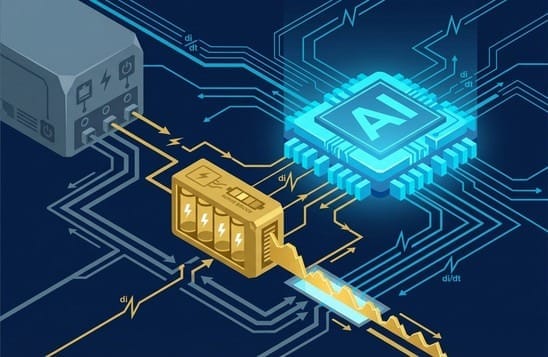
In a nutshell: The power consumption transient of AI chips occurs in 'microseconds'; even the fastest PSUs have a physical delay of 'tens to hundreds of microseconds'. Consequently, the BBU (Battery Backup Unit) has been upgraded from a power outage backup component to a 'transient power buffer' that operates continuously, using Peak Shaving to cover that critical time gap.
⏱️ The Fatal Microsecond: The 'Physical Limit' of Power Supply Units
In our previous chapters, Delta Electronics and Lite-On Technology have pushed server Power Supply Units (PSUs) to their absolute limits.
However, in the face of the extreme computational power of AI chips, traditional power architectures still possess a fatal physical vulnerability: the "time lag".
When a Blackwell GPU is in standby mode, it resembles a sleeping giant, requiring only a minimal current to maintain its operations.
But if a user suddenly submits an LLM (Large Language Model) inference task requiring hundreds of billions of parameters, the tens of billions of transistors within this GPU will instantly awaken within a "millionth of a second (one microsecond)", drawing thousands of amperes of massive current in an instant.
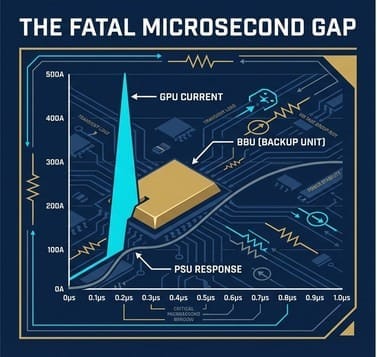
This phenomenon is known in electrical physics as the formidable $di/dt$ (rate of change of current).
Facing such sudden "extreme current draw", even the most advanced power supply units, due to internal capacitor discharge, switchover, and signal propagation, physically require a reaction time of "tens to hundreds of microseconds" to deliver the additional power.
During this extremely brief "window of vulnerability", the chip has already drained the power from the motherboard. Consequently, the voltage across the entire rack will plummet instantaneously, a phenomenon known as $dv/dt$ (transient voltage droop).
AI chips have extremely stringent tolerance for voltage fluctuations. If the voltage instantaneously drops below the chip's minimum acceptable threshold (e.g., 0.65V), this GPU, worth tens of thousands of US dollars, will crash due to logical operation errors.
🛡️ Peak Shaving: From 'Logistics Caretaker' to 'Frontline Assault Team'
To resolve this fatal microsecond, NVIDIA issued an industry-shaking mandate for the GB200 NVL72 rack architecture: the mandatory inclusion of the BBU (Battery Backup Unit) as standard rack equipment.
In the traditional server era of the past decade or so, the BBU was merely an inconspicuous "supporting role".
Its function was simple: when an unexpected power outage occurred outside the data center, the BBU would provide power for 3 to 5 minutes, allowing servers enough time to save data to hard drives and shut down safely. It was like a "logistics caretaker," inactive during normal operation, only deployed in times of disaster.
However, in the AI era, the fundamental logic of the BBU has undergone an epic 180-degree transformation.
Today's BBU is no longer a logistics unit waiting for power outages; it has transformed into a "frontline active assault team" fully equipped with ammunition.
When NVIDIA chips instantly operate at full speed, causing the terrifying di/dt current draw, and Delta or Lite-On's power supply units "haven't had time to react" within those tens of microseconds:
- The BBU instantly intervenes, actively performing "instantaneous discharge" with extremely high current to precisely cover this power gap.
- When the chip's computation ends and power consumption drops, the BBU absorbs excess power to recharge itself.
This process is known in the industry as "Peak Shaving".
This means the BBU has evolved from a passive safety device "potentially used only once every few years" into an active dynamic power source that "instantaneously charges and discharges every second whenever AI chips are computing".
💣 On the Brink of Explosion: The Chemical Limits of High C-rate Discharge
The lithium batteries in your phone or laptop are designed for "slow and stable discharge".
If you attempt to instantaneously draw hundreds of amperes of massive current from an ordinary lithium battery within a microsecond, the battery's internal chemical reactions will instantly spiral out of control. Its internal resistance will convert into extreme waste heat, causing the battery to swell, catch fire, and even lead to catastrophic "thermal runaway" and explosion.
To withstand the instantaneous di/dt current draw in AI racks, BBU manufacturers must completely abandon traditional IT batteries and instead adopt a special, extremely expensive material with very high technical barriers: "High C-rate Battery Cells".
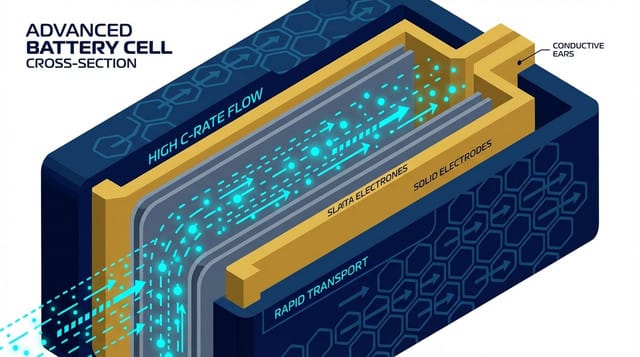
These cells were originally primarily used in high-end power tools or instantaneous acceleration systems for supercars. Their internal structure is specially designed (e.g., thinner separators, thicker conductive tabs) to release enormous current like a floodgate opening in a very short time, while also strictly suppressing temperatures within a safe range.
In the high-temperature environment of AI servers, enabling these high C-rate cells to undergo thousands of "peak shaving" charge-discharge cycles without degradation poses unprecedentedly stringent requirements for battery packaging manufacturers' "thermal management and mechanical design".
🧠 Microsecond-Level AI Brainwave Synchronization: The Invisible Moat of BMS (Battery Management System)
Possessing high C-rate cells merely provides strong "muscles". To achieve microsecond-level rescue, the BBU also requires an extremely powerful "brain" – the BMS (Battery Management System).
In traditional BBUs of the past, the BMS simply needed to monitor whether the battery was fully charged or overheating, with relatively simple code.
However, under the GB200 architecture, the complexity of BMS has undergone an "exponential leap".
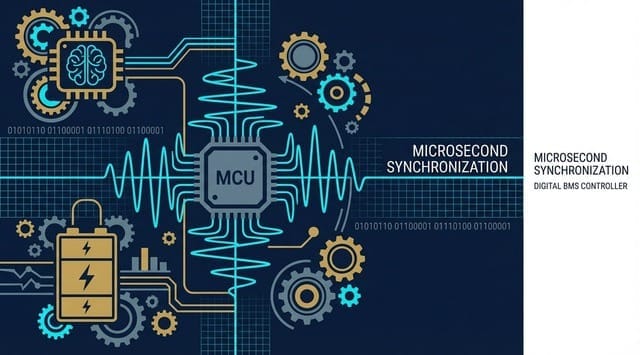
When NVIDIA's GPU prepares for instantaneous high-current computation, the BBU's brain (BMS) must achieve perfect, microsecond-level synchronization with the entire AI server's "Power Sequencing".
This is like an extremely dangerous high-wire relay race:
- If the BMS discharges one microsecond too late: the chip's voltage plummets, and the GPU crashes instantly.
- If the BMS discharges one microsecond too early, or supplies too much power: the surging current will directly burn out delicate components on the motherboard.
To solve this challenge, high-end BBUs now must incorporate microcontrollers (MCUs) with powerful edge computing capabilities, and even sophisticated predictive algorithms.
It is no longer just a simple battery pack; it has essentially transformed into a "self-aware dynamic power regulator".
👑 The Former Hegemon's Concerns: AES-KY (6781)'s 'High Gross Margin Curse' and Over-Concentration
When discussing high-end data center BBUs, we cannot overlook the dominant player in Taiwan – AES-KY (6781).
In recent years, while other battery manufacturers were battling fiercely in the red ocean of laptop and e-bike batteries, AES-KY, leveraging substantial support from its parent company (Simplo Technology) and its foresight in entering the high-power BBU market early, secured the most lucrative high-end server orders from major US cloud giants.
However, AES-KY's throne is showing extremely dangerous cracks.
In the business world, there is an iron rule: "When a product's gross margin is too high and it becomes a mandatory standard component, customers will go to extreme lengths to introduce second and third sources to drive down prices".
Cloud Service Providers (CSPs) will absolutely not allow the lifeline of their AI racks to be tied down by a single, high-margin battery manufacturer.
More critically, as "system-level general contractors" like Delta Electronics and Lite-On Technology aggressively take over the rack's Power Shelf, AES-KY must prove its ability to seamlessly integrate into these power giants' ecosystems, rather than operating independently.
Foreign investors frankly state that the market has already "priced in" AES-KY's strong momentum, but has severely underestimated the brutal price competition it will face in its future pricing power.
⚔️ The Veteran's Powerful Counterattack: SunnyPeak Inc. (3211) and the HVDC Specification Bonus
As the former hegemon faces cloud giants' strategies of "price reduction and supplier diversification", this presents a perfect windfall for other veteran battery manufacturers.
Among them, the veteran battery manufacturer undergoing the most rapid transformation and whose earnings forecasts are being aggressively upgraded by institutional investors is SunnyPeak Inc. (3211).
Previously, SunnyPeak Inc. primarily relied on battery modules for IT products (laptops/tablets). Now, it is entering the core supply chain of AI server BBUs with extremely strong momentum.
SunnyPeak Inc.'s confidence stems from the radical specification upgrade brought by HVDC (High Voltage Direct Current).
Recall the 380V HVDC revolution we discussed in 6-1-1. As the rack's voltage architecture is comprehensively elevated, the BBU's output voltage and capacity (Wattage) must also surge significantly to perform "Peak Shaving" within microseconds.
According to industry data obtained by our think tank, the wattage demand for BBUs in next-generation AI infrastructure is growing exponentially.
SunnyPeak Inc. has not only successfully developed high-end BBU modules compatible with high-voltage architectures but also perfectly addresses cloud giants' pain points of "desiring high quality while simultaneously seeking risk diversification and cost reduction", leveraging its accumulated "extreme cost control and mass production scale" from consumer electronics.
This HVDC specification bonus is precisely the most powerful engine driving SunnyPeak Inc.'s transformation and its revenue and profit's structural surge.
🥷 The Ecosystem's Agile Assassin: Newmax Technology (4931)'s ODM Bundling Strategy
If SunnyPeak Inc. is confronting the challenge head-on with scale and high-voltage technology, then another battery manufacturer, Newmax Technology (4931), perfectly exemplifies what it means to be an "agile assassin within the ecosystem".
Shipments of AI servers are often controlled by large ODM (Original Design Manufacturer) firms such as Quanta, Wistron, and Inventec. When these ODM firms assemble racks for NVIDIA or CSPs, they require battery partners capable of "extreme flexibility for customized modifications".
Newmax Technology (which also shares DNA roots with the Simplo Group, but has a unique positioning in high-power lithium battery modules) is pursuing this flexible path of "deep ODM integration".
Compared to AES-KY, which typically interfaces directly with cloud end-customers, Newmax Technology is more adept at operating "alongside system integrators".
When different server contract manufacturers design power shelves of varying shapes and propose different microsecond-level BMS (Battery Management System) communication protocols, Newmax Technology can rapidly customize high-power BBU modules that perfectly fit their requirements.
It's like water; whatever shape the client's rack is, Newmax Technology's BBU can adapt to that shape.
Today, with cloud giants striving for decentralization and ODM firms gaining more influence, Newmax Technology's "ultimate backup" strategy—combining high-power discharge technology with extreme flexibility—has allowed it to carve out a bottomless profit trench amidst the fierce competition in the GB200 supply chain.
🗺️ Strategic Wrap-up: From 'Exclusive Profits' to 'Infrastructure Arms Race'
Let's take a bird's-eye view and re-examine the strategic landscape of the BBU market.
The di/dt crisis brought by GB200 has propelled the BBU from an unheeded backup component to the forefront of the AI computing tsunami.
- AES-KY (6781), as a pioneer, enjoyed the first wave of most lucrative profits, but also faces the immense pressure of defending its leading position.
- SunnyPeak Inc. (3211), armed with the technological dividends of HVDC high-voltage upgrades and cost advantages, launched the most aggressive frontal assault.
- Newmax Technology (4931), through deep integration with ODM firms and agile customization capabilities, has become an unpredictable assassin within the ecosystem.
This is no longer a niche market that can be monopolized by a single manufacturer. The future BBU battleground will be a competition over whose BMS algorithms are more precise, whose high C-rate cells have higher yield rates, and who can achieve the most perfect "microsecond-level integration" with power shelves from Delta Electronics and Lite-On Technology.
In-depth Research · Quantitative Perspective
Want more semiconductor quantitative research insights?
【Insight Subscription Plan】Bid Farewell to Retail Investor Mindset: Build Your Alpha Trading System with 'Quantitative Capital Flows' and 'Consensus Data'EDGE Semiconductor Research
📍 Series Map — Navigate the Complete EDGE Semiconductor Research →


