

Key Points
- MOSFETs act as "microscopic faucets" in server power modules, using high-frequency switching to "chop" input voltage into the low voltage required by GPUs.
- Under the high current and high di/dt conditions of AI servers, the $R_{DS(on)}$ of silicon-based MOSFETs leads to an explosive increase in $I^2R$ waste heat, pushing against physical limits.
- Super Junction technology extends the efficiency of silicon MOSFETs with its 3D structure, becoming the cost-effective main component for conversions below 48V.
- IGBTs handle high-voltage scenarios at the front end of data centers, each maintaining its distinct role with MOSFETs.
🚰 Microscopic Electronic Faucets: Extreme Switching Millions of Times Per Second
To understand power semiconductors, you just need to imagine one image in your mind: **"a faucet."**
Imagine electric current as tap water with extremely high pressure, and the GPU chip as a monster that desperately craves water but is also extremely delicate. If you connect a high-pressure water pipe directly to the monster's mouth, it will explode on the spot. You must install a "valve" in between to precisely control the flow of water, opening and closing it to deliver the water pressure smoothly.
On a circuit board, this electronic valve responsible for controlling the current switch is called a MOSFET (Metal-Oxide-Semiconductor Field-Effect Transistor).
But this is certainly no ordinary faucet. In the high-frequency power modules of AI servers, this microscopic electronic faucet must perform "open, close, open, close" actions at an astonishing frequency of "hundreds of thousands, or even millions, of times per second." This process "chops" the input voltage and converts it into the extremely low voltage required by the GPU (e.g., 0.7V).
For decades, this electronic faucet has been manufactured using the most familiar basic material: "Silicon."
🌇 Twilight of Silicon: On-Resistance Pushed to the Brink by di/dt
In traditional PCs or general enterprise servers, currents rarely exceed a few tens of amperes, and silicon-based MOSFETs thrived, being inexpensive and technologically mature.
However, with the arrival of Blackwell or Rubin-generation AI servers, traditional silicon materials have encountered a "grim reaper" in physics.
Recall the alarming phenomenon we repeatedly emphasized in the previous chapter: **$di/dt$ (instantaneous change in current)**.
When AI chips instantaneously draw furious currents of up to thousands of amperes within microseconds, this massive flood of electrons must forcefully squeeze through this tiny silicon-based MOSFET faucet.
At this point, a fatal inherent flaw of silicon material is infinitely magnified: "on-resistance ($R_{DS(on)}$)."
Even when a faucet is fully open, there is still friction inside the pipe. In electronics, this friction is the on-resistance.
According to Joule's law (heat generated $P = I^2R$), when the current ($I$) passing through a component increases by 10 times, the waste heat generated by the component explodes at a "squared" rate, meaning **100 times**!
Under the extreme high currents of AI servers, the seemingly negligible on-resistance of traditional silicon-based MOSFETs instantly transforms into extremely deadly high-temperature waste heat. If not controlled, this power component will burn itself out in an instant, and consequently scorch the surrounding motherboard.
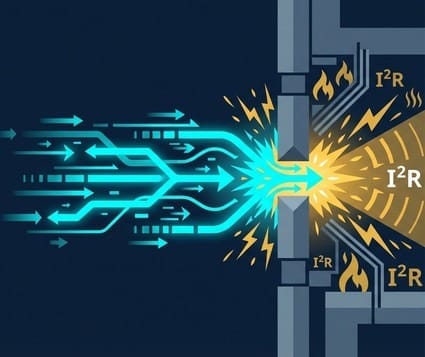
We are witnessing the end of an era. Traditional silicon-based power components have hit an insurmountable "physical wall" in the high-voltage, high-current, high-frequency environment of AI servers.
🏗️ Underground Pipeline Engineering: The Extreme Miniaturization of Super Junction
If flat electronic pipes are too narrow and easily clogged, leading to heat, what should we do?
Engineers came up with an extremely audacious answer: **"Dig underground!"**
To solve the dead-end problem of excessive on-resistance in traditional silicon-based MOSFETs, the industry invented a 3D structural technology called **Super Junction**.
Under a microscope, engineers use extreme etching processes to dig deep "P-pillars" into the silicon wafer, one after another. This is like excavating a dense network of deep underground pipelines beneath crowded surface roads!
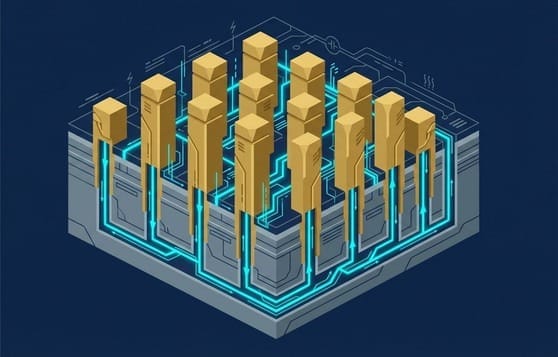
When current passes through, these 3D channels dramatically increase the electron flow area, forcibly reducing "on-resistance ($R_{DS(on)}$)" to less than one-tenth of traditional structures. At the same time, these deep P-pillars act like a high wall, staunchly preventing high-voltage breakdown.
Think Tank Strategic Positioning: The King of Cost-Effectiveness Below 48V
With the miraculous extension of life provided by Super Junction, silicon-based MOSFETs finally withstood the high-frequency, high-current demands on AI server motherboards (48V to 12V or even lower).
Because it is significantly cheaper than expensive third-generation semiconductors, Super Junction remains the "absolute king of cost-effectiveness" in this voltage range, widely adopted by server manufacturers.
🛡️ Heavy Armor at the Forefront of the Server Room: The IGBT (Insulated-Gate Bipolar Transistor) Tank
While Super Junction technology is impressive, it primarily defends the mid-to-low voltage lines on the "server motherboard."
When we shift our perspective back to the **HVDC (High-Voltage Direct Current) server rooms** mentioned in the previous chapter, facing ultra-high voltages of tens of thousands of volts from the Taiwan Power Company and massive UPS (Uninterruptible Power Supply) rectifier cabinets, often hundreds of kilowatts, at the very front end of the server room, even Super Junction would be instantly incinerated.
Here, what we need is a "heavy tank" capable of withstanding ultra-high voltages and extreme currents.
The full name of this tank is **IGBT (Insulated-Gate Bipolar Transistor)**.
The IGBT is a perfect "hybrid." It combines the "high input impedance (easy to control switching)" of MOSFETs with the "extremely high current and high voltage endurance" characteristics of BJTs (Bipolar Junction Transistors).
If a MOSFET is a very fast sports car (high-frequency switching), then an **IGBT is a heavy-duty tank that, while not fast (low-frequency switching), can carry hundreds of tons of explosives (ultra-high voltage and current) and remain as stable as a mountain.**
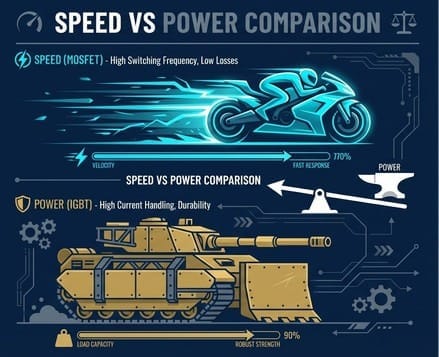
In the giant transformers and rectifier modules at the very front end of AI data centers, IGBT modules are densely packed. They do not aim for ultra-fast switching millions of times per second; their sole responsibility is to firmly guard the entrance of the server room, steadily taming the furious external power into usable high-voltage DC power for the internal infrastructure.
🏰 The Foundation of the Silicon Empire: The 2.5 Billion Euro AI Computing Power Monetization Code
When discussing power semiconductors, **Infineon** is an absolutely indispensable name. It is the undisputed global leader, possessing an unfathomable patent moat and extremely massive modular mass production capabilities.
While the world focuses on how many NVIDIA GPUs are sold, Infineon is quietly reaping enormous profits from the thousands of "microscopic faucets" on AI server motherboards.
Infineon has communicated extremely clear AI strategic targets to the capital market. They anticipate their AI data center-related revenue will reach an astonishing **2.5 billion euros (approximately NT$85 billion)** in fiscal year 2027 (FY27)!
This is certainly not merely an expansion of revenue figures. Of these 2.5 billion euros, up to 1 billion euros comprise "high-margin value-added businesses." Infineon is aggressively capitalizing on the profit redistribution driven by the surge in AI computing power through its top-tier MOSFETs and high-voltage control chips.
🔄 The Ultimate Magic of Production Capacity: Converting Idle IGBT Tanks into Money-Printing Machines
However, what makes Infineon's competitors despair the most is its almost terrifyingly flexible "production capacity scheduling capability."
Do you recall the IGBT tanks we mentioned in the previous article? In recent years, due to temporary headwinds in the global electric vehicle and industrial markets, Infineon actually had a significant amount of idle IGBT production capacity. This would have generated substantial "idle costs" of up to 800 million euros, a major burden on its financial statements.
But, facing the black hole-like demand for high-end MOSFETs from AI servers, Infineon demonstrated a master-level magical operation: **They directly "repurposed and converted" these idle IGBT production lines into money-printing production lines for high-margin AI MOSFETs!**
This brilliant move yielded a dual-nuclear explosion effect:
- It instantly satisfied the enormous hunger of NVIDIA and cloud giants for AI power components without needing to build a new factory that would take three years.
- It drastically cut the idle costs on the financial statements by 100 million euros (reducing them to 700 million euros), leading to an excellent recovery in gross margin and profit structure.
This is the underlying logic behind why top institutional investors continue to give Infineon's AI momentum extremely high ratings, even today, when the semiconductor cycle has not fully recovered.
🛡️ Expansion of the Empire: 570 Million Euro Acquisition, Deepening Automotive and Industrial Moats
If you thought Infineon was solely focused on AI, you'd be underestimating this German giant.
While expanding its AI footprint, Infineon just completed an extremely precise "strategic bottom-fishing" maneuver: **aggressively acquiring AMS Osram's automotive, industrial, and medical sensor divisions for 570 million euros.**
The brilliance of this deal lies in its outrageously low price! Infineon acquired this cash cow at an EV/EBITDA valuation of less than **10x (approximately 9.7x)**, whereas industry peers' acquisition valuations often range from 13x to 34x!
This acquisition will not only contribute positively to EPS from "day one" but, more crucially, these top-tier sensor IPs (intellectual properties) will perfectly integrate with Infineon's existing power semiconductors. It directly completes Infineon's final puzzle piece in the automotive electronics sector, solidly establishing its position as the global runner-up in automotive sensors and launching a fatal charge against the market leader.
Internally, it reaps AI profits through capacity conversion; externally, it deepens its automotive moat through precise acquisitions. This is the undisputed global leader!
🌪️ The Blind Spot of Giants: The Exploding Business Opportunity in High-End AI DC Fans
While everyone is focused on the power supply modules next to the GPUs, another "microscopic monster" that consumes power like water is hidden inside the server rack: **high-end AI server DC (Direct Current) fans.**
Recall what we discussed in earlier chapters: to dissipate the terrifying 1000W of heat, servers must be equipped with "counter-rotating dual-motor fans." These fans spin at an astonishing 30,000 RPM, practically like small jet engines!
To drive such extremely powerful motors and precisely control their speed (to prevent stalling or burning out), the fan's interior must house a dedicated motor control circuit board. And the most critical component on this board is the **MOSFET (power semiconductor)**, responsible for controlling current switching!
Due to the extremely high power consumption of AI fans and their need to operate at full speed 24/7 in high-temperature environments exceeding 80°C, they impose extremely stringent requirements on a MOSFET's "on-resistance" and "thermal tolerance." This is definitely not something that traditional, inexpensive PC fans could ever handle.
This is the "high-margin flank battlefield" that foreign giants overlook but which manufacturers in Taiwan have precisely targeted!
🥷 AnPEC (8261)'s Elegant Transformation: An Assassin's Strike Leveraging "Foxconn Ecosystem" Resources
In this fan flank battle, what most surprised the capital market was the powerful breakthrough by **AnPEC (8261)**.
In the past, AnPEC primarily focused on the mid-to-low-end MOSFET market for PCs and consumer electronics. This was a highly "red ocean meat grinder" where gross margins were long suppressed.
However, AnPEC experienced a historical turning point that changed its destiny: **the forceful entry and resource injection from the Foxconn Group (and the Yageo Group)!**
This provided AnPEC with two devastating strategic weapons:
- A massive and certain "outlet": Foxconn is the world's largest AI server assembly manufacturer, holding the largest system-level orders for GB200 racks. This means that as long as AnPEC's MOSFET specifications meet requirements, it can be seamlessly integrated into AI server cooling modules directly through Foxconn's supply chain system.
- Upgrade in high-end packaging and process technology: AnPEC demonstrated extremely strong growth momentum in the second half of 2025, driven primarily by the enormous demand for **AI DC Fans (Direct Current Fans)**. AnPEC successfully developed low on-resistance MOSFETs capable of matching high-end AI fans, which directly optimized its product mix and led to a structural and powerful reversal of its previously sluggish gross margins.
AnPEC is no longer just a low-end "PC parts vendor"; it has essentially become **the strongest assassin in the broader Foxconn AI empire, controlling microscopic cooling currents**!
🛡️ Taiwan Semiconductor (5425)'s Steady Front: Super Junction Veteran's Counterattack
Beyond the fan battlefield, we also cannot overlook the veteran in diodes and power components in Taiwan: **Taiwan Semiconductor (5425)**.
In the second part of 6-2-1, we mentioned that to push silicon materials to their limits, engineers invented **Super Junction** technology, which became the king of cost-effectiveness for 48V to 12V conversions.
Taiwan Semiconductor did not pursue ambitious competition with foreign companies in extreme 800V high-voltage applications. Instead, it chose to concentrate its efforts on the completeness of its Super Junction product line and certifications in automotive and industrial control fields.
When Delta Electronics and Lite-On Technology design internal power conversion circuits for servers below 48V, they also require a large number of MOSFET arrays that are stable in supply and extremely cost-effective. Leveraging its years of accumulated advantages in yield and production capacity, Taiwan Semiconductor has become the most reliable arms supplier for this 48V defense line.
In-Depth Research · Quantitative Perspective
Want more insights into semiconductor quantitative research?
【Insight Subscription Plan】Break Free from Retail Investor Mentality: Build Your Alpha Trading System with "Quantitative Chips" and "Consensus Data"EDGE Semiconductor Research
📍 Series Map — Navigate the Complete EDGE Semiconductor Research →


