
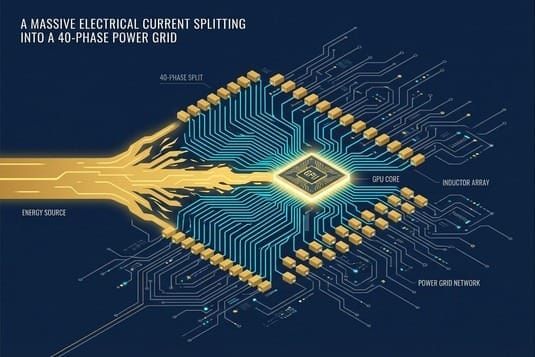
Key takeaway for this section: The lower the core voltage and the higher the current, the more motherboard power delivery must undergo an "explosion of phases" and improve transient response; thus, PMIC, TLVR, M-CLL, and Vertical Power Delivery (VPD) become critical battlegrounds in the AI era.
🌊 1000 Amperes: The Physical Death Sentence – A Microcosmic Deluge
Let's zoom in from the server rack to the motherboard, entering the core area of an NVIDIA GPU – a tiny chip the size of a fingernail, yet immensely valuable.
Here, we will witness one of the most extreme phenomena in physics.
When a Blackwell B200 chip operates at full speed, it requires an extremely low core voltage (around 0.6V ~ 0.8V), but the current surges to a terrifying 1000 Amperes (1000A) or more!
What does 1000 Amperes mean? The typical circuit breaker trip standard for a household is only 50 Amperes. In other words, the instantaneous current drawn by this tiny chip is equivalent to the total power consumption of 20 households simultaneously running their air conditioners at full blast.
If you attempt to feed this 1000 Amperes into the chip using a "single" copper wire, according to Joule's law ($I^2R$), this wire would instantly glow white like a tungsten filament light bulb, then cause a violent explosion and vaporization of the motherboard.
Faced with this electronic deluge, the only solution for electrical engineers is "Divide and Conquer."
Since one large pipe would burst, I'll break this 1000-Ampere flood into 20, 30, or even 40 smaller pipes! Each small pipe (known as a "Phase" in electronics) only needs to carry 30 to 50 Amperes, ensuring everything survives.
This is why AI server motherboards are densely packed with dozens of identical small square components surrounding the GPU. They aren't there for aesthetics; they form a "Multi-phase VRM" survival array.
🧠 Microsecond Maestro: PMIC's Neural Network
However, after dividing the pipes into 40, an even more terrifying problem arises: Who will orchestrate the switching sequence of these 40 pipes?
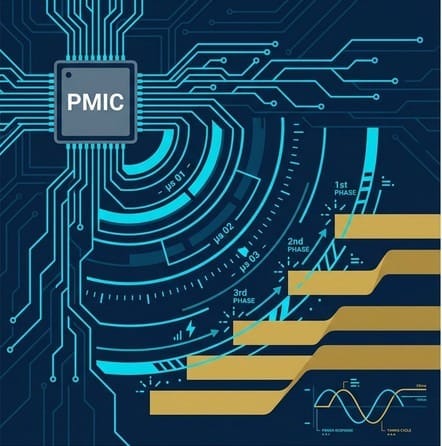
If all 40 power phases switch on simultaneously, the current would instantly overshoot and burn out the chip; if they all switch off simultaneously, the voltage would instantly drop to zero, causing a system crash. They must operate like an orchestra: the first phase switches on, a few microseconds later the second phase, then a few microseconds later the third phase, and so on......
Through extremely precise "Interleaving" operation, these 40 small currents are superimposed before entering the GPU, forming a perfectly smooth, ripple-free DC current, like a mirror surface.
The "chief conductor" responsible for orchestrating these 40 power phases with an error margin of no more than one millionth of a second is the PMIC (Power Management IC). In the age of AI, it is no longer a simple chip; it is the "super brain" on the motherboard.
And controlling this super brain are two global powerhouses with distinct styles, yet equally dominant.
💎 Silicon Valley's Tech Maverick: MPS (Monolithic Power Systems, MPWR)'s Single-Chip Magic
If there's any company in the power industry that could be called the "Apple," it would undoubtedly be MPS.
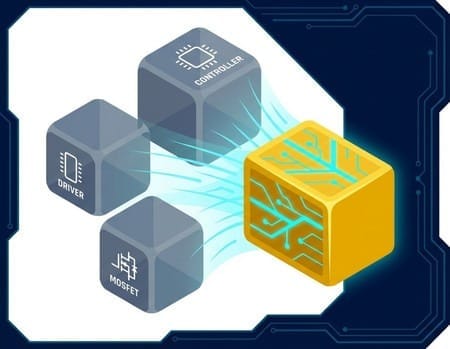
Founded by Chinese-American legend Michael Hsing, the company's corporate culture can be summarized in one word: "audacious." MPS doesn't follow standards; it prefers to "redefine them."
1. Core Technological Moat: Monolithic (Single-Chip Full Integration)
MPS's full name is Monolithic Power Systems, and "Monolithic" (single-chip/integrated unit) is its very essence.
In traditional architectures, the controller chip, driver, and power switch (MOSFET) are typically three separate chips. However, MPS possesses proprietary semiconductor manufacturing technology (BCD Process), which allows it to integrate all three distinct components onto a "single wafer"!
This offers devastating advantages:
- Zero Parasitic Inductance: Without wire bonding between chips, signal transmission has no delay, and switching speeds are extremely fast.
- Ultimate Miniaturization: On AI motherboards where space is at a premium, MPS's solutions often occupy only half the volume of competitors', making them highly favored by NVIDIA.
2. Latest Institutional Intelligence Decoded (Needham & Equisights):
According to the latest reports, MPS is undergoing a qualitative transformation from a "component supplier" to a "strategic partner."
- Surging Revenue Signal: Reports clearly indicate that MPS's "Enterprise Data" revenue is projected to surge by over 50% in 2026! This proves that it is no longer merely supplying laptops or consumer electronics; it is a core beneficiary of AI computing infrastructure.
- Reliance of AI Model Builders: More interestingly, Equisights' report points out that even giants like Google and xAI, which develop their own chips, directly rely on MPS's team when designing power boards. MPS has evolved from simply selling chips into a "power solution consultant."
⚔️ The Awakened Japanese Giant: Renesas (Renesas Electronics, 6723.T)'s Acquisition Empire
If MPS is a special forces unit, then Renesas is a modern aircraft carrier battle group armed with a variety of heavy weaponry.
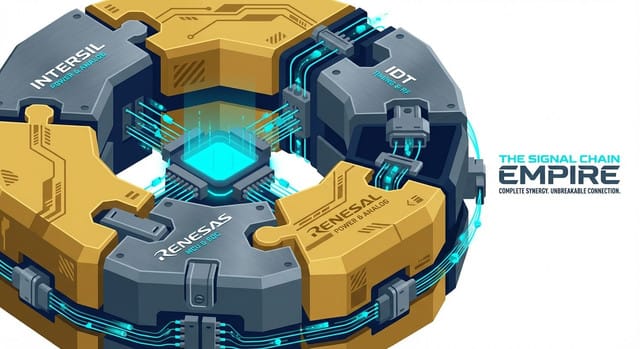
1. Core Technological Moat: The Perfect Puzzle of Intersil and IDT
Renesas was originally a traditional giant formed by the merger of the semiconductor divisions of Japan's NEC, Hitachi, and Mitsubishi Electric, specializing in microcontrollers (MCUs). However, over the past few years, it has completely transformed its position in AI power through two precise "transformative acquisitions":
- Acquisition of Intersil (2017): Gained top-tier American power management technology (Intersil was once considered a prestigious 'Whampoa Military Academy' of the power industry).
- Acquisition of IDT (2019): Acquired key technologies for memory interface and analog signals.
This makes Renesas one of the very few global manufacturers capable of providing a "complete signal chain." It doesn't just sell PMICs; it can also bundle timing controllers and memory power interfaces. For customers who don't want to spend time piecing together components from various suppliers, Renesas's "all-in-one" solution is highly appealing.
2. Latest Institutional Intelligence Decoded:
This Japanese giant has awakened and is undergoing a "slimming down" plan called "Effective Reorganization."
- Divesting Non-core Assets: Renesas plans to sell off some low-margin timing device businesses, demonstrating management's determination to "extremely focus" resources on AI data centers and automotive electronics.
- Doubled AI Revenue: Benefiting from this strategic focus, Renesas's AI-related revenue is projected to "double" in 2026! This is a very aggressive signal, indicating a significant expansion of its supply chain share with NVIDIA and AMD.
🌊 Physics' Dilemma: The Demise of Traditional Inductors and the 'Transient Response' Crisis
An inductor, at its core, is simply a copper wire coiled around a magnetic material. Its function is straightforward: "store energy and filter noise."
For decades in electronics, inductors have faced an eternal physical contradiction:
- Large Inductance: Good filtering effect, clean current, but slow response speed (like a large reservoir where it takes a long time for water to flow out after the gate opens).
- Small Inductance: Fast response speed, but poor filtering effect (like a small pipe where water flows quickly but with significant fluctuations).
Before the advent of AI servers, this contradiction could be compromised.
However, in the AI era, facing the NVIDIA GPU's extremely violent di/dt (instantaneous current change), this compromise has become a death sentence.
When a GPU instantaneously draws 1000 Amperes, if the inductor reacts too slowly (inductance is too large), current replenishment won't keep up, causing voltage to instantly collapse (V-droop) and leading to computational errors. If the inductor is too small, the current will be filled with noise ripples, directly burning out sensitive 3-nanometer transistors.
Traditional inductor architectures are now completely obsolete. To save Moore's Law, the passive component industry has been forced to initiate a structural revolution, giving rise to two "game-changing" technological approaches: TLVR and M-CLL.
🏗️ TLVR (Trans-Inductor Voltage Regulator): The 'Quantum Entanglement' of Inductors
The first solution is called TLVR (Trans-Inductor Voltage Regulator).
This is an ingenious design.
In traditional multi-phase power delivery, each inductor phase operates as a "solo island." While the first phase is busy discharging, the eighth phase might still be idle, offering no assistance whatsoever.
TLVR is like setting up a "high-speed communication hotline (Secondary Winding)" between these isolated islands.
Engineers add an extra "secondary winding" inside each inductor and connect the secondary windings of all inductors in series.
This creates an astonishing "chain reaction":
When the first phase inductor senses the GPU's instantaneous high current demand, it "broadcasts" this need to the other 39 inductor phases instantly through the magnetic coupling of its secondary winding!
Much like quantum entanglement, the other inductors, initially at rest, are compelled to instantaneously participate in the discharge through this magnetic link.
Result: TLVR boosts bandwidth by more than 3 times! It perfectly solves the "response speed" problem, allowing the 1000-Ampere current surge to arrive synchronously within microseconds.
🤝 M-CLL (Magnetic Coupled Inductor): The Magician of Extreme Space
The second solution is called M-CLL (Magnetic Coupled Inductor).
If TLVR is about speed, then M-CLL is about "space and efficiency."
On NVIDIA's motherboards, the space next to the GPU is more expensive than land in Taipei's Xinyi District. Fitting 40 inductors simply isn't physically possible.
The logic behind M-CLL is: since all phases need to discharge, why not integrate two, or even multiple, inductor phases into the "same magnetic core"!
Through precise magnetic circuit design, magnetic fields between different phases cancel each other out (Ripple Cancellation). This not only significantly reduces volume but also enables it to handle high currents with extremely low losses.
💎 Cyntec: The Brightest Diamond in Delta Electronics' Crown
Having discussed the physics and technology, we will now finally unveil the true dominant force behind this inductor war.
Globally, only one company possesses both top-tier TLVR and M-CLL expertise, with yields so high that foreign competitors (such as Vishay, Eaton) feel stifled.
That company is Cyntec, a 100%-owned subsidiary of Delta Electronics (2308).
- From Apple to NVIDIA: The Pioneer of Molding Chokes
Cyntec is not an ordinary component manufacturer. Over a decade ago, it exclusively developed "high-density molding choke" technology.
Unlike traditional inductors that use copper wire coiled around a magnetic material (prone to acoustic noise, large volume), Cyntec directly encapsulates the coil with a specialized "metal magnetic powder," then "die-casts" it into a high-density small cube using an extremely high-pressure mold.
This technology was first recognized by Apple, used to solve the extremely constrained power space issues in iPhones. Cyntec consequently reaped benefits from Apple's business for a full decade.
Now, this die-casting process has been perfectly adapted for AI servers. AI inductors must withstand temperatures and current densities hundreds of times more severe than those in mobile phones, and Cyntec holds "exclusively formulated magnetic powders" and "patented mold designs," which form its deep moat.
- Keeping Profits In-House: Delta Electronics Group's 'Vertical Dominance'
This is where Cyntec's true power lies.
As we mentioned in 6-1-2, Delta Electronics is the "prime contractor" for AI power systems. When NVIDIA or Microsoft entrusts the entire server rack power order to Delta Electronics, Delta's internal design team naturally prioritizes the inductor solutions from its own subsidiary, Cyntec.
This creates a perfect "locked-in cycle":
- Delta Electronics secures orders for Power Shelves and motherboard power modules.
- To ensure efficiency and yield, Delta Electronics specifies the use of Cyntec's TLVR and Molding Chokes.
- Cyntec's revenue and profit are ultimately all channeled back into Delta Electronics' financial statements (this is also the secret behind the extremely high gross margins of the "passive components" segment in Delta Electronics' financial reports).
- The Invisible Financial Behemoth
Although Cyntec has been delisted and privatized, institutional estimates suggest that Cyntec is one of the units within the Delta Electronics Group with the "highest per capita output value and most astounding gross margins." The unit price of a high-end AI TLVR inductor is tens or even hundreds of times that of a traditional inductor. In 2026, when GB200 ramps up volume, Cyntec will become the strongest invisible engine in Delta Electronics' profit structure.
🏗️ Eliminating 'The Last Inch': From Planar Congestion to Vertical Elevators
Traditional motherboard power delivery is akin to Taipei's Neihu Technology Park during rush hour. All current (traffic flow) must squeeze from the adjacent roads (motherboard copper traces) into the central GPU (office building). When the traffic (current) reaches a certain volume, the roads overheat and become congested, with significant energy loss along the transmission path. This is known as "The Last Inch" loss.
Vicor's VPD (Vertical Power Delivery) technology essentially eliminates these roads. It excavates a dedicated ultra-high-speed elevator directly "beneath" the GPU chip!
The core of this technology is called FPA (Factorized Power Architecture). Unlike traditional power supplies that convert 48V to 0.8V at the motherboard's edge (resulting in extremely high losses for low-voltage, high-current transmission), Vicor allows the 48V high-voltage power to rush directly beneath the GPU. Then, using a special module called VTM (Current Multiplier), it reduces the voltage and multiplies the current by 100 times precisely at the moment of "vertically upward" entry into the chip!
This is a revolution in spatial geometry. Because the power module is directly beneath the chip, the transmission path approaches zero. Impedance is virtually eliminated, and transmission heat loss is negligible. The valuable space on the motherboard surface, once occupied by dozens of inductors, is instantly freed up for more High Bandwidth Memory (HBM) and signal lines.
📈 Resurgence of a Lone Dominator: Record Revenue and Full Capacity in 2026
Does this cutting-edge technology sound expensive and difficult to manufacture? Indeed. In recent years, Vicor's stock price experienced a brutal correction due to production yield issues and NVIDIA's temporary shift to traditional architectures (using MPS + Cyntec solutions).
However, this lone dominator has made a strong comeback!
- Order-to-Ship Ratio (B/B Ratio) Skyrockets: Reports indicate that Vicor's B/B ratio has surged past 1.2 (orders significantly exceeding shipments) and continues to climb in Q1 2026. This signifies a massive influx of customer demand for vertical power delivery.
- Factory Capacity Nearing Limits: Vicor's wafer fab in Andover is projected to approach 80% full capacity utilization by the end of 2026. This is a critical signal, meaning Vicor is poised to regain "pricing power," with annualized revenue challenging the $800 million mark.
- Urgency for Expansion: Due to overwhelming demand, Vicor is actively seeking land for a second wafer fab (chip fab). This is not for R&D; it's to address the impending explosion in AI computing power.
⚖️ Global Patent Scorched-Earth War: A Declaration Against Delta Electronics, MPS, and Quanta
Vicor's most formidable asset isn't its products, but rather the "patent nuclear weapon" it wields.
When NVIDIA and Google discovered that vertical power delivery was the only path forward, the entire supply chain (including Delta Electronics and MPS) began developing similar technologies, attempting to circumvent Vicor's patent wall. Vicor's response was simple and blunt: "Sue them all!"
According to Needham's latest report, Vicor has filed a second wave of patent infringement lawsuits with the U.S. International Trade Commission (ITC). Just look at the list of defendants; it practically targets the entire AI server supply chain:
- Power Module Giants: Delta Electronics, MPS (Monolithic Power Systems)
- System Assembly and Connector Manufacturers: Quanta (Quanta Computer), Wiwynn, Wistron, Luxshare (Luxshare Precision Industry)
This is an epic "Scorched Earth Strategy." Vicor's logic is clear: VPD is my invention, and the FPA architecture is my patent. You want to use vertical power delivery to solve the Rubin chip's heat dissipation and space issues? Fine, either buy my modules or pay hefty licensing fees.
The outcome of this lawsuit will determine the profit distribution in the AI power market for the next five years. If Vicor wins, it will transform from a niche player into a super landlord collecting "tolls" on AI computing power across the globe; while Delta Electronics and MPS could face significant risks of damages or forced design modifications.
In-depth Research · Quantitative Perspective
Want more semiconductor quantitative research insights?
[Insight Subscription Plan] Bid Farewell to Retail Investor Thinking: Build Your Alpha Trading System with 'Quantitative Capital Flows' and 'Consensus Data'EDGE Semiconductor Research
📍 Series Map — Navigate the Complete EDGE Semiconductor Research →


