6-3-2 The Final Gasp of Air Cooling: Auras Technology's (3017) 3D VC Dominance and the 1000W Physical Limit
AI chip power >1000W brings air cooling to physical/parasitic limits. Thermal leader Auras Technology (3017) built a deep moat with 3D VC's yield/in-house edge for high-end computing, leveraging 3D VC cash to expedite liquid cooling cold plate/manifold markets, becoming an amphibious industry win...
🛑 The 1000W Sighing Wall: Compute Power Devoured by 'Parasitic Power'
Before we dive into the deep waters of liquid cooling, we must first pay tribute to an old soldier who has guarded the electronics industry for decades – Air Cooling.
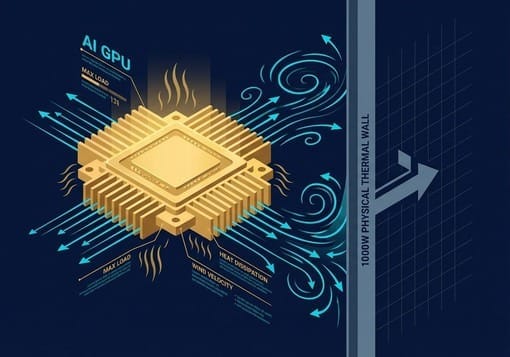
In the era of NVIDIA H100 (700W), air cooling is still very much alive. However, when chip power consumption crosses the red line of 1000W (e.g., B200 or the entry-level next-generation Rubin), air cooling hits an insurmountable physical sighing wall.
This is not just because it 'can't cool enough', but because the cost is too high. To dissipate 1000W of heat using air, the fans at the rear of the server must spin up to **30,000 revolutions per minute (RPM)**, almost like jet engines. This leads to two devastating consequences:
Two Devastating Consequences
Sonic Weapon-Level Noise: The noise in the data center will exceed 100 decibels, vibrating hard disk drive (HDD) heads to the point where they cannot read or write data.
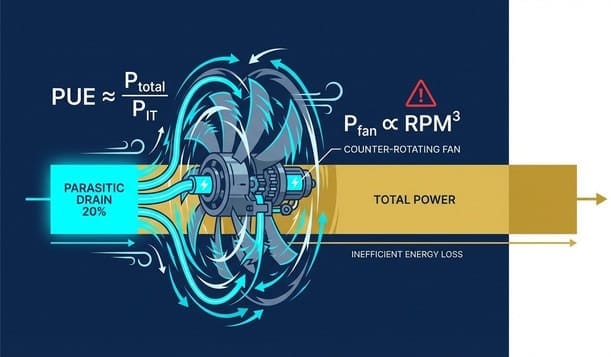
Terrifying Parasitic Power: This is what pains cloud service providers (CSPs) the most. According to our model calculations, when air cooling systems are pushed to their limit, the power consumed by the fans alone accounts for 15% or even 20% of the total power consumption of the entire rack!
This means that for every 100 units of electricity bill you pay, 20 units are not used for AI computation, but for 'blowing air'. In the battle of HVDC data centers, which prioritize PUE (Power Usage Effectiveness), this energy waste is absolutely unacceptable. Therefore, 1000W is defined as the 'physical red line' for air cooling.
🌪️ Air Cooling's Final Resurgence: The Black Technology of 3D VC (3D Vapor Chamber)
However, before air cooling makes its complete exit, engineers, in their effort to squeeze out the last drop of air cooling's potential, invented a 'black technology' that manipulates copper and water to the extreme – 3D VC (3D Vapor Chamber).
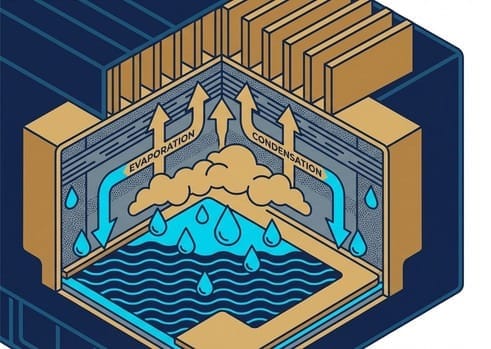
Please forget traditional 'Heat Pipes'. Those thin, long tubes are too slow to conduct the instantaneous burst of energy from AI chips, which act as 'Point Heat Sources'. The concept of 3D VC is to make the entire cooling base a giant 'vacuum chamber'.
Its operating principle is a microscopic storm:
Instantaneous Vaporization: When the high heat from the chip is conducted to the bottom of the vacuum chamber, the tiny amount of working fluid inside the chamber 'boils and vaporizes' instantaneously.
Sonic Diffusion: The gas molecules move extremely fast (near sonic speed), so heat is no longer slowly conducted, but instantly fills the entire chamber with steam, evenly diffusing to the large heat fins above.
Condensation and Return: After the vapor contacts the cold fins, it condenses back into water, and then quickly returns to the bottom through the precise 'sintered powder' capillary structure on the inner wall of the chamber, ready for the next cycle.
This gives 3D VC an 'equivalent thermal conductivity' dozens of times higher than pure copper. It is the last and most powerful fortress of the air cooling era, extending air cooling's lifespan to the B200 generation.
🦅 Auras Technology's (3017) Hegemony: Alchemy in the Sintering Furnace
In the realm of 3D VC, only one manufacturer globally achieves absolute dominance in yield and scale: **Auras Technology (3017)**.
Why Auras Technology? There are so many thermal solution providers, why is it the only one that can capture the most lucrative orders from NVIDIA and major US cloud service providers (CSPs)? Based on our in-depth analysis of the industry supply chain, Auras Technology possesses two major moats:
Two Major Moats
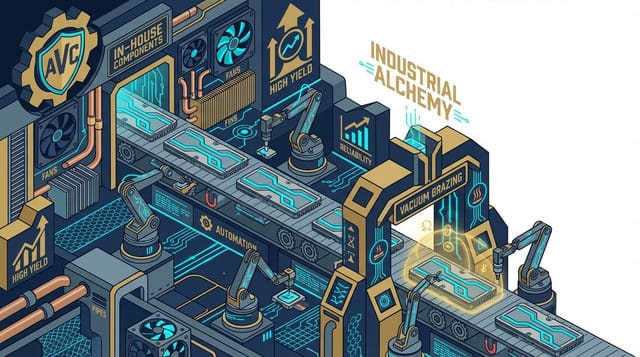
1. Yield Barrier in Chamber Sintering and Brazing: A 3D VC is a vacuum vessel. Even a tiny micro-fissure would allow air in, causing the vacuum to fail, turning the entire heatsink into scrap metal. Auras Technology has accumulated decades of parameter data in 'Diffusion Bonding' and 'Vacuum Brazing' processes. Its 3D VCs maintain perfect airtightness even after thousands of thermal shock cycles. This industrial-grade reliability leaves second-tier manufacturers with low yields far behind.
2. Cost Advantage of In-house Production: Unlike competitors who need to procure fans or heat pipes externally, Auras Technology is one of the very few giants with 'complete in-house manufacturing capabilities'. From fan motors and heat pipe sintering to mold stamping, it does everything itself. This gives Auras Technology extremely strong gross margin defense capabilities when facing price reductions from CSP customers. This is also why, in the financial community's evaluation, Auras Technology is regarded as the most financially stable 'Cash Cow' among thermal solution providers.
💰 The Strategic Significance of Cash Flow: Using Air Cooling to Foster Liquid Cooling
The investment market often has a misconception: 'Air cooling is dead, liquid cooling is ascendant, so we should sell air cooling stocks and buy liquid cooling stocks.' This is a huge strategic misjudgment.
We must understand Auras Technology's strategic logic: 3D VC is currently in its most profitable harvest period. Although AI servers of the B200 class are starting to adopt liquid cooling, a significant number of inference servers and enterprise-grade applications still rely on air-cooled architectures. The average selling price (ASP) of these high-end air cooling modules is significantly higher than traditional servers, and there are few competitors (because they are too difficult to manufacture).
Auras Technology is leveraging the substantial cash flow generated by 3D VC to heavily invest in its Vietnam factory and liquid cooling production lines. It is not a dinosaur of the air-cooling era; it is an amphibious crocodile. While the market is still debating the golden crossover point between air and liquid cooling, Auras Technology has quietly secured certifications for cold plates and manifolds for the Rubin platform. It is using air cooling profits to buy itself a first-class ticket to the liquid cooling era.
🩸 The Energy Vampire: What is 'Parasitic Power'?
In the data center energy war, there is a supreme metric called PUE (Power Usage Effectiveness). An ideal PUE is 1.0, meaning every unit of electricity bill you pay is genuinely used for AI computation.
However, in real-world air-cooled data centers, we face an awkward physical dilemma: to cool a 1000W chip, we must consume additional electricity to drive the fans. This power, which must be wasted for heat dissipation, is called 'parasitic power'.
In traditional servers, fans only consumed 3% to 5% of the total power, so no one paid much attention. But when the rack density of NVIDIA B200 is pushed to its limit, the fans must operate at full speed to forcibly blow away the heat with air. According to the 'Fan Laws' of fluid mechanics, fan power consumption is proportional to the 'cube' of the rotational speed! This means that when you double the speed, power consumption skyrockets by 8 times.
Shocking Data (original data retained):
The shocking data we observe is: in AI racks at the limit of air cooling, as much as 15% to 20% of the electricity is consumed by that entire array of furiously rotating fans! This is intolerable for companies like Google or Meta. It means that out of a 100MW power plant, 20MW of electricity (equivalent to the power consumption of a small city) produces absolutely no compute power, but only generates noise and wind. This is why 1000W is called the 'air cooling death line'. Beyond this line, electricity costs explode exponentially.
🌪️ The Aesthetics of Violence: Counter-Rotating Dual-Motor Fans
However, during the transition period before air cooling completely exits the stage (e.g., H100/H200 and the air-cooled version of B200), engineers, to combat high-density heatsinks, invented an extremely violent mechanical structure – counter-rotating dual-motor fans.
A typical fan has only one set of blades. But in AI servers, the heatsink fins are too dense, preventing air from flowing through (this is called 'high back pressure'). Counter-rotating fans fit two motors, front and back, within a very small frame:
Two Motors of Counter-Rotating Fans
First Motor (Intake): Rotates clockwise, responsible for drawing in a large volume of air.
Second Motor (Pressurization):Rotates counter-clockwise. This is key! It is responsible for 'straightening' the swirling airflow generated by the first fan and providing secondary pressurization.
This is similar to the turbine blades of a jet engine. This structure can generate extremely formidable 'static pressure', forcibly 'squeezing' cold air deep into high-density heatsink fins. When operating at full speed, these fans reach 30,000 RPM. If you were to insert a finger, the bone would be instantly severed; and the high-frequency noise they emit is enough to damage traditional hard disk drives (HDDs).
🦅 The Ultimate Craftsmanship of Motors: SUNON (2421)'s MagLev Moat
In this realm of violent aesthetics, Taiwan has a world-class hidden champion – **SUNONwealth Electric Machine Industry Co., Ltd. (2421)**.
Making fans seems simple, but getting a motor just a few centimeters in size to stably maintain 30,000 RPM and operate continuously for five years, 24 hours a day, requires extremely precise 'MagLev' technology.
Traditional ball bearings generate high heat due to physical friction at such extreme speeds, causing them to wear out and seize quickly. SUNON's patented technology uses magnetic forces to 'levitate' the rotor shaft in the air, ensuring no physical contact between the shaft and bearing during operation. This brings three decisive advantages:
Three Decisive Advantages
Ultra-Long Lifespan: No friction, no wear.
Vibration Resistance: Magnetic forces act like shock absorbers, absorbing the rotor's high-frequency vibrations and protecting server hard drives.
Extreme Miniaturization: SUNON can wind motor coils smaller than a grain of rice, freeing up more space for fan blades and increasing airflow.
This is why SUNON's high-end counter-rotating fans consistently hold a core supplier position in NVIDIA's reference designs. This is not a plastic injection molding industry; this is a 'precision motor industry'.
🔄 The Shifting Battlefield: With Liquid Cooling's Arrival, Will Fans Die Out?
Finally, we must clarify a major investment misconception: **'With the advent of the liquid cooling era, will SUNON be out of the game?'**
This post is for subscribers only
Sign up now to read the post and get access to the full library of posts for subscribers only.