
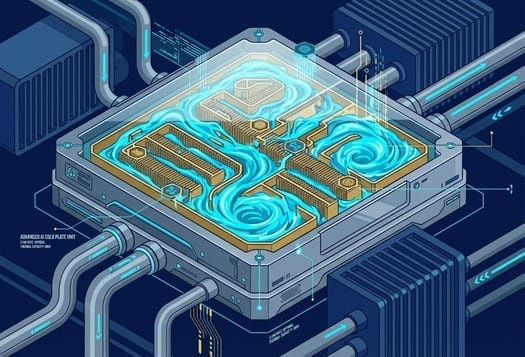
🌊 Microscopic Maze in Copper Blocks: Why Can't It Just Be "Drilling a Hole"?
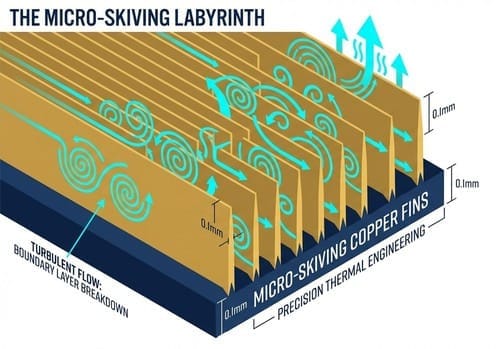
If we cut open a cold plate and examine it under a microscope, you would see a breathtaking microscopic world. To allow flowing water to dissipate an enormous amount of heat in a very short time, engineers must create an extremely large "Surface Area" inside the cold plate.
Traditional CNC drilling is no longer sufficient. The current mainstream process is called "Micro-Skiving".
What is Micro-Skiving? Imagine a chef with unparalleled knife skills, using a skiving tool to rapidly "shave" wafer-thin copper fins from the surface of a copper block. The key is: **these copper fins are not cut off!** They remain attached to the base and are forcibly "stood up" by the skiving tool.
The strategic value of this process lies in:
- Zero Thermal Resistance Interface: Because the fins are "skived" directly from the base, they are integrally formed with no welding points. Heat can be transferred from the base to the fin tips without any impedance.
- Extreme Density: In AI-grade cold plates, these fins are only 0.1mm to 0.2mm thick, with extremely small pitches. This means that within a matchbox-sized space, hundreds of fins can be packed in, increasing the contact area with water by tens of times!
🎯 Targeting "Hot Spots": The Turbulent Flow War of Microfluidics
Having addressed surface area, the next challenge is "flow". AI chips generate heat very unevenly. The Logic Cores responsible for computation can instantly produce extremely high temperatures, forming what are known as "Hot Spots," while adjacent Cache or I/O areas have lower temperatures.
If cooling water simply flows smoothly like a small river (Laminar Flow), a stationary "boundary layer" will form near the copper wall, impeding heat exchange. To break this physical limitation, engineers at Sunonwealth and Auras Technology must design precise "Pin Fins" or special flow channel geometries within the cold plate.
This is the art of creating "chaos". The goal is to generate intense "Turbulent Flow" as the water passes over hot spots. This turbulence powerfully scours away the boundary layer, like a brush, instantly sweeping away the heat accumulated on the copper wall. NVIDIA's certification specifications have extremely stringent requirements for maximum heat dissipation (Q-max) and Pressure Drop at specific flow rates. Designing a flow channel that "can generate sufficient turbulence without overwhelming the water pump" is the true moat of top-tier manufacturers.
Verification Angle (for readers to quickly grasp the moat)
- The objective function is actually dual: high Q-max, while ensuring Pressure Drop does not exceed limits.
- Creating turbulence is not difficult; the challenge lies in producing "mass-producible and consistent" turbulence under certification conditions.
🔒 The Absolute Red Line: Vacuum Brazing and Helium Leak Detection
After creating precise flow channels, the final and most critical step is **"packaging"**. Cold plates typically consist of two copper plates, upper and lower, joined together. How can these two copper plates be bonded such that, over the next five years, despite countless cycles of thermal expansion and contraction and water pressure shocks, absolutely "not a single drop of water will leak"?
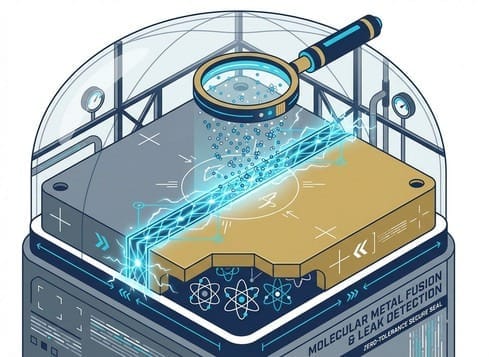
The process used here is "Vacuum Brazing". Engineers insert a special "brazing foil" between the upper and lower copper plates, which are then sent into a vacuum high-temperature furnace. In an extremely high-temperature and vacuum environment, the brazing material melts and permeates into the crystal lattice gaps of the copper plates, "fusing" the two metal blocks together at an atomic level.
Critical factors for yield:
- Zero tolerance for air bubbles: Even a tiny air bubble on the brazing surface can become a leakage point under high water pressure.
- Deformation control: High temperatures can cause copper plates to warp. If the bottom surface is not flat after brazing, it cannot properly attach to the chip, rendering the cold plate unusable (this is why we emphasized the importance of Jentech's forging technology in 6-3-1).
Before leaving the factory, every cold plate must undergo a "Helium Leak Test". Helium molecules are extremely small; if even helium cannot escape, water molecules certainly cannot leak out. This is a semiconductor-grade testing standard, and a threshold that second-tier manufacturers find difficult to cross.
Red Line Zone (the section in your article that most resembles 'barrier to entry pricing power')
- Vacuum brazing + flatness + helium leak testing: these three factors collectively bar second-tier manufacturers.
- This section is suitable for leading into the argument "Why Group A doesn't just look at cost" later.
🏆 What is NVIDIA's "Group A" Strategy?
Before discussing Sunonwealth's strategic position, we must first understand NVIDIA's supply chain language. In procurement cases for GB200/GB300, which involve millions of cold plates, NVIDIA has implemented a supplier tiering strategy called "Group A" to ensure quality consistency while preventing any single supplier from monopolizing prices.
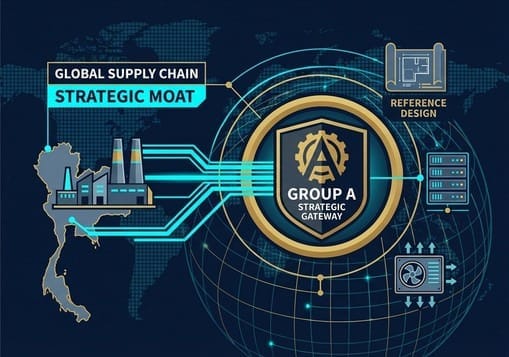
This is an elite club.
Manufacturers admitted into Group A are certified to meet NVIDIA's "Reference Design" standards. When system integrators (ODMs) like Quanta and Foxconn ship standard cabinets, they prioritize, and in some cases are required to, use products from Group A suppliers. While this implies potential long-term price competition (as NVIDIA does not wish suppliers to earn excessive profits), from another perspective, it is a "guarantee of shipment."
Sunonwealth currently not only holds a stable position in Group A, but more importantly, it has demonstrated astonishing growth in its share of NVIDIA's supply. This isn't just a promise; it's real revenue already reflected in shipment data.
One-sentence framework
Group A = "Deliverable list included in Reference Design": Guarantees shipments, but also means long-term price management.
📈 January Revenue Signal: "Structural Transformation" Behind Record High
According to the latest data we have obtained, Sunonwealth delivered an impressive performance in January 2026: its single-month revenue hit a historic high, with a year-on-year (YoY) increase of 122%!
Note this timing. January is typically a traditional off-season for the electronics industry, and with fewer working days due to the Lunar New Year, revenue usually declines. However, Sunonwealth not only avoided a dip but achieved a record high against the trend.
This signals two strong strategic messages:
- Golden Cross of Liquid Cooling Proportion: Sunonwealth's revenue share from liquid cooling products is climbing at an astonishing rate. From approximately 35% in Q3 2025, it is expected to surge to 45% in Q4 2025. This means it is no longer merely a company selling PC thermal modules; it has officially transformed into an "AI liquid cooling system provider." When nearly half of a company's revenue comes from liquid cooling, its valuation logic fundamentally changes.
- Seamless Transition to New GB300 Projects: This historic high is primarily driven by the rapid ramp-up of "new GB300-related projects." This confirms that Sunonwealth has successfully transitioned from GB200 to the next-generation GB300 without being dropped from the supply chain, and has even secured a larger share due to increased cold plate usage in Switch Trays.
How to read the data (to anchor the narrative)
- Record high in off-season essentially hints at a shift in "product mix + shipment pace."
- This section is very suitable as a "connecting point" for subsequent discussions on the Thailand plant and increased GB300 usage.
🏭 Strategic Value of Thailand Plant: Production Capacity and Geopolitical Sanctuary
Beyond technology and certifications, another core moat for Sunonwealth lies in "Thailand." Against the backdrop of the US-China tech rivalry, North American CSPs (Cloud Service Providers) are extremely concerned about supply chain origin risk (OOC, Out of China). They do not want all cold plates to originate from Chinese factories.
Sunonwealth is among the earliest and most proactive thermal solution providers in Taiwan to establish production capacity in Thailand.
The latest supply chain investigations indicate that a significant portion of Sunonwealth's better-than-expected January revenue is attributable to the "continuous ramp-up of its new Thailand plant's capacity." While competitors are still busy acquiring land and building factories, Sunonwealth's production lines in Thailand are already mass-producing and shipping. This gives it a substantial "geopolitical premium" when competing for orders from American clients like Amazon and Google.
Where production origin premium lands
- OOC is not a moral issue; it's a risk pricing issue.
- When the supply chain requires "mass-producible non-China capacity," being an early mover facilitates a stronger negotiating position.
⚔️ Divergence in the Paths of the Two Titans: Auras Technology's Comprehensive vs. Sunonwealth's Flexible
We often compare Auras Technology and Sunonwealth, but their strategic characters are actually quite different:
- Auras Technology (3017): Like a heavy armored division. Highly vertically integrated (even making chassis and rails), large production scale, skilled at "battalion operations," securing entire cabinet orders.
- Sunonwealth (3324): Like special forces. Rapid technical response, focused on core cooling components (Cold Plate, Manifold, CDU), and a more flexible client structure. Notably, in addition to targeting NVIDIA's supply chain, Sunonwealth has actively penetrated the ASIC self-developed chip supply chains of AWS (Trainium) and Meta (MTIA).
This demonstrates Sunonwealth's very smart strategy; it doesn't put all its eggs in NVIDIA's basket. When NVIDIA uses Group A to drive down prices, Sunonwealth can maintain profitability through high-margin ASIC customized design orders.
Comparison table (readers understand instantly)
- Auras Technology: Takes on entire cabinets, scale and integration advantages.
- Sunonwealth: Focuses on core thermal solutions, responsiveness and customization advantages, more diversified clients.
🚀 GB300's "Quantitative Shift": Cold Plate Benefits from Switch Tray
NVIDIA's product iteration speed is astonishing. While the market is still focused on GB200, the supply chain is already preparing for GB300. Many assumed GB300 was just a minor update to GB200, having little impact on thermal solution providers. Wrong. This is a "hidden upgrade" in cold plate usage.
According to industry research, a standard GB200 NVL72 cabinet configuration requires approximately 126 cold plates (covering GPUs and CPUs). However, in the GB300 NVL72 architecture, to handle higher-speed data transmission, the thermal design power (TDP) of the Switch Tray has significantly increased, forcing the switch chips to also transition from air cooling to liquid cooling.
This leads to an increase in cold plate usage per single cabinet, from 126 plates to over 135 plates.
These additional 9 plates are a "windfall" for Sunonwealth. This doesn't require selling more cabinets; simply upgrading the same cabinet adds nearly 10% to the order volume out of thin air. As a core supplier for GB300, Sunonwealth will directly benefit from this "quantitative shift."
How to interpret the quantitative shift (investor perspective)
- The upward revision of water-cooling plate count for the same NVL72 means amplified component demand "without relying on increased cabinet shipments."
- This type of structural growth typically merits a valuation premium more than a mere cyclical upturn.
🛡️ Breaking Free from NVIDIA's Dominance: The Second Battlefield of ASIC Self-Developed Chips
If NVIDIA's orders are the "main course," then CSP (Cloud Service Provider) self-developed chips (ASIC) are the more lucrative "specialty dish."
Giants like Amazon, Google, and Meta are aggressively investing in their own AI accelerators to reduce reliance on NVIDIA. As these chips (such as AWS Trainium, Google TPU, Meta MTIA) improve in performance, they are also fully transitioning to liquid cooling.
What does this mean for Sunonwealth? It means an increase in pricing power.
Under NVIDIA's Group A system, prices are tightly controlled. However, in the customized ASIC market, Sunonwealth engages in joint design with clients, giving it a higher technological premium.
The latest industry intelligence confirms that Sunonwealth has successfully entered:
- AWS (Amazon): Liquid cooling solutions for the Trainium series chips.
- Meta (Facebook): Thermal projects for MTIA self-developed chips.
This is a strategically significant breakthrough. Sunonwealth anticipates that non-NVIDIA ASIC liquid cooling projects will begin contributing substantially to revenue in 2026. This allows the company to walk on two legs, preventing it from being held hostage by a single client.
In-Depth Research · Quantitative Perspective
Want more semiconductor quantitative research insights?
【Insight Subscription Plan】Break Free from Retail Investor Mindset: Build Your Alpha Trading System with "Quantitative Chips" and "Consensus Data"EDGE Semiconductor Research
📍 Series Map — Navigate the Complete EDGE Semiconductor Research →


