

This article focuses on: The three critical components of liquid cooling systems – CDU / Manifold / QD, tracing the engineering logic through to the supply chain and opportunities for Taiwanese manufacturers.
🔄 The System's Heart: What is a CDU (Coolant Distribution Unit)?
If cold plates are the capillaries, then the CDU is the "heart" of an entire AI data center.
Its function is far more complex than its literal designation 'distribution' suggests. The CDU is responsible for isolating and connecting two entirely distinct water loop systems:
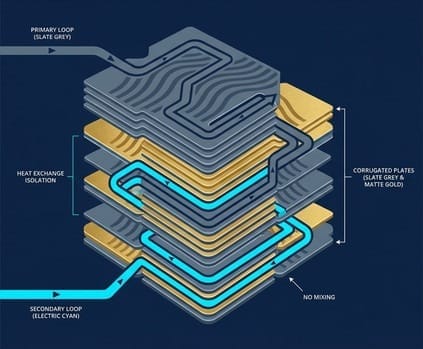
- Primary Loop (FWS): This is 'dirty water' (Facility Water) from external facility cooling towers outside the server room. It has high flow rates and low temperatures but contains impurities.
- Secondary Loop (TCS): This is 'ultrapure water' or special coolant (Technology Cooling System) circulating inside the server rack, directly contacting expensive GPU cold plates.
The CDU's task is to use its internal 'plate heat exchanger' (Plate Heat Exchanger) to enable high-efficiency heat exchange between these two water streams 'without direct contact'. Concurrently, the CDU must precisely control the secondary loop's water pressure, flow rate, and temperature to ensure each GPU receives coolant at exactly 25°C~40°C, and absolutely prevent pipe bursts.
Essence of CDU: Between the primary loop's 'dirty water' and the secondary loop's 'ultrapure water': Isolation + Heat Exchange + Pressure/Flow/Temperature Control.
🛠️ Core Technology: The Brazing Barrier of Plate Heat Exchangers (PHEx)
The most critical and technologically sophisticated component within a CDU is the plate heat exchanger (Plate Heat Exchanger).
This is no ordinary steel plate. It is composed of dozens, or even hundreds, of intricately corrugated stainless steel plates stacked together.
There are two extreme technological hurdles here:
- Micro-corrugation Design: The corrugations on the steel plates are designed to create intense 'turbulent flow', causing the water to churn vigorously as it passes, maximizing heat exchange efficiency. This demands extremely high-precision mold design capabilities.
- Vacuum Brazing: This is a bond that cannot tolerate the slightest error. Engineers must place copper or nickel foil between each layer of steel plate, then send them into a vacuum furnace for high-temperature brazing. If the brazing is imperfect, high-pressure water will instantly rupture the braze joints, leading to contamination of the secondary loop by dirty water from the primary loop, which would be a catastrophic disaster for AI servers.
Key Barrier Keywords: High-precision molds (corrugations) + Vacuum brazing (hermeticity/reliability).
🦅 Kaori (8996)'s Moat: From Hydrogen Fuel Cells to AI: The Alchemy of Thermal Energy
In this field, Kaori (8996) is Taiwan's undisputed leader.
Why Kaori? Because it possesses a unique expertise—brazing experience with hydrogen fuel cells (Fuel Cell).
According to in-depth industry research, Kaori has long served as a core supplier to the US-based company Bloom Energy (BE), responsible for producing the most critical reactor ('Hot Box') in hydrogen fuel cells. These reactors must operate at extreme temperatures of 800°C, and the demands for brazing hermeticity and reliability are several times more stringent than for liquid-cooled CDUs.
Kaori is simply applying 'space shuttle manufacturing' technology to 'water heater production'. This is what is known as a 'dimension-reducing strike'.
Industry Intelligence Decoded:
- Structural Surge in Liquid Cooling Revenue: According to the latest data, Kaori's revenue contribution from liquid cooling products (Liquid Cooling) is experiencing a vertical surge. From being a minor contributor in the past, it has soared to a 50% revenue contribution by Q3 2025. This signifies its successful transformation into a pure-play AI thermal management stock.
- Dual Engines of CDU and Manifold: Kaori not only supplies the internal plate heat exchangers for CDUs but also extends its reach downwards to manufacture manifolds (distribution pipes) within server racks. This allows it to capture the two highest-value metal structural components in liquid cooling systems.
🔮 2026 Outlook: Scaling Production and Doubling Output Value for In-Row CDUs
Looking ahead, as NVIDIA GB200 and GB300 server rack power densities exceed 100kW, traditional cooling methods have become ineffective.
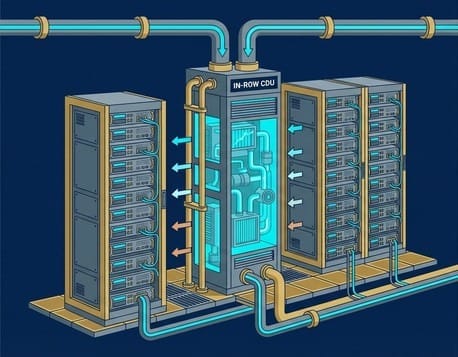
Data centers will extensively adopt In-Row CDUs (In-Row Cooling Distribution Units). These CDUs function like large refrigerators, directly placed between rows of server racks to provide powerful cooling capabilities nearby.
According to industry estimates, in 2026, with the introduction of the Vera Rubin platform, rack power consumption will be further elevated, which will necessitate a simultaneous increase in demand and upgrade in specifications for In-Row CDUs. Kaori, as a critical partner in the global liquid cooling supply chain (e.g., Vertiv), stands at the forefront of this infrastructure upgrade wave.
Demand Drivers: >100kW Rack Power Density → Accelerated In-Row CDU Adoption → Specification Upgrades and Output Value Revision Upwards.
🛑 The Art of Non-Return Flow: Why are QDs (Quick Disconnects) So Expensive?
QD stands for Quick Disconnect.
Its core mission is singular: "hot swap".
When an AI server in a rack malfunctions, maintenance personnel must disconnect the server's water pipes for replacement while the system remains operational and water pumps continue to run.
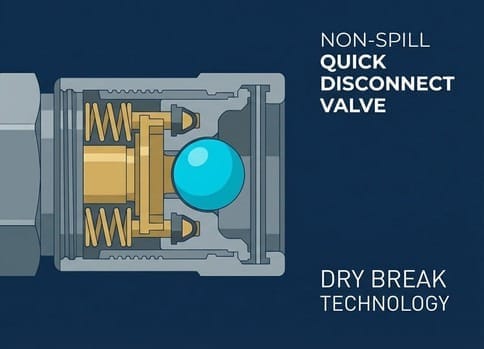
This is an extremely hazardous operation physically. High-pressure water could spray out at any moment, damaging an entire rack of GPUs worth millions of dollars. Therefore, QDs must possess "non-spill / dry break" capabilities.
QD's Value Proposition: Perform hot swaps under active pump operation and high-pressure conditions while also achieving Dry Break / Non-spill.
The Mystery of Microstructure:
The interior of a QD is filled with precise springs, pins, and valve structures.
- Upon Connection: Male and female connectors mate, valves automatically open, allowing water to flow unimpeded (low flow resistance).
- At the Moment of Disconnection: Within 0.1 seconds of disconnection, the internal valves of both male and female connectors must 'instantly' snap back and seal the pipe openings before water can spray out.
This requires extreme "metal processing precision" and "rubber sealing technology". Even a slight deviation in tolerance means either the connection won't fit, or a few drops of water will leak upon disconnection (which is a death sentence). This is why this small component commands such astonishingly high gross margins.
🦅 The Shadow of International Giants: The UQD Standard of CPC and Parker Hannifin
For a long time, this market has been dominated by major US manufacturers, particularly CPC (Colder Products Company) and Parker Hannifin.
They established a universal standard called UQD (Universal Quick Disconnect). In the NVIDIA H100 generation, almost all reference designs specified products from these two companies. They possess deep patent moats, levying expensive 'tolls' on the global AI supply chain.
However, with the surging shipments of AI servers, the production capacities of these two major manufacturers can no longer keep up with demand, leading to frequent material shortages. This has presented a once-in-a-lifetime entry opportunity for precision metal processing manufacturers in Taiwan.
💎 JPC (3533)'s Strategic Breakthrough: From Socket to QD: A Dimension-Reducing Strike
In this domain, the most qualified entity in Taiwan to challenge US hegemony is the connector stock leader—JPC (3533).
1. Logic of Technological Homogeneity:
JPC is a world-leading supplier of CPU/GPU sockets. Sockets require extremely precise metal contact pin and fastening technologies, which shares remarkable similarities in craftsmanship with the precise valve structures inside QDs.
According to the latest industry analysis, JPC has initiated close contact with chip suppliers to strategically position itself for potential socket and liquid cooling opportunities.
2. Potential AI Business Explosion:
While JPC's AI-related revenue (QD, GPU sockets) is still in its early stages (accounting for 5-10% of estimated revenue in 2026-2027), this is precisely the key factor for the market to grant it a valuation re-rating.
Industry intelligence indicates that while the adoption path for GPU sockets still has variables, JPC's progress in QDs (Quick Disconnects) and SOCAMM (new memory module sockets) will become a strong tailwind over the next two years. This is a strategic positioning with extremely high 'option value', and once certified for mass production, it will deliver significant annual EPS accretion.
Investment Language Translation: Socket's precision metal component capabilities → Technological homogeneity with QD manufacturing → Low early-stage contribution but prone to triggering a re-rating (Option Value).
🛡️ Another Hidden Player: Fositek (6805)'s Hinge Technology
Besides JPC, we must also pay attention to Fositek (6805), a subsidiary of AVC (3017).
This company, which originally specialized in folding phone hinges, has successfully entered the QD market by leveraging its expertise in processing complex metal components.
According to supply chain intelligence, Fositek has begun shipping QDs and floating quick disconnect modules for the GB300 Switch Tray. This proves that manufacturers in Taiwan possess the full capability to pass NVIDIA's stringent tests in the field of precision metal processing.
🔮 Future Outlook: From UQD to NVQD: The Specification War
Looking ahead to the Vera Rubin generation beyond 2026, NVIDIA, in pursuit of higher density and cooling efficiency, is promoting a new generation of connector standard—NVQD.
According to industry estimates, future Compute Trays will predominantly adopt a configuration of 90% NVQD paired with 10% UQD.
This implies that whoever can first obtain NVQD certification will seize a market share several times larger than the current one in the next wave of specification upgrades. JPC and Fositek are standing at the starting line of this specification war.
🏗️ More Than Just Water Pipes: Manifold's Fluid Dynamics Challenge
Manifolds are typically installed at the rear or side of a server rack. It appears as a long metal rectangular pipe with dozens of holes, connecting to the water paths of each server. However, to engineers, this presents an extremely challenging fluid dynamics problem: "Flow Balancing".
Imagine water being pumped up from the bottom of a server rack. If poorly designed, servers at the bottom layer would experience high water pressure and fast flow rates; whereas at the top layer, water pressure would attenuate, and flow rates would slow down.
This would lead to a catastrophic consequence: GPUs on lower layers would be well-cooled, while those on upper layers would overheat and throttle.
To ensure that all 72 GPUs in an entire rack receive consistent cooling performance, the manifold's internal flow channel geometry must undergo precise CFD (Computational Fluid Dynamics) simulations, and even special flow-guiding structures must be designed within the pipes.
Manifold's Engineering Challenge: It's not merely about 'passing water', but achieving consistent Flow Balancing across the entire rack.
🔨 The Art of Welding: From TIG to Vacuum Brazing
Beyond design, manufacturing processes are even more critical. A manifold has dozens of interfaces (bosses) that need to connect to QD quick disconnects. Each interface is a potential leakage point. Traditional TIG welding (tungsten inert gas welding) relies on manual labor, is slow, and has inconsistent quality. In the 'zero-tolerance' environment of AI servers, the industry is transitioning to more advanced processes:
- Automated Laser Welding: Fast, small heat-affected zone, minimal deformation.
- Vacuum Brazing: This is Kaori (8996)'s absolute stronghold. The entire pipe component is sent into a vacuum furnace, where capillary action allows the brazing filler metal to penetrate every crevice. Products produced by this process boast extremely high structural strength and perfect hermeticity, making it the preferred process for high-end manifolds.
⚔️ Supply Chain Reorganization: System-Level 'Bundle' War
The emergence of manifolds has changed the rules of the thermal management industry.
Previously, selling fans was selling 'components'; now, selling liquid cooling is selling 'systems'.
According to the latest industry supply chain analysis, CSPs (Cloud Service Providers) and system integrators (ODMs) are increasingly favoring 'Turnkey (one-stop)' solutions. This means that whoever can integrate and sell cold plates, manifolds, and CDUs (Coolant Distribution Units) together will secure the largest orders.
1. AVC (3017): The Vertically Integrated Giant
AVC's strategy is 'I want it all'. It not only produces cold plates but also entered the assembly of QD quick disconnects and manifolds through its subsidiary Fositek.
Intelligence indicates that AVC has penetrated the GB300 supply chains of giants like Microsoft, Oracle, and Google, offering comprehensive solutions including cold plates, manifolds, and even CDU Sidecars. This high level of in-house manufacturing (In-house) gives it a significant advantage in cost control.
2. Auras (3324): The Technology-Leading Vanguard
Auras, meanwhile, is moving extremely fast in terms of technical specifications. Beyond securing NVIDIA's orders, Auras is also actively positioning itself in the CSP's self-developed ASIC chip market (e.g., AWS Trainium, Meta MTIA).
This is a highly strategic move. Because ASIC manifold designs are typically highly customized, offering better profit margins than standard products. Auras anticipates that revenue from ASIC Rack Manifolds will contribute significantly in 2026.
3. Kaori (8996): The Brazing Technology Armorer
Kaori does not compete with thermal management companies for cold plates; it focuses on its strengths—CDU heat exchangers and manifold brazing.
The report indicates that Kaori has become a critical partner for international giants like Vertiv in CDUs and manifolds. While AVC and Auras battle on the front lines, Kaori, in the rear, provides the most critical heat exchange cores and metal piping components, making it a stable beneficiary in this war.
The Deciding Factor in the 'Bundle' War: Whoever can offer a Turnkey solution (Cold Plate + Manifold + CDU) will more easily secure large orders.
🚀 Future Outlook: GB300's 'Internal and External Assault' and Doubled Output Value
Finally, we must pay attention to the structural changes brought by NVIDIA GB300.
According to supply chain intelligence, the GB300 rack design will be more complex. In addition to the existing Rack Manifold at the rear, an 'Internal Manifold' will also be added in the Switch Tray area inside the server rack.
This means:
- Increased Usage: Both the quantity and length of manifolds required per single rack will increase.
- Doubled Output Value: Coupled with upgrades to cold plates and QDs, the overall thermal management output value for GB300 racks is estimated to increase by 15%~20% compared to GB200.
By 2026, with the explosive growth in liquid cooling adoption, this complete vascular system, from cold plate to CDU, will become the most lucrative new artery for Taiwan's electronics industry.
In-Depth Research · Quantitative Perspective
Want more quantitative research insights on semiconductors?
【Insight Subscription Plan】Bid Farewell to Retail Investor Mentality: Build Your Alpha Trading System with 'Quantitative Chips' and 'Consensus Data'EDGE Semiconductor Research
📍 Series Map — Navigate the Complete EDGE Semiconductor Research →


