
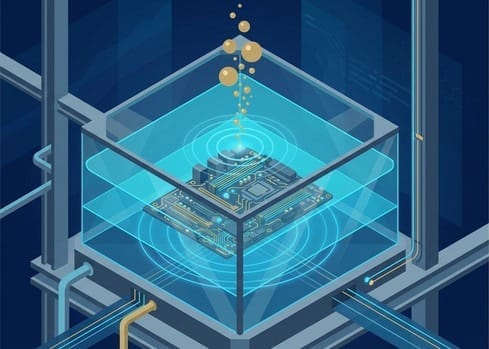
Positioning: This article focuses on the "chemical supply chain cliff" in immersion cooling – after 3M Novec's exit, the two-phase route faces a redistribution of power due to PFAS regulations and alternative liquids; meanwhile, the single-phase route uses synthetic oils and system engineering to bypass chemical and hermetic complexity.
🛑 3M's Exit and the Industry's "Chemical Cliff"
Over the past decade, the technology for Two-Phase Immersion Cooling has been almost entirely built upon the products of a single company: 3M's Novec electronic fluorinated fluids.
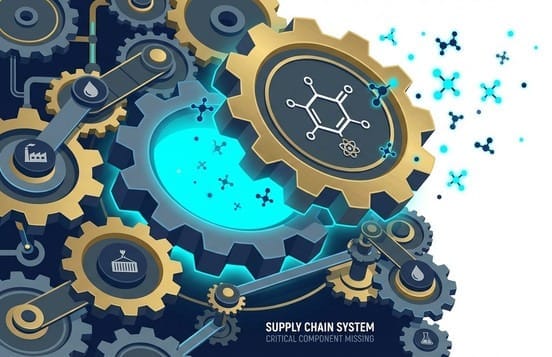
This fluid possessed remarkable properties: it was dielectric (non-conductive), had a low boiling point (around 50°C, ideal for chip cooling), and was non-flammable.
However, Novec belongs to the PFAS (Per- and Polyfluoroalkyl Substances) family.
These chemical bonds are exceptionally strong, making them virtually non-decomposable in nature, earning them the moniker "Forever Chemicals." They accumulate in soil, water sources, and even the human body, posing health risks.
Facing increasingly stringent environmental fines and lawsuits from the EU and the US EPA, 3M dropped a bombshell at the end of 2022: it announced that it would completely cease production of PFAS-related products by the end of 2025.
For the immersion cooling industry, this was tantamount to pulling the rug out from under them. Server manufacturers (ODMs) and cloud giants (CSPs) suddenly realized that their meticulously designed next-generation cooling systems were about to face a "weaning" crisis.
Key Takeaway: 3M's exit isn't just "losing a supplier"; it directly severs the core working fluid for two-phase immersion cooling, effectively pushing the industry towards a dual redefinition in material science and regulatory compliance.
🦅 The Rise of a New Dominator: Chemours (科慕) and the High Profits of its TSS Division
As the old king abdicates, a new one is set to ascend the throne.
Amidst this upheaval, the American chemical giant Chemours (科慕, CC), spun off from DuPont, is poised to take over this massive vacuum in the market with its exclusive patented formulations.

According to the latest industry analysis reports, while Chemours' traditional titanium dioxide (TiO2) business has been soft due to cyclical fluctuations, its TSS (Thermal & Specialized Solutions) division has demonstrated remarkable resilience and growth potential.
Why Chemours?
1. Opteon's (歐特昂) Technological Barrier:
Chemours has developed a new generation of HFO (hydrofluoroolefin) technology, branded as Opteon™. Compared to traditional refrigerants, Opteon has an extremely low GWP (Global Warming Potential) and a short atmospheric lifetime, complying with the latest environmental regulations. It is currently one of the very few two-phase immersion cooling fluids capable of replacing 3M Novec and possessing mass production capabilities.
2. Regulatory Tailwinds (AIM Act):
The U.S. AIM Act (American Innovation and Manufacturing Act) mandates the reduction of high-GWP hydrofluorocarbons (HFCs). While seemingly a restriction, this effectively clears out lower-tier competitors for Chemours, as only Chemours possesses sufficient patents and production capacity to supply compliant next-generation cooling fluids. Regulations are no longer a barrier but rather Chemours' strongest moat.
Interpretation: Competition in two-phase immersion cooling is no longer solely about thermal performance but a trinity of "compliance + patents + mass production." Whoever can supply compliant working fluids holds the authoritative voice in the system roadmap.
💰 The Hidden Cash Cow: Structural Re-evaluation of the TSS Division
The investment market often perceives Chemours merely as a "cyclical titanium dioxide stock," assigning it a lower price-to-earnings ratio.
However, a deeper dive into its financial reports reveals that the TSS division (including data center cooling fluids) boasts an EBITDA margin of over 36%, significantly higher than traditional chemical products.
As demand for immersion cooling in AI data centers explodes in 2026-2027, Chemours' TSS division is set to become the company's primary profit engine.
Industry intelligence indicates that the Opteon series' application in data center cooling is rapidly growing, and due to patent protection, its pricing and profit margins are highly defensible. This is not merely selling chemical agents; it's selling "liquid consumables for AI computing."
⚠️ Two-Phase vs. Single-Phase: The Unresolved Mystery of Physics
While Chemours offers a solution for two-phase cooling, the "two-phase" technology itself still presents physical challenges:
- Hermeticity: When the liquid boils and turns into gas, its volume expands. If not properly sealed, the expensive Opteon gas will leak (this is called "evaporation loss").
- Cost: Although Opteon is environmentally friendly, its price remains high (hundreds of US dollars per liter).
Consequently, another school of thought has emerged in the market: "Why must the liquid boil? Why not just use 'single-phase' oil for cooling?"
This brings us to another European chemical giant, Solvay (索爾維), and startups specializing in synthetic oil technology. They are attempting to bypass complex gas management by solving heat dissipation issues in a simpler, cheaper way.
Essence of the Divergence: Two-phase leverages "latent heat" as its weapon, while single-phase uses "engineering controllability." The outcome of these two routes will depend on the speed at which power density increases and the pace at which regulations tighten.
🌡️ The Physics Dilemma: Latent Heat vs. Specific Heat
To understand this battle, we must first revisit high school physics.
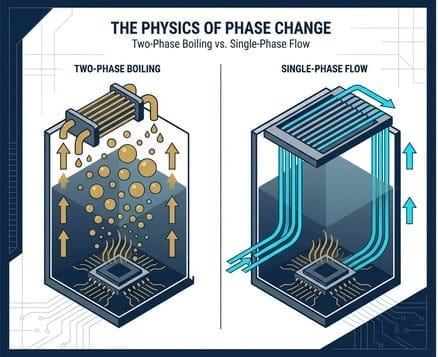
1. Two-Phase Immersion: The Violent Aesthetics of Boiling
- Principle: Utilizes the immense Latent Heat absorbed when a liquid "vaporizes" to remove heat. The cooling fluid boils on the chip surface, turns into bubbles that rise, and condenses back into liquid upon contact with the top condenser coils, then falls back down.
- Advantages: Extremely high heat dissipation density (supports >100kW racks), no pumps needed to circulate the liquid (gravity-driven circulation), and exceptionally uniform temperature.
- Fatal Flaws:
- Gas Management: Requires extremely high hermeticity. Once expensive fluorinated fluid vapor leaks, it's literally money evaporating.
- PFAS Shadow: To achieve a suitable boiling point (50°C), chemical formulations often involve PFAS. Even Chemours' Opteon, despite significantly reduced GWP (Global Warming Potential), still faces strict scrutiny from environmental regulations.
2. Single-Phase Immersion: The Silent Guardian of Flow
- Principle: Utilizes the liquid's "temperature difference" and "Specific Heat" to force the liquid to flow over the heat source via pumps. The liquid remains in its liquid state throughout, without boiling.
- Advantages: Simple system (no hermetic sealing required), low cost (synthetic oils can be used), and relatively safe maintenance.
- Challenges: Liquid Viscosity. Oil is more viscous than water, requiring powerful pump energy to drive it across the chip's cooling fins; additionally, its heat dissipation limit is lower than that of two-phase systems.
🛡️ The Chemical Giant's Pivot: Solvay (索爾維)'s Balanced Strategy
In this battle of technological routes, European chemical giant Solvay (索爾維) plays a pivotal role.
Unlike Chemours, which is betting on a specific coolant product line, Solvay is undergoing a massive group-level transformation.
According to the latest industry analysis, Solvay is facing price pressure in its traditional businesses (such as Soda Ash), which forces management to accelerate cost reduction and seek high-value-added solutions.
Although the soda ash business saw a decline in EBITDA due to soft demand, this has paradoxically become a catalyst for Solvay to shift towards "specialty polymers and high-performance fluids."
Solvay possesses extensive fluorochemical and polymer technology reserves. Following 3M's exit, Solvay's Galden® and Fomblin® series (perfluoropolyether PFPE) have become important alternative options for both two-phase and single-phase cooling fluids.
Solvay's strategy is more flexible; it doesn't just sell fluids, but places greater emphasis on the role of material science in the "energy transition." Although its short-term financials are hampered by traditional chemical cycles, its deep chemical expertise makes it Chemours' strongest European competitor in the high-end cooling fluid market.
🦄 The Rising Star in System Integration: Submer and Single-Phase Standardization
Given that chemical fluids are so expensive and troublesome, the European startup Submer, focused on single-phase technology, has chosen a different path: "perfecting the oil tank."
Submer does not produce chemical fluids; instead, it designs "Immersion Tanks."
They advocate for the use of biodegradable "synthetic oil" (a high-grade version similar to transformer oil), completely free of PFAS, thereby thoroughly addressing environmental concerns.
Submer's core technology lies in its SmartPod system, which, through specialized flow channel design and robotic arms (CDPU), addresses the pain points of single-phase cooling: "uneven flow rate" and "difficult maintenance (hands getting dirty)."
This approach has garnered significant attention from Intel and OCP (Open Compute Project). For large-scale data centers, "safety, affordability, and environmental friendliness" are often more appealing than ultimate heat dissipation performance.
📉 Industry Outlook: Single-Phase in the Short Term, Two-Phase in the Long Term?
Synthesizing information from various sources, we draw a strategic conclusion:
- Short Term (2025-2026): Due to PFAS regulatory uncertainties and the shock of 3M's exit, single-phase immersion cooling (synthetic oil) will gain more validation opportunities, especially in enterprise-level and edge computing centers.
- Long Term (2027+): When AI chip power consumption surpasses 1500W or even 2000W, the physical limits of single-phase oil cooling will be reached. At that point, environmentally improved two-phase immersion cooling (such as Chemours' new formulations), combined with more advanced sealed cabinets, will become the sole solution for high-density computing.
Chemours' TSS division is expected to continue benefiting from this rigid demand for thermal management, and the division's profitability has already proven capable of resisting fluctuations in traditional cycles.
Strategic Convergence
- 2025-2026: Single-phase capitalizes on "controllability" benefits first.
- 2027+: Power density pushes systems back to two-phase, but only if chemical and regulatory issues are resolved.
🦄 Wiwynn's Unique DNA: More Than Just an OEM, Also a "Standard Setter"
To understand Wiwynn, one cannot equate it with a typical assembler.
Wiwynn is a core member of OCP (Open Compute Project). This means that it's not merely "building to spec"; it's one of the rule-makers involved in defining "what the next-generation data center looks like."
In the field of immersion cooling, this point is crucial.
Because immersion cooling has no standard answer. How large should the oil tank be? How should the flow field be designed? How do robotic arms retrieve servers? All of these need to be defined from scratch.
Leveraging its status within OCP, Wiwynn collaborates closely with cloud giants like Meta and Microsoft to jointly develop reference architectures for immersion cooling. This allows it to secure the most critical "cooling system integration rights" before technical specifications are even finalized.
🛡️ The ASIC Safe Haven: Avoiding NVIDIA's "Group A" Red Ocean
As we mentioned in previous chapters, NVIDIA's "Group A" strategy has compressed profit margins within the supply chain.
However, Wiwynn has taken a bold gamble on a "non-NVIDIA route," and this bet now appears to be translating into significant dividends.
According to the latest industry analysis, Wiwynn's primary growth drivers come from CSP (Cloud Service Provider) in-house chip projects. These ASIC chips are typically optimized for specific AI models, feature extremely high power density, and are not constrained by NVIDIA's reference design thermal limits, thus making them more amenable to aggressive liquid cooling solutions.
Wiwynn's Two Trump Cards:
- AWS Trainium Project: This represents Wiwynn's biggest breakthrough in recent years. As AWS accelerates the deployment of its proprietary AI inference chips (Trainium), Wiwynn, as a key partner, has secured a large volume of high-end AI server orders. These projects require not just servers, but rack-level liquid cooling solutions.
- Meta MTIA Project: As a long-term strategic partner to Meta, Wiwynn plays a crucial role in the development of Meta's in-house AI chips (MTIA v2/v3).
These two major ASIC projects provide Wiwynn with a more robust profit structure than its peers in 2025-2026, as ASIC projects are typically highly customized, offering superior gross margins compared to standard products.
💧 From Cold Plates to the "Deep Sea": The Ambition for 100% Liquid Cooling Penetration
Wiwynn's ambition is not just to sell boards, but to sell a "complete liquid cooling ecosystem."
Current new ASIC projects are already showing a trend of 100% adoption of liquid cooling technology. This represents a qualitative leap for Wiwynn, as it transitions from mere "electronic assembly" to "thermal engineering."
Wiwynn's technological evolution roadmap is very clear:
- Present (2025-2026): Full adoption of Direct-to-Chip (DTC) cooling (i.e., cold plates). Wiwynn not only manufactures compute trays but also integrates CDUs and manifolds, providing rack-level delivery.
- Future (2027+): Two-Phase Immersion Cooling. When ASIC power consumption breaks physical limits, Wiwynn will have already completed the validation of immersion tanks in its labs, utilizing the electronic fluorinated fluids (or their alternatives) mentioned in our previous two articles.
This is an "end-to-end" strategic layout. Wiwynn knows that all AI servers will eventually "go underwater," so it is now gaining experience in liquid management by training on ASIC projects.
📈 Dual-Engine Drive: General Server Recovery and AI Explosion
Finally, we cannot overlook Wiwynn's other growth engine—the recovery of general servers.
With the arrival of corporate equipment upgrade cycles, demand for traditional servers is rebounding. This provides Wiwynn with a stable cash flow (Cash Cow), giving it the confidence to invest in expensive immersion technology and ASIC development.
In summary, Wiwynn's strategic position lies in this: it is the system manufacturer that best understands the "mindset of cloud giants."
When Meta and AWS seek to break free from NVIDIA's control and experiment with more aggressive cooling technologies, Wiwynn is the crucial partner capable of turning blueprints into reality.
Deep Research · Quantitative Perspective
Want more insights into quantitative semiconductor research?
【Insight Subscription Plan】Break Free from Retail Investor Mentality: Build Your Alpha Trading System with "Quantitative Chips" and "Consensus Data"EDGE Semiconductor Research
📍 Series Map — Navigate the Complete EDGE Semiconductor Research →


