
Key Takeaways
- Wiwynn's core principle: Reject "inflated revenue" and working capital pressure caused by Buy/Sell model → Prioritize orders, pursue profit quality
- Organizational solution: Wistron handles L10 (capital & manufacturing), Wiwynn handles L11 (system integration) → Division of labor + profit sharing
- Growth engines: ASIC + NRE (high gross margin, long cycle, fewer competitors) and general server cash cow
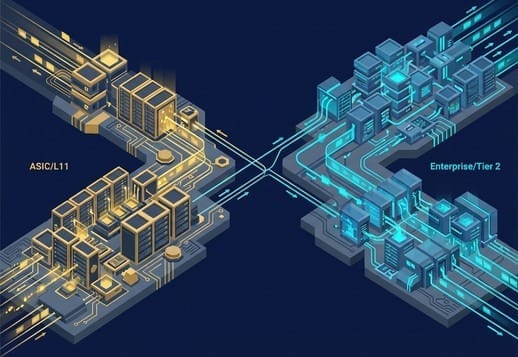
- Gigabyte's positioning: Utilize channels and product breadth to capture the enterprise-grade and Tier 2 long-tail markets → "Guerrilla tactics"
🛑 Rejecting "Bloat": Why Wiwynn Remains "Calm" Towards GB200?
First, we need to understand an accounting trap: the "Buy/Sell Model." Under the NVIDIA GB200 NVL72 architecture, a single rack can be valued as high as US$3 million, with 70-80% of the cost coming from GPU chips. If an assembly plant is to ship a complete rack (L11), it typically must first pay to purchase the GPUs (Buy) and then sell them to the customer after assembly (Sell).
Section Summary: The GB200 trap isn't technology, but accounting and capital structure.
This leads to two severe financial consequences:
- Inflated Revenue, Diluted Gross Margin: While revenue figures surge (due to the inclusion of expensive GPUs), the actual processing fees earned remain unchanged, leading to a sharp decline in Gross Margin. This was one of the main reasons Wiwynn's Q4 2025 gross margin fell short of expectations, as some low-margin GPU projects diluted the profit structure.
- Capital Pressure: To procure GPUs, companies need to prepare astronomical amounts of working capital.
Therefore, unlike Hon Hai (Foxconn) or Quanta, which aggressively vie for every GB200 order, Wiwynn has adopted a "selective order acceptance" strategy. According to industry surveys, after completing some GB200 rack projects in Q4 2025, Wiwynn adopted a more cautious attitude towards subsequent standard product orders. It does not pursue the vanity of revenue rankings; it seeks "quality profits."
🤝 Parent-Child Collaboration: Wistron (L10) + Wiwynn (L11) Golden Combination
If you don't want to bear the inventory pressure of GPUs but still want to profit from AI, what should you do? Wiwynn devised an ingenious solution: find a wealthy parent company for assistance.
Section Summary: Using "division of labor" to deconstruct Buy/Sell risks, positioning Wiwynn in high-value-added segments.
Wiwynn and its parent company, Wistron, are building a new model of "collaborative division of labor" and "Profit Sharing," especially for large GPU projects targeting CSPs (such as the future Vera Rubin VR200 series).

The operational logic of this strategy is as follows:
- Wistron (The Manufacturer) is responsible for L10: Wistron possesses strong SMT production lines and financial strength. Wistron is responsible for procuring GPUs, producing baseboards (L6), and assembling them into server systems (L10). Wistron bears most of the manufacturing and financial burden.
- Wiwynn (The Architect) is responsible for L11: Wiwynn focuses on what it does best – rack design and system integration. It is responsible for designing liquid cooling solutions, power architectures, and ultimate rack-level testing and delivery.
- Profit Sharing: Both parties share profits through internal agreements. This frees Wiwynn from heavy hardware assets, allowing it to focus on "high-value-added technical services."
This model allows Wiwynn to avoid the gross margin dilution risk brought by the "Buy/Sell" model. As the cooperation model matures in 2026, Wiwynn's gross margin is expected to rebound quarter by quarter, as it earns higher-purity technical profits.
💎 Back to Basics: ASIC and NRE's High-Margin Moat
In addition to tactical adjustments, Wiwynn strategically adheres to its "ASIC (Application-Specific Integrated Circuit) priority" stronghold.
Section Summary: The essence of ASIC is a "co-development relationship" and "high-margin upfront revenue."
In 2025, a significant portion of Wiwynn's revenue growth came from the strong demand for ASIC server projects. Why does Wiwynn favor ASICs so much?

- NRE (Non-Recurring Engineering) Revenue: ASIC projects typically require high customization, and customers pay substantial NRE fees. This money is pure profit, with almost no associated costs, significantly boosting gross margins.
- Longer Product Lifecycle: Compared to the frantic pace of NVIDIA GPUs, which change annually, CSP-designed ASIC chips have a longer lifecycle, offering more stable order visibility.
- Fewer Competitors: When producing NVIDIA standard products, you compete on price with Hon Hai, Quanta, and Supermicro; for ASICs, you need to be deeply involved in the client's chip development from the early stages, creating extremely high entry barriers.
Looking ahead to 2026, Wiwynn's ASIC business is expected to usher in a new wave of growth. In addition to existing projects, the next-generation ASIC platform is expected to ramp up in the second half of 2026. This will be Wiwynn's core engine for maintaining high profitability.
🔄 Dual-Engine Driven: The Recovery of General Servers
Finally, let's not forget Wiwynn's foundation – General Servers. After experiencing a high base correction in 2025, the industry anticipates the general server market will return to growth in 2026 (estimated 8.3% year-on-year increase).
Section Summary: General servers are a cash cow, supporting significant investments in ASIC and liquid cooling.
This is crucial for Wiwynn. Because general servers are a "Cash Cow," they provide stable cash flow, giving Wiwynn the leeway to invest in expensive liquid cooling technology and ASIC development. Although general servers have lower gross margins than NRE projects, with rising memory costs and product portfolio adjustments, Wiwynn is striving to maintain profitability through operating leverage.
🌪️ The ASIC Frenzy: Not Letting NVIDIA Monopolize the Spotlight
While NVIDIA's GPUs dominate media headlines, for CSPs, ASIC (Application-Specific Integrated Circuit) is their secret weapon for long-term cost control and differentiation.
According to the latest industry supply chain survey, 2026 will be the "breakout year" for ASIC chip shipments.
Section Summary: CSPs' long-term strategy is "self-developed chips," not perpetually chasing GPUs.
Key Data Unlocked:
- AWS (Amazon): Its Trainium and Inferentia chips are expected to see a year-on-year shipment increase of 50-55% in 2026. This shows AWS is accelerating its move away from complete reliance on NVIDIA to build its own AI computing power.
- Google: As a pioneer in ASICs, its TPU (Tensor Processing Unit) v5/v6 series shipments are even more astounding, projected to increase by 75-80% year-on-year in 2026. Google has massive search and YouTube businesses, and the cost-effectiveness of using self-developed TPUs far exceeds that of general-purpose GPUs.
- Meta (Facebook): Although Meta has purchased many H100s, its self-developed MTIA chip shipments are also expected to see significant growth in 2026. While starting from a lower base, the growth momentum should not be underestimated.
Wiwynn's Strategic Positioning: Wiwynn is one of the biggest beneficiaries of this ASIC wave. It is AWS's primary L11 (full rack) supplier. Unlike GPU servers, which many companies produce, ASIC servers require deep collaboration with CSPs from the chip development stage (co-design). This means Wiwynn's relationship with its clients is not "buy and sell" but "strategic partnership." This high-stickiness relationship allows Wiwynn to enjoy better profits in ASIC projects than with standard products, with extremely high order visibility. The next generation of ASIC projects is expected to see significant volume ramp-up in the second half of 2026.
🏢 The Enterprise-Grade Blue Ocean: Gigabyte's Guerrilla Tactics
If Wiwynn is a special force serving "whales" (CSPs), then Gigabyte is a guerrilla force serving "sharks" (Enterprise/Tier 2 CSPs).
Section Summary: The key to the long-tail market isn't the lowest cost, but channels, immediate availability, and configuration flexibility.
Not all customers have the capacity to place orders for an entire data center and design their own chips, like Google or Meta.
Many Tier 2 cloud service providers (such as CoreWeave, Lambda) and large enterprises (finance, healthcare, manufacturing) need:
- Immediate Availability (Time-to-Market): They don't want to wait 52 weeks for delivery; they need machines now.
- Flexibility: They might only need a few racks, or even a few units, but with specific configurations.
Gigabyte's Competitive Advantages:
- Channel King: Gigabyte possesses a strong global channel network and brand recognition, allowing it to reach small and medium-sized AI customers that Hon Hai (Foxconn) and Quanta "overlook" or "cannot serve."
- Product Breadth: Gigabyte's AI server product line is extremely broad, ranging from modular servers supporting NVIDIA MGX to liquid-cooled and air-cooled solutions. This enables it to quickly meet the diverse needs of enterprise-grade customers.
- Flexible Pricing: In the enterprise-grade market, price sensitivity is not as high as with CSPs, allowing brand manufacturers like Gigabyte to maintain decent gross margins. While its revenue scale may not match that of ODM giants, driven by the high unit price of AI servers, its profit explosive power is equally astonishing.
⚓ General Server: The Underestimated Ballast Stone
While chasing AI, we must not overlook the recovery of general servers.
For both Wiwynn and Gigabyte, this is an important source of cash flow (Cash Cow).
Section Summary: General servers provide a stable foundation, allowing AI deployment without relying heavily on leverage.
After experiencing inventory adjustments and budget crowding-out effects in 2024-2025, the industry expects the general server market to return to growth in 2026, with an estimated year-on-year shipment increase of approximately 10%.
- Drivers: Demand for new platforms from Intel (Birch Stream) and AMD (Turin), as well as ongoing enterprise investment in digital transformation.
- Wiwynn's Strategy: Wiwynn anticipates general server revenue to grow by 8.3% in 2026. While the growth rate is not as high as AI, this provides a stable foundation, allowing the company to invest in ASIC and liquid cooling technology R&D without apprehension.
🧭 7-2-2 Strategy Summary: A Path to Survival Beyond Scale
We've reviewed the strategies of Wiwynn and Gigabyte. These two companies demonstrate that in the trillion-dollar AI server battlefield, one doesn't necessarily have to pursue "the largest scale," but must pursue "the most precise positioning."
Section Summary: One goes deep (CSP+ASIC+division of labor model), the other goes broad (channels+enterprise-grade+long-tail).
- Wiwynn: Adheres to the ODM Direct and ASIC routes. It does not compete with Hon Hai on production capacity or with Quanta on Google orders; it focuses on serving the deep customization needs of AWS and Meta, and maximizes shareholder return on equity (ROE) through its division of labor model with Wistron.
- Gigabyte: Deeply cultivates the channel and enterprise-grade markets. It captures the trend of AI computing moving downwards (from cloud to edge/enterprise), using flexible tactics to secure rich profits from the long-tail market.
In-Depth Research · Quantitative Perspective
Want more semiconductor quantitative research insights?
【Insight Subscription Plan】Break Free from Retail Investor Mentality: Build Your Alpha Trading System with "Quantitative Chips" and "Consensus Data"EDGE Semiconductor Research
📍 Series Map — Navigate the Complete EDGE Semiconductor Research →


