
⏱️ The Violent Expansion of the Demand Pool: Out-of-Control "Test Time"
To understand why King Yuan Electronics (KYEC) is raking in profits, we cannot solely focus on the "shipment volume" of AI chips. Instead, we must examine a more critical multiplier: "Test Time".
In the past, test houses' revenue growth often increased linearly with wafer foundries' shipment volumes. However, in the AI era, this formula has fundamentally changed. AI chips are incredibly complex, packed with hundreds of billions of transistors and High Bandwidth Memory (HBM). To ensure no microscopic circuits are short-circuited, test equipment must run through countless program loops.
According to our industry research, the single-chip test time for NVIDIA AI chips is undergoing a disheartening "geometric progression explosion":
- H Generation (Hopper): The single-chip test time is approximately 350 seconds.
- B Generation (Blackwell): Test time has skyrocketed nearly 3 times to 1,000 seconds!
- Future R Generation (Rubin): Industry estimates suggest that to cope with even greater computational power and complex CoWoS architectures, test time will exceed limits, reaching 1,200 seconds or even 1,500 seconds!
Consider this terrifying math problem carefully: what does it mean when NVIDIA's shipment volume doubles, and the test time for each chip extends by 3 to 4 times? It means that the global total demand for "high-end test capacity (equipment and cleanroom space)" will surge by 6 to 8 times in just two years!
This is the reality KYEC is currently facing: their test capacity is instantly overwhelmed by AI giants, with clients lining up with cash, even willing to accept "price increases" to secure dedicated test equipment. This is the ultimate money printer, driven by "time."
🔥 The Fear of Death: Silent Data Corruption and the Rise of "Burn-in"
However, simply extending regular test time is not enough. Cloud giants (such as Google, Meta, and Microsoft) are now most afraid of a ghost known as "Silent Data Corruption (SDC)".
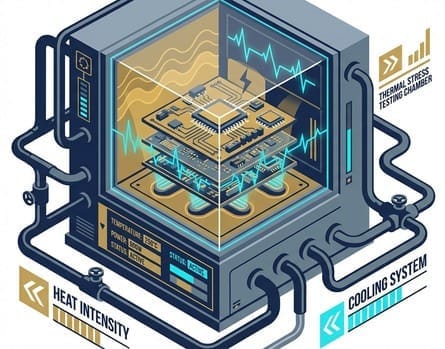
This is an extremely insidious flaw. When a chip is tested at normal room temperature, everything appears fine; but after it's installed in a server and run at full speed for several days at high temperatures above 100°C, a tiny nanometer circuit inside the chip can suddenly break, leading to incorrect computation results. This "Infant Mortality" phenomenon can completely derail the training progress of an AI data center costing hundreds of millions of dollars. To address this fear, production lines have been forced to recall an ancient but extremely brutal tool: "Burn-in (aging pre-burn test)".
Previously, Burn-in was only performed on automotive chips critical for human safety or a very small number of military-grade chips. The process involves placing packaged chips into a specialized "large oven (burn-in oven)," applying extremely high voltage and current, and "stressing them to death" continuously for several days at extreme temperatures of 125°C or even higher! If a chip is inherently weak, it will fail in the oven; only those that survive can be sent to AI servers.
🏰 KYEC's Absolute Moat: Why Not ASE?
At this point, you might ask: "Testing is so profitable, won't ASE (3711), the global leader in semiconductor assembly and test, try to seize this opportunity?"
This is KYEC's "ultimate moat": KYEC possesses strong "in-house Burn-in oven manufacturing capabilities"!
While ASE is large, their Burn-in equipment primarily relies on purchases from major international equipment manufacturers (such as Advantest). These foreign-made machines are extremely expensive, have long lead times, and standard foreign equipment simply cannot be customized quickly enough to adapt to NVIDIA's high-power chips, which are revamped every six months.
In contrast, for the past decade, KYEC has cultivated an engineering team dedicated to "designing and assembling their own" burn-in ovens and water-cooling systems!
- Extremely fast customization: When NVIDIA demands that burn-in ovens must be able to suppress the terrifying waste heat of 1,500W per chip, KYEC can immediately modify water-cooling pipelines in-house to meet client needs.
- Extremely low cost: Manufacturing their own ovens is far cheaper than purchasing from foreign suppliers, giving KYEC's pricing devastating competitiveness.
Thanks to this "in-house burn-in oven" moat, KYEC has not only secured large back-end test orders for NVIDIA GPUs but has also become the designated turnkey test contractor for various cloud giants (such as AWS and Meta) in the battle for Google TPUs (Tensor Processing Units) and other AI ASICs (Application-Specific Integrated Circuits). According to Morgan Stanley's estimates, Google TPUs alone are projected to contribute nearly 10% of KYEC's substantial revenue by 2026!
⚔️ The Never-Ending War of Attrition: The "Razor and Blades" Model of AI Testing
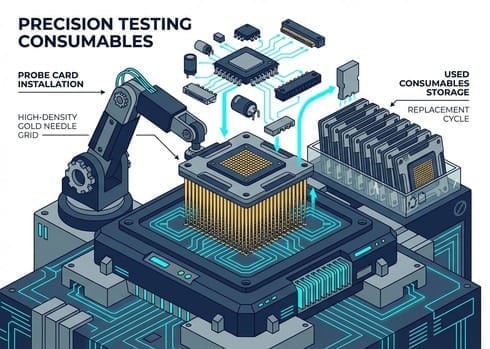
This is the classic "Razor and Blades" model taught in business schools. KYEC acquires expensive test equipment (the razor), but to keep these machines running, they must purchase new, extremely costly test interfaces and probes (the blades) from upstream "arms dealers" every few weeks or months.
As AI chip test times lengthen, and burn-in and SLT (System-Level Test) become standard, it means "consumables spend more time being ravaged in high-temperature ovens." Their lifespan is drastically shortening, and the replacement rate is skyrocketing exponentially!
In this brutal war of attrition for consumables, Taiwan's arms dealers are firmly grasping the throat of global AI chip testing:
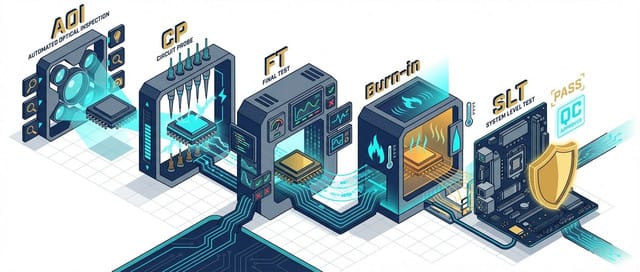
👁️ First Judgment: Optical Micro-Inspection (AOI Inspection)
- Phase Mission: Before the chip is powered on, use "eyes (high-end cameras and lasers)" to inspect whether the hundreds of thousands of micro-bumps in advanced packaging (CoWoS) are cracked or misaligned.
- Battlefield Preview (5-4-1): This is a 3D revolution akin to finding a needle in a haystack. We will show you why AOI equipment accounts for 15-20% of the capital expenditure for advanced packaging plants, and how Machvision (3563), Test Research, Inc. (3030), Pylicon (6816), and Evertek (3167) build moats with AI algorithms through their "data flywheel."
🔬 Second Judgment: Microscopic Needle-Point Showdown (CP Wafer Probing)
- Phase Mission: While the chips are still on a 12-inch circular wafer, we must use a "probe card" equipped with tens of thousands of tiny metal needles to precisely make contact and power on the wafer, identifying and isolating defective bare dies to avoid wasting subsequent expensive packaging costs.
- Battlefield Preview (5-4-2 & 5-4-6): This is a highly profitable "consumables business" akin to F1 racing tires. We will delve into the MEMS probe card showdown between MPI Corporation (6223) and Chunghwa Precision Test Tech (6510), and the rim overlord hidden behind the tires, Avertek Technology (6683).
🔥 Third Judgment: The Fire-Breathing Dragon's Throne (FT Final Test)
- Phase Mission: After the chip is diced and packaged, it must be placed on a specialized "test socket" for full-function powered testing. At this point, AI chips will instantly emit kilowatts of intense heat, with temperatures approaching 150°C.
- Battlefield Preview (5-4-3): Traditional test sockets would melt, and signals would be interfered with. We will reveal how Winway Technology (6515), using its "coaxial test socket" black technology with a unit price of up to ten thousand US dollars, has become the ultimate beneficiary of this extreme heat dissipation battle.
🛁 Fourth Judgment: The Deadly Bathtub Curve (Burn-in Aging Test)
- Phase Mission: To prevent chips from experiencing "infant mortality" at the client end, they must be baked in a 125°C high-temperature oven for several days, forcing weak chips to fail within the factory.
- Battlefield Preview (5-4-5): Burn-in officially transitions from optional to standard! We will analyze how Honjing Technology (7769), recently listed on the emerging stock market, overcomes the limits of mechanical thermal expansion at high temperatures to become a major infrastructure provider for risk outsourcing in the AI era.
💻 Fifth Judgment: The Ultimate Combat Exercise (SLT System-Level Test)
- Phase Mission: Passing all "written tests" (CP/FT) is not enough; the chip must be plugged into a real motherboard, loaded with an operating system, and run actual LLM (Large Language Model) software.
- Battlefield Preview (5-4-4): Chip power consumption will surge from 50W to 800W within 0.1 seconds. We will show you Chroma ATE (2360)'s "ATC Active Thermal Control" magic and why it boasts extreme customer stickiness comparable to EDA software companies.
🔪 Ultimate Coroner: The Microscopic Dissection Table (MA/FA Material and Failure Analysis)
- Phase Mission: If a chip fails at any preceding stage, or if AOI cannot detect internal fractures within the package, the chip must be "cross-sectioned" to examine the atomic arrangement using an electron microscope.
- Battlefield Preview (5-4-7): As a grand finale, we will introduce the three leading players in material analysis and inspection: Material Analysis Technology (6830), MAAT (3587), and iST (3289), and observe how they directly benefit from the surging complexity of 2nm and 3D packaging.
This "Path of Judgment," influencing hundreds of billions in output value, has been laid out for you. Each checkpoint represents a highly profitable secret of a hidden Taiwanese champion.
In-depth Research · Quantitative Perspective
Want to gain more semiconductor quantitative research insights?
[Insight Subscription Plan] Bid Farewell to Retail Investor Thinking: Build Your Alpha Trading System with "Quantitative Chips" and "Consensus Data"EDGE Semiconductor Research
📍 Series Map — Navigate the Complete EDGE Semiconductor Research →


