
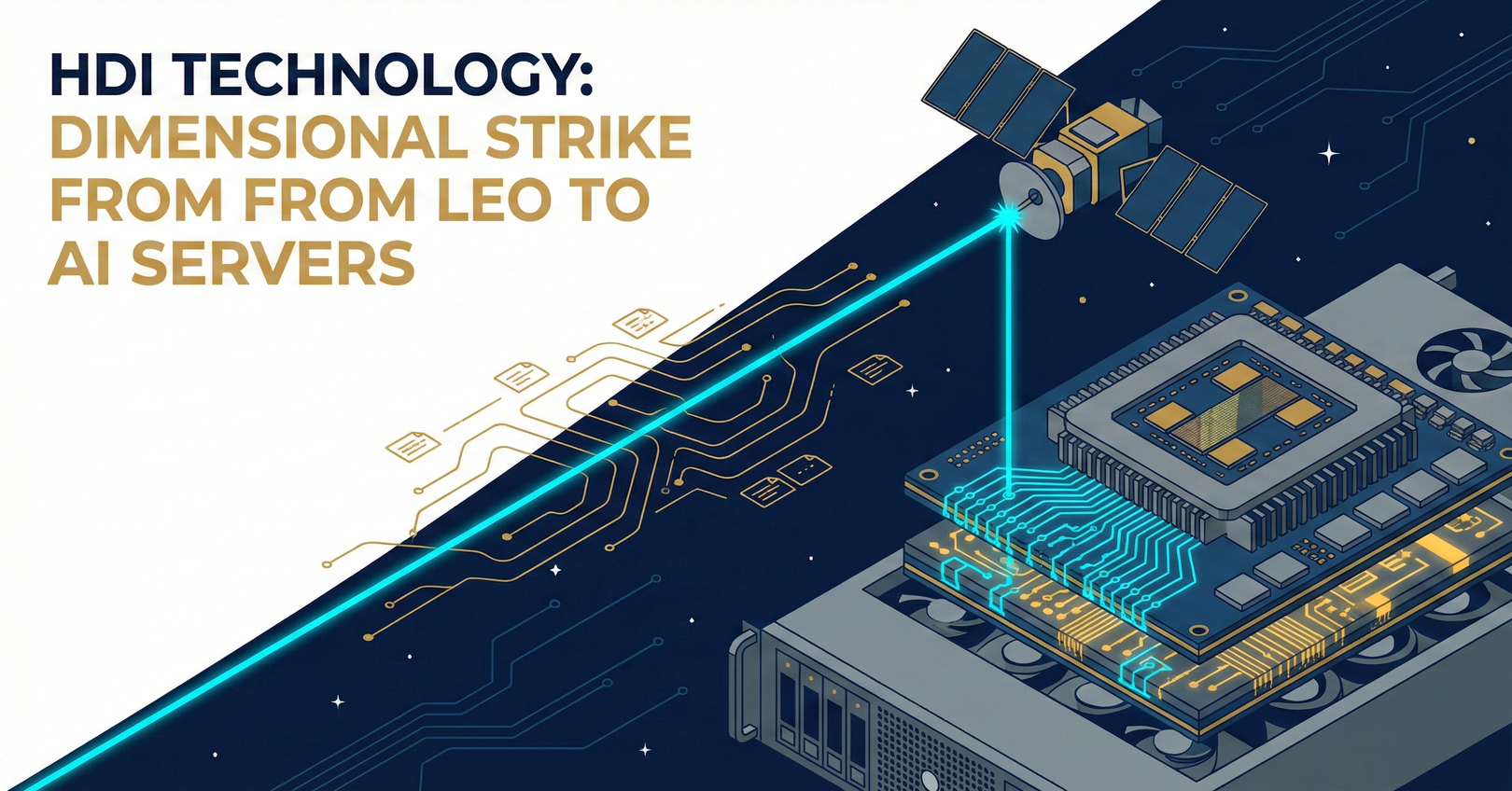
What is a "Dimensional Reduction Strike"?
While traditional server board manufacturers are still using mechanical drills to precisely bore holes in thick boards, Compeq (2313) has long been accustomed to the demanding requirements of high-end smartphone motherboards, which involve "embedding thousands of miniaturized traces using laser blind/buried vias (HDI) within a fingernail-sized area."
When AI servers, in their pursuit of ultimate computing density, are forced to fully adopt high-end HDI technology for the OAM modules beneath their GPUs, Compeq (2313) has no need to relearn. It simply seamlessly transfers its smartphone manufacturing technology to AI server boards, which boast extremely high unit prices and technical barriers. What's even more formidable is that before entering the AI market, Compeq (2313) had already used this HDI technology to dominate another trillion-dollar market beyond Earth—Low Earth Orbit (LEO) satellites.
🛰️ Chapter One: Absolute Dominance of the Starlink Overlord — Capturing 90% of the Space Market
To understand Compeq (2313)'s current underlying strength, one must look beyond smartphones and first examine "what's flying in space."
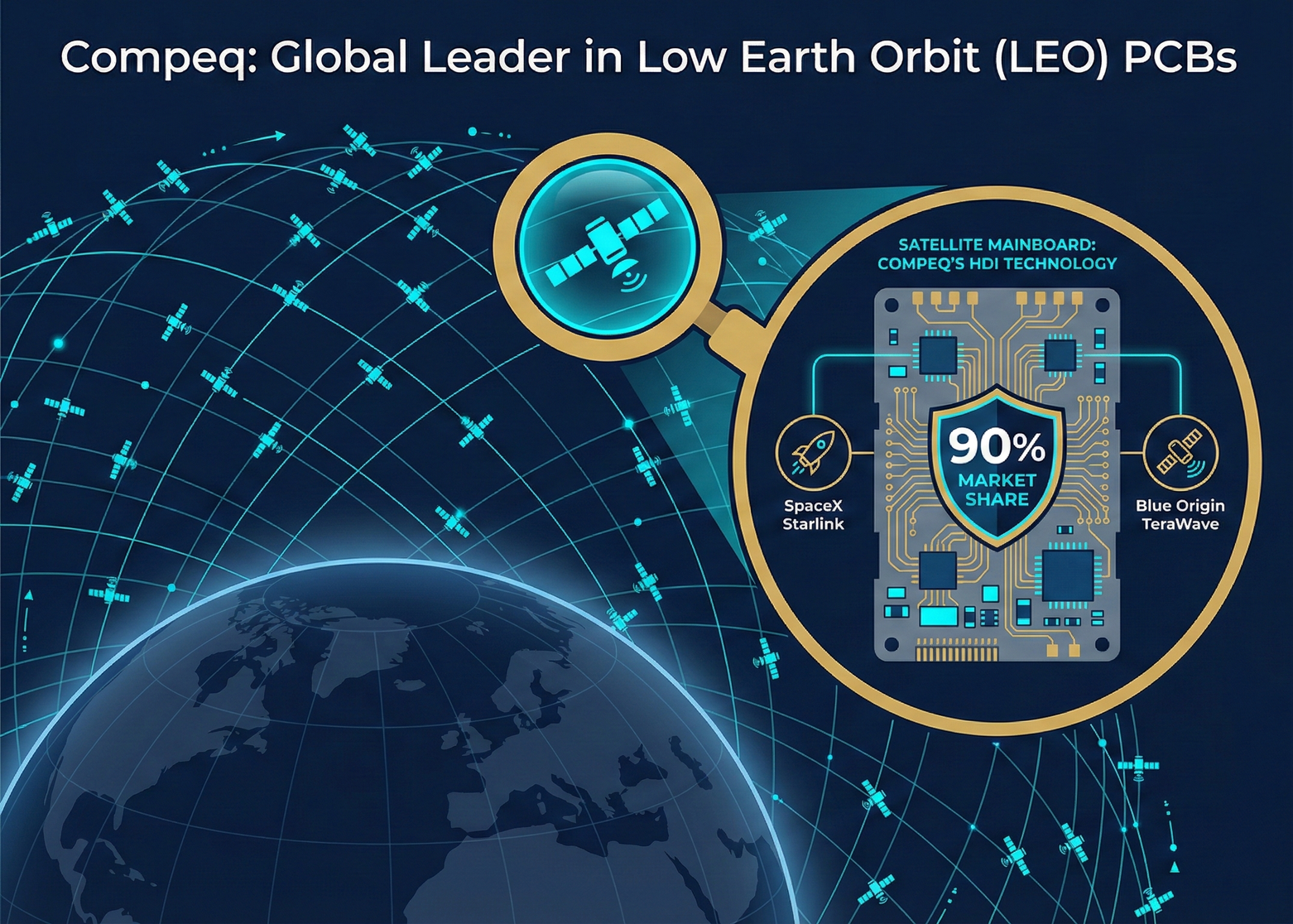
When SpaceX ignited the global Low Earth Orbit (LEO) satellite race, Compeq (2313), with its extreme HDI technology and lightweight high-frequency board processes, became the absolute arms dealer in this space competition. Industry data shows that Compeq (2313) is currently the world's largest LEO satellite PCB supplier, holding a global market share as high as 70%. Furthermore, for "space boards" (i.e., PCBs on the satellite body itself), which have the highest technical barriers and extreme environmental resilience requirements, its market share reaches an astounding 90%.
In 2026, this space communications race will enter an unprecedented "hyper-growth phase," bringing strong revenue momentum to Compeq (2313)'s foundation:
- SpaceX Moving Towards Ten Million Users and Direct-to-Cell Connectivity: Starlink's active user count has exceeded 9 million by early 2026 and is progressing towards the 10 million mark, performing far better than market expectations. As its business expands from initial SMS and internet to "direct satellite-to-phone" voice and data services, SpaceX recently secured approval from the U.S. FCC (Federal Communications Commission) to deploy an additional 7,500 satellites, advancing towards its ultimate constellation goal of 42,000 satellites.
- Blue Origin Joins the Fray, Titans' Space Rivalry: Space is not Musk's sole dominion. In addition to its existing Project Kuiper, Amazon's subsidiary Blue Origin dramatically announced a new generation high-capacity satellite communication network project named "TeraWave" on January 21, 2026. This system, designed for enterprises and data centers, will be composed of 5,408 satellites, with deployment expected to begin in Q4 2027.
- Strong Growth in Satellite Business: Driven by the accumulated launch demands of these giants, the largest U.S. satellite customer's launch volume is expected to exceed 3,000 satellites in 2026. Compeq (2313)'s satellite business is anticipated to achieve robust 17% annual growth in 2026, accounting for 21% of total revenue.
⚔️ Chapter Two: The AI Assassin's Surprise Attack — Counterattacking Data Centers from Space
With LEO satellites as a high-margin "cash cow" providing underlying strength, Compeq (2313) has aimed its sights at the hottest battleground on Earth: AI servers and data centers.
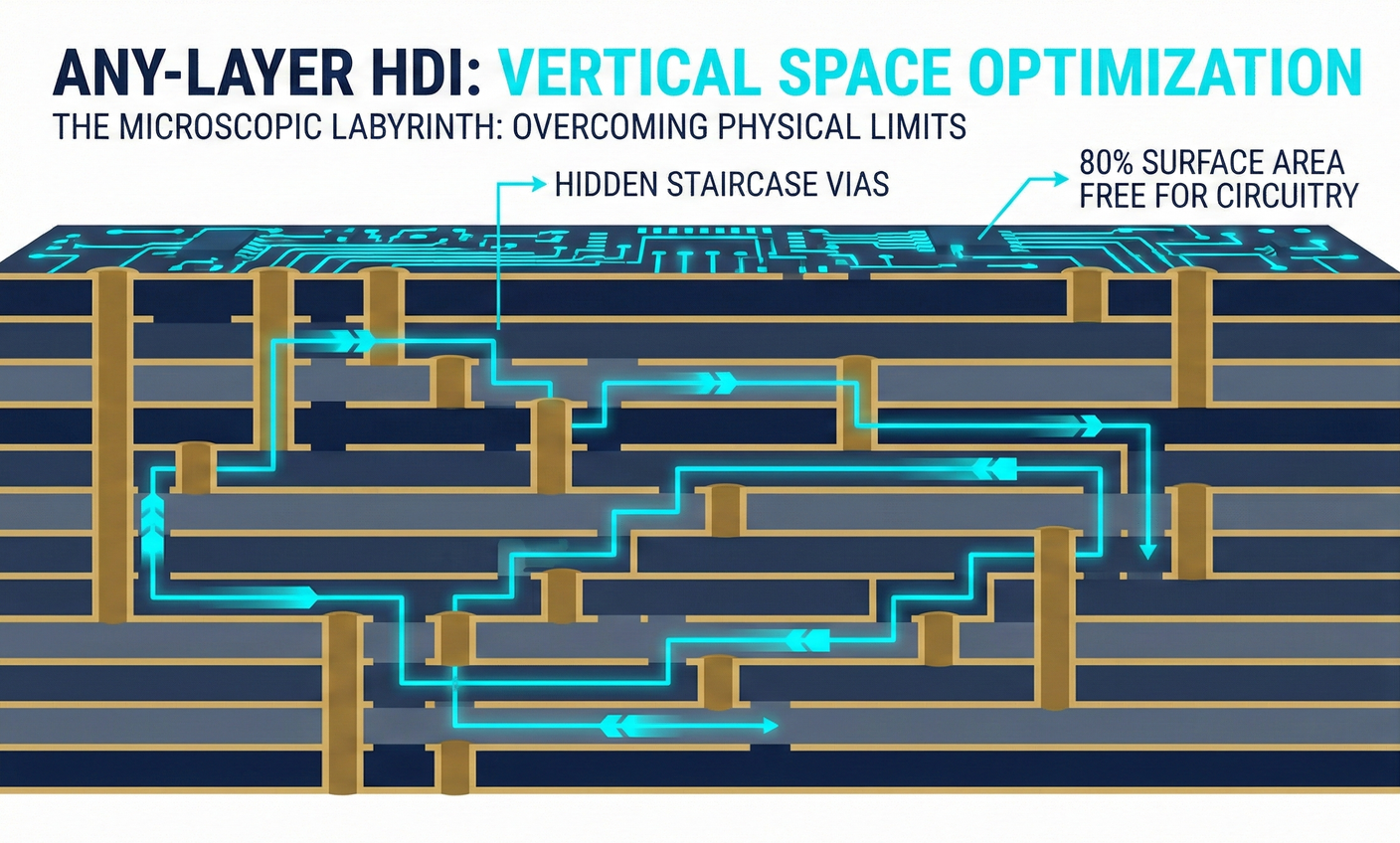
OAM (Open Accelerator Module) computing modules in AI servers require extremely dense 5-stage HDI or even Any-layer (any-layer interconnect) technology. Traditional server board manufacturers excel at large-area thick board lamination, but are outmatched when facing this kind of "microscopic maze." Compeq (2313) exploited this technical blind spot to launch a surprise attack.
- Penetrating the U.S. AI Motherboard Supply Chain: According to supply chain tracking, while Compeq (2313)'s current shipments for AI servers are still primarily ancillary boards (such as CPU motherboards), leveraging its expanded multi-layer board capacity and HDI advantages, Compeq (2313) is expected to officially enter the supply chain for "two U.S. AI motherboards" in 2026.
- Astonishing Explosion in Server Revenue: Buoyed by an expected annual increase of over 65% in AI ASIC chip shipments in 2026, Compeq (2313)'s server business revenue in 2026 is projected to achieve an explosive annual growth of up to 84%, becoming a powerful vanguard for the company's expansion.
🏭 Chapter Three: The Thailand Plant's Strategic U-Turn — Massing Forces on Multi-layer Rigid Boards
With a full order book, capacity allocation must keep pace. Compeq (2313)'s deployment in Southeast Asia demonstrates extremely high strategic flexibility, directly targeting the boom in AI and satellites.
To meet the enormous demand from these two major high-end sectors, Compeq (2313) has significantly revised its capacity plans for its Thailand plant:
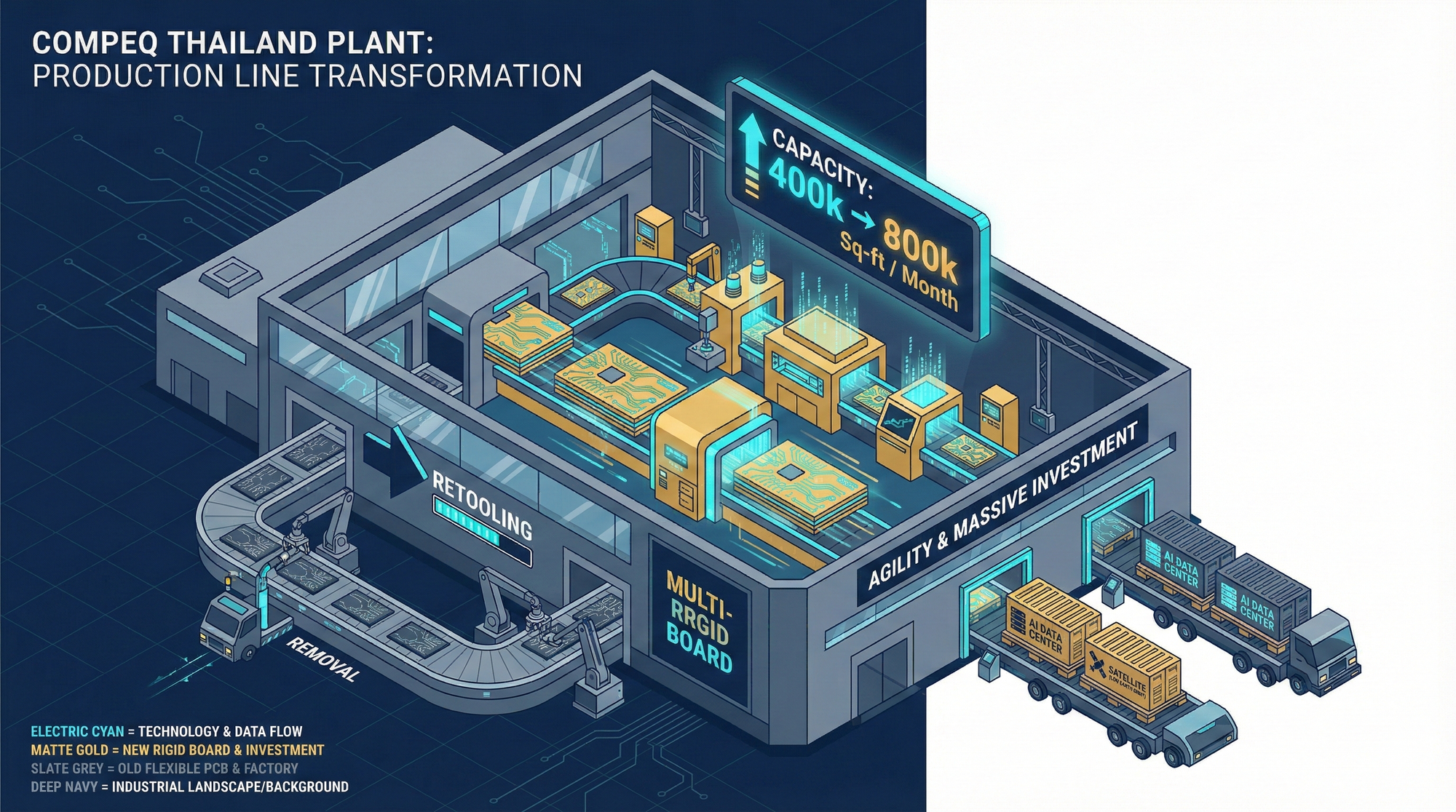
- Abandoning FPC, Focusing on Rigid Boards: Compeq (2313)'s Thailand plant's original Phase 2 plan was to add FPC (flexible printed circuit) capacity, but it has now urgently "pivoted" to rigid board capacity and is accelerating the establishment of Phase 3 multi-layer rigid board capacity. It is estimated that by the end of 2026, the Thailand plant's capacity will double from the current 400,000 square feet to 800,000 square feet.
- Significant Release of Data Center Capacity: The Thailand plant currently focuses on producing LEO satellite products. However, starting from H2 2026, the Thailand plant will begin "small-batch production" of data center-related products. It is expected that by 2027, the proportion of data center products will significantly increase to a critical scale of 20-30%.
🚗 Chapter Four: The Second-in-Command Escaping the Red Ocean — Apex (2367)'s Automotive and Satellite Transformation
If you have followed the past Apple supply chain, Apex (2367) was once a primary supplier of iPhone battery boards and AirPods rigid-flex boards. However, the characteristic of consumer electronics is that "once a technology becomes widespread, it is followed by ruthless price wars." After several years of fierce competition from the "red supply chain," Apex (2367) chose to make a painful but decisive break, embarking on an extremely arduous but immensely correct strategic transformation.
Apex (2367) fully transitioned its proud HDI and rigid-flex board technologies to two "hardcore tracks" with extremely high certification barriers:
- The "Strongest Second-in-Command" in LEO Satellites: In the space business opportunities ignited by SpaceX, Apex (2367), closely following Compeq (2313), has become an indispensable second-largest PCB supplier to major U.S. LEO satellite companies. Compared to terrestrial base stations, satellite boards sent into space must withstand extreme temperature differences and cosmic radiation. To reduce rocket payload, the boards must be "extremely thin and prevent signal attenuation." With its high-end HDI process, Apex (2367) successfully secured a large share, including "space boards" and ground receiving stations, reaping the rich dividends from this "space arms race."
- The Invisible King of High-End Automotive HDI: This is Apex (2367)'s true foundation. With the popularization of electric vehicles (EVs) and advanced driver-assistance systems (ADAS), cars have become "supercomputers on four wheels." To integrate high-frequency radar (LiDAR), image sensors, and powerful autonomous driving computing brains within a confined vehicle body, traditional automotive thick boards are simply insufficient; a full upgrade to high-end automotive HDI boards is necessary. Apex (2367) currently holds a dominant position in the HDI supply chain for ADAS and high-frequency radar, representing a super moat with a certification period of several years, making it extremely difficult for others to snatch orders.
💻 Chapter Five: The New Battleground for AI Edge Computing — Extending HDI's Strike Radius
The battleground for AI computing power is not limited to cloud data centers; it is rapidly spreading to user-end devices (Edge AI).
With Microsoft and Intel aggressively promoting AI PCs, laptop motherboards are undergoing their biggest specification overhaul in a decade. Because AI PCs must integrate powerful NPUs (Neural Processing Units) while simultaneously solving extremely demanding heat dissipation problems, the motherboard area of AI PCs is severely compressed, while trace density must increase exponentially.
What does this mean? It means that traditional low-end PCBs used in PC laptops will be phased out, replaced by new types of motherboards that require high-end HDI or even Any-layer (any-layer interconnect) technology.
Apex (2367) has recognized this trend and is directly extending its accumulated "high-frequency, high-speed HDI experience" from LEO satellites and automotive ADAS downwards to the AI PC and AI server peripheral accelerator card markets. Although in the most critical cloud OAM modules, Apex (2367)'s scale is not yet comparable to Compeq (2313)'s, the HDI penetration it demonstrates in edge AI devices is definitely an undeniable undercurrent in the industry.
📊 4-2-7 Strategic Summary: HDI's Dimensional Reduction Strike and Paradigm Shift
The two parts of "[4-2-7 HDI's Cross-Industry Surprise Attack]" conclude perfectly here. Through the strategic trajectories of Compeq (2313) and Apex (2367), we have witnessed a cruel "paradigm shift" occurring in the hardware manufacturing industry:
- Physical Limits Break Class Barriers: In the past, manufacturers making phones couldn't make servers, and those making servers looked down on phone manufacturers. However, when AI computing density broke through the physical limits of traditional mechanical drills, the "HDI laser micro-surgical scalpel" originally used to cut phone chips became the only solution for cutting into the most lucrative OAM modules of AI servers.
- Dual ATMs for Cloud and Space: The HDI dominator led by Compeq (2313), leveraging its accumulated extreme environmental resilience and high-frequency transmission technology in LEO satellites (Starlink, etc.), perfectly matched the computing power demands of AI servers. This dual-pronged model of "earning space wealth with one hand, AI wealth with the other" represents a strategic height that traditional server board manufacturers cannot replicate.
- The "Dual Monopoly" Ecosystem of AI Server PCBs: The future hardware architecture of AI servers is already very clear—"The heavy foundation is handed to traditional overlords, the precise top floor to HDI assassins." Traditional thick board kings like WUS Printed Circuit (2368) will continue to monopolize UBB (Universal Base Board), Switch Boards, and giant copper backplanes; while HDI kings like Compeq (2313) will relentlessly capture all OAM computing modules and high-end accelerator cards that require extreme miniaturization.
💡 Ultimate Industry Insight: In these two super arms races—AI and LEO satellites—that are changing the course of human technological progress, "HDI laser technology" is no longer just a means of miniaturization, but the absolute entry ticket determining whether a hardware manufacturer can ascend to become a "top-tier arms dealer."
In-Depth Research · Quantitative Perspective
Want more quantitative research insights on semiconductors?
【Insight Subscription Plan】Bid Farewell to Retail Investor Mindset: Build Your Alpha Trading System with "Quantitative Chips" and "Consensus Data"EDGE Semiconductor Research
📍 Series Map — Navigate the Complete EDGE Semiconductor Research →


