Foreword: How to Grow into a Giant Amidst Giants?
On the global semiconductor map, the U.S. defines the rules, while Taiwan implements them.
This brutal upstream-downstream relationship has been the survival strategy for fabless IC design companies in Taiwan for the past three decades: "When U.S. giants eat meat, we drink the soup; when U.S. giants become lazy or expensive, we snatch the meat."
However, by 2026, this rule is being broken.
With the surge in hardware costs driven by AI, and geopolitical factors leading to de-Americanization/de-Sinicization of supply chains, companies in Taiwan are seizing an unprecedented opportunity for "strategic upgrade." They are no longer just cheap alternatives; they are becoming indispensable pieces in the strategic puzzles of Google, Meta, and NVIDIA.
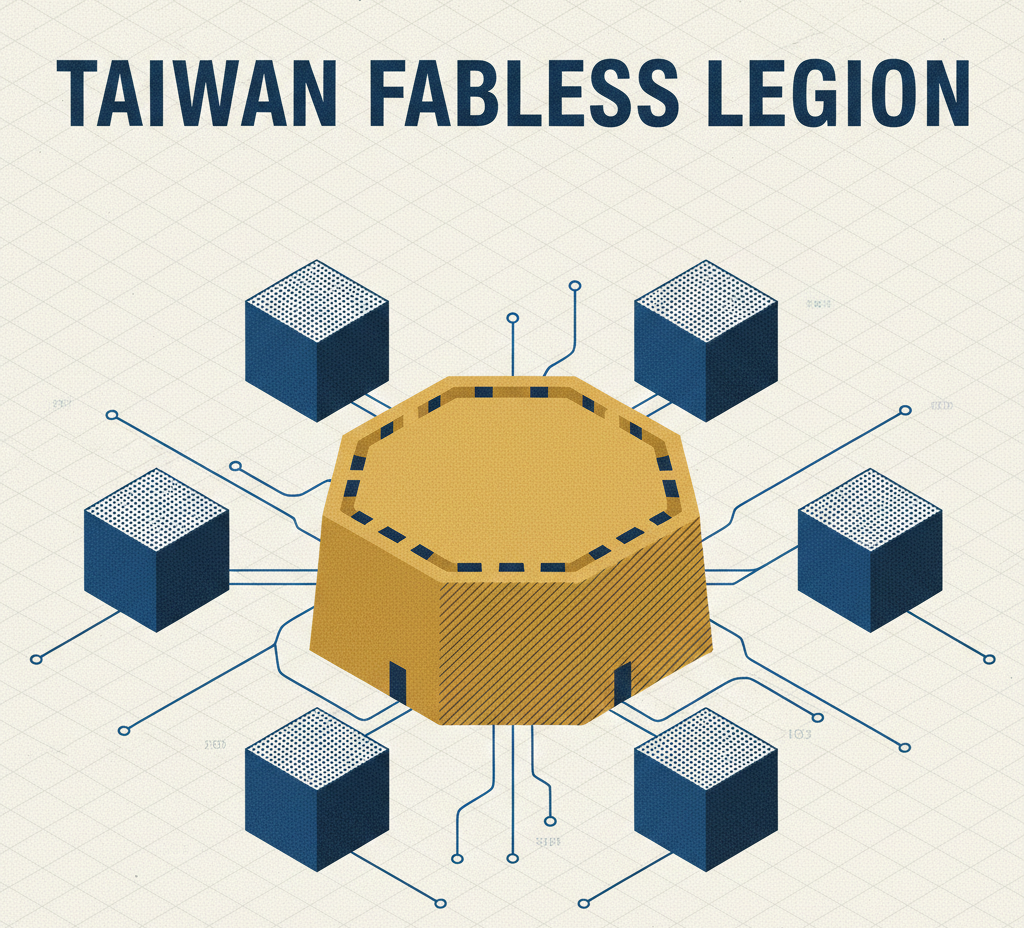
We will focus on one marshal (MediaTek) and three generals (Novatek, Realtek, Phison).
👑 Chapter One: MediaTek — From King of Knockoffs to 'Computing Power Armsmaker'
This company is a miracle in the history of Taiwan's semiconductor industry. In the past, it was looked down upon by Qualcomm, ridiculed as the "father of knockoff phones." But now, it is a potential partner for Google TPU, an exclusive ally for NVIDIA's automotive chips, and the world's leading smartphone chip manufacturer by market share.
Why? Because Chairman Ming-Kai Tsai holds three trump cards, each perfectly targeting the soft spots of U.S. giants.
1. Frontline One: Mobile — The Counterattack of Dimensity
This is a classic 'tortoise and hare' race.
- Past Pain Point: Previously, MediaTek chips were cheap but "hot" and "slow," always limited to low-end phones.
- Historical Turning Point: Dimensity 9000 (2021). When Qualcomm (Snapdragon) opted for Samsung's 4nm process due to tight global production capacity, MediaTek made a bold gamble: securing TSMC's most expensive 4nm capacity.
- Physical Outcome: Qualcomm's Snapdragon 8 Gen 1 became a "fire dragon" due to leakage issues with Samsung's process; meanwhile, MediaTek's Dimensity 9000, bolstered by TSMC's process, exhibited astonishing performance that was both "fast and cool."
- Result: This strategic misstep allowed MediaTek to successfully penetrate the flagship smartphone markets of OPPO, Vivo, and even Samsung, officially shedding its low-end label. The current Dimensity 9400's GPU performance can now compete head-to-head with Qualcomm's flagships.
2. Frontline Two: ASIC (Custom Chips) — Challenging Broadcom's Monopoly 🌟 (Core of Re-rating)
This is the key reason Wall Street is re-evaluating MediaTek's valuation from a "mobile stock" to an "AI stock."
Why are Google and Meta starting to approach MediaTek for collaboration when developing AI chips?
- Technological Foundation: The SerDes (Serializer/Deserializer) Arms Race Do you recall us mentioning in [1-3-2] that Broadcom's strongest moat is SerDes? Through a decade of acquisitions (absorbing MStar, Richtek) and deep cultivation in networking chips (WiFi/Switch), MediaTek has quietly amassed world-class 112G/224G SerDes IP. This entry ticket is extremely expensive, with only a few companies globally possessing it. This signifies MediaTek's capability to produce "data center-grade" chips, not just mobile phone chips.
- Business Model: The 'Affordable Alternative' to Broadcom
- Broadcom (Michelin Three-Star): Top-tier technology, but astronomical prices, with NRE (Non-Recurring Engineering) fees often in the hundreds of millions of dollars, and a strong, uncompromising stance.
- MediaTek (Din Tai Fung): Also world-class in technology (with priority access to TSMC's CoWoS capacity), reasonably priced, with excellent service and high cooperativeness.
- Customer Mindset: Silicon Valley giants, for supply chain security, desperately need a Second Source to counterbalance Broadcom. MediaTek is that perfect backup, with the potential to even become a primary supplier.
3. Frontline Three: Dimensity Auto — A Century-Defining Alliance with NVIDIA
This is the powerful alliance between Jensen Huang and Ming-Kai Tsai, a direct declaration of war against Qualcomm's automotive dominance.
- Complementary Pain Points:
- NVIDIA has the strongest AI computing (GPU) but lacks communication technologies (5G/WiFi).
- MediaTek has the strongest communication technologies but cannot yet outperform Qualcomm in automotive AI computing power.
- Solution: Chiplet Packaging Masterstroke Both parties developed Dimensity Auto Cockpit. Utilizing advanced packaging technology, NVIDIA's GPU chiplets and MediaTek's CPU/SoC are integrated into a single chip.
- Strategic Significance: This chip can both run AAA games (thanks to NVIDIA) and make 5G calls (thanks to MediaTek). This allows car manufacturers to solve all problems with a single chip, directly threatening Qualcomm Snapdragon's dominance in digital cockpits.
🎨 Chapter Two: Novatek — The Artist Behind the Screen
It is a global leader in display driver ICs (DDIs). For anything with a screen (iPhones, TVs, automotive panels), there's a chip behind it, directing millions of pixels when to light up and what color to display.
1. Core Technology: OLED DDI and High-Voltage Process
- Technical Barrier: Driving OLED screens is much more challenging than traditional LCDs because it requires precise current control for each sub-pixel. Novatek holds exclusive high-voltage analog process patents, making it difficult for competitors to circumvent.
- Crisis and Opportunity: Chinese manufacturers (such as Will Semi, InnoLux) are aggressively price-cutting in the low-end LCD market. Novatek's strategy is very clear: abandon the red ocean and head for the high ground.
2. New Battlegrounds: ASIC and OLEDoS
- ASIC Transformation: Novatek not only sells standard products but has also started developing customized image processing chips (TV SoCs) for top-tier TV manufacturers (such as Sony/Samsung).
- OLEDoS (OLED on Silicon): This is a key technology for the metaverse. Screens used in VR/AR headsets (such as Apple Vision Pro) are not printed on glass but directly on silicon wafers. This requires extremely high integration capabilities and is Novatek's future secret weapon.
🦀 Chapter Three: Realtek — The 'Crab' of the Network World
If you disassemble your home computer, router, or set-top box, there's a high probability you'll find a chip with a "crab" logo. Realtek is playfully called "the poor man's Broadcom" in the industry, which is actually a compliment.
1. Core Philosophy: The 'Cockroach Theory'
Realtek possesses immense vitality. Its strategy is: as long as there's market volume, we can make it cheaper and more stable than anyone else. It excels at transforming originally expensive high-tech products (such as Ethernet and audio chips) into standard, affordably priced commodities.
2. Key Battles: WiFi 7 and Automotive Ethernet
- WiFi 7 (The Last Mile for AI): Edge AI devices (such as AI smartphones, AI PCs) need to communicate with the cloud without delay. WiFi 7 introduces MLO (Multi-Link Operation) for greater bandwidth. Realtek's rapid deployment in WiFi 7 makes it a direct beneficiary of AI application implementation.
- Automotive Ethernet: Cars are increasingly resembling computers on wheels, and in-car wiring is transitioning from older, slower CAN Bus to high-speed Ethernet. This is a new blue ocean for Realtek, where it is outperforming major European and American manufacturers (such as NXP/TI), with its market share rapidly climbing.
💾 Chapter Four: Phison — The Strategist of the Storage World
Led by CEO K.S. Pua, Phison is not just manufacturing SSD controller chips; it now aims to solve AI's most vexing problem: "memory being too expensive."
1. Core Technology: NAND Controller (Control Chip)
An SSD is not just for storage; it requires a very intelligent "brain" to manage data read/write longevity and error correction. Phison is one of the global leaders in this field.
2. Secret Weapon: aiDAPTIV+ (AI's Virtual Memory) 🌟
- Pain Point: Small and medium-sized enterprises (SMEs) want to train AI models but cannot afford NVIDIA H100s (millions of dollars) or hundreds of GBs of HBM memory.
- Solution: Using SSDs as pseudo-DRAM. Phison developed an intermediate software architecture (aiDAPTIV+) that allows AI models to quickly store temporarily unused parameters in SSDs during computation and retrieve them when needed.
- Technical Key: Although SSDs are slower than DRAM, Phison, through its proprietary algorithms, optimizes SSD read/write speeds to the extreme, making this "slowness" "acceptable."
- Strategic Value: This allows an AI server setup that would originally cost 50 million to now perform fine-tuning for just 5 million. This is a crucial enabler for AI's "democratization" and "popularization."
📊 1-3-4 Strategic Summary: The Survival Path of Taiwan's Tech Cohort
Let's compare the differences between the U.S. and Taiwan's forces to understand the investment value of companies in Taiwan:
| Characteristics | U.S. Giants | Taiwan Pioneers |
|---|---|---|
| Representative Companies | NVIDIA, Broadcom, Qualcomm | MediaTek, Novatek, Realtek, Phison |
| Core Advantage | Architectural Definition Authority | Supply Chain Integration Capability |
| Business Model | Selling systems, licensing, high gross margins | Selling chips, providing services, high cost-performance ratio |
| Strategic Position | Rule Makers | Best Implementers & Backup Suppliers |
| AI Opportunity | Defining how AI computes (CUDA) | Making AI cheaper and more widespread (ASIC/WiFi7) |
Implications for Investors
- MediaTek is not a bystander: Through ASIC (SerDes) and Dimensity Auto, it has secured its entry ticket to the core AI battleground, no longer solely focused on mobile phones.
- Look for 'water sellers next to the arsenal': While Realtek (WiFi 7) and Phison (aiDAPTIV+) do not directly manufacture GPUs, they address the physical bottlenecks of AI transmission and storage.
- Geopolitical Dividends: Amidst the U.S.-China tech cold war, U.S. giants cannot use Chinese chips, and China is reluctant to use U.S. chips. Companies in Taiwan have become the "greatest common divisor" acceptable to both sides.
In-depth Research · Quantitative Perspective
Want more insights from semiconductor quantitative research?
[Insight Subscription Plan] Bid Farewell to Retail Investor Thinking: Build Your Alpha Trading System with 'Quantitative Capital Flows' and 'Consensus Data'EDGE Semiconductor Research
📍 Series Map — Navigate the Complete EDGE Semiconductor Research →


