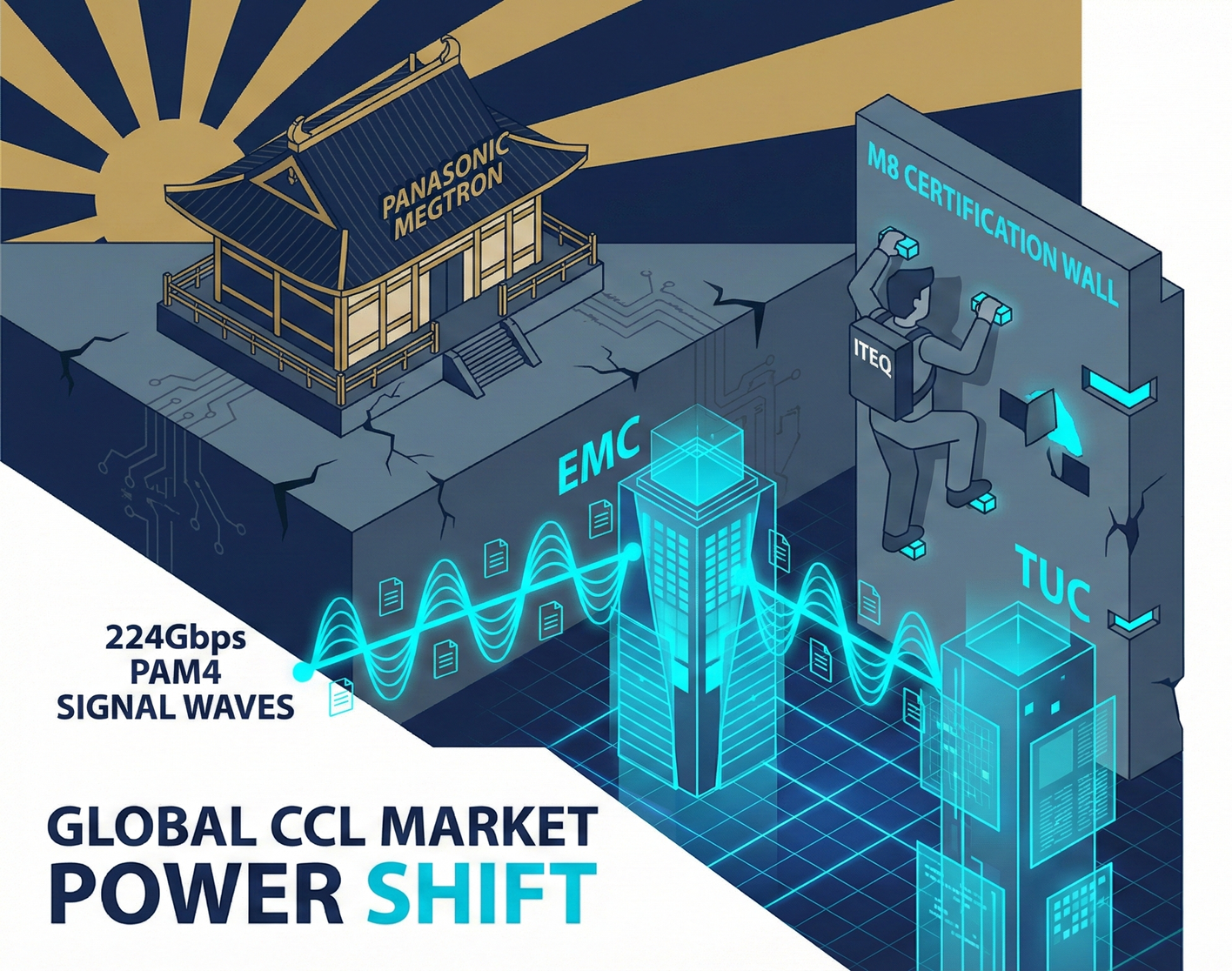
To firmly establish oneself at the pinnacle of the AI era, the margin for error is zero. Even a slight delay in the transition between generations of specifications can instantly lead to a change of hands for the original throne, relegating one to the ranks of "struggling challengers."
🧗 Chapter One: The Fall of ITEQ and Its Desperate Catch-up Attempt
If you invested in the PCB material sector of the Taiwan stock market before 2020, ITEQ would undoubtedly have been a core holding in your portfolio.
During the era of Intel's dominance in data centers (from the Purley to Whitley platforms), material specifications for general server motherboards primarily fell within the Mid Loss (M4) to Low Loss (M6) grades. ITEQ possessed exceptionally strong cost-performance and mass production capabilities in this segment, making it the well-deserved "traditional server CCL hegemon."
However, when AI servers arrived with the extreme specifications of M7 and M8, ITEQ unexpectedly "fell behind" during the transition period.
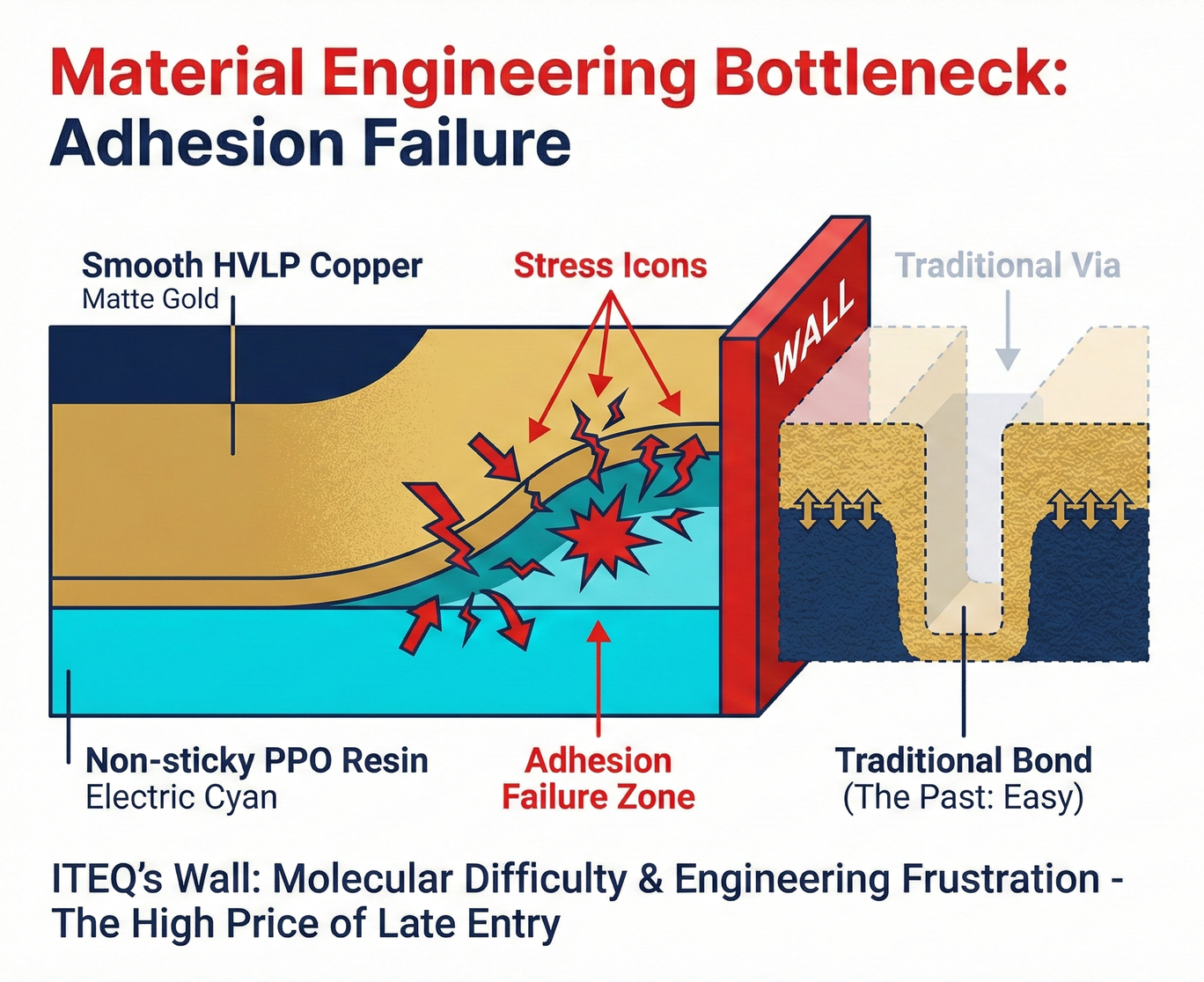
- Underlying Physical Logic for Falling Behind: As we mentioned in [4-2-1 Physics Edition], M8-grade materials must use PPO resin, which is extremely difficult to process. Elite Material (EMC) perfectly adapted to the HDI lamination process for AI servers due to its halogen-free experience from producing "Apple iPhone HDI boards." However, ITEQ had previously focused too much on through-hole lamination technology for "traditional servers (non-HDI processes)." When faced with the highly challenging HDI laser blind/buried via formation required for AI substrates, which involve "extremely smooth HVLP copper foil" and "non-adhesive PPO resin," ITEQ encountered a significant "bottleneck" in its initial yield rates and formulation adjustments.
- Desperate Pursuit of M8 Certification: After missing the first wave of NVIDIA H100 generation's explosion, ITEQ thoroughly reflected on its setback and dedicated the company's full resources to the research and development of M8 Extreme Low Loss materials. Currently, ITEQ is aggressively submitting samples with its latest improved formulations to NVIDIA and major CSPs (cloud giants) for testing, attempting to secure a spot as a "second or third source" supplier for the upcoming GB200 or next-generation ASIC projects.
- Defensive Base: Automotive and General Servers: Although temporarily lagging in the top-tier AI GPU battlefield, ITEQ's financial foundation remains protected. With the surging demand for high-frequency materials in advanced electric vehicle (EV) autonomous driving systems (ADAS) and the eventual replacement cycle for traditional general-purpose servers (upgrading to PCIe Gen 5), these vast markets for M6 to M7 grade materials continue to be ITEQ's stronghold for consistently generating cash flow.
🌅 Chapter Two: The Twilight of the Gods for Panasonic
The company we are about to discuss holds a position in the CCL industry akin to the "Shaolin Temple" in wuxia novels. The material classification standards we have repeatedly mentioned — M4, M6, M7, M8 — the letter "M" is actually derived from Megtron, Panasonic's series of high-frequency materials!
Panasonic is the "pioneer" of ultra-low loss materials globally; they defined the specifications and standards for the entire industry. In the past, the highest-end routers and supercomputers exclusively used Megtron. However, in this wave of AI frenzy, this pioneer appears to be faltering, with its market share continuously eroded by Elite Material (EMC), TUC, and South Korea's Doosan. Why?
- Fatal Flaw One: Inability to Match AI's "Extreme Iteration Speed" The pace of the AI industry is frenetic. NVIDIA and cloud giants might revise motherboard trace designs every few months, which demands that CCL material manufacturers "fine-tune" chemical formulations in real-time. The approach taken by Taiwanese manufacturers (such as Elite Material and TUC) is to dispatch their top-tier FAE (Field Application Engineer) teams to literally "pitch tents" outside clients' R&D centers. The moment a client encounters an issue, the Taiwanese company returns to the lab that same evening to modify the formula, delivering new samples immediately the next day. In contrast, Panasonic, as a vast traditional Japanese conglomerate, has a corporate culture that is rigorous but also extremely rigid. Modifying a single formula might require multiple layers of reporting and approval from its Japanese headquarters. Such a lengthy decision-making chain is undoubtedly fatal in the rapidly changing AI battlefield.
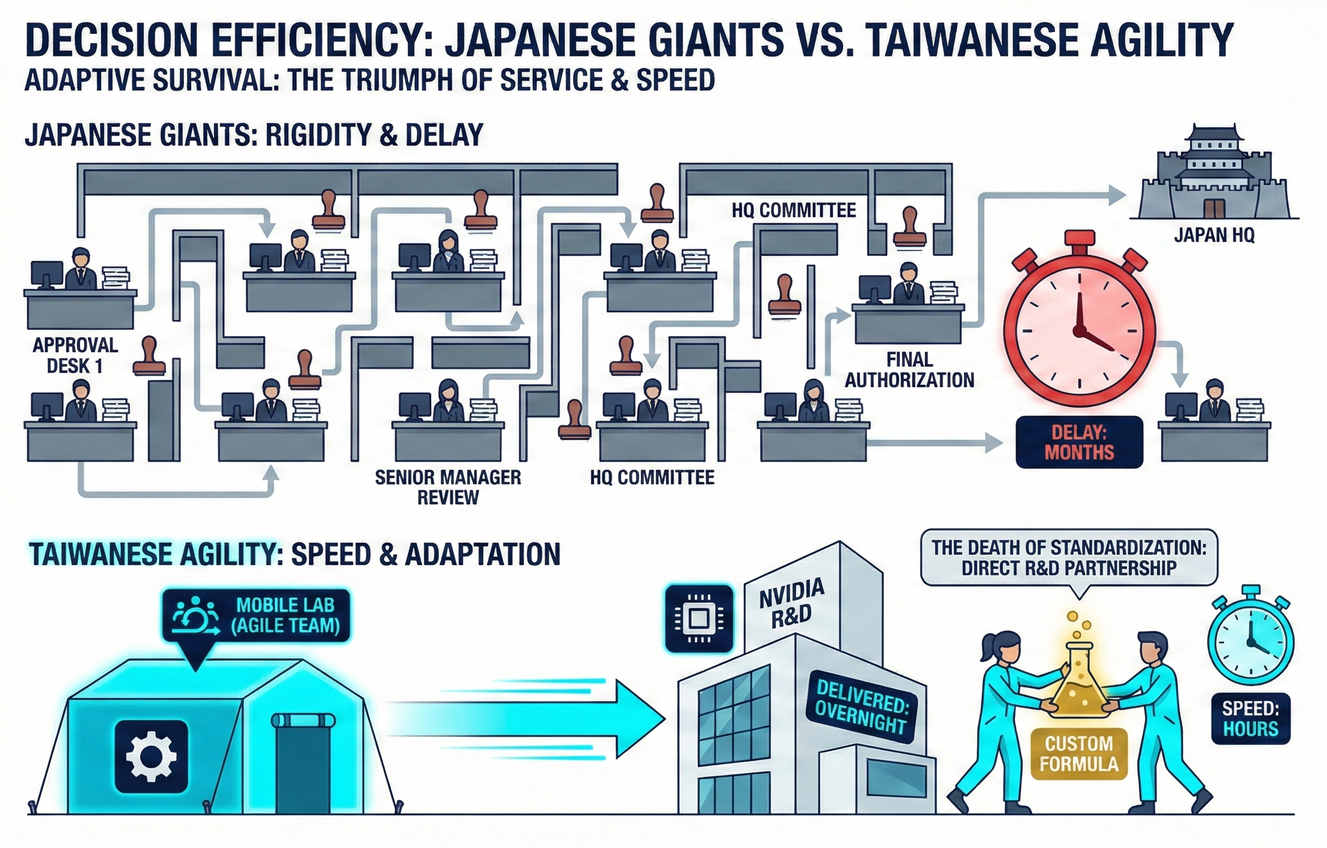
- Fatal Flaw Two: Unwillingness to "Highly Customize" for a Single Client M8 or M9 grade materials are no longer "standard specifications" but require "highly customized adjustments" to match the specific lamination equipment of downstream PCB manufacturers. Japanese giants are accustomed to an arrogant stance of "we formulate perfect standard products, and you figure out how to use them yourselves." However, Taiwanese and South Korean manufacturers are willing to humble themselves and tailor exclusive formulations for NVIDIA.
- The Pioneer's Retreat: Of course, Panasonic still holds the most core resin and chemical patents, remaining irreplaceable in certain extremely stringent aerospace or specialized military sectors. However, in the commercial AI server sector, which demands mass production and ultimate speed, this "Twilight of the Megtron Gods" heralds the comprehensive rise of Taiwanese and South Korean material manufacturers.
🏆 4-2 Battle Zone (CCL Materials Chapter) Ultimate Strategic Summary: The Chemical Magic of Winner-Takes-All
The four chapters of [4-2 Superhighway for Signals - CCL Copper Clad Laminates] converge perfectly here. From the fundamental physics of Dk/Df, we have observed the power shifts among the world's top four material giants. Allow me to distill the ultimate business principles of this chemical warfare for you:
- Materials are the absolute domain determining the life and death of computing power: Under ultra-high frequency transmission of 224Gbps, without M8/M9 grade Ultra/Extreme Low Loss materials, even the most powerful GPU is nothing more than scrap metal.
- Class-stratified Oligopolistic Market: The CCL industry has completely formed a pyramid structure.
- Diamond in the Crown (Primary Supplier): Elite Material (EMC), leveraging the chemical dark magic of "halogen-free + HDI," captures over half of the market's exorbitant profits with 40% of the production capacity, and has already secured a position in the next-generation M9 (EM-896K3).
- Fierce Predators (Secondary Suppliers): TUC (6274) launches an encirclement from its home ground in 800G switches; South Korea's Doosan, armed with chaebol capital and NVIDIA's balancing strategy, initiates a frantic 71% capacity expansion.
- Anxious Chasers: ITEQ (6213) desperately pursues M8 certification in an attempt to reclaim its glory; while the standard-setter Panasonic, due to slow decision-making, has receded to a second-tier position in the AI wave.
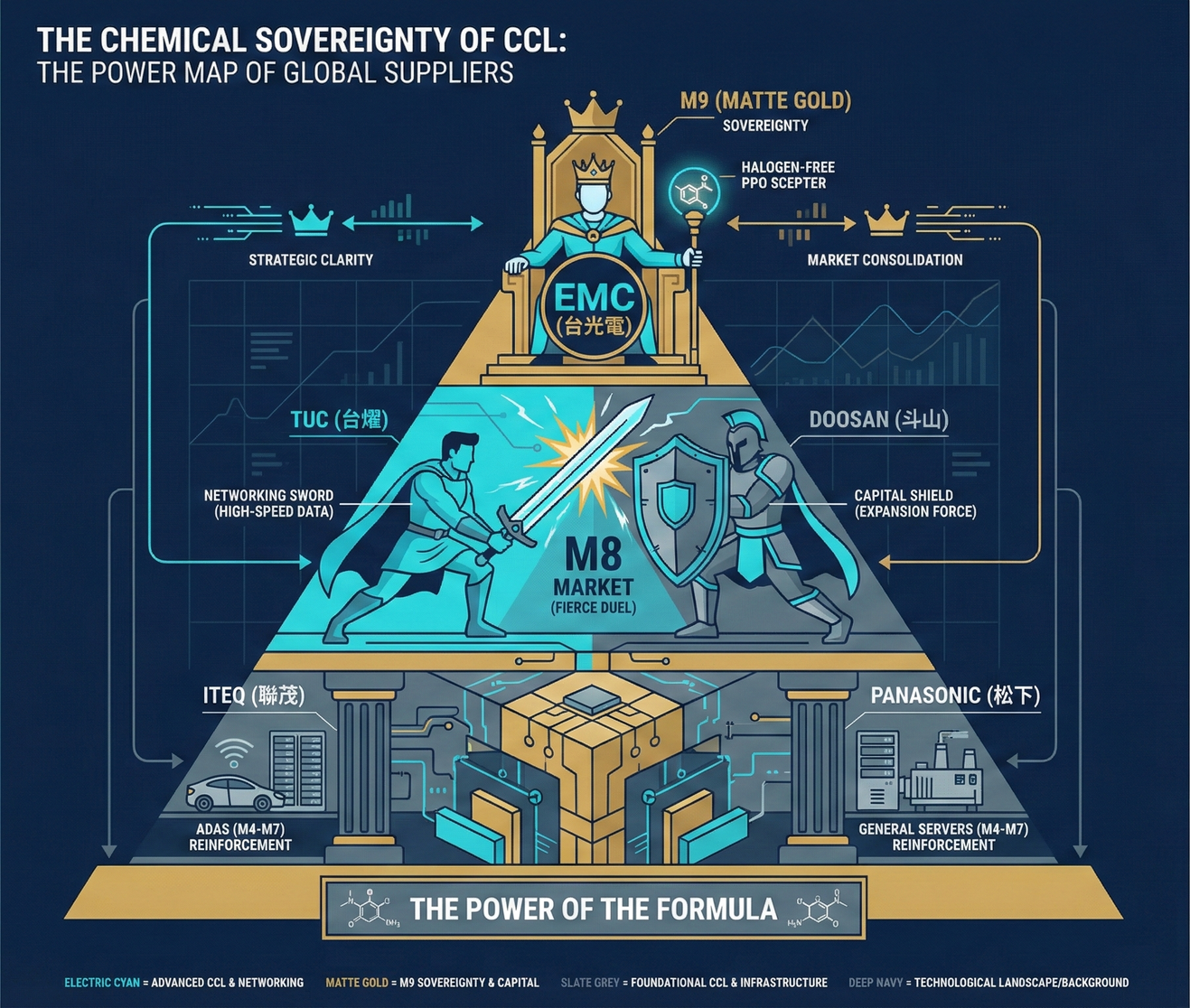
💡 Ultimate Investment Logic: While CCL is not the most expensive component in the hardware cost of AI servers, it is an "invisible cash machine" characterized by the "deepest technological barriers, highest replacement costs, and most aggressive gross profit expansion." Whoever masters the exclusive formulation for reducing Df (dielectric loss) possesses the power to levy taxes on cloud giants worldwide.
In-Depth Research · Quantitative Perspective
Want more quantitative research insights on semiconductors?
[Insight Subscription Plan] Bid Farewell to Retail Investor Mindset: Build Your Alpha Trading System with "Quantitative Chips" and "Consensus Data"EDGE Semiconductor Research
📍 Series Map — Navigate the Complete EDGE Semiconductor Research →


