
Layout and Formatting Principles: The following only adjusts paragraph structure, highlights key points, and refines the layout for readability, without deleting any original text. If you wish to convert certain paragraphs into "collapsible toggles", I can also assist with that.
👻 The Invisible Killer: The High-Frequency Disaster of EMI (Electromagnetic Interference)
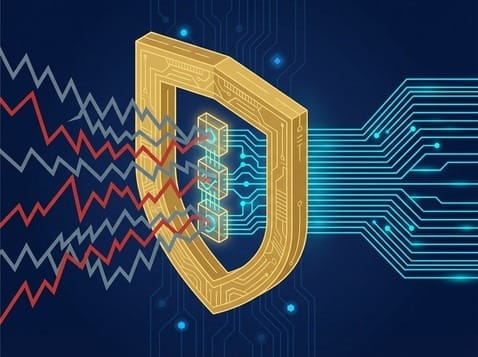
In previous chapters, to miniaturize power modules, we introduced ultra-fast switching GaN and SiC, allowing current to switch frantically at frequencies of millions of times per second (MHz). While this solved space and efficiency issues, it summoned a terrifying physical phantom—EMI (Electromagnetic Interference).
Imagine the instant when current switches "on" and "off" at extremely high frequencies, generating intense magnetic field oscillations around the conductors. These oscillating waves are like invisible noise, scattering across the circuit board. In traditional servers, this might be tolerable. However, in AI servers, Blackwell GPUs are performing extremely precise signal transmissions via PCIe 6.0 or even NVLink. At such times, if even a tiny bit of EMI noise "intrudes" into the signal lines, a signal originally representing "1" could turn into "0", leading to a complete logical collapse of the entire AI computation!
The First Regulatory Breakwater (AC Inlet)
- Common Mode Choke
- X/Y Safety Capacitors
Therefore, at the first checkpoint where power enters the server, we must erect a "regulatory breakwater." This is the battleground for Common Mode Chokes and X/Y Safety Capacitors. They act like a dense filter, firmly blocking high-frequency noise attempting to infiltrate from the power lines, ensuring that the power delivered into the chassis is absolutely pure.
💊 The Lifesaving Pill Closely Attached to the Chip: Decoupling Capacitor
Having addressed external noise, we now face the most challenging internal problem: "Distant water cannot quench a nearby fire."
Do you remember we mentioned that a GPU can instantly draw 1000 amps within a microsecond? Although we have Kuen-Chun's TLVR inductors and MPS controllers, current still takes time to travel on the circuit board (even if only a few nanoseconds). At the "exact moment" a current spike occurs in the GPU chip, the power supply simply cannot deliver power quickly enough!
At this point, the only saviors are a multitude of tiny components—thousands or even tens of thousands of them—clinging tightly to the GPU chip's pins: Decoupling Capacitors.
You can imagine these small capacitors as "front-line miniature ammunition depots". Normally, they store electrical charges; when the GPU instantly demands a large current, and the power supply is still en route, these small capacitors "discharge instantly", providing the first wave of energy to prevent an immediate voltage collapse (Voltage Droop).
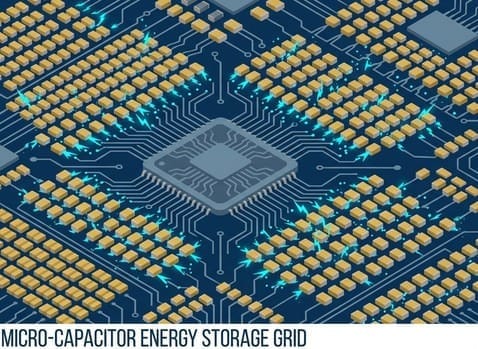
This is why, in photos of NVIDIA motherboards, you'll see the back of the GPU densely covered with tiny, sand-grain-like dots. Each dot is a miniature sentinel guarding voltage stability. In the age of AI, the demand for these sentinels isn't in the hundreds, but a staggering "hundreds of millions per rack"!
🧪 This Layer, Only Nanometers Thick: The Exclusive Formula of Dielectric Ceramic Powder
To understand Murata Manufacturing's (Murata) dominance, you cannot view it as an electronics assembly industry; you must see it as the world's leading "material science laboratory."
The physical structure of an MLCC (Multilayer Ceramic Capacitor) is like a "thousand-layer cake" the size of a grain of sand. Engineers must stack conductive layers and insulating layers (dielectric layers) one by one within an extremely small volume. The more layers stacked, the more charge can be stored.
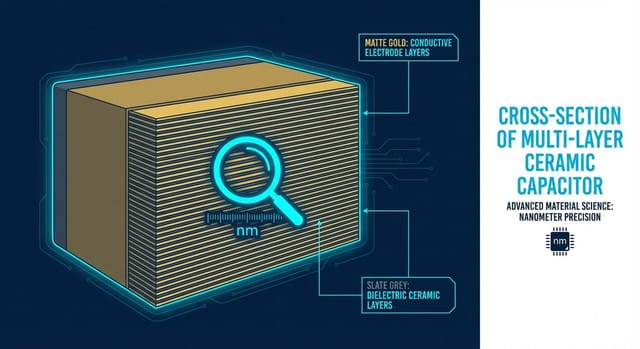
In the AI era, to accommodate the extremely precious space on GB200 motherboards, the thickness of each dielectric layer has been compressed to the ultimate "nanometer (nm) level."
This is the unbridgeable chasm between second-tier manufacturers and Murata.
90% of passive component manufacturers on the market purchase standardized barium titanate (BaTiO3) powder from external chemical plants to produce capacitors. This is like baking a cake with pre-mixed powder bought from a supermarket; the upper limit is fixed.
But Murata insists on "growing its own flour"!
Murata possesses the world's most mysterious dielectric powder formula, including special rare earth additives and particle control technology. This gives Murata's sintered MLCCs a strength that defies conventional physics:
- Extreme High-Temperature Resistance: Even in a 100°C environment next to an AI chip, the capacitance remains rock-solid (meeting X7R/X7S/X7T high-spec standards), preventing an avalanche-like decay in capacitance due to overheating.
- Ultimate Miniaturization: At the same 0201 or even 01005 size, Murata can stack hundreds more layers than its competitors, achieving several times the capacitance density.
This is why, in NVIDIA's Reference Designs, the most critical, life-saving capacitors closest to the GPU core are almost exclusively specified as Murata. This isn't a question of price; it's a question of physical limits.
📈 Deep Dive: Not Linear Growth, but "Exponential" Stacking
Based on our in-depth analysis of the industry chain, there's a significant cognitive bias in the market regarding Murata's growth potential in the AI era. Many believe that AI server shipments, numbering only tens of thousands, have limited impact on MLCCs, which ship hundreds of millions of units. This is a serious misjudgment.
The real data we observe indicates that the consumption of high-end MLCCs by AI servers (especially the upcoming high-volume GB300 series) is showing an "Exponential" surge. As GPU computing power increases and instantaneous current ($di/dt$) becomes larger, the number of capacitors and total capacitance required around a single chip to stabilize voltage is increasing geometrically.
More critically, this is a "yield moat battle."
As MLCC stacking layers become higher and the manufacturing process more complex, the yield rates of second-tier manufacturers will plummet, leading to uncontrolled costs. Murata, leveraging its long-standing process advantages, can instead enjoy "monopolistic profits" in such high-difficulty manufacturing.
Murata's revenue in the AI and high-end automotive sectors is projected to maintain double-digit growth, significantly exceeding the industry average, over the next five years. This is not a cyclical upturn; it is a structural winner-take-all scenario.
⚖️ Market "Divergence": GB300 Brings Extreme Tightness
Finally, we want to reveal a market truth that is currently unfolding: the MLCC market is experiencing an unprecedented "Great Divergence."
- Low-end Market: Indeed, the consumer electronics and standard product markets are facing price competition from Chinese manufacturers, making it a red ocean. Murata's strategy is very clear—strategic abandonment, not playing the price-cutting game.
- High-end Market: This is the key. With NVIDIA GB300 expected to begin mass shipments between April and June this year, the supply and demand for high-end, large-capacity MLCCs are about to shift instantaneously from "balance" to "Even Tighter."
Although Murata's executives have been reserved on the topic of "price increases" in public, maintaining the cautious approach typical of Japanese corporations, we understand the underlying supply and demand language: driven by the dual engines of AI servers and high-end smartphones, high-end MLCCs have completely transformed into a "seller's market."
Even without a grand announcement of price hikes, for Quanta and Hon Hai, who are eager to ship, securing a sufficient quantity of top-tier MLCCs means "price" is no longer the focus of negotiations; "delivery time" and "allocation" are.
🧬 DNA Recombination: This is No Longer the "Cyclical Stock" You Knew
In the past, the market viewed Yageo based on the pricing of standard MLCCs, which were "commodities" whose prices depended on supply and demand, with price competition being the norm. However, if you carefully dissect Yageo's current revenue structure, you'll be surprised to find: the proportion of standard MLCCs has significantly decreased (down to only about 20%), replaced by a group of high-end special forces named "Kemet" and "Pulse."
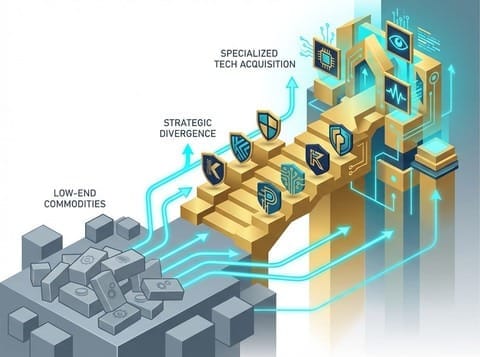
These two acquisitions were critical turning points in Yageo's transformation:
- Acquisition of Kemet: Acquired the world's leading "Tantalum Capacitor" technology and the entry ticket to high-end automotive customers in Europe and America (such as Tesla, Bosch).
- Acquisition of Pulse: Completed its portfolio with high-end "Magnetics" and antenna technology, directly entering the 5G and server power supply markets.
This means that when Quanta or Hon Hai assemble GB200 racks, Yageo no longer sells them a few cheap ceramic capacitors, but a "full suite of high-end passive components" including tantalum capacitors, high-end inductors, and resistors.
💎 Tantalum Capacitors: The Stable Cornerstone of AI Computing Power
Why are we specifically discussing "Tantalum Capacitors"? Because they are the most underestimated strategic material in AI servers.
While conventional MLCCs (ceramic capacitors) are inexpensive, they have two fatal weaknesses:
- Piezoelectric Effect: Generates noise (audible hum) under high-frequency vibration.
- Temperature Dependence of Capacitance: Capacitance degrades at high temperatures.
Tantalum capacitors (especially high-end Polymer Tantalum capacitors) completely lack these issues. Their capacitance is extremely stable, their lifespan is exceptionally long, and they produce no noise. In the environment of AI servers, which operate 24/7 with drastic temperature fluctuations, tantalum capacitors are the crucial stabilizing force ensuring "absolute voltage stability."
More critically, this is a "seller's market." Tantalum is a rare metal with extremely limited global production capacity. Kemet, as the dominant player in global tantalum capacitors, holds a very high market share. According to our think tank's investigation of the supply chain, as AI servers demand near-exacting levels of stability, demand for high-end tantalum capacitors is exploding. This is not a question of "whether you can haggle on price," but "whether you have the goods."
📈 Fundamental Change in Pricing Logic (Pricing Dynamics Change)
This is the core insight of this report. For the past thirty years, the iron rule of the passive component industry has been: "Annual Price Decline." Customers would demand a 3% to 5% cost reduction every year; it was destiny.
However, under the AI wave of 2026, this iron rule is being broken.
We are observing an astonishing phenomenon: within Yageo's product lines, high-end resistors, magnetics (inductors), and tantalum capacitors are initiating a "Multi-year Pricing Uplift" cycle. Why?
- Extremely High Technical Barrier: AI uses precision resistors and special magnetic materials that second-tier manufacturers cannot produce.
- Capacity Crowding-out Effect: Manufacturers are shifting all production capacity to high-margin AI products, leading to a tightening supply of traditional high-end products.
Yageo now possesses tremendous leverage. When AI customers line up with cash for products, Yageo is no longer a supplier passively accepting price cuts; it is a strategic partner with "pricing power." Institutional investors have begun to re-evaluate Yageo, no longer treating it as a cyclical stock with a P/E ratio of only 8, but assigning it a valuation closer to international giants (such as Vishay, TE Connectivity) of 15 times or even higher.
🛡️ Magnetics: Pulse's Invisible Firepower
Finally, don't forget the inductor war we mentioned in the previous chapter (6-2-3). Yageo's subsidiary Pulse, though not as famous as Kuen-Chun, is an absolute invisible champion in the field of networking and power magnetic components.
With the surge in demand for TLVR (Transformer-Like Voltage Regulator) inductors and high-frequency filters for AI servers, Pulse's high-end magnetic components have become the fastest-growing dark horse in Yageo's financial reports. This is also why we say Yageo has undergone a "qualitative change": it holds Kemet's capacitors in its left hand and Pulse's inductors in its right. On the Bill of Materials (BOM) for AI motherboards, Yageo is now capable of capturing 40% or even 50% of the share!
In-Depth Research · Quantitative Perspective
Want more semiconductor quantitative research insights?
【Insight Subscription Plan】Break Free from Retail Investor Mentality: Build Your Alpha Trading System with "Quantitative Chips" and "Consensus Data"EDGE Semiconductor Research
📍 Series Map — Navigate the Complete EDGE Semiconductor Research →


