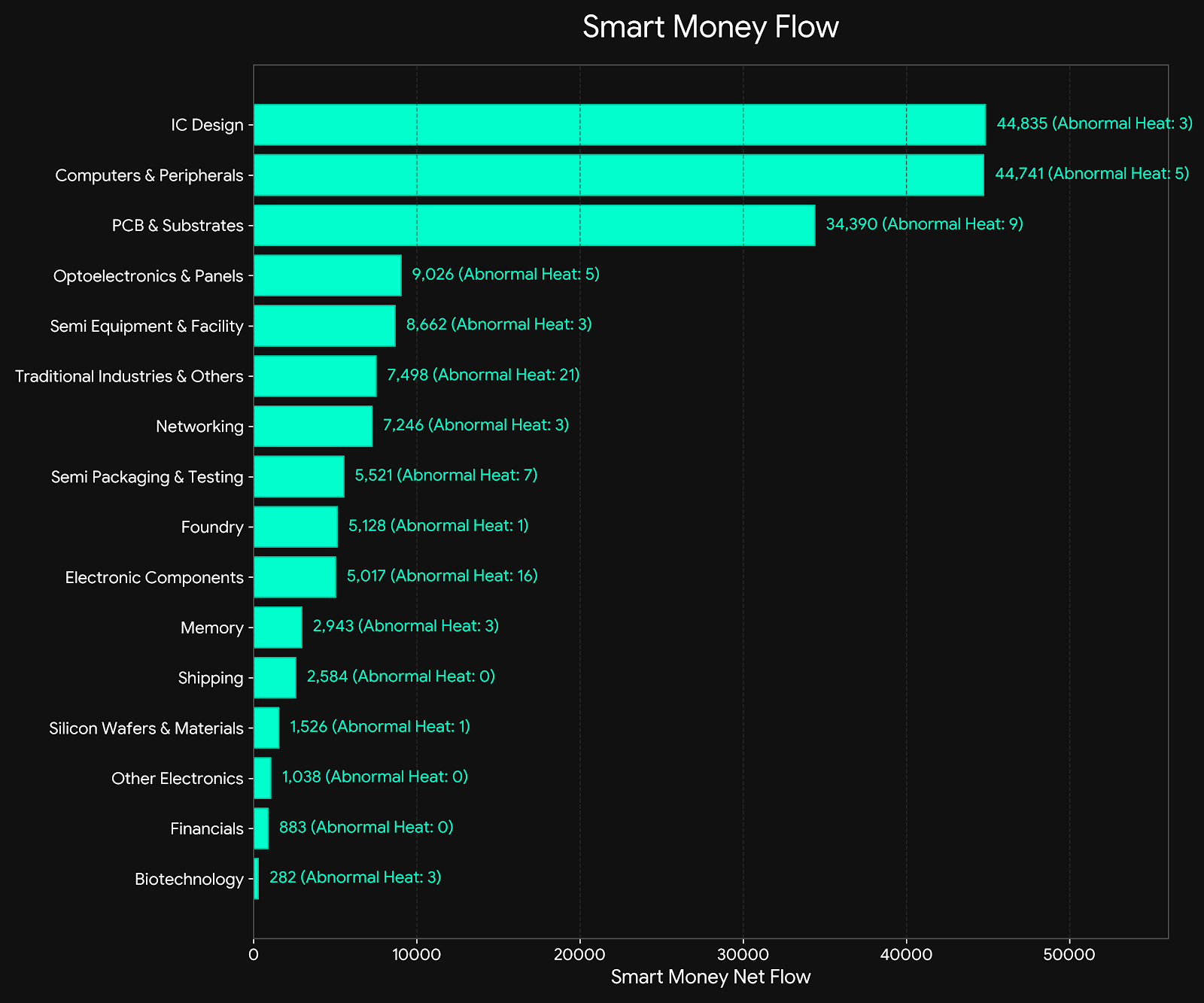
This week, Smart Money flows exhibited strong intentionality and clustering effects. By filtering out market noise using quantitative data, we can see that the top three sectors with significant net inflows from smart money across the market were: IC Design (NT$44,835 million), Computers & Peripherals (NT$44,740 million), and PCB and Substrates (NT$34,390 million). The concentration of capital in these three sectors reveals the current strategic positioning and hedging logic of institutional investors from a macro perspective:
🧠 Macro Logic Review The core trajectory of Smart Money this week is very clear—superficially, capital continues to be heavily invested in mainstream AI tracks, but the actual offensive focus has quietly shifted downstream from "high valuation, high popularity" end-user devices and chip design to the components sector, which is characterized by essential physical infrastructure demand and a margin of safety.
I. Long-term Consensus on Technology Infrastructure and Liquidity Cover (IC Design, Computers & Peripherals) This week, the IC Design and Computers & Peripherals sectors absorbed the absolute majority of market liquidity, with their combined total approaching NT$90 billion. From a macro perspective, this reflects the firm long-term development consensus among large capital regarding High-Performance Computing (HPC), AI server specification competition, and the implementation of edge computing terminals. Large capital must rely on such deep sectors to anchor their core positions.
However, behind the massive capital inflow lies a strong intention for "adjustment." Combined with micro-level chip momentum, the underlying chip purity of these two major capital magnets shows extreme bearish dominance. This means that smart money is leveraging the high public attention and liquidity of these two sectors to maintain price stability on the market (propping up prices), while in reality, it is engaging in micro-level profit-taking and risk-shifting. This is a standard institutional method of "exchanging time for space" for large-position adjustments.
This post is for subscribers only
Sign up now to read the post and get access to the full library of posts for subscribers only.




![[Semiconductor Consensus Tracking] 20260426 Trap Signals in the AI Frenzy](https://storage.ghost.io/c/45/e8/45e8af65-5e37-4e0a-95c0-7bd52e1935a5/content/images/size/w1200/2026/04/quadrant_20260426_en.png&q=100)